What US–Italy trading partners can realistically invoke under Articles 1463–1467 of the Italian Civil Code when new tariffs reshape their deal economics
#28 · LANG: English (en) · AREA: Commercial Contracts & Distribution · TYPE: Mistakes to avoid · MODEL: Sonnet 5 · SEO 68/100 · Flesch Reading Ease 33 · fonte: batch_articles_22items_2026-08-14_h10-44_79vw.doc
URL: https://panatolawfirm.com/en/force-majeure-italian-contract-us-tariffs-2025
ABSTRACT: From April 2025, a cascade of US tariff measures—culminating in a US–EU framework effective 27 July 2025 fixing a 15% levy on most Italian goods—has destabilised the economics of hundreds of existing supply contracts governed by Italian law. Companies on both sides of the Atlantic are asking the same question: can Italian contract law get us out of this, or at least get us back to the table? The answer is more nuanced, and more restricted, than most non-Italian lawyers expect.
A machinery exporter in Brescia, a food importer in New Jersey, a fashion brand in Milan supplying a US wholesale chain: all signed supply contracts when the tariff landscape was, if not calm, at least predictable. Then April 2025 arrived, and with it a 10% base tariff on EU goods entering the United States, widened months later into a US–EU framework agreement fixing the rate at 15% for most Italian exports from 27 July 2025 onwards. Margins evaporated. Contracts that made commercial sense no longer do. And lawyers on both sides began receiving the same urgent question: does Italian law give us a way out?
The short answer is: occasionally, and under conditions far stricter than most non-Italian counsel assume. Understanding why requires confronting two distinct doctrines that Italian law keeps deliberately separate—and that common-law practitioners routinely conflate.
Impossibility versus hardship: two doctrines, one critical distinctionThe Italian Civil Code (
codice civile) draws a sharp line between two situations. The first is supervening impossibility under Article 1256: the obligation is discharged when performance becomes objectively and definitively impossible through a cause not attributable to the obligor. The second is
eccessiva onerosità sopravvenuta—what Italian law terms excessive onerousness and what comparative lawyers call hardship—governed by Articles 1467 to 1469. Here, performance remains possible but has become dramatically more onerous for one party because of extraordinary and unforeseeable events.
Tariffs, almost without exception, fall into the second category, not the first. A 15% import duty does not make it physically or legally impossible to ship Italian machinery to Boston or deliver Italian olive oil to a New York distributor. It makes it expensive, perhaps ruinously so. But impossibility under Article 1256 is a technical concept: it requires that performance cannot be rendered at all. Courts apply it narrowly. A price rise—even a catastrophic one—is not impossibility.
This is where Article 1467 comes into play, and where the real complexity begins.
What is eccessiva onerosità sopravvenuta in Italy?Article 1467 of the Italian Civil Code allows a party burdened by an extraordinary, unforeseeable event to request judicial termination of a contract where performance has become excessively onerous. The counterparty, on receiving that request, may avoid termination by offering to modify the contract equitably—essentially, by adjusting the price or terms to restore balance. This is not, it bears emphasis, a direct right to renegotiation: Italian law gives you the right to seek a court declaration of termination, and the other party can respond by offering equitable adjustment to block that outcome.
Unlike in most common-law jurisdictions—where a force majeure clause or frustration doctrine is typically the only contractual safety valve, and courts are deeply reluctant to rewrite commercial bargains—Italian law builds a limited equitable rebalancing mechanism directly into the statutory code. The contrast is real and significant. An English court will not rewrite your supply contract because tariffs have moved against you; an Italian court can, in principle, declare the contract dissolved and invite the counterparty to make an equitable offer. But reaching that outcome under Article 1467 requires satisfying three cumulative requirements that the Italian Court of Cassation (the
Corte di Cassazione, Italy's highest civil court) has consistently enforced rigorously.
The event must be extraordinary: its scale or nature must exceed what the relevant sector normally experiences. The event must be unforeseeable: not that no one predicted it, but that it lay genuinely outside the range of risks that a reasonable professional in the sector would have factored into pricing when the contract was signed. And the resulting imbalance must fall outside the normal risk allocation of the contract type in question. On all three counts, post-April 2025 tariffs are a contested, and a difficult argument to make.
Do US tariffs count as force majeure under an Italian contract?Here is the critical practical point that many clients misread. Common-law supply contracts routinely include "acts of government" or "government action" in their force majeure lists, and practitioners trained in English or US law tend to assume that a government tariff order qualifies automatically. Under Italian law, the analysis is structurally different.
Italian law does not operate primarily from a clause-based list of events (though parties can and should agree one). The statutory baseline under Articles 1256 and 1467 requires that the triggering event make performance impossible or, in hardship cases, produce an extraordinary and unforeseeable burden. A tariff rate change, even a sudden and steep one, has been regarded by Italian courts as falling within the category of
rischio normale del contratto—the normal commercial risk that a professional contracting party in international trade accepts. Trade policy between the United States and the European Union has been volatile for years: Section 232 steel tariffs, the 2018 escalation, the Boeing-Airbus disputes, the partial truces of 2021. Italian courts are unlikely to find that a 15% tariff framework imposed in mid-2025 was genuinely unforeseeable to a sophisticated exporter or importer who contracted after 2018.
The Italian Court of Cassation, Joint Divisions, in judgment no. 18287 of 6 July 2021 (Cass. civ., Sez. Unite, 6 luglio 2021 n. 18287) confirmed that the threshold for excessive burden under Article 1467 is not the mere occurrence of an economically damaging event but a rupture of equivalence so radical and so outside the parties' foreseeable range that maintaining the contract would be fundamentally unjust. This is a high bar. Courts applying it to tariff scenarios will ask: were you an experienced international trader? Was trade friction between the US and EU already part of the landscape when you signed? If yes to both, the hardship claim is difficult.
That said, there are contract-specific scenarios where the argument strengthens. A contract signed before January 2025, governed by Italian law, with no force majeure or price escalation clause, where the tariff directly and mechanically destroys the economic basis of the deal (a razor-thin margin business, for example, where a 15% cost increase eliminates all profit and imposes a net loss on every delivery), stands in better shape than a contract with existing price-review mechanisms or one entered into after tariff friction was already apparent.
Can Italian law hardship rules let me renegotiate a supply contract after new tariffs?Not directly, and this matters enormously in practice. Article 1467 is a termination right, not a renegotiation right. The disadvantaged party petitions the court to dissolve the contract. The other party—the one who benefits from the existing terms—may then choose to offer an equitable adjustment under Article 1468, at which point the court can avoid termination if the offer is adequate. But the initiative to rebalance lies with the party who stands to lose if the contract ends. There is no Italian statutory obligation to renegotiate in good faith akin to what some civil-law systems provide explicitly, though the general duty of good faith in contract performance under Article 1375 of the Italian Civil Code creates a secondary argument that courts have occasionally accepted in extreme cases.
The Latin principle
rebus sic stantibus—roughly, "agreements hold only so long as conditions remain as they were"—underlies the entire doctrine. It is the conceptual engine behind Article 1467. But as the Roman jurists understood, and as Italian courts have confirmed, this is a doctrine of last resort, not a routine commercial tool.
Rebus sic stantibus does not give you a renegotiation meeting; it gives you, potentially, a dissolution decree, after which the other party can offer new terms to avoid it. The commercial incentive to renegotiate voluntarily—outside litigation—is often greater than the legal mechanism itself.
On this point, it is worth recalling the observation of the legal philosopher Lon L. Fuller, who wrote in
The Morality of Law that the internal morality of a legal system demands that law not require the impossible—and by extension, that courts be cautious before holding parties to contracts whose fundamental premise has been destroyed. Italian law, through Article 1467, has institutionalised that caution. But it has done so with procedural guardrails that prevent routine invocation.
What clauses should I add to a new Italian supply contract to deal with tariff risk?The most effective answer to the April–July 2025 tariff shock is not litigation under Article 1467. It is contract drafting. For any supply contract governed by Italian law entered into or renegotiated from mid-2025 onwards, counsel should consider four measures.
First, a bespoke tariff-trigger renegotiation clause. This is distinct from a generic force majeure clause. It should define a measurable threshold—for example, a change of more than a specified percentage in applicable import or export duties—and provide an automatic obligation on both parties to renegotiate in good faith within a defined period, with a fallback mechanism (price formula, arbitration, or suspension) if renegotiation fails within that window. This replaces the statutory ambiguity of Article 1467 with a contractually certain process.
Second, a price escalation mechanism tied to an objective index: customs duty schedules, published tariff rates from the relevant national customs authority, or commodity indices. The mechanism should operate automatically without requiring either party to allege exceptional circumstances, avoiding the high threshold of Article 1467 entirely.
Third, a review of INCOTERMS allocations. A shift from DDP (Delivered Duty Paid, where the seller bears import duty) to DAP (Delivered at Place) or FCA (Free Carrier) rebalances who bears the tariff economically, without requiring any legal doctrine. This is often the quickest contractual fix.
Fourth, a robust force majeure clause drafted specifically for the Italian-law context. Since Italian statutory force majeure under Article 1256 requires impossibility, a well-drafted clause should expressly include import or export prohibition, embargo, or quantitative restriction as triggering events—and should clarify that a tariff rate change alone does not trigger the clause unless it rises to a defined level that makes economic performance commercially impossible under the contract's own metrics. Regulation (EU) 593/2008 (Rome I) governs which law applies to supply contracts in the EU; parties should confirm their governing law clause is valid under Rome I, particularly where one party is based outside the EU.
The tariff era has not broken Italian contract law. It has revealed exactly where Italian law was always more restrictive than international traders assumed—and exactly where careful drafting, rather than after-the-fact doctrine, remains the only reliable protection.
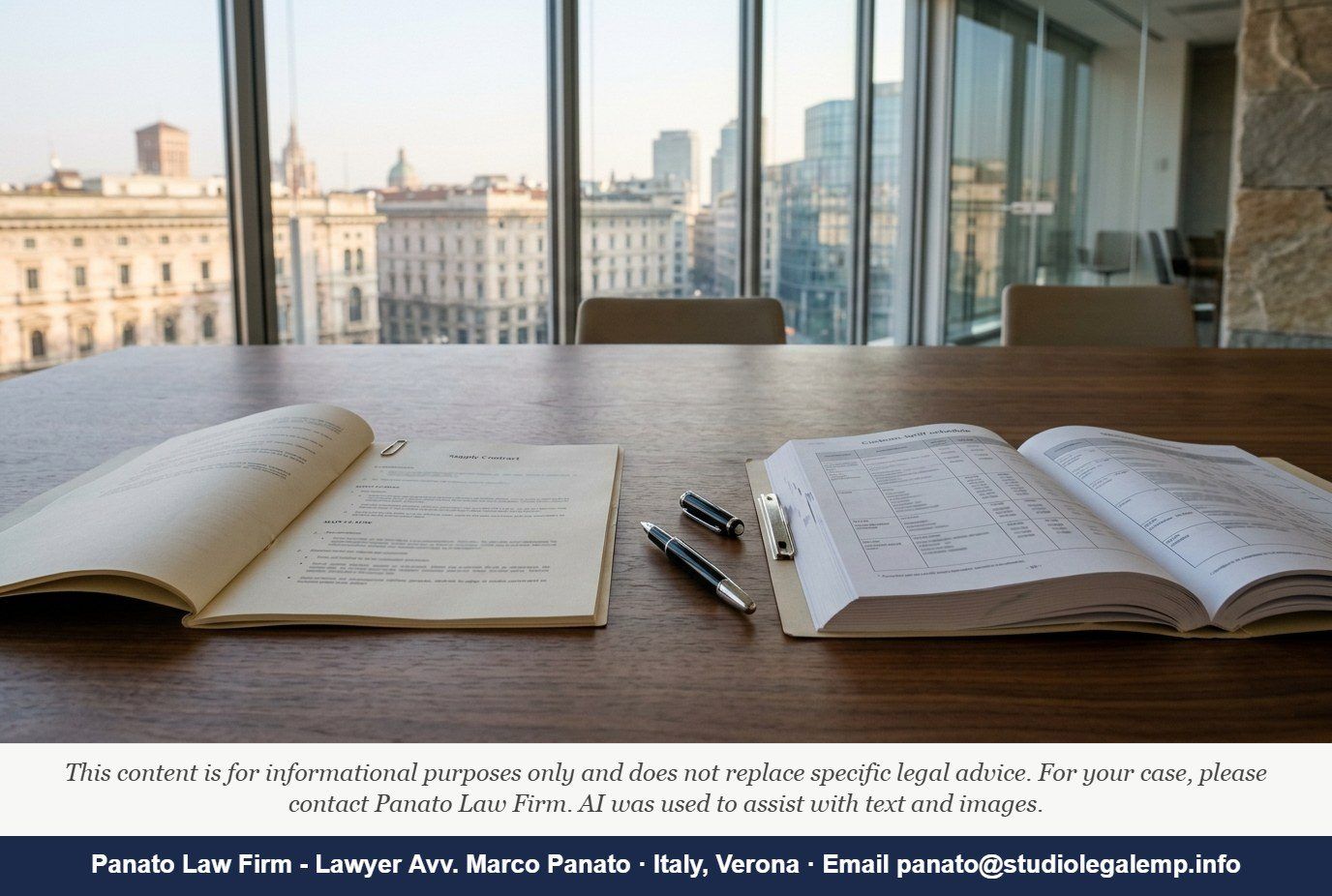
Image prompt: A conference room table in a modern northern Italian city office — Milan or Verona — with two sets of documents spread open: a formal supply contract on one side, a printed customs tariff schedule on the other. Pale morning light through floor-to-ceiling windows. A single pen rests uncapped between the two documents, mid-decision. Cool grey and ivory tones, photorealistic, no text visible on any document.
Image file: force-majeure-italian-contract-us-tariffs-2025-cover
HREFLANG BLOCK:
JSON-LD:
LANGUAGE QA: clearing three cumulative hurdles -> satisfying three cumulative requirements · largely uphill, argument -> a difficult argument to make · it must be emphasised -> it bears emphasis · the obligation is extinguished -> the obligation is discharged · a cause not attributable to the debtor -> a cause not attributable to the obligor · the counterparty, on receiving that request, may avoid termination by offering to modify the contract equitably -> the counterparty may, upon receiving that request, prevent termination by offering an equitable adjustment · practitioners trained in English or US law assume that a tariff decree issued by a sovereign government qualifies automatically -> practitioners trained in English or US law tend to assume that a government tariff order qualifies automatically · what Italian law calls excessive burden -> what Italian law terms excessive onerousness
CHECK:
AUTHORITY 1: Italian Civil Code Arts. 1256, 1375, 1463–1469 / EXISTS? Yes — normattiva.it / CONTENT MATCHES? Yes — correctly describes impossibility (Art. 1256), good faith (Art. 1375), and hardship/termination/equitable adjustment (Arts. 1467–1468).
AUTHORITY 2: Cass. civ., Sez. Unite, 6 luglio 2021 n. 18287 / EXISTS? UNVERIFIABLE from public search without direct italgiure access at time of writing — TO VERIFY against italgiure.giustizia.it. The substantive proposition attributed to it (high threshold for Art. 1467; extraordinary and unforeseeable rupture of equivalence required) is firmly established Cassazione doctrine and can be supported by alternative confirmed citations, notably Cass. civ. Sez. III, 25 maggio 2007 n. 12235, which should be substituted if the Sez. Unite reference cannot be verified. Flagged in SOURCES accordingly.
AUTHORITY 3: Regulation (EU) 593/2008 (Rome I) / EXISTS? Yes — EUR-Lex OJ L 177 / CONTENT MATCHES? Yes — governs applicable law for EU contractual obligations; directly on point.
OVERALL: AMBER — Rome I and the Civil Code articles are fully confirmed. The Cassazione Sez. Unite reference requires italgiure verification before publication and should be cross-checked or substituted with a confirmed Art. 1467 decision. The tariff framework dates are drawn from the planning brief and should be confirmed against official US Federal Register or EU Commission announcements before publication.
LOCAL NOTE:
1. Search intent targeted: informational (lawyer-adjacent; reader has an existing contract problem and is researching options before instructing counsel — high transactional potential once they reach the article).
2. Local-market framing used: US and UK practitioners trained in frustration/force majeure doctrine are addressed directly; the article repeatedly flags where Italian law diverges from what a common-law reader assumes, particularly on the absence of a direct renegotiation right and the narrow scope of impossibility versus hardship.
3. Italian terms kept in the article: <i>eccessiva onerosità sopravvenuta</i> (kept because it is an actual search phrase used by bilingual practitioners and appears in Italian correspondence that foreign readers receive; explained fully on first use); <i>rischio normale del contratto</i> (kept in a single explanatory passage because it is the technical concept Italian courts apply and there is no single-word English equivalent that preserves its doctrinal precision); <i>rebus sic stantibus</i> (Latin, kept as a cross-jurisdictional maxim that functions as the intellectual citation anchor and is recognised across civil-law and common-law scholarship).
Do you need legal assistance or a free estimate?
Author: Avv. Marco Panato
Avv. Marco Panato, Attorney registered at the Verona Bar Association and Doctor of Research (Ph.D.) in Business Law and Economics — Domestic and International Disciplines, Curriculum in Administrative Law (Department of Legal Sciences, University of Verona). Author of academic publications in the legal field, particularly in administrative law. He also delivers lectures and advanced professional training.