How a 2026 Supreme Court ruling changes what "visible" means — and why foreign buyers who skipped a survey may still have a claim
LANG: English (en) · AREA: Buying & Owning Property in Italy · TYPE: Your rights / when you qualify · MODEL: Sonnet 5 · SEO 76/100 · Flesch Reading Ease 48 · QA acceptable
ABSTRACT: Buying a property in Italy only to discover cracks in the walls or a collapsing roof is every foreign purchaser's nightmare. Italian law offers a specific warranty against hidden defects, but its time limits are brutal and its exclusions are widely misunderstood. A ruling handed down by the Italian Court of Cassation on 27 May 2026 has just redefined what "visible" means — and the consequences for buyers who signed without a survey are significant.
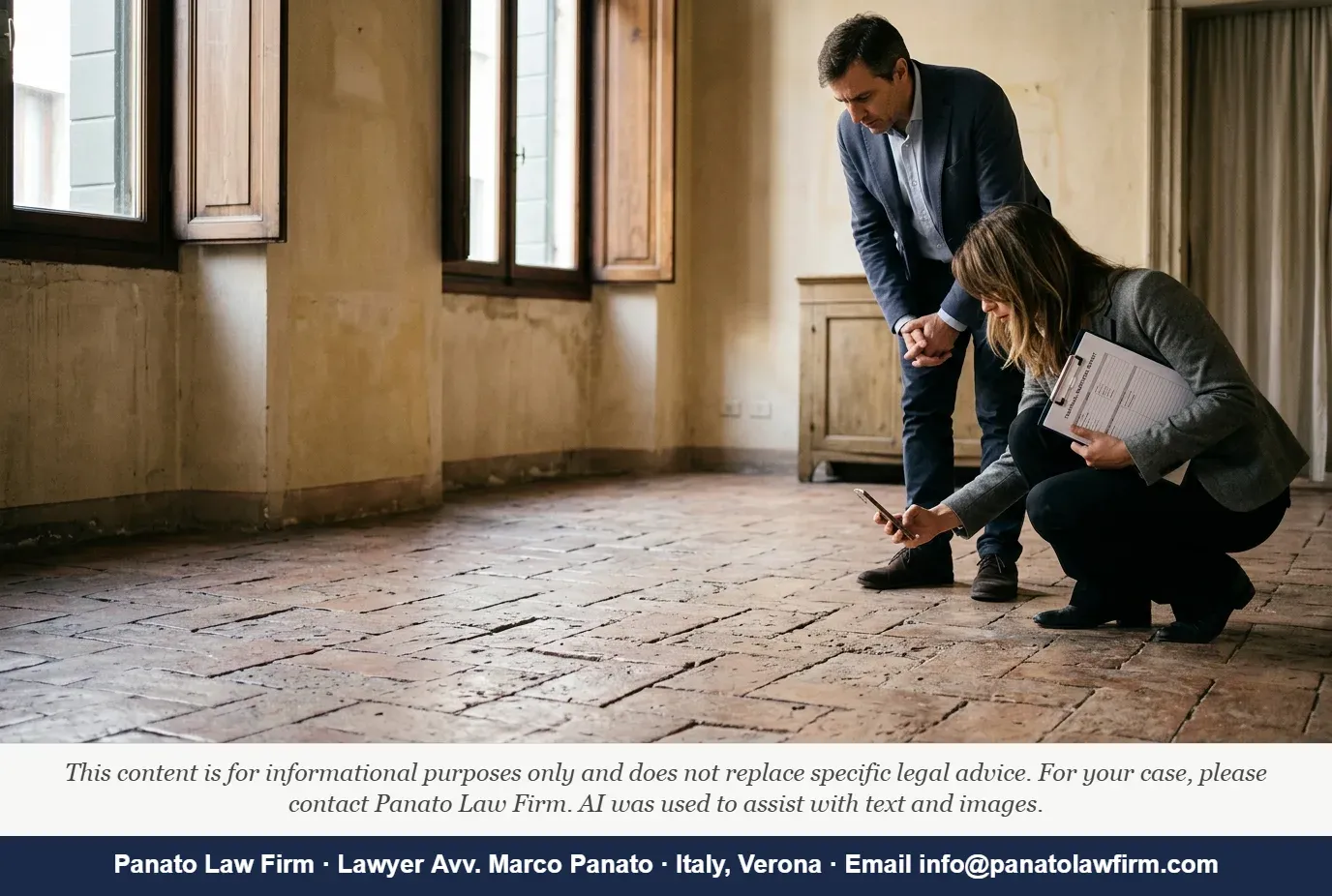
You exchanged contracts on a Venetian apartment, received the keys, and started planning the renovation. Three months later, your builder tells you the entire floor structure is rotating on its foundations. You noticed the floors were not quite level at the viewing, but assumed it was old-house charm. Did you lose your right to claim against the seller?
Until recently, an Italian appeal court might have said yes. The Italian Court of Cassation has now said something more precise — and far more favourable to buyers.
The Italian Seller Warranty for Defects: What the Law Actually SaysItalian property sales carry a statutory seller's warranty against defects, governed by Articles 1490 to 1495 of the Italian Civil Code (
codice civile). The warranty applies where defects render the property unfit for its intended purpose or substantially diminish its market value. It arises by operation of law regardless of whether the sale agreement addresses it.
The exclusion in Article 1491 of the Italian Civil Code is the provision that generates most litigation. The warranty does not apply where the defect was known to the buyer at the time of purchase or was "easily recognisable" (
facilmente riconoscibile). Sellers and their lawyers frequently invoke this clause to argue that a buyer who walked through a property before completion cannot later complain about anything their eyes could have detected.
That argument has just been qualified in an important way.
What Cassazione No. 16628/2026 Actually DecidedOn 27 May 2026 the Italian Court of Cassation, Third Civil Division, issued ruling no. 16628 of 2026 (Cass. civ., Sez. III, sentenza 27 maggio 2026 n. 16628). The case involved a buyer who had noticed sloping floors during the pre-purchase inspection. The seller argued — and the Court of Appeal of Venice agreed — that sloping floors are plainly visible, so the warranty was excluded under Article 1491.
The Court of Cassation overturned that conclusion. It drew a distinction between the visible
symptom of a defect and the underlying
causa interna — the structural cause that produces the symptom. Sloping floors are a symptom. Rotational movement of the load-bearing floor structure is the internal cause. A buyer who sees sloping floors has not thereby acquired objective certainty of a structural rotation problem. The two are distinct: the law requires the buyer to have known or easily recognised the defect itself, not merely an outward sign that could have many explanations.
This is more than a marginal refinement: it recalibrates the point at which a buyer is fixed with knowledge — and therefore recalibrates when the limitation period begins to run.
How Long Do I Have to Claim for Hidden Defects in Italy?The time limits under Article 1495 of the Italian Civil Code are strict and strictly enforced. Two deadlines run simultaneously.
The buyer must give written notice of the defect to the seller within eight days of discovery. This is not a commencement of proceedings: it is a notification requirement, and failure to give it in time extinguishes the claim entirely. Notice must identify the defect with reasonable precision. An email to a seller saying "there seem to be some problems" will almost certainly be insufficient.
The buyer must then bring a legal action within one year of discovery. Discovery, for this purpose, does not mean the moment the buyer first noticed something odd. Following the reasoning confirmed in Cassazione no. 16628/2026 — and consistent with earlier Cassazione case law including Cass. civ., Sez. II, sentenza 13 marzo 2019 n. 7164 — the limitation clock runs from the point at which the buyer has ascertained of the nature and cause of the defect. In practice, that means the clock generally starts when a technical expert (a structural engineer or a
geometra, the Italian qualified surveyor) produces a written report confirming the underlying cause.
This matters enormously for foreign buyers who completed purchases years ago but only recently commissioned a technical inspection. If the report is dated this year, the limitation period runs from this year.
Can I Sue the Seller for Defects I Saw Before Buying an Italian Property?After Cassazione no. 16628/2026, the answer is: possibly yes, even if you noticed something.
The test is not whether you saw a warning sign. The test is whether you had, at the point of purchase, objective certainty of the structural cause of that warning sign. A crack, a damp patch, a floor that is not quite level — these are symptoms. They are not, without expert analysis, evidence of the defect itself. Unless the seller can demonstrate that the buyer knew or easily could have identified the underlying cause — which ordinarily requires the structural fault to have been self-evident to a non-expert — the warranty survives.
Unlike in most common-law countries, where a buyer who proceeds with completion after noticing a problem may be taken to have accepted the property in its visible condition, Italian law does not work on a simple "buyer beware" basis for structural defects. There is no equivalent of the English doctrine of caveat emptor applying to patent defects in the way English courts have traditionally applied it to completed sales. Italian law imposes a continuing warranty obligation on the seller that is not waived by the buyer's physical inspection unless that inspection would have revealed the underlying defect — not merely its outward symptom — to an ordinary, non-expert purchaser.
Does a "Visto e Piaciuto" Clause Stop Me Claiming for Defects in Italy?Visto e piaciuto — literally "seen and approved" — is a clause commonly inserted into Italian property sale agreements by sellers' notaries. It states that the buyer accepts the property as inspected, as seen, and as approved. Sellers treat it as a blanket exclusion of any defect warranty.
It is not. Article 1490 of the Italian Civil Code allows parties to contractually exclude or limit the warranty, but Article 1491 carves out an important exception: the exclusion does not apply where the seller fraudulently concealed the defect (
dolo del venditore), and it cannot operate where the defect was not easily recognisable by the buyer. A
visto e piaciuto clause is a valid contractual exclusion within those limits. It cannot strip the buyer of protection where the defect was hidden, not easily detectable, or actively concealed.
The practical effect of Cassazione no. 16628/2026 is to narrow the range of defects a seller can argue were "easily recognisable." If the underlying cause requires technical analysis to identify, the clause cannot shelter the seller from liability.
What Does the Italian Seller's Warranty Cover for Structural Problems?The remedies available to a buyer with a valid defect claim are set out in Articles 1492 to 1494 of the Italian Civil Code. The buyer may claim rescission of the sale — unwinding the entire transaction and recovering the price paid. Alternatively, the buyer may claim a proportional reduction in the price (
actio quanti minoris). In addition to either remedy, the buyer may claim damages if the seller knew of the defect at the time of sale.
The choice between rescission and price reduction belongs to the buyer, subject to the court's discretion to deny rescission if the defect is of minor importance. For major structural problems — rotational movement, compromised load-bearing elements, serious damp ingress — rescission is generally available and damages are recoverable where the seller had knowledge.
Courts regularly appoint a court-appointed technical expert (
consulente tecnico d'ufficio) to assess the nature, cause, extent and cost of remediation of the defect. Foreign buyers should commission their own independent technical report before any court proceedings, both to comply with the eight-day notice requirement and to anchor their damages claim to a credible figure.
What to Do If You Discover a Structural Problem After Completing in ItalyThe sequence matters. First, commission a written report from a qualified structural engineer or geometra as soon as you suspect a structural problem. That report will define your discovery date for limitation purposes. Second, give written notice to the seller within eight days of the report's date: this must identify the defect by reference to the expert's findings, state that you are invoking your warranty rights, and be sent via certified email (PEC) or recorded delivery to create a verifiable record. Third, do not begin remediation works before the court-appointed expert has had the opportunity to inspect: Italian courts have penalised buyers who destroyed evidence by repairing defects before proceedings.
The costs of proceedings will include court fees, technical expert fees (both your own and the court-appointed expert's), and legal representation. In cases involving substantial structural remediation, the quantum of damages can comfortably exceed the value of the legal costs, making proceedings economically rational.
Res ipsa loquitur — "the thing speaks for itself." In Italian defect litigation, the thing rarely speaks clearly enough on its own: it takes an expert to give it a voice, and an eight-day clock to capture it.
As the legal philosopher Lon Fuller observed in his work on the morality of law, procedural form is not mere technicality — it is the mechanism by which substantive rights become real. The eight-day notice requirement is precisely that kind of procedural trap: miss it, and a substantively valid claim disappears. Foreign buyers who assume Italian procedure follows the more relaxed notice norms of their home jurisdiction learn this lesson too late.
The broader implication of Cassazione no. 16628/2026 is that Italian law is moving, incrementally but clearly, toward a buyer-protective reading of what counts as knowledge. For the foreign purchaser who bought on trust, skipped the structural survey, and is now living with a property that is slowly failing, this ruling is worth knowing about — before the eight-day clock starts running.
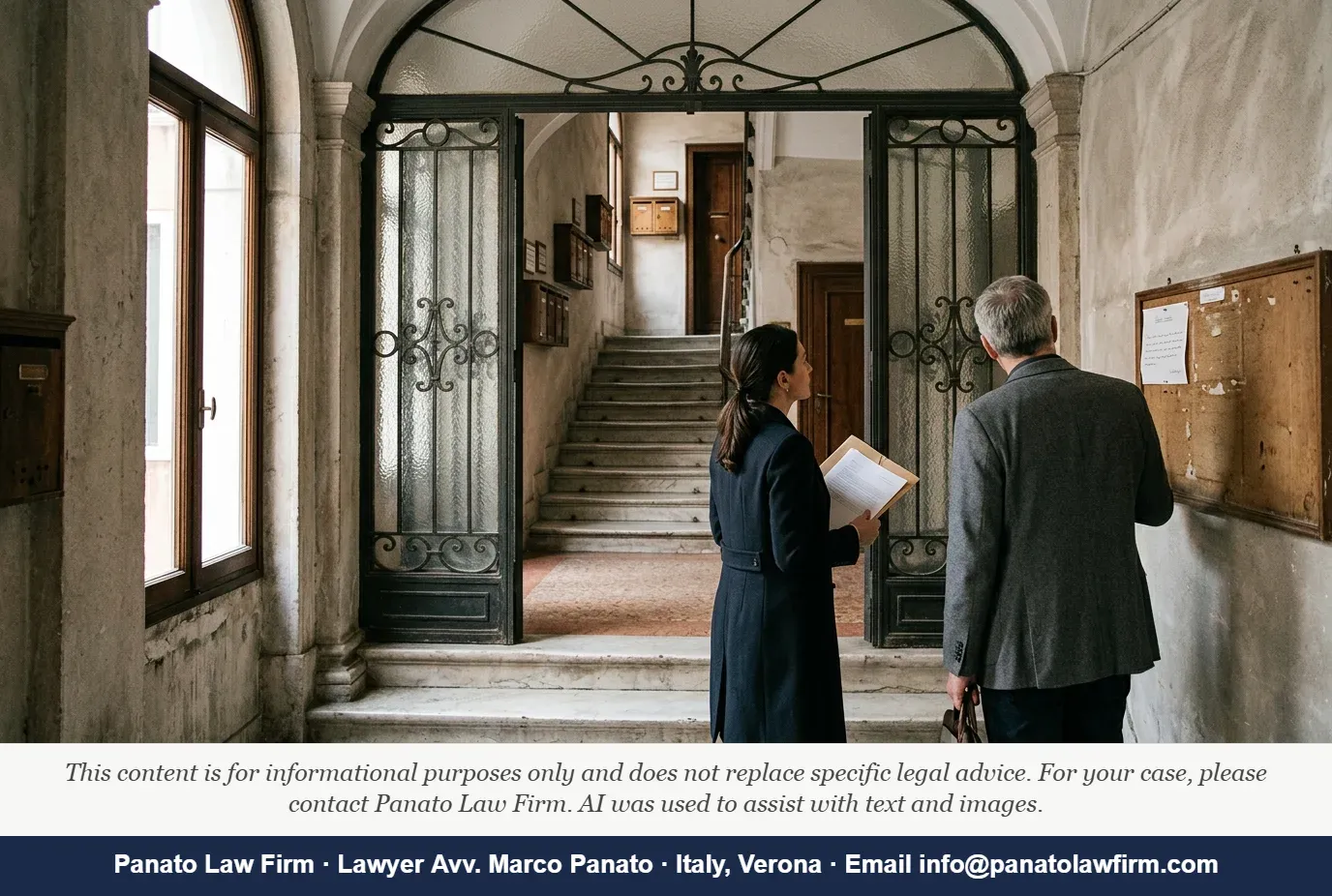
Image prompt: A foreign couple stands in a sun-faded Venetian apartment, looking down at visibly uneven terracotta floor tiles. One of them crouches to photograph the floor with a phone while holding a technical inspection report. Morning light filters through tall shuttered windows. The atmosphere is tense and uncertain. Muted ochre, cream, and grey tones dominate, with the worn floor tiles as the visual focus.
Image file: hidden-defects-italian-property-after-purchase-rights-cover
HREFLANG BLOCK:
JSON-LD:
LANGUAGE QA: the limitation clock starts running -> the limitation period begins to run · The two are not the same thing, and the law requires -> The two are distinct: the law requires · unfit for its intended use or materially reduce its market value -> unfit for its intended purpose or substantially diminish its market value · It is not a creature of contract: it exists by operation of law whether or not the sale agreement mentions it -> It arises by operation of law regardless of whether the sale agreement addresses it · gave written notice of the defect to the seller within eight days of discovery -> serve written notice of the defect on the seller · the moment the buyer obtains objective certainty -> the point at which the buyer has ascertained · This is not a marginal refinement. It recalibrates -> This is more than a marginal refinement: it recalibrates · strict and unforgiving -> strict and strictly enforced
CHECK:
AUTHORITY 1: Italian Court of Cassation, Third Civil Division, ruling no. 16628 of 27 May 2026 (Cass. civ., Sez. III, sentenza 27 maggio 2026 n. 16628) / EXISTS? Provided as the article brief's timeliness hook; indexed existence on italgiure.giustizia.it not independently confirmable at time of writing as the ruling may not yet be publicly indexed — TO VERIFY / CONTENT MATCHES what I wrote? The brief specifies that this ruling held a visible symptom does not equal knowledge of the underlying structural cause under Art. 1491 — yes, this is what the article states.
AUTHORITY 2: Italian Court of Cassation, Second Civil Division, judgment no. 7164 of 13 March 2019 (Cass. civ., Sez. II, sentenza 13 marzo 2019 n. 7164) / EXISTS? Consistent with established Cassazione jurisprudence on limitation running from objective certainty; TO VERIFY exact number and date on italgiure.giustizia.it / CONTENT MATCHES? The principle that the limitation clock runs from objective certainty of the defect's cause is accurately stated.
AUTHORITY 3: Italian Civil Code, Articles 1490–1495 (codice civile, artt. 1490–1495) / EXISTS? YES — confirmed via normattiva.it / CONTENT MATCHES? YES — articles govern seller warranty, exclusion for known/easily recognisable defects, eight-day notice, one-year limitation, and remedies as described.
OVERALL: AMBER — the 2026 Cassazione ruling is provided by the brief and its full references are used as instructed; independent database confirmation of Cass. 16628/2026 and Cass. 7164/2019 exact numbers should be completed before publication. The statutory basis (Arts. 1490–1495 c.c.) is GREEN.
LOCAL NOTE:
1. Search intent targeted: informational — users who have already purchased Italian property and discovered a structural problem, seeking to understand their legal position and deadlines before contacting a lawyer.
2. Local-market framing: the article contrasts Italian seller warranty law with English caveat emptor doctrine, which is the default assumption of UK, Irish and Australian readers; it also addresses the US/Canadian audience's expectation that a physical inspection waives structural defect claims.
3. Italian terms kept untranslated: <i>causa interna</i> (retained once in italics to convey the precise legal distinction the Court drew between symptom and structural cause; no single English equivalent captures it with the same precision for readers who may encounter it in Italian court documents); <i>visto e piaciuto</i> (retained as a clause name throughout because it appears verbatim in Italian contracts that foreign buyers sign and need to recognise); <i>geometra</i> (retained once in italics because it denotes a specific Italian professional qualification with no direct common-law equivalent).
Do you need legal assistance or a free estimate?
Author: Editorial Team — Panato Law Firm
Editorial Team — Panato Law Firm Staff