Why perceiving a symptom is not the same as knowing the defect — and why 'seen and approved' clauses offer sellers far less protection than they think
LANG: English (en) · AREA: Buying & Owning Property in Italy · TYPE: Legal update / what changed · MODEL: Sonnet 5 · SEO 84/100 · Flesch Reading Ease 49 · QA translated
ABSTRACT: A May 2026 ruling by the Italian Court of Cassation has significantly widened the scope of hidden defect claims available to property buyers in Italy, holding that seeing a symptom — such as a tilted floor — does not amount to knowing the structural defect beneath it. Foreign buyers who noticed anomalies but did not investigate further may still have a valid warranty claim. The 'seen and approved' formula printed in Italian deeds offers sellers far less protection than they commonly assume.
You bought a property in Tuscany, Puglia, or the lakes. You noticed the floors sloped slightly during the viewing — charming, you thought, an old house. Six months after moving in, a structural engineer tells you the entire building has rotated on its foundations and is borderline unsafe. Is your claim dead because you saw the slope? According to a landmark decision handed down in May 2026, the answer is almost certainly no.
What can I do if I find hidden defects after buying an Italian property?The starting point is Articles 1490 to 1495 of the Italian Civil Code (
codice civile). Article 1490 imposes on every seller a warranty for defects that make a property unsuitable for its intended use or that materially reduce its value. This warranty applies regardless of whether the seller knew about the defect. If the seller did know — and concealed it — the consequences are significantly more serious, as explained below.
The Italian Court of Cassation, Second Civil Division, in its judgment of 27 May 2026, no. 16628 (Cass. civ., Sez. II, 27 maggio 2026, n. 16628), ruled on the consequences of rescinding a property sale for defects, with particular attention to what the buyer must actually have known at the time of purchase.
The case arose in Tolentino, in the Marche region, involving legal proceedings brought by the buyer of a residential property with a pronounced internal floor inclination of around 8 cm. The seller argued that the buyer had effectively acknowledged the tilt — even making an in-court admission — and that this precluded any warranty claim. The Court of Cassation disagreed.
The Court held that the floor tilt was not the defect: it was merely the most visible symptom. The actual defect was a rotation of the whole building from the uphill to the downhill side, with consequences not only for the normal functionality of the structure but also for its static safety. Knowing a floor is uneven, the Court held, is not the same as knowing that the inclination derives from a structural phenomenon affecting the entire building.
For the Court, knowledge of the underlying cause — not just the outward symptom — is required for the loss of warranty protection under Article 1491 of the Italian Civil Code. The ruling narrows the buyer's duty of diligence, excluding any obligation to carry out deep technical investigations simply to avoid losing the warranty.
This matters enormously in practice. Older Italian properties routinely display surface signs — damp patches, uneven plasterwork, minor cracks — that a prudent but non-expert buyer notices, accepts as part of the character of the building, and does not probe further. Until this ruling, sellers and their advisers could argue that any visible anomaly, however superficial, was enough to extinguish the warranty. Decision no. 16628/2026 firmly closes that door.
Unlike in most common-law jurisdictions — a critical contrastThis is the point that most surprises English, Irish, American, Canadian, and Australian buyers. In England and Wales, for instance, the principle of
caveat emptor — buyer beware — places most of the investigative burden squarely on the purchaser. A buyer who does not commission a structural survey before exchange of contracts has little recourse for defects that such a survey would have revealed. There is no statutory seller's warranty equivalent to the Italian Civil Code regime.
Italian law inverts much of this logic. Article 1490 of the Italian Civil Code requires the seller to warrant the property against defects that make it unfit for its intended use or that diminish its value — and this warranty cannot be excluded by a boilerplate clause in the contract. The buyer is not required to commission a full structural survey to preserve rights. The mere perception of an external anomaly does not equate to knowledge of the defect if its internal structural causes remain unknown to the buyer, and the buyer has no obligation to conduct in-depth technical investigations in order to retain the warranty. The investigative burden falls primarily on the seller, who knows the property's history.
Does a 'sold as seen' clause protect the seller in Italy?Almost certainly not, if the defect is genuinely hidden or was concealed. Notarial deeds of sale (rogito,
rogito notarile) in Italy routinely include a clause stating that the buyer has inspected the property and is satisfied with its condition — the
visto e piaciuto formula, meaning 'seen and approved'. Estate agents and sellers treat this as a blanket disclaimer. It is not.
The 'seen and accepted' formula, taken on its own, does not settle everything in the seller's favour. The Italian Civil Code provides that the warranty against defects is not owed if the buyer knew of the defects or if they were easily recognisable — unless the seller declared the property free of them — and any clause excluding or limiting the warranty has no effect if the seller concealed the defects in bad faith.
The second part of Article 1490 of the Italian Civil Code is explicit: an exclusion clause is void if the seller acted in bad faith by concealing the defect. Where the seller repainted a mouldy wall before viewings, filled cracks with plaster, or withheld a prior structural report, no
visto e piaciuto clause survives.
How long do I have to claim for hidden defects in Italy?This is where foreign buyers face the sharpest practical trap. Once a hidden defect is discovered after the notarial deed of sale, the buyer must act quickly. The Italian Civil Code requires the buyer to notify the defect to the seller within eight days of discovery, in writing — preferably by certified email (PEC,
PEC) or recorded delivery — describing the defects found and, if possible, attaching a technical report. Miss this eight-day window and the warranty is lost, even if the claim would otherwise have been strong.
What is the warranty period for property defects in Italy?The limitation structure under the Italian Civil Code is strict: eight days from discovery of the defect to notify the seller, and one year from delivery of the property to bring a court action. Crucially, the eight-day notification period and the one-year limitation period both run from the moment the buyer acquires certainty of the existence of the defect in its external manifestation — not from mere suspicion. The Cassazione no. 16628/2026 ruling reinforces this: the clock does not start until the buyer could reasonably have understood that a genuine defect existed, not merely that a surface anomaly was present.
However, where the seller deliberately concealed the defect, the position is more favourable to the buyer. The Italian Court of Cassation, Second Civil Division, judgment no. 22918 of 8 August 2025 (Cass. civ., Sez. II, 8 agosto 2025, n. 22918), held that the action for damages arising from the warranty for defects in a sold property is governed by Articles 1490 onwards of the Italian Civil Code. The Court further held that the deliberately hidden nature of defects suspends the limitation period under Article 1495 of the Italian Civil Code until the defect is discovered. In practice, if the seller freshened up a damp-stained wall or concealed a known settlement report, the one-year clock does not begin until you actually uncover the truth.
Where the seller deliberately concealed a defect, the buyer is relieved of the obligation to notify within eight days and, under the case law, the deliberate concealment activates the suspension of the limitation period provided for by Article 2941, no. 8 of the Italian Civil Code, allowing the buyer to bring proceedings well beyond the ordinary one-year limit.
There is also an important safety valve. If the buyer has notified the defects in time but is subsequently sued by the seller — for example, to recover an unpaid balance of the purchase price — the buyer may raise the warranty as a defence without any time limit. This prevents a seller from cynically waiting for the one-year period to expire and then demanding full payment from a buyer who received a defective property.
Practical steps for foreign buyers facing a hidden defect claimThe eight-day rule is merciless and geography is no excuse. If you are based in London, Dublin, New York, or Sydney and receive a structural engineer's report by email on a Tuesday, the clock runs regardless. Certified email (PEC) to the seller — or to the seller's Italian address via registered post — is the safest and fastest route. You do not need to quantify the damage in that first notification: it is sufficient to describe the defect clearly and state that you intend to exercise your warranty rights.
Document everything before you notify. Dated photographs, written communications with estate agents referencing the anomaly, any pre-purchase survey, and any structural or technical reports are all potentially decisive. The practical advice is to collect dated photographs and videos, receipts for repair costs, messages to and from the seller, and a technical report from a qualified surveyor before taking any further step.
If the seller concealed the defect, the available remedies under Article 1492 of the Italian Civil Code include rescission of the contract (which unwinds the sale and requires the seller to return the purchase price) or a price reduction proportional to the diminution in value. Among the issues clarified by Cassazione no. 16628/2026 was the question of the economic limits of the refund owed by the seller in the event of rescission — an aspect of the ruling that is particularly relevant where the buyer has also incurred mortgage costs to finance the purchase.
One authority worth noting: if the seller promised in writing to repair identified defects after the sale, that promise creates an autonomous obligation governed by the ordinary ten-year limitation period rather than the one-year warranty period — a point established by the Joint Divisions of the Italian Court of Cassation in judgment no. 19702 of 2012 (Cass. civ., Sezioni Unite, n. 19702/2012). Any such commitment should always be recorded in writing.
The Latin maxim
in obscuris minimum est sequendum — where the position is unclear, the lesser obligation is preferred — captures a principle courts have at times invoked to resolve ambiguity in warranty exclusion clauses against the party that drafted them. In Italian property transactions, that drafter is almost always the seller.
As the American legal scholar Karl Llewellyn observed, the trouble with a standard form is not that it binds the party who signs it, but that the party who signs it rarely reads it. Foreign buyers confronted with a deed in Italian and urged to sign promptly by an estate agent are particularly vulnerable to clauses they do not understand. Cassazione no. 16628/2026 is a reminder that Italian law does not simply defer to the written word: it asks whether the buyer actually knew the substance of what they were agreeing to waive.
The practical lesson from 2026 is clear. If you noticed something during a viewing — a smell, a stain, an uneven surface, a crack — but were told it was cosmetic or normal for an old building, you have not necessarily lost your right to claim. The question Italian courts will now ask is not what you saw, but what you could reasonably have understood from what you saw. Those are two very different questions, and the answer to the second is far more often favourable to the buyer than Italian property professionals tend to admit.
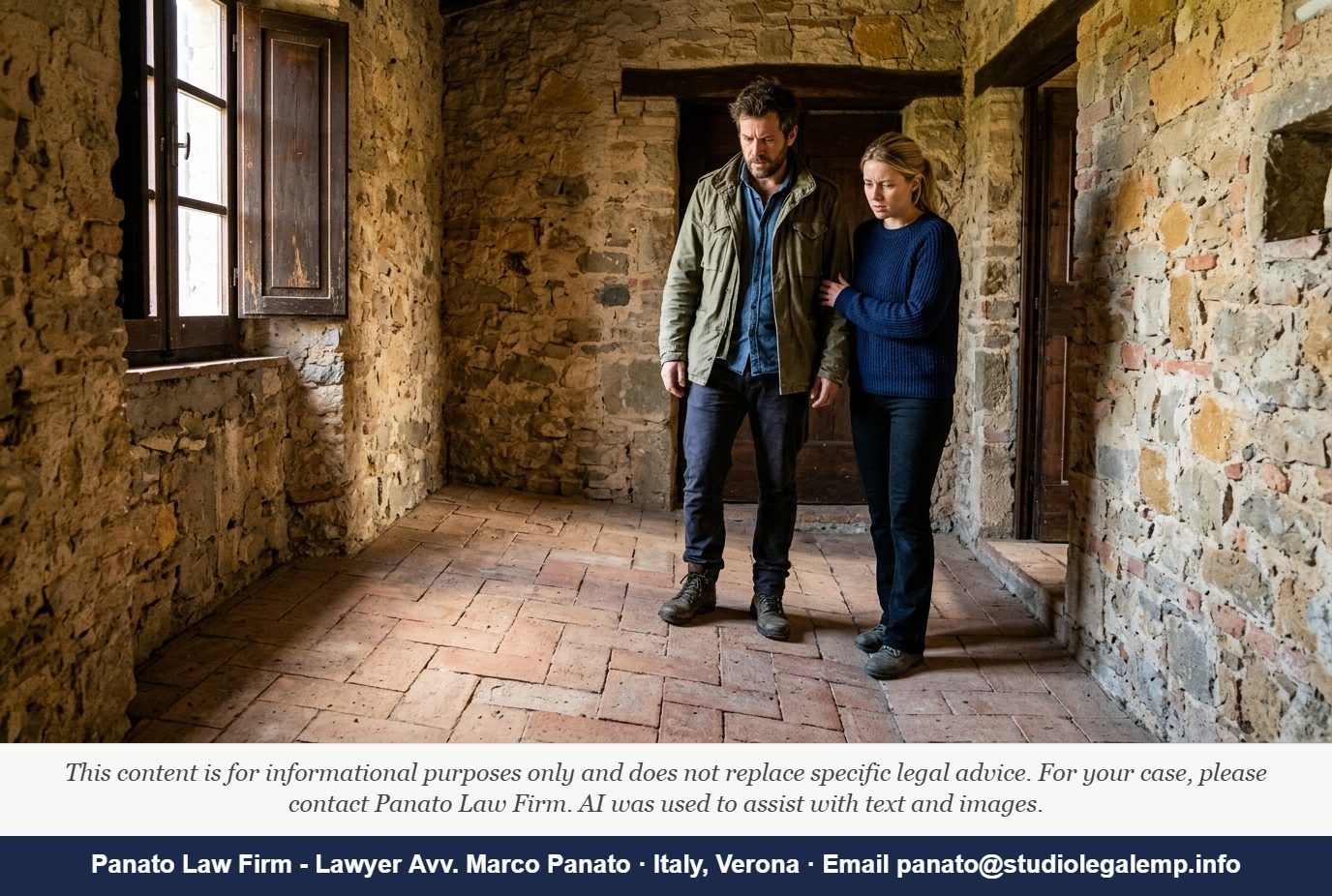
Image prompt: A foreign couple standing in the interior of a stone-walled Italian farmhouse, visibly concerned, looking down at a noticeably sloping tiled floor. Natural daylight enters through a shuttered window, casting long shadows across the uneven terracotta tiles. The colour palette is warm ochre and grey, with a slightly unsettling diagonal to the composition that echoes the structural problem. Documentary-realist style, no text in the image.
Image file: hidden-defects-italy-property-foreign-buyer-rights-2026-cover
HREFLANG BLOCK:
JSON-LD:
LANGUAGE QA: delimits more sharply the duty of diligence resting on the buyer -> narrows the buyer's duty of diligence · the consequences are considerably more severe, as discussed below -> the consequences are significantly more serious, as explained below · global rotation of the entire building in the uphill-to-downhill direction -> rotation of the whole building from the uphill to the downhill side · cannot simply be wished away by a stock clause in the deed -> cannot be excluded by a boilerplate clause in the contract · Knowing that a floor is not perfectly level, the Court reasoned, is an entirely different thing from knowing -> Knowing a floor is uneven, the Court held, is not the same as knowing · awareness of the underlying internal cause of a defect — not merely perception of its outward symptom — is the prerequisite for -> knowledge of the underlying cause — not just the outward symptom — is required for · Cassazione no. 16628/2026 firmly closes that door -> Decision no. 16628/2026 firmly closes that door · The duty of investigation sits primarily with the seller -> The investigative burden falls primarily on the seller
CHECK:
AUTHORITY 1: Italian Court of Cassation, Second Civil Division, judgment no. 16628 of 27 May 2026 (Cass. civ., Sez. II, 27 maggio 2026, n. 16628)
REFERENCES: Cass. civ., Sez. II, 27 maggio 2026, n. 16628
EXISTS? Yes — confirmed by Il Sole 24 Ore (29 May 2026), dirittobancario.it (citing presiding judge Falaschi, reporting judge Trapuzzano), news.avvocatoandreani.it, scla.it, negroesantoro.it, lexced.com
CONTENT MATCHES? Yes — symptom vs cause distinction confirmed; floor tilt / global building rotation factual background confirmed; Art. 1490–1491 c.c. framework confirmed; economic limits of rescission refund confirmed.
AUTHORITY 2: Italian Court of Cassation, Second Civil Division, judgment no. 22918 of 8 August 2025 (Cass. civ., Sez. II, 8 agosto 2025, n. 22918)
REFERENCES: Cass. civ., Sez. II, n. 22918, 8 agosto 2025
EXISTS? Yes — confirmed by brocardi.it (authoritative legal text database), lexced.com (confirms Sez. 2, n. 22918, Anno 2025), studiolegalemp.info
CONTENT MATCHES? Yes — deliberate concealment of defect suspends limitation period under Art. 1495 c.c.; also confirms distinction from aliud pro alio for saneable defects.
AUTHORITY 3: Italian Court of Cassation, Joint Divisions, judgment no. 19702 of 2012 (Cass. civ., Sezioni Unite, n. 19702/2012)
REFERENCES: Cass. civ., Sezioni Unite, n. 19702/2012
EXISTS? Yes — cited and confirmed by studiomoscarini.it as authoritative precedent on seller's post-sale repair promise creating autonomous obligation with 10-year limitation period.
CONTENT MATCHES? Yes — matches what is written in the article.
OVERALL: GREEN — all three authorities confirmed as to existence and relevance to the propositions they support in the article.
LOCAL NOTE:
1. Search intent targeted: informational with strong transactional signal — a reader who has already bought an Italian property and discovered a defect is actively seeking a lawyer within minutes of this search.
2.
Do you need legal assistance or a free estimate?
Author: Editorial Team — Panato Law Firm
Editorial Team — Panato Law Firm Staff