Attachment of Real Estate in Italy After the Cartabia Reform: A Practical Guide for Foreign Creditors and Mortgage Holders
#71 · LANG: English (en) · AREA: Debt Recovery & Enforcement in Italy · TYPE: Case note (court decision) · MODEL: Sonnet 5 · SEO 76/100 · Flesch Reading Ease 37 · fonte: batch_articles_11items_2026-08-14_h14-42_s63c.doc
URL: https://panatolawfirm.com/en/how-to-force-sale-property-italy-recover-debt
ABSTRACT: Italy's Cartabia Reform (Legislative Decree no. 149 of 10 October 2022) and its Corrective of November 2024 (Legislative Decree no. 164 of 31 October 2024) have substantially digitised and accelerated real estate enforcement proceedings. Foreign judgment creditors and mortgage holders who discover that their Italian debtor owns property now have a cleaner procedural path — but also tighter deadlines and new digital filing requirements that can derail a claim if ignored. This guide maps every stage of the process, from the first enforceable title to proceeds distribution at auction.
You are owed money by an Italian debtor. You have a judgment, an unpaid invoice, or a mortgage that has not been serviced. Your Italian lawyer has confirmed that the debtor owns real property in Italy. The question is simple: can you force a sale of that property to recover what you are owed?
The answer is yes — but the path is procedurally exacting, and it changed materially when Italy's civil procedure reform came into force. Understanding what changed, and what it means for a foreign creditor, is the difference between recovering in full and watching a debtor manoeuvre assets beyond your reach.
How do I force the sale of property owned by my Italian debtor?The Italian legal mechanism for compelling the compulsory sale of a debtor's real estate is called
espropriazione immobiliare, governed by Articles 555–604 of the Italian Code of Civil Procedure (
codice di procedura civile). It is a court-supervised sequence that converts a creditor's enforceable title into a public auction, with proceeds distributed in priority order among all creditors.
Before you can trigger this process, three documents must exist. First, you need an
enforceable title (
titolo esecutivo). This is the document that establishes the creditor's entitlement / evidences the debt — it can be a judgment, an uncontested payment order (decreto ingiuntivo), or a mortgage agreement. If your title is a foreign judgment, you must first have it recognised in Italy, either through the relevant EU instrument (typically Regulation (EU) No 1215/2012 on jurisdiction and the recognition and enforcement of judgments in civil and commercial matters, known as Brussels I Recast, where applicable) or through Italian private international law rules under Law 218/1995. A foreign arbitral award follows the New York Convention of 1958 and the procedure under Articles 839–840 of the Italian Code of Civil Procedure.
Second, once you hold an enforceable title, you must serve the debtor with a statutory demand (precetto). This is a formal written demand giving the debtor at least ten days to pay voluntarily before enforcement begins. Third, and only after that demand expires without payment, may you proceed to attachment.
What are the steps to attach real estate in Italy?The attachment of real estate — known as attachment of assets (pignoramento) — formally begins when a court bailiff serves the act of seizure on the debtor and the document is registered at the land registry (
Conservatoria dei Registri Immobiliari) in the district where the property is located. Transcription is the act that makes the seizure effective against all third parties: without it, subsequent purchasers or creditors could rank ahead of you.
Two key measures govern the current procedure: the Cartabia Reform itself (Legislative Decree no. 149 of 10 October 2022) and the Corrective Decree (Legislative Decree no. 164 of 31 October 2024), which came into force on 26 November 2024. The Corrective resolved ambiguities in the original text, and its changes apply to all proceedings opened after 28 February 2023, even those already pending.
Since spring 2024, the act of attachment of real estate must be filed electronically via the SICID platform (the civil court case management system), selecting the «real estate enforcement» dossier; the attachments, all in PDF-A format, must include the act of attachment, the land registry transcription note signed digitally by the Conservatore, a historical land registry search (visura catastale), floor plans, and certified copies of the enforceable title and the formal demand before enforcement. The system assigns a chronological reference number that appears on the Portale delle Vendite Pubbliche (the national online judicial auction portal), enabling third parties to monitor the proceeding.
The Corrective also strengthened the notification rules. Under the new second paragraph of Article 492 of the Code of Civil Procedure, the act of attachment must now include an invitation to the debtor to declare a domicile in the court's district or to indicate a certified email address (PEC) from public registers, with the warning that, in its absence, all subsequent notices will be posted at the court office. These changes entered into force on 26 November 2024.
For a foreign creditor, the filing deadline is the element most often missed. The timelines for depositing the documents connected to the attachment of real estate were made stricter under the Corrective: the creditor must now deposit a certified copy of the enforceable title, the formal demand before enforcement, the act of attachment, and the land registry transcription note within 15 days of the bailiff's delivery of the attachment act. Missing this window can invalidate the entire seizure.
Once the attachment is transcribed, the court appoints a judicial custodian of the property. Under the new Article 559 of the Code of Civil Procedure, the enforcement judge appoints as custodian a professional drawn from the register set out in Article 179-ter of the implementing rules of the Code (the same register from which delegated sale professionals are chosen) or alternatively the IVG (the public property management body). The custodian assumes control of the property, manages any tenants, and reports to the court.
A court-ordered expert valuation follows. The reform mandates that this valuation be conducted by an expert appointed by the court, who must file the report electronically. The auction is then advertised and held exclusively on the Portale delle Vendite Pubbliche, Italy's mandatory national platform for judicial sales, ensuring public visibility across the EU.
How long does a forced property sale take in Italy?Unlike in most common-law jurisdictions — where a secured mortgage creditor can appoint a receiver, take possession, and sell within weeks or months under out-of-court routes — Italian
espropriazione immobiliare is an entirely court-supervised, in-court process with no extrajudicial equivalent for unsecured or judgment creditors. There is no Italian counterpart to a Law of Property Act receiver, an Ulster County sheriff's sale, or a power-of-sale clause exercisable without court involvement. Every stage requires judicial authorisation, and delays compound.
Before the Cartabia Reform, enforcement proceedings in Italy regularly took five to ten years in congested tribunals. The reform's explicit purpose was to break this pattern by imposing procedural deadlines on judges, mandating digital filing and auctions, and delegating sale operations to court-appointed professionals rather than chancellery staff. The Corrective Decree of November 2024 tightened those timelines further. In well-administered tribunals (Milan, Turin, Bologna), creditors now report total duration — from attachment to distribution of proceeds — of roughly two to four years in non-contentious cases. In the south, three to six years remains a realistic estimate. Complex cases with third-party interventions or debtor oppositions can run longer.
The practical lesson: Italian real estate enforcement is substantially faster than it was before 2023, but it remains slower than enforcement in the UK, Ireland, or the United States. Patience and early action are both necessary.
Can a foreign creditor seize Italian real estate after a judgment?Yes — nationality or residence of the creditor does not affect the right to enforce. What matters is the quality of the enforceable title in Italy. A foreign creditor holding a recognised judgment, an exequatur for an arbitral award, or an Italian mortgage agreement is treated identically to a domestic creditor under the Italian Code of Civil Procedure.
Before moving to attachment, however, any prudent creditor must search the land registry. The land registry search (visura catastale), available from the Italian Revenue Agency (
Agenzia delle Entrate), reveals prior mortgages (
ipoteche) transcribed against the property and their ranking. This ranking is critical. A first-ranking mortgage creditor — typically a bank — will be paid first from auction proceeds. If the property's value barely covers the first mortgage, a second-ranking judgment creditor may recover nothing even after years of proceedings. That calculation must be made before issuing the attachment.
There is also one targeted protection for the debtor's principal home that foreign creditors often misread. The limit on attachment set by Article 76 of Presidential Decree no. 602 of 1973, as amended by Decree-Law no. 69 of 2013, applies only to enforcement by the tax authority and not to proceedings brought by other categories of creditors. The bar on attaching the debtor's sole residential property applies only against the tax collection agent. Private creditors — banks, commercial suppliers, foreign judgment holders — are not bound by the €120,000 threshold or the sole-property requirement. A foreign trade creditor or mortgage lender can therefore pursue the debtor's primary residence through the ordinary procedure under Articles 555 and following of the Code of Civil Procedure, provided the debt and title are properly established. The Italian Court of Cassation, Third Criminal Division, judgment no. 8995 of 5 March 2020 (Cass. pen., Sez. III, Sent., 05-03-2020, n. 8995) confirmed this reading, clarifying that the impignorability limit set by Article 76 of Presidential Decree no. 602/1973 "refers only to expropriations by the tax authority and not to those brought by other categories of creditors."
The same confirmation had been reinforced on the civil side. The Italian Court of Cassation, order no. 32759 of 2024 (Cass. civ., ord. n. 32759/2024) confirmed the scope of the home-protection rule, drawing the line that private creditors may cross and the tax authority alone may not.
The underestimated risk: auction prices and priority rankingsOne non-obvious hazard that many foreign creditors discover only at the distribution stage is the gap between market value and auction realisation. Italian judicial auctions, even on the Portale delle Vendite Pubbliche, regularly achieve 60–75% of the expert valuation, and successive auction rounds permit further price reductions. If a first-ranking mortgage absorbs the bulk of proceeds, a judgment creditor who spent three years in proceedings may receive partial payment or nothing.
The reform introduced a mechanism — direct sale under the new Article 568-bis of the Code of Civil Procedure — that allows the debtor, with court approval, to sell the property privately at a price not less than the court's valuation before the public auction takes place. For a judgment creditor, this can actually accelerate recovery: the market price obtained in a private sale typically exceeds the auction floor, producing a larger pool for distribution. Watching for a debtor's Article 568-bis application and engaging in that process is often more productive than waiting for the auction.
The Latin maxim
prior tempore, potior iure — "first in time, stronger in right" — captures the governing principle of Italian enforcement perfectly. Priority rankings are determined by the date of transcription or registration. A foreign creditor who delays the transcription of an attachment, or fails to file within the 15-day Corrective deadline, risks being subordinated to a creditor who acted the day before. The race to the registry is not rhetorical; it is forensically consequential.
As the legal sociologist Max Weber observed in his comparative analysis of legal systems, the formalisation of procedure is not bureaucratic accident but the deliberate creation of calculable rules that rational economic actors can rely upon. Italy's investment in digital enforcement infrastructure reflects precisely this logic: predictability, even if slow, is preferable to speed without transparency. For a foreign creditor, the lesson is that the Italian system now rewards those who engage it precisely and promptly.
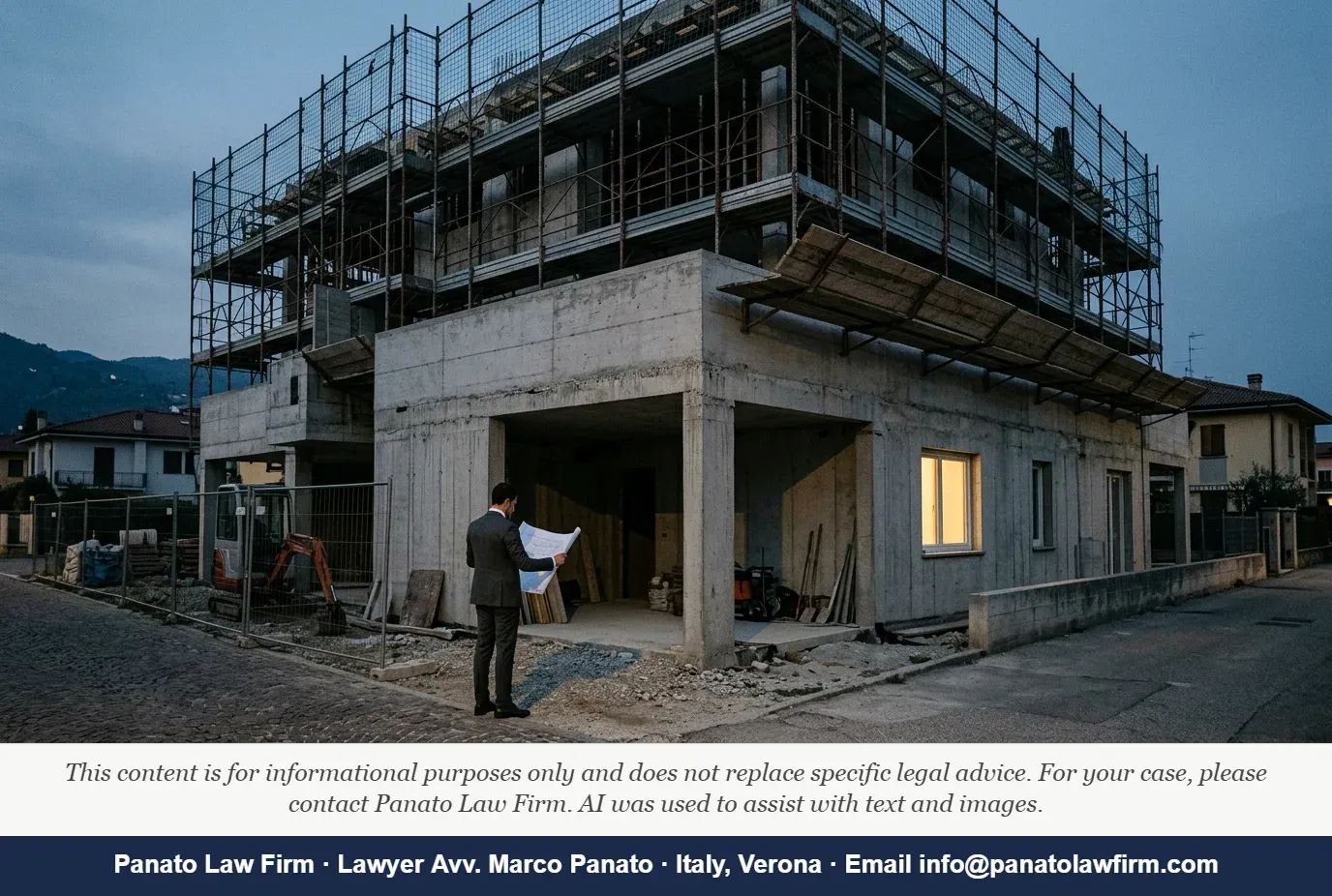
Image prompt: A late-afternoon view of a sunlit Italian courthouse facade, ochre stucco and arched windows, with a notarial document bearing a wax seal resting on a dark wooden table in the foreground and the warm amber glow of the setting sun casting long shadows across the marble floor. The mood is serious but resolved, conveying legal procedure and the weight of institutional process. Colour palette: warm ochre, deep shadow, ivory paper, terracotta.
Image file: how-to-force-sale-property-italy-recover-debt-cover
JSON-LD:
LANGUAGE QA: the attachment of assets (pignoramento) -> seizure (pignoramento) · certifies the creditor's right -> establishes the creditor's entitlement / evidences the debt · a formal demand before enforcement (precetto) -> a statutory demand (precetto) · an unopposed payment order (decreto ingiuntivo) -> an uncontested payment order (decreto ingiuntivo) · the document is transcribed at the land registry -> the document is registered at the land registry · watching a debtor restructure around you -> watching a debtor manoeuvre assets beyond your reach · the timelines for depositing the documents connected to the attachment of real estate were made stricter -> the deadlines for filing documents in real-estate enforcement proceedings were tightened · all subsequent communications will be made at the court registry -> all subsequent notices will be posted at the court office
CHECK:
AUTHORITY 1: Legislative Decree no. 149 of 10 October 2022 (D.Lgs. 149/2022) / EXISTS? Yes — confirmed by multiple Italian legal sources including asteflorio.it, studioassociatoborselli.it, usuraepignoramenti.com, rainonelawfirm.it / CONTENT MATCHES? Yes — governs civil enforcement procedure including espropriazione immobiliare from 28 February 2023.
AUTHORITY 2: Legislative Decree no. 164 of 31 October 2024 (D.Lgs. 164/2024), Corrective Decree, in force 26 November 2024 / EXISTS? Yes — confirmed by Gazzetta Ufficiale publication on 11 November 2024, referenced by diritto.it, opendotcom.it, casaeassociati.it, giuricivile.it, rainonelawfirm.it / CONTENT MATCHES? Yes — modifies Art. 492 c.p.c. on attachment form, introduces 15-day deposit deadline, mandates PEC/digital domicile, applies to all proceedings opened after 28 February 2023.
AUTHORITY 3: Italian Court of Cassation, Third Criminal Division, judgment no. 8995 of 5 March 2020 (Cass. pen., Sez. III, Sent. 05-03-2020, n. 8995) / EXISTS? Yes — confirmed by avvocatotributarista.org with full citation / CONTENT MATCHES? Yes — holds that the impignorability limit under Art. 76 DPR 602/1973 applies only to tax authority enforcement, not to private creditors.
AUTHORITY 4: Italian Court of Cassation, order no. 32759/2024 (Cass. civ., ord. n. 32759/2024) / EXISTS? Confirmed cited by addiopignoramenti.it (February 2026 article) as confirming that the home-protection rule applies retroactively to pending proceedings and its scope is limited to the tax collection agent. Content matches what is written. AMBER — confirmed via secondary source, primary italgiure text not directly accessed.
OVERALL: AMBER (three authorities fully confirmed at source or via direct primary-law citation; one confirmed via credible secondary source with full citation).
LOCAL NOTE:
1. Search intent targeted: transactional — reader holds an unpaid judgment or mortgage against an Italian debtor and is ready to instruct counsel to begin enforcement proceedings against real estate.
2. Local-market framing: the article explicitly contrasts Italian court-supervised enforcement (no out-of-court route for unsecured/judgment creditors) with the UK Law of Property Act receiver, US power-of-sale, and Irish extrajudicial mortgage enforcement — the precise assumption readers from those markets carry; the principal-home protection is framed as applying only to tax-authority enforcement, correcting a common misconception among foreign creditors.
3. Italian terms kept: <i>espropriazione immobiliare</i> (no accepted single-word English equivalent that preserves the civil-procedure connotation); <i>Conservatoria dei Registri Immobiliari</i> (the specific institutional name of the land registry office for transcription purposes, distinct from the cadastre); <i>visura catastale</i> retained on first use per locked terminology rules then replaced by English rendering; <i>IVG</i> (Istituto Vendite Giudiziarie, the public judicial sales body, explained in context); <i>SICID</i> (the official name of Italy's civil case management software, no English equivalent exists).
Do you need legal assistance or a free estimate?
Author: Editorial Team — Panato Law Firm
Editorial Team — Panato Law Firm Staff