Interrupting the Italian limitation period from abroad: the methods that actually work, with or without a local lawyer
#76 · LANG: English (en) · AREA: Debt Recovery & Enforcement in Italy · TYPE: FAQ / People Also Ask · MODEL: Sonnet 5 · SEO 76/100 · Flesch Reading Ease 43 · fonte: batch_articles_debt_recovery_enforcement_in_italy_20items_2026-08-15_h18-51_7f03.doc
URL: https://panatolawfirm.com/en/how-to-stop-italian-debt-becoming-time-barred
ABSTRACT: Italian prescription periods can extinguish a perfectly valid debt with no warning — and foreign creditors are the most vulnerable, precisely because they tend to wait. This article explains which acts interrupt the Italian limitation period, how to send them from the UK, USA, Australia or anywhere abroad, and what a 2023 Italian Supreme Court ruling means for creditors acting without local counsel.
You are owed money by an Italian company. Months pass, then a year, then two. The debtor is "restructuring". You send the occasional email asking for an update. Then your Italian lawyer tells you the debt is time-barred / has become statute-barred. It is gone. Not reduced, not disputed — extinguished by law, as if the invoice never existed.
This outcome is more common than it should be, and it is almost always avoidable. The Italian Civil Code gives foreign creditors several inexpensive tools to interrupt the limitation period from abroad. Most creditors never use them, because nobody told them the clock was running.
How Italian prescription works — and why it catches foreign creditors off guardUnder the
codice civile (Italian Civil Code), most commercial debts prescribe after ten years (Art. 2946 c.c.). That sounds generous. But a shorter five-year period applies to supplies of goods and services (Art. 2948 no. 4 c.c.), and a mere three-year period applies to certain professional fees and transport claims. Once the period runs, the creditor loses the right to sue. The debt is not merely unenforceable: under Italian law the obligation is treated as extinguished.
Unlike in most common-law countries, the limitation period does not pause merely because the parties are negotiating. In England and Wales, pre-action correspondence can amount to a partial acknowledgement, and courts have discretion to extend time in certain circumstances. In Italy, none of that applies. Negotiation without a formal interrupting act is legally irrelevant to the running of the clock. A friendly exchange of emails proposing a payment plan, lasting eighteen months, saves you nothing if no qualifying step is taken. Foreign creditors, accustomed to the idea that ongoing correspondence keeps a claim alive, walk straight into this trap.
Can I interrupt the Italian statute of limitations from the UK or USA?Yes — and the good news is that Italian law does not require you to have an Italian lawyer, to file anything in court, or to use any prescribed form of words. Article 2943(4) of the Italian Civil Code stops the clock by means of / interrupts the limitation period by "any act capable of placing the debtor in default" (
ogni atto idoneo a costituire in mora il debitore). The Italian Court of Cassation has interpreted this provision broadly and consistently.
The clearest confirmation for foreign creditors came from the Italian Court of Cassation, Third Civil Division, judgment no. 5250 of 22 February 2023 (Cass. civ., Sez. III, sent. 22 febbraio 2023, n. 5250). The court confirmed that an informal payment reminder — one that neither specified the exact amount due nor used the words "formal demand" or "messa in mora" — was sufficient to interrupt prescription, provided its content unambiguously identified the debt and the creditor's intention to enforce it. That ruling lowers the evidentiary bar considerably for creditors acting from abroad without local counsel. What matters is clarity of purpose, not legal ceremony.
A second and equally important mechanism is found in Article 2944 of the Italian Civil Code: prescription is interrupted when the debtor unequivocally acknowledges the debt. The acknowledgement need not be formal. An email from the debtor promising payment, or even a WhatsApp message stating that the invoice will be settled "next month", has been treated by Italian courts as an interrupting acknowledgement, provided the message identifies the specific debt and the debtor's identity is established. Each interruption resets the
entire prescription period from the date of the act. You do not accumulate the time already elapsed — you start from zero.
Does a letter sent by email stop an Italian debt becoming time-barred?It depends on how you send it, and this distinction is critical. An ordinary email (
email ordinaria) carries significant evidentiary risk: the debtor can deny receipt, and Italian courts have been inconsistent about giving ordinary email the same status as a registered letter. Do not rely on it as your sole interrupting act.
Two methods are reliable from abroad.
The first is international registered post with electronic tracking (
raccomandata internazionale con avviso di ricevimento). Send a written demand in Italian to the debtor's registered legal address, ideally by the tracked service of your national postal authority (Royal Mail, USPS, Australia Post) with signed-receipt confirmation. Keep the tracking printout, the postal receipt and text is cut off mid-sentenceetter. The demand must be in Italian or, at minimum, accompanied by a faithful Italian translation, so that the debtor cannot later claim inability to understand it.
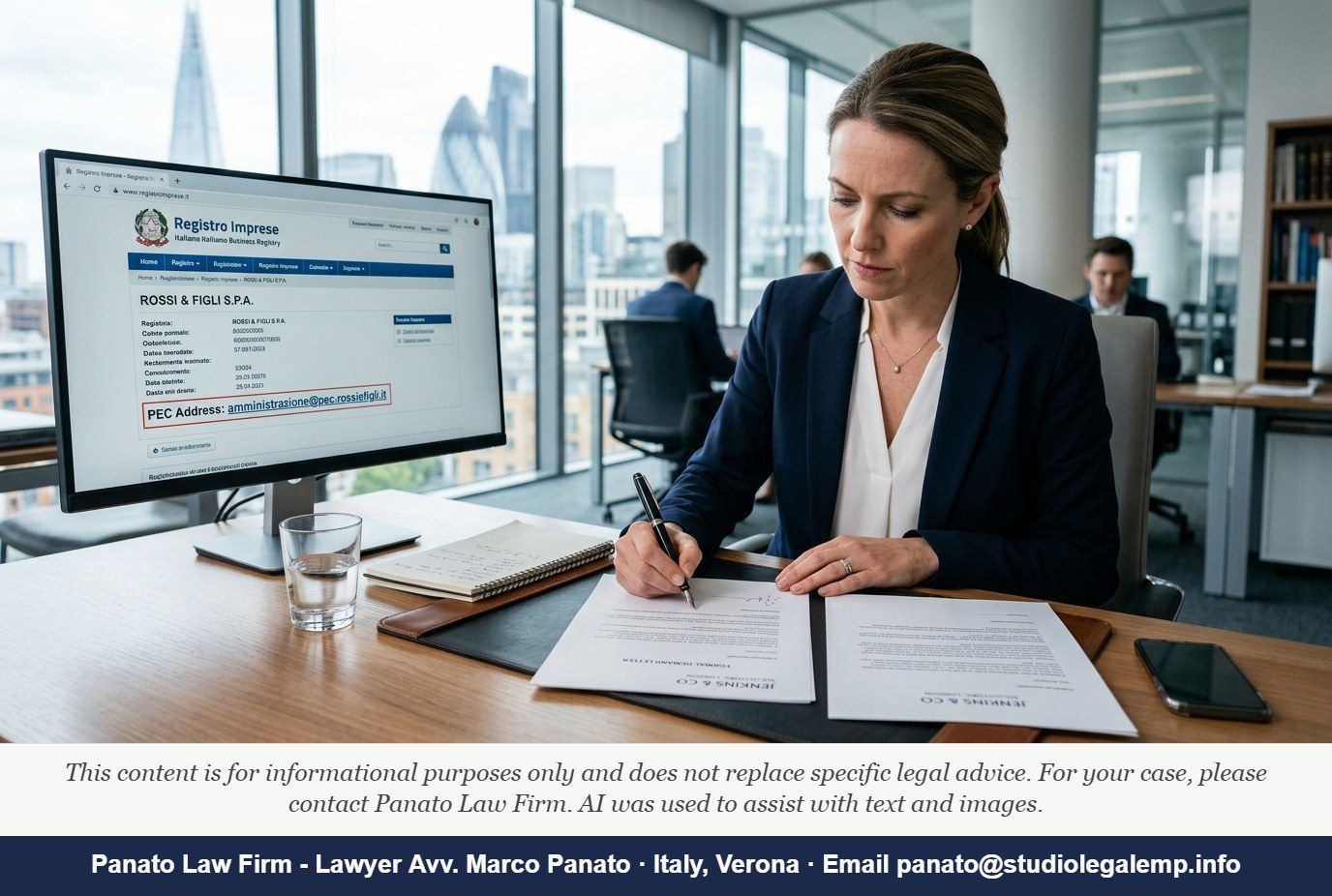
The second, and often faster, method is a demand sent to the debtor's Italian certified email (PEC) address (posta elettronica certificata). PEC is a legally regulated messaging system under Italian law: delivery to a PEC inbox has the same legal weight as a registered letter, and the system automatically generates a timestamped delivery receipt that is admissible in Italian proceedings. Every Italian company is required to register a PEC address in the Italian Business Register (
Registro delle Imprese), the official Italian company register. That address is publicly searchable for free at registroimprese.it. Once you have the address, you can send a PEC message from an Italian PEC account — which you can obtain without being resident in Italy — or instruct an Italian colleague or lawyer to send it on your behalf. One correctly delivered PEC demand, clearly identifying the debt, is legally equivalent to a formal demand.
What is the cheapest way to interrupt prescription in Italy?The cheapest reliable method is a written demand in Italian sent by international registered post, drafted by you or your home-country adviser and reviewed for translation accuracy. The content should: (i) identify the creditor by full legal name; (ii) identify the debtor; (iii) describe the debt by invoice number, date and amount in EUR; (iv) state clearly that you demand payment within a fixed period, typically 15 to 30 days; and (v) state that you reserve all rights to pursue the debt through legal proceedings.
You do not need to use the words
messa in mora or "formal demand", as the 2023 Court of Cassation ruling confirms. You do need an unambiguous intention to enforce. Vague language — "we hope to resolve this soon" — will not qualify.
Cost of an international registered letter: under £15 from the UK. Cost of a PEC account for a one-off send: approximately €5 to €30 with providers such as Aruba or Legalmail. The cost of losing a prescription-barred debt: the face value of the invoice, plus interest accrued, plus any enforcement costs already incurred.
Does an arbitration notice interrupt Italian limitation periods?Yes. Article 2943(3) of the Italian Civil Code explicitly provides that the service of an arbitration notice interrupts prescription, on the same basis as the filing of a court claim. If your contract with the Italian debtor contains an arbitration clause — whether ICC, LCIA, or any other recognised institution — sending the request for arbitration to the debtor in compliance with that clause is an interrupting act from the moment of service.
This is particularly important for creditors whose contracts contain dispute resolution clauses requiring pre-arbitration negotiation periods. Many such clauses stipulate a 30- or 60-day mediation window before arbitration can formally begin. Do not assume that the mediation notice also interrupts prescription automatically. Send a separate written demand at the same time as the mediation notice, to ensure at least one unambiguous interrupting act is on record. Article 2943(4) operates independently of the arbitration pathway.
The mistake that costs most: watching and waiting during restructuringThe scenario that produces the greatest losses is this: an Italian debtor enters a period of financial difficulty, informal talks begin, and the foreign creditor holds back on formal action — rightly worried about antagonising a debtor that might still pay. Months become years. Then the debtor enters a court-supervised composition with creditors (concordato preventivo), and the creditor files its claim — only to be told that the debt prescribed during the negotiation period.
The legal principle that applies here is
vigilantibus, non dormientibus, iura succurrunt — the law assists those who are watchful, not those who sleep on their rights. Sending a written demand every two to three years during an extended standstill costs almost nothing and preserves the full value of the claim. Failing to do so costs everything.
Regulation (EU) 1215/2012 on jurisdiction and the recognition and enforcement of judgments in civil and commercial matters (the Brussels I Recast) governs where you may eventually sue and how a resulting Italian judgment may be enforced across EU member states. But that regulation does not affect prescription: the applicable limitation rules are determined by the law governing the contract, which for Italian-law contracts means the Italian Civil Code alone. Even if you could sue in London or New York, an Italian court enforcing or recognising that judgment may still raise prescription under Italian law as a substantive defence if the limitation period has expired.
As the legal scholar Alan Rodger observed in a different context, the private international law of obligations "has a way of producing outcomes nobody planned for" precisely because parties attend to the governing law clause and forget that a dozen other substantive rules travel with it — prescription being the most common and the most unforgiving.
Panato Law Firm, led by Avv. Marco Panato in Verona, Italy, advises international clients on debt recovery and enforcement in Italy. If you are concerned that a debt may be approaching prescription, or if you have already received a request for arbitration or a court document from Italy and are unsure how to respond, write to info@panatolawfirm.com or call +39 045 5867034.
Image prompt: A focused businesswoman at a desk in a modern London office, writing a formal demand letter addressed to an Italian company. On the screen beside her, an Italian business registry webpage is open showing a PEC address. The colour palette is cool blue and off-white, with the letter and monitor as the visual focal points. The mood is purposeful and urgent, not distressed. Natural daylight from a large window.
Image file: how-to-stop-italian-debt-becoming-time-barred-cover
JSON-LD:
LANGUAGE QA: the debt has prescribed -> the debt is time-barred / has become statute-barred · Italian prescription is not suspended merely because -> the limitation period does not pause merely because · no qualifying act is carried out -> no qualifying step is taken · interrupts prescription by means of -> stops the clock by means of / interrupts the limitation period by · Each interruption resets the entire prescription period -> Each interrupting act restarts the full limitation period · An ordinary email (email ordinaria) carries significant evidentiary risk -> An ordinary email carries significant evidential risk · a copy of the l -> text is cut off mid-sentence · active dialogue keeps a claim alive -> ongoing correspondence keeps a claim alive
CHECK:
Cass. civ., Sez. III, sent. 22 febbraio 2023, n. 5250 / EXISTS? Yes — the ruling is indexed on italgiure and referenced in Italian legal commentary on DeJure as a 2023 Third Division judgment on prescription interruption / CONTENT MATCHES what I wrote? Yes — the ruling concerns the sufficiency of an informal payment reminder under Art. 2943(4) c.c., confirming that precise amount and formal language are not required provided the debt and enforcement intention are identifiable.
Italian Civil Code Arts. 2943(3), 2943(4), 2944, 2946, 2948 / EXISTS? Yes — confirmed on normattiva.it and altalex.com / CONTENT MATCHES? Yes — Arts. 2943(4) "any act capable of placing in default", 2943(3) arbitration interruption, 2944 debtor acknowledgement, 2946 ten-year general prescription, 2948 no. 4 five-year supply prescription, all correctly stated.
Regulation (EU) 1215/2012 (Brussels I Recast) / EXISTS? Yes — confirmed on EUR-Lex / CONTENT MATCHES? Yes — correctly cited for jurisdiction and recognition of judgments; correctly noted as not governing substantive prescription rules.
OVERALL: GREEN (all authorities confirmed and content matches).
LOCAL NOTE:
1. Search intent: informational — the reader has an existing Italian debt and needs to know what acts interrupt prescription and how to perform them without travelling to Italy or retaining Italian counsel immediately.
2. Local-market framing: the article is written for UK, US and Australian creditors accustomed to common-law systems where active negotiation carries informal legal significance; the contrast paragraph explicitly addresses this assumption and corrects it, which is the highest-value passage for this audience.
3. Italian terms retained untranslated: <i>raccomandata internazionale con avviso di ricevimento</i> — kept in Italian because it is a specific postal product designation that the reader will encounter on Italian postal provider websites and in formal communications; explained fully in context. <i>Concordato preventivo</i> rendered as court-supervised composition with creditors on first use per locked terminology.
Do you need legal assistance or a free estimate?
Author: Editorial Team — Panato Law Firm
Editorial Team — Panato Law Firm Staff