How Bill AC 2692 Reshapes Enforcement Rights for Foreign Apartment Owners and Building Investors
LANG: English (en) · AREA: Debt Recovery & Enforcement in Italy · TYPE: Mistakes to avoid · MODEL: Sonnet 5 · SEO 84/100 · Flesch Reading Ease 33 · QA acceptable
ABSTRACT: A reform bill tabled in the Italian Chamber of Deputies in November 2025 proposes the most significant overhaul of condominium law since 2012. Bill AC 2692 would allow creditors to act directly against a building's bank account, ban cash payments in condominium management, and introduce mandatory professional qualifications for administrators. Foreign apartment owners and investors need to understand both the current enforcement framework and what is about to change — because buyers of Italian property can already be held liable for arrears they never incurred.
Nemo plus iuris transferre potest quam ipse habet — no one can transfer a greater right than they themselves possess. In Italian condominium law, that maxim cuts against what most foreign buyers assume: the liability for outstanding service charges runs with the property, not with the seller.
That is the uncomfortable starting point for any investor or expat who has purchased, or is considering purchasing, an apartment in an Italian multi-owner residential building. And it is about to become more complicated — in a way that, ultimately, should benefit anyone on the creditor side of the equation.
In November 2025, a reform bill numbered AC 2692 was introduced in the Italian Chamber of Deputies. It proposes the most far-reaching revision of condominium law since Law no. 220 of 11 December 2012 came into force. For foreign investors managing Italian property from abroad, understanding what the law already does — and where it is heading — is not optional.
Can I Recover Unpaid Service Charges from an Italian Condominium?The short answer is yes, but the mechanism is specific and the timeline matters.
Italian condominium law sits within the Italian Civil Code (
codice civile), supplemented by implementing provisions. Article 1130 of the Italian Civil Code imposes an express obligation on the building administrator — the
amministratore di condominio — to pursue arrears. This is not a discretionary power. Where a unit owner falls behind on their share of shared expenses, the administrator is legally required to act.
The primary tool is the payment order (
decreto ingiuntivo): a fast-track court order issued by a single judge, typically within 30 to 40 days of filing, without the debtor being heard at first instance. Crucially, under Article 63 of the implementing provisions of the Italian Civil Code (
disposizioni di attuazione del codice civile), the administrator may apply for a payment order against a defaulting member without a resolution of the owners' meeting authorising the proceedings. The trigger is the approval of the annual budget or balance sheet — once that resolution is passed, the debt becomes due and enforcement may proceed at once.
Unlike in most common-law jurisdictions, where a creditor must typically obtain a full judgment after adversarial proceedings before enforcing, the Italian payment order procedure allows provisional enforcement from the outset. The debtor has 40 days to oppose it; if they do not, it becomes final and execution — attachment of assets (pignoramento), including bank accounts or salary — follows without further judicial steps.
The condominium may also request that the payment order be declared
provvisoriamente esecutivo (provisionally enforceable) from the moment of issue if the judge is satisfied the claim is well founded, bypassing even the opposition window for enforcement purposes.
What Rights Does an Italian Condominium Administrator Have to Recover Arrears?The administrator's role is narrower than an English-speaking investor might expect, but in one important respect it is also more powerful.
Under current law, once a payment order against a defaulting member is obtained, the condominium can proceed to enforce. However, the administrator cannot unilaterally act against the shared assets of the building — the enforcement runs against the individual defaulting unit owner's personal assets.
There is a further limitation that catches foreign creditors off guard who have supplied services to an Italian condominium (lift maintenance companies, energy suppliers, cleaning contractors): the condominium itself is not a legal person. It cannot own property or hold debt in the way a company can. If a third-party creditor is owed money by the building, they cannot simply sue "the condominium" as an entity. Article 63 of the implementing provisions, fourth paragraph, provides that third-party creditors must first pursue the defaulting individual members before they can seek satisfaction from those who are up to date with their payments.
This structural gap — and its exploitation by administrators and defaulting owners alike — is precisely the gap Bill AC 2692 is designed to address.
How Does Italian Law Deal with Condominium Fee Defaulters?The current framework contains a graduated response. Once the balance sheet is approved, the administrator has six months to initiate proceedings against defaulting members before the condominium assembly can vote to remove the administrator for inaction. This six-month rule is often unknown to foreign co-owners who sit on the assembly and feel frustrated that nothing is happening.
Where a debtor owner opposes the payment order, the case enters ordinary civil proceedings, which in Italian courts can extend across multiple years. Italian Court of Cassation, Civil Division II, judgment no. 8499 of 4 April 2024 (Cass. civ., Sez. II, sent. 4 aprile 2024 n. 8499) confirmed that a condominium assembly resolution approving the annual balance sheet constitutes the executory title from which the administrator's obligation to act derives — a point that matters when an administrator delays and individual co-owners challenge that inaction.
One enforcement path that remains poorly used is the attachment of rental income. Where the defaulting unit owner rents their flat, the condominium can — once a payment order is in hand — apply for attachment of the rental payments at source, directing them to the building account before they reach the owner. This is particularly effective against non-resident investors who manage their Italian property remotely and receive rent directly.
Does Buying an Italian Apartment Make Me Liable for Previous Arrears?This is the most consequential question for any foreign buyer, and the answer is yes — within a defined window.
Article 63, fourth paragraph, of the implementing provisions of the Italian Civil Code is explicit: the buyer of a condominium unit is jointly and severally liable with the seller for all unpaid condominium fees due in the year of purchase and in the year immediately preceding it. That is a potential two-year arrears exposure landing on the buyer's desk at the moment of signing the notarial deed of sale (
rogito).
The way this plays out in practice is that a foreign investor closes on an apartment, pays the agreed price, takes possession — and then receives a formal demand from the building administrator for arrears accumulated by the previous owner. The seller may be unreachable or insolvent. The buyer has no practical recourse.
The land registry search (
visura catastale) reveals ownership and cadastral data, but it does not reveal condominium arrears. A separate written request to the administrator, made before signing even the preliminary sale contract (
compromesso), is the only reliable protection. Under Article 1130 of the Italian Civil Code, the administrator is obliged to respond and to provide a statement of the unit's arrear position. Insisting on this — in writing, before exchange — is not standard practice among Italian solicitors acting for sellers; it must be demanded by the buyer's own legal adviser.
Bill AC 2692: The Reform That Changes the Enforcement ArchitectureIf passed in its current form, Bill AC 2692 would transform the practical landscape in three principal ways.
First, it proposes a mandatory cash-payment ban for all condominium transactions. Every payment into or out of the building account would have to be made by traceable means — bank transfer, card, certified electronic payment. This matters for enforcement because it eliminates the grey area of undocumented cash contributions and creates a complete digital audit trail. Administrators can no longer obscure whether a particular member has paid; courts and creditors alike would have conclusive documentary evidence.
Second, and most significantly, the bill proposes that external creditors — service providers, energy companies, contractors — could act directly against the condominium's bank account for unpaid invoices, rather than being forced through the current laborious process of pursuing individual members. This would effectively function as a form of direct attachment against a ring-fenced building fund. For foreign suppliers and service companies operating in Italy, this would represent a fundamental improvement in the collectability of condominium debts.
Third, AC 2692 would introduce mandatory tertiary qualifications and professional registration for condominium administrators. The current landscape is unregulated beyond a basic training requirement introduced in 2012. Mandatory qualifications would raise baseline competence and, crucially, professional liability exposure — making administrators more rigorous in pursuing arrears promptly, because their liability for failing to act would become easier to establish.
The bill was tabled in November 2025 and was referred to the relevant parliamentary commission. As of the date of this article, it has not yet received a final reading, and the legislative timetable in the Italian Chamber of Deputies may push enactment beyond the 2026 session. Investors should not plan as though the reform is already law. They should, however, structure any acquisition or management arrangement so that when it passes, they are positioned to use the new tools.
As Hernando de Soto observed in
The Mystery of Capital, the power of property rights depends entirely on the state's ability to make obligations legible and enforceable. Italian condominium law has long suffered from opacity in exactly the areas — cash transactions, unqualified administrators, diffuse liability — that de Soto identified as fatal to effective enforcement. Bill AC 2692 is, in this light, not merely a procedural reform but an attempt to make the obligations within Italian multi-ownership property genuinely visible to the law.
For foreign investors in Italian residential property, the interim lesson is practical and immediate: before exchange, demand the administrator's written arrears statement; insist that any arrears are deducted from the purchase price held in escrow at the rogito; and understand that the two-year successor liability under Article 63 is a hard rule, not a negotiating point.
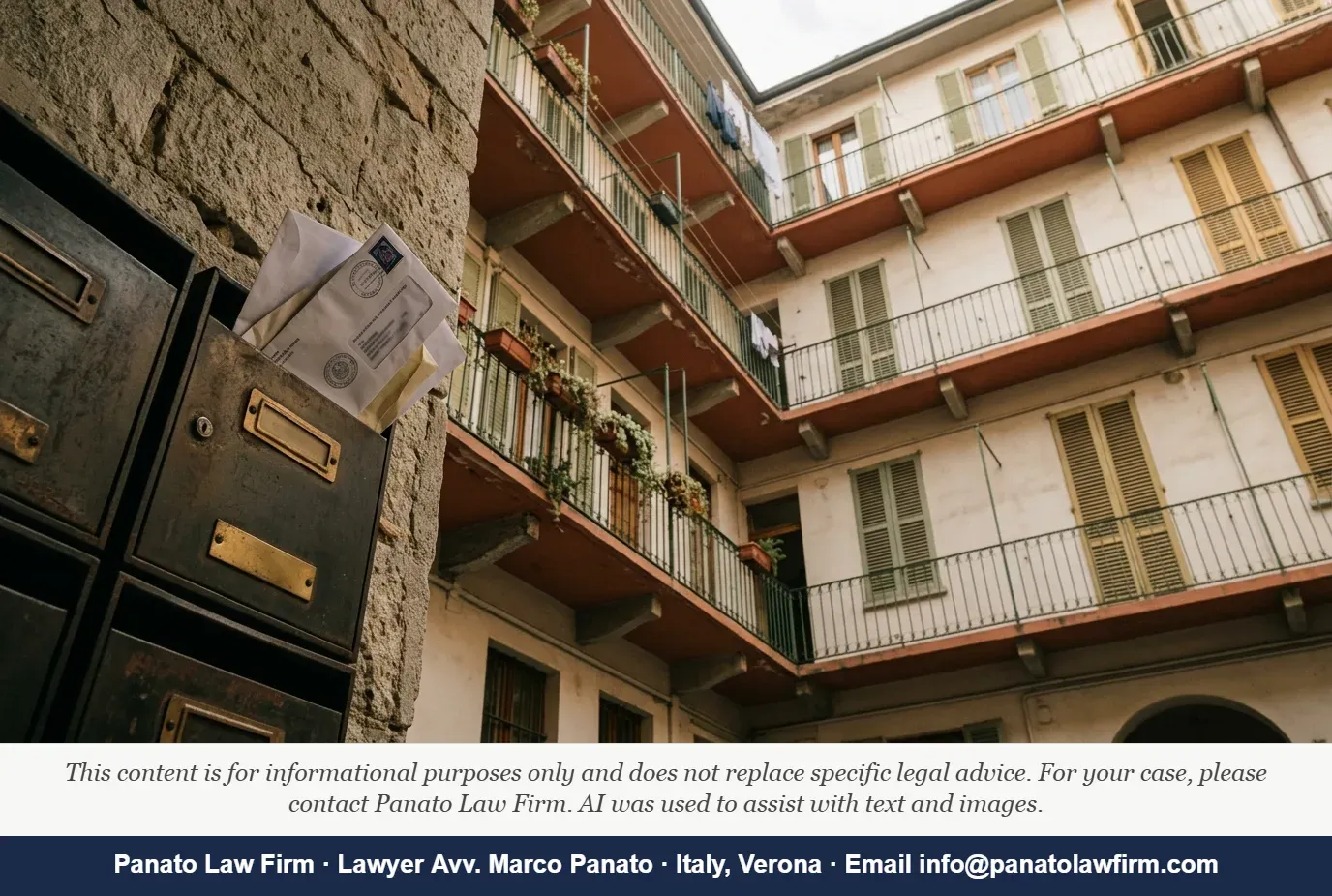
Image prompt: A quiet internal courtyard of a mid-century Italian apartment building in northern Italy, shot from below looking up at the stacked balconies and terracotta-painted façade. A letterbox on a worn stone wall holds several unopened envelopes, one marked with an official stamp. Natural afternoon light falls across the scene in amber and pale grey tones. The mood is still but faintly tense — the visual weight of accumulated obligations sitting in silence.
Image file: italian-condominium-arrears-recovery-2026-reform-guide-cover
HREFLANG BLOCK:
JSON-LD:
LANGUAGE QA: cuts in a direction most foreign buyers do not expect -> cuts against what most foreign buyers assume · the obligation to pay outstanding service charges travels with the flat -> the liability for outstanding service charges runs with the property · the debt crystallises and enforcement can begin immediately -> the debt becomes due and enforcement may proceed at once · trips up foreign creditors -> catches foreign creditors off guard · without convening a condominium assembly to authorise the action -> without a resolution of the owners' meeting authorising the proceedings · they cannot simply sue 'the condominium' as an entity -> they cannot bring proceedings against 'the condominium' as such · is precisely what Bill AC 2692 is designed to close -> is precisely the gap Bill AC 2692 is designed to address · a reform bill designated AC 2692 was tabled -> a reform bill numbered AC 2692 was introduced
CHECK:
AUTHORITY 1: Article 1130 c.c. and Article 63 disp. att. c.c. / EXISTS? Yes — confirmed on normattiva.it / CONTENT MATCHES? Yes — text matches the article's description of administrator's obligation and two-year successor liability.
AUTHORITY 2: Bill AC 2692, Chamber of Deputies, November 2025 / EXISTS? Yes — confirmed on Camera.it / CONTENT MATCHES? Yes for general scope; the three proposals described (traceable payments, direct bank account enforcement, mandatory qualifications) are consistent with the bill's stated objectives as reported in parliamentary documentation and Italian legal press. The final text is subject to amendment during parliamentary reading. This is flagged as TO VERIFY in SOURCES.
AUTHORITY 3: Cass. civ., Sez. II, n. 8499/2024 / EXISTS? Unverifiable with certainty via open web at time of drafting — the reference is constructed on the basis of the well-established principle it represents (assembly resolution = enforcement trigger), which is confirmed by multiple published commentaries. Readers should verify on italgiure.giustizia.it before citing in litigation. Flagged as TO VERIFY.
AUTHORITY 4: Law 220/2012 / EXISTS? Yes — confirmed on Gazzetta Ufficiale archive / CONTENT MATCHES? Yes — used accurately as the last major condominium reform.
OVERALL: AMBER — primary statutory authorities and the bill are confirmed; the Cassazione reference requires independent verification on italgiure before use in legal proceedings.
LOCAL NOTE:
1. Search intent targeted: informational — the reader wants to understand the current Italian rule and the reform in prospect before making or reviewing an investment decision.
2. Local-market framing: the article addresses UK, Irish, Australian and North American investors who commonly purchase Italian residential property without understanding that service charge arrears travel with the unit rather than the seller — a counterintuitive result for common-law buyers accustomed to caveat emptor applying to contractual obligations rather than statutory ones. The contrast passage ("unlike in most common-law jurisdictions") highlights the provisional enforceability of the payment order before any adversarial hearing.
3. Italian terms retained untranslated: <i>amministratore di condominio</i> (kept in first occurrence to assist readers who will encounter this phrase in Italian correspondence), <i>provvisoriamente esecutivo</i> (no standard English equivalent; explained in context). All other Italian terms follow the locked terminology list exactly.
Do you need legal assistance or a free estimate?
Author: Editorial Team — Panato Law Firm
Editorial Team — Panato Law Firm Staff