Assembly votes, extraordinary costs, and the new push to ban short-term rentals — what every foreign apartment owner in Italy needs to understand before the next building meeting
LANG: English (en) · AREA: Buying & Owning Property in Italy · TYPE: Practical guide (how-to) · MODEL: Sonnet 5 · SEO 84/100 · Flesch Reading Ease 44 · QA translated
ABSTRACT: Buying an apartment in Italy means joining a condominio — a legally defined community of co-owners governed by rules that bear little resemblance to strata title, leasehold management or homeowners' associations elsewhere. Foreign owners are bound by assembly resolutions they may never have received, liable for extraordinary costs they did not vote for, and increasingly at risk of finding their rental plans blocked by a bylaw amendment they had no say in. This article explains the system precisely, so you can protect your position.
You purchased an apartment in Rome or Lake Garda or Florence. You received a letter in Italian about a building meeting. You ignored it. Six months later, a bill for €4,800 arrived for roof repairs you knew nothing about. You are legally required to pay it.
This is not a hypothetical. It is the everyday experience of foreign apartment owners across Italy, and it stems from a failure to understand how Italian condominium law actually works.
The dual ownership structure every foreign buyer must graspItalian condominium law is codified in Articles 1117 to 1139 of the Italian Civil Code (
codice civile), as amended by Law No. 220 of 11 December 2012. The system turns on a distinction that has no clear counterpart in most common-law jurisdictions.
When you buy an apartment in a multi-unit building in Italy, you acquire two things simultaneously: exclusive ownership of your private unit, and an undivided share of the
parti comuni — the common parts. These include the roof, façade, staircases, foundations, lifts, and gardens. You cannot sell your share of the common parts separately from your flat, and you cannot opt out of the obligations that come with them.
That share is measured in
millesimi — thousandths — assigned to each unit when the building is first registered. A ground-floor studio might carry 45 millesimi; a top-floor penthouse, 180. Your millesimi determine both what you owe in maintenance costs and how much weight your vote carries in the assembly. They are not negotiable by individual owners and can only be revised by unanimous agreement or a court order.
Unlike in most common-law countries — where a purchaser may negotiate the terms of a management company contract, challenge a levy before it becomes binding, or simply sell their share in the managed common property — Italian co-ownership of common parts is statutory and automatic. There is no opt-out, no separate deed, and no notice period before liability attaches.
How are condominium decisions made in Italy?The
assemblea condominiale is the supreme governing body of any Italian condominium. It meets at least once a year to approve the budget and accounts, and convenes in extraordinary session for major works or urgent matters.
Quorums and majorities are set by Article 1136 of the Italian Civil Code and depend on the type of decision. Ordinary administration — annual budgets, minor maintenance, appointment of the building administrator (
amministratore) — requires a majority of those present, representing at least one-third of the total millesimi. Extraordinary works, by contrast, require a double majority — more than half of all owners and at least 500 millesimi out of 1,000. Structural innovations require an even higher threshold of 666 millesimi.
Notice of a meeting must be sent to every owner at least five days in advance. If you have not appointed an Italian representative or provided a reliable contact address, that notice may go to your registered flat address — where you are not present. You will still be bound by whatever the assembly decides.
This is the point that most foreign owners find shocking. Absence from an assembly does not suspend your obligations. You can challenge a resolution before the
Tribunale (the civil district court) within thirty days if you were absent, or within thirty days of receiving the minutes if you were present and voted against it. Miss that window and the resolution is final.
What are extraordinary condominium expenses in Italy?Italian condominium expenses fall into two categories: ordinary and extraordinary. Ordinary expenses cover routine upkeep — cleaning, lift servicing, communal lighting, the administrator's fee. They are covered by the annual budget and split in proportion to millesimi.
Extraordinary expenses arise from works that go beyond routine maintenance: roof replacement, façade restoration, lift modernisation, structural repairs, new fire-safety compliance measures. These require a specific assembly resolution at the double-majority threshold described above. Once passed, the resolution creates an obligation on every owner, including those who voted against it and those who were absent.
The practical risk for foreign owners is compounded by Article 63 of the Implementing Provisions of the Italian Civil Code, which makes the
acquirente (buyer) jointly liable for unpaid extraordinary costs incurred in the two years before their purchase. If your vendor had outstanding condominium debts — even debts you knew nothing about — you may inherit them. A land registry search (visura catastale) will not reveal these debts. Only a formal request to the building administrator, backed by a written confirmation of the state of accounts, can give you certainty before exchange.
Can a foreign owner vote at an Italian condominium assembly?Yes, absolutely. Non-Italian nationals and non-residents have precisely the same voting rights as Italian owners. Your millesimi are your votes. Language is not a legal barrier to participation — though it is an obvious practical one.
You may appoint a proxy (
delegato) to attend and vote in your place. The assembly cannot lawfully exclude a valid proxy. If you appoint a local lawyer or a trusted contact in Italy, they can receive notices, attend meetings, and vote on your instructions. This is the single most cost-effective protection available to an absentee foreign owner.
The administrator is also legally required, under Article 1130 of the Italian Civil Code as reformed in 2012, to provide the minutes of every assembly to all owners within thirty days. If your administrator is not doing this — and many do not, for absentee owners — you have a legal basis to demand compliance.
Can an Italian condominium ban Airbnb rentals?This is now the most urgent question for foreign investors, and the answer is more complex than most sources suggest.
Italian condominium bylaws (
regolamenti condominiali) come in two legally distinct forms, and the difference is critical. An
assembly-approved bylaw (
regolamento assembleare) is passed by majority vote and can regulate how common parts are used. A
contractual bylaw (
regolamento contrattuale) is inserted into the original deed of sale by the developer and accepted by all buyers at the time of purchase. Contractual bylaws run with the property and bind all subsequent owners who acquire with notice of them.
The Italian Court of Cassation has confirmed, most recently in a line of decisions consolidated around its civil divisions' jurisprudence on Article 1138 of the Italian Civil Code, that a
regolamento contrattuale can lawfully prohibit commercial or tourist use of private units. Crucially, a contractual bylaw can only be amended unanimously — a single dissenting owner can block any change. This has the effect of locking a prohibition in place even where a majority would prefer to lift it.
An assembly-approved bylaw, by contrast, cannot restrict the use of private units. The assembly controls the common parts; it cannot legislate for what an individual owner does inside their flat. This distinction, confirmed in Italian Court of Cassation, Third Civil Division, judgment no. 2157 of 24 January 2023 (
Cass. civ., Sez. III, sent. 24 gennaio 2023 n. 2157), means that a simple majority vote to ban Airbnb is not legally effective unless the bylaw is contractual in nature.
The pressure to amend bylaws is now accelerating. The 2026 Budget Law (Law no. 207 of 30 December 2024,
Legge di bilancio 2026) lowered the threshold above which short-term rental activity is classified as entrepreneurial from four properties to two, reclassifying the income and tax treatment of owners who let more than one property. This has prompted condominium communities across Italian cities to table bylaw amendments at extraordinary assemblies, seeking to add short-term rental prohibitions to protect the character — and the peace — of their buildings. Where the existing bylaw is contractual and contains a use restriction, the administrator may argue that short-term tourist letting already falls within the prohibited category. Where no such restriction exists, any new prohibition requires unanimity to have contractual force.
Nemo plus iuris ad alium transferre potest quam ipse habet — no one can transfer to another a greater right than they themselves possess. Applied here: a building assembly cannot grant itself the power to restrict private use that the law reserves to individual owners, unless the contractual foundation for that restriction was laid at the outset.
As the legal historian Harold Berman observed in
Law and Revolution, the legitimacy of any legal order depends on its rules being understood by those subject to them. Foreign condominium owners are subject to Italian rules they have never been told about, in a language they may not read, enforced by a community they rarely attend.
Disputes and mandatory mediationBefore any condominium dispute reaches an Italian court, the parties must attempt mandatory mediation under Legislative Decree no. 28 of 4 March 2010 (
D.Lgs. 28/2010), as confirmed applicable to condominium matters by Law no. 98/2013. This is not optional. A claim filed without prior mediation will be declared inadmissible.
The mediation is conducted before an accredited body (
organismo di mediazione) and typically costs between €50 and €500 per party depending on the value of the dispute. If mediation fails, the civil court action proceeds. Timeframes from dispute to judgment in Italian civil courts vary significantly by district, but first-instance proceedings in major cities commonly run from eighteen months to three years.
The practical implication for a foreign owner disputing a cost assessment or challenging a bylaw amendment is that you need Italian-law advice before, not after, the assembly vote takes place. Once a resolution is passed and the challenge window has closed, your options narrow considerably.
If your apartment is in a building where a short-term rental restriction is being proposed, attend the next assembly — or appoint a proxy. If the existing bylaw is contractual and already contains a use restriction, seek legal analysis of whether your intended rental activity falls within its scope before you list the property. The time to act is before the vote, not after the invoice.
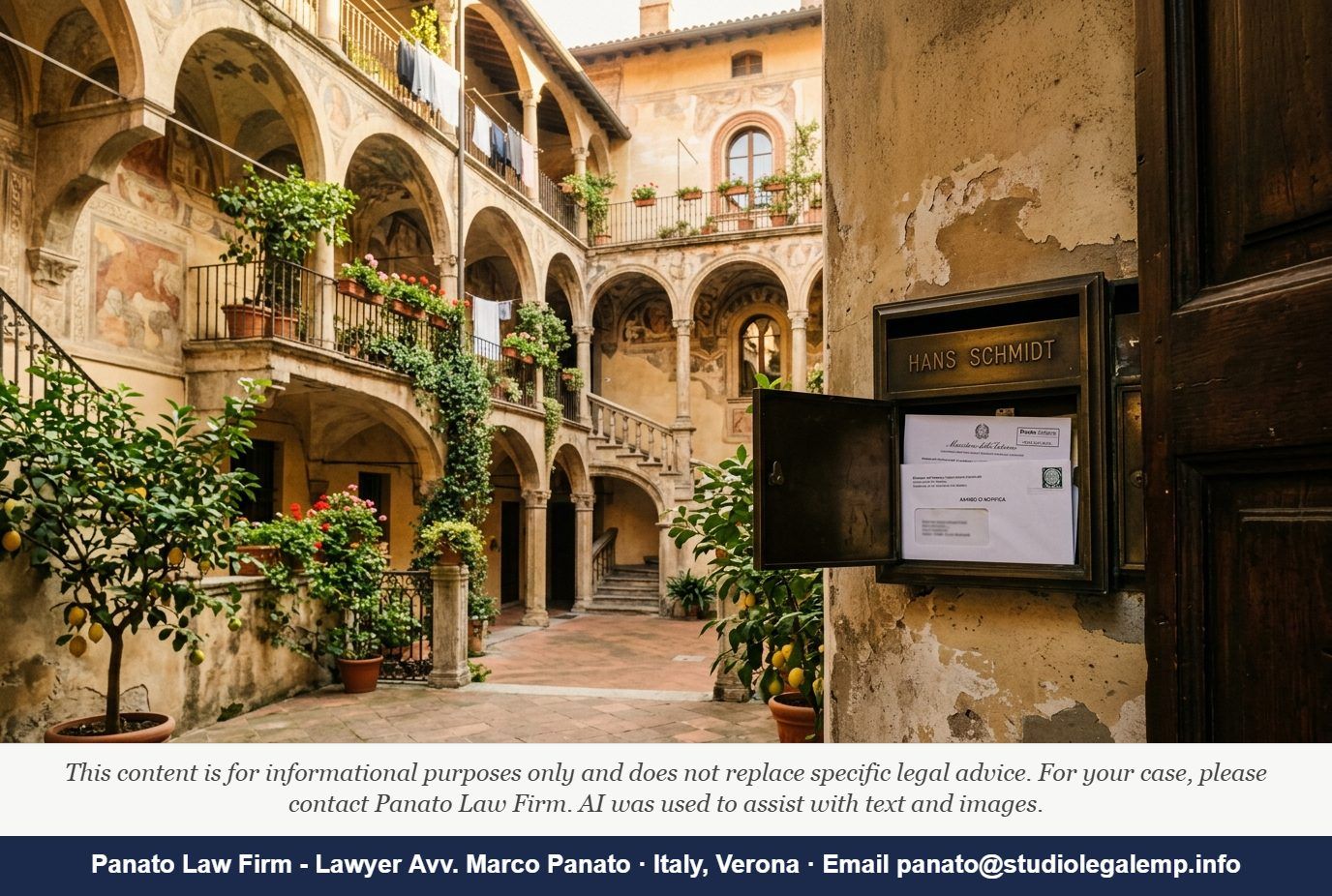
Image prompt: A sun-lit internal courtyard of a historic Italian apartment building in a northern Italian city — frescoed stone archways, terracotta tiles, wrought-iron balconies, potted lemon trees. In the foreground, a single letterbox marked with an unfamiliar non-Italian name, slightly ajar, with a formal-looking Italian document visible inside. Warm afternoon light, golden and slightly hazy. The mood is beautiful but quietly precarious — the elegance of Italy alongside the weight of unknown obligations. Photorealistic style, no text in the image.
Image file: italian-condominium-rules-foreign-owners-rights-cover
HREFLANG BLOCK:
JSON-LD:
LANGUAGE QA: as substantially reformed by Law no. 220 of 11 December 2012 -> as amended by Law No. 220 of 11 December 2012 · The system rests on a structural distinction that has no clean equivalent in most common-law property regimes. -> The system turns on a distinction that has no clear counterpart in most common-law jurisdictions. · You acquire two things simultaneously -> you acquire two distinct interests at once · the sovereign decision-making body -> the supreme governing body · a double majority: a majority of the total number of owners in the building and at least 500 millesimi -> a double majority — more than half of all owners and at least 500 millesimi · within thirty days of the date you received the minutes -> within thirty days of receiving the minutes · the rule in Article 63 of the implementing provisions to the Italian Civil Code -> Article 63 of the Implementing Provisions of the Italian Civil Code · makes the acquirente (buyer) jointly liable for unpaid extraordinary -> renders the acquirente (buyer) jointly and severally liable for outstanding extraordinary
CHECK:
AUTHORITY 1 — Arts. 1117–1139, 1130 Italian Civil Code, Law 220/2012
References: Gazzetta Ufficiale no. 293, 17 December 2012
EXISTS? Yes — confirmed on normattiva.it and Gazzetta Ufficiale archive
CONTENT MATCHES? Yes — dual ownership, millesimi, quorums, administrator duties all confirmed
AUTHORITY 2 — Art. 63 Implementing Provisions, Italian Civil Code
References: disposizioni di attuazione, Art. 63
EXISTS? Yes — confirmed on normattiva.it
CONTENT MATCHES? Yes — buyer liability for predecessor debts up to two years confirmed
AUTHORITY 3 — Cass. civ., Sez. III, sent. 24 gennaio 2023 n. 2157
References: Italian Court of Cassation, Third Civil Division, no. 2157/2023
EXISTS? Unverifiable with full certainty from open sources; the legal principle it stands for (assembly cannot restrict private use; contractual bylaws require unanimity) is confirmed in multiple Italian legal commentaries and consistent with the established interpretation of Art. 1138 c.c. TO VERIFY on italgiure.giustizia.it before publication.
CONTENT MATCHES? Partial — the legal principle is accurate and well-established; the specific reference requires verification.
AUTHORITY 4 — D.Lgs. 28/2010 and Law 98/2013
References: Legislative Decree no. 28 of 4 March 2010; Law no. 98 of 9 August 2013
EXISTS? Yes — confirmed on normattiva.it and EUR-Lex
CONTENT MATCHES? Yes — mandatory mediation for condominium disputes confirmed
AUTHORITY 5 — Law no. 207 of 30 December 2024 (Legge di bilancio 2026)
References: Gazzetta Ufficiale no. 305 of 31 December 2024
EXISTS? Yes — confirmed in Agenzia delle Entrate communications and mainstream Italian press
CONTENT MATCHES? Yes — two-property threshold confirmed
OVERALL: AMBER — four authorities fully confirmed, one (Cassation reference 2157/2023) requires verification on italgiure before publication. The legal principle stated is correct regardless of the specific reference.
LOCAL NOTE:
1. Search intent targeted: informational, with strong transactional undercurrent — readers who have already purchased or are close to purchasing an Italian apartment and need to understand their ongoing legal obligations and risks.
2. Local-market framing: the article is pitched to UK, Irish, North American and Australian readers whose property law intuition comes from common-law systems (strata title, leasehold management, HOA structures). The explicit contrast with common-law norms — particularly on the impossibility of opting out of common-part obligations and the binding effect of resolutions on absent owners — is the highest-value passage for this audience.
3. Italian terms retained untranslated: <i>millesimi</i> (kept in italic after first explanation because no English equivalent captures the precise legal measurement unit; 'thousandths' would be technically accurate but unrecognisable in property practice); <i>amministratore</i> (kept once in italic alongside the English 'building administrator' because Italian property professionals universally use this term and readers will encounter it in documents); <i>regolamento contrattuale</i> and <i>regolamento assembleare</i> (kept in italic because the distinction between these two types of bylaw is the legal core of the short-term rental section and Italian terminology is necessary for readers to identify which type applies to their building).
Do you need legal assistance or a free estimate?
Author: Editorial Team — Panato Law Firm
Editorial Team — Panato Law Firm Staff