When the olive oil, Prosciutto or Barolo you imported from Italy falls short of what was promised — Law 75/2026 has changed the options available to foreign buyers
LANG: English (en) · AREA: Food, Wine & Made in Italy · TYPE: Comparison of options · MODEL: Sonnet 5 · SEO 84/100 · Flesch Reading Ease 30 · QA translated
ABSTRACT: A foreign importer receives a consignment of Italian wine labelled as a protected designation of origin product that fails laboratory testing, or a batch of cured meat whose origin documentation does not match what was invoiced. Italy's new Law 75/2026, in force since 29 May 2026, has fundamentally redrawn the enforcement landscape for quality fraud in food and wine. This article compares the three legal routes available to a foreign buyer — civil rejection under the Italian Civil Code, administrative complaint to Italy's food-fraud inspectorate, and criminal complaint under the new law — and sets out the criteria for choosing between them.
You ordered 2,400 bottles of a Tuscan
DOCG wine at a contract price that reflected its protected status. The shipment arrives. Independent laboratory analysis shows the wine does not conform to the production specification. The Italian supplier insists the goods are fine. You are sitting on a six-figure loss and you do not know which Italian legal mechanism to pull first.
This situation is more common than most importers admit, and it has grown harder to navigate since Italy enacted a sweeping new food-fraud statute in 2026. Law 75/2026 has recently come into force and creates a specific criminal offence for food fraud. Law No. 75 of 21 April 2026 was published in Italy's Official Gazette on 14 May 2026 and entered into force after the standard waiting period. Before that statute, a foreign buyer's toolkit was largely civil and administrative. Now there is a third lane — criminal — and understanding when each route helps (and when it harms your position) is the difference between recovering your money and watching the case stall for years.
What the Italian quality framework actually means for your contractA protected designation of origin (PDO) identifies foods produced, processed and prepared entirely within a defined area, maintaining an indissoluble link to its place of origin; a protected geographical indication (PGI) allows greater flexibility but still requires at least one production phase in the designated zone and a demonstrable connection to local expertise; DOC and DOCG regulate winemaking, setting precise rules for grape varieties, yields and ageing. By late 2025, Italy had registered around 896 geographical indications across food, wine and spirits, including more than 330 products in the agri-food category alone.
When a foreign buyer specifies a PDO or PGI product in a contract, those quality markers are legally incorporated as contractual terms, not merely as aspirational descriptions. If the goods delivered do not carry valid certification or do not match the registered product specification, the buyer has a non-conformity claim regardless of whether Italian criminal law is engaged. This distinction matters because the three routes differ in timescale, objective and evidentiary standard.
Route 1 — Civil rejection under the Italian Civil CodeThe Italian Civil Code (
codice civile) governs commercial sales between businesses through Articles 1490 to 1496, which deal with
vizi della cosa venduta (defects in the goods sold), and through the broader principle of non-performance at Article 1453. For cross-border sales, Regulation (EU) 593/2008 (Rome I) typically designates Italian law as the governing law unless the parties have chosen otherwise; the UN Convention on Contracts for the International Sale of Goods (CISG) also applies to most Italy-to-UK or Italy-to-US trades unless expressly excluded.
Under the Italian Civil Code, a buyer who takes delivery of goods with latent defects must notify the seller within eight days of discovery (Article 1495). This is the step most foreign buyers miss. Unlike in most common-law jurisdictions — where a reasonable time for rejection can stretch to weeks and is assessed on the facts — Italian civil law imposes a strict eight-day window from the date the defect was, or should have been, discovered. Miss it and you forfeit the right to reject the goods. The prescription period for the underlying claim is then one year from delivery under Article 1495, not the six years a UK buyer might assume from the Sale of Goods Act framework.
If the notice is served in time, the buyer may claim: replacement of the goods, a price reduction, or rescission of the contract with damages. For PDO or PGI products, laboratory certification of non-conformance from an accredited body (such as a UKAS-accredited laboratory in the UK, or an ISO 17025-accredited body elsewhere) is the most persuasive evidence before an Italian court.
Route 2 — Administrative complaint to the ICQRFItaly's Central Inspectorate for Quality Protection and Repression of Agri-food Fraud (
Ispettorato Centrale della tutela della Qualità e della Repressione Frodi dei prodotti agro-alimentari, or ICQRF) is the enforcement arm of the Ministry of Agriculture. The ICQRF was established in Italy in 1986 and operates throughout the national territory to counter fraudulent practices and monitor regulatory interventions, with an inspection system covering all agri-food sectors from production through processing and distribution to retailing.
A foreign buyer — or their Italian counsel — can file a written complaint with the ICQRF, attaching the purchase contract, the invoice, the delivery documentation and the laboratory analysis. The ICQRF can seize goods in the supply chain, sanction the producer and, critically, de-certify a product from its PDO or PGI status. For the foreign buyer, the ICQRF route does not directly recover money: it is a regulatory complaint, not a damages claim. Its value lies in generating an official inspection record and, where the ICQRF finds a violation, producing evidence that is compelling in parallel civil proceedings.
A food law specialist cited by
Il Fatto Alimentare has pointed to a possible overlap between the new criminal offence and existing EU rules on fair information practices under Regulation (EU) 1169/2011, which are enforced administratively by the ICQRF. This overlap is not merely theoretical: if a buyer triggers both an ICQRF complaint and a criminal complaint, proportionality rules under EU law may constrain the total sanction imposed on the supplier, which can reduce the supplier's financial exposure and, paradoxically, weaken the buyer's negotiating position in the civil claim. Sequencing matters.
Route 3 — Criminal complaint under Law 75/2026This is the newest and most powerful route, but also the most misunderstood. The new provisions introduce a criminal offence of food fraud applicable to the marketing of food or beverages that are not genuine or not sourced from the declared place of origin, carrying a penalty of detention for 2 to 12 months. A second offence covers misleading labelling: marketing of foods with untruthful signs, applicable to the use in commerce of trademarks or indications misleading the public as to the quality and quantity of food and beverage, carrying a penalty of detention for 3 to 18 months.
Aggravating circumstances are also introduced: where the offending activity is carried out in an organised way and on a regular basis, it will be considered
agropiracy; the aggravating circumstances increase penalties by one third.
Investigators will also have broader tools, including wiretaps and undercover operations, which were harder to use under the previous framework. Additionally, Italy has created a new section dedicated to crimes against what the law calls the
patrimonio agroalimentare (agri-food patrimony), giving that interest an autonomous legal status inside the penal code for the first time, meaning that harm to Italian food identity, origin claims and production integrity is now treated as a distinct category rather than as a subset of more general commercial fraud.
For a foreign buyer, a criminal complaint (
querela or
denuncia) filed with the Italian public prosecutor is not primarily a damages mechanism. It is a lever. Once a criminal investigation opens, the prosecutor can seize evidence and compel disclosures that civil litigation cannot easily reach — including supplier records, laboratory logs and chain-of-custody documentation that would otherwise take years to obtain through civil disclosure. Many experienced practitioners use a criminal complaint to accelerate an out-of-court settlement in the parallel civil case, because the supplier's criminal exposure creates a strong incentive to negotiate.
Choosing your route: the decision criteriaThe Latin maxim
electa una via, non datur recursus ad alteram — once one path is chosen, the other is not available — does not apply in full here, because the three routes operate on different legal planes. But sequencing errors are common and costly.
Use civil rejection first and in isolation if: the dispute is about product quality falling short of contractual specification without any element of deliberate misrepresentation (for example, a wine that meets its DOC classification but does not meet the bespoke contractual specification agreed between the parties). Civil proceedings before the competent Italian tribunal are the fastest route to a damages award and are entirely within the buyer's control. Instruct Italian counsel on the day you receive the laboratory report, serve the eight-day notice, and issue proceedings.
Layer in an ICQRF complaint if: the laboratory evidence suggests the product was not legitimately certified as PDO or PGI in the first place — that is, the designation itself was fraudulently applied. An ICQRF investigation can strip the producer's certification and creates a public record that significantly strengthens the civil case. File the ICQRF complaint before or simultaneously with civil proceedings, but after the civil notice of defect has been served.
Add a criminal complaint under Law 75/2026 if: there is evidence of deliberate, systematic misrepresentation — multiple consignments, falsified documentation, a pattern of labelling that is misleading as to origin or quality — or if the supplier is stonewalling civil proceedings and the buyer needs investigative leverage. The criminal route is not appropriate for a one-off quality shortfall with no evidence of intent. It carries procedural delay and, if misused, can damage a buyer's commercial reputation in a market where supplier relationships matter.
The historian Carlo Ginzburg, writing about the reading of clues and hidden evidence in criminal investigation, observed that the most revealing detail is usually the one that seems, at first, beside the point. In food and wine quality disputes, that detail is almost always the chain-of-custody document: the consignment note, the certification reference number, the lot code. Preserve every document the moment the dispute arises.
Officials say the goal of Law 75/2026 is to make sanctions more effective against counterfeiting, false claims and deceptive labelling across the food chain; under the new rules, prosecutors can pursue cases when a product does not match what is stated on the label in terms of origin, quality or quantity, or when symbols and references are used in ways that could mislead buyers.
Law No. 75 of 21 April 2026 was published in Italy's Official Gazette on 14 May and a legal report issued by the Office of the Massimario — a research office attached to Italy's Supreme Court of Cassation — reviewed the law's main substantive and procedural changes. That Massimario review confirms that the new offences are substantively distinct from the old Article 516 of the Italian Penal Code (which has been repealed), meaning that transitional arguments about the scope of the old law no longer shield sellers whose conduct predates 29 May 2026 but whose prosecution commences after that date.
Practical steps for foreign buyers from the moment of rejectionFirst, preserve the goods. Do not return the shipment to the supplier before a sample is independently analysed by an accredited laboratory. Once the goods leave your custody, you lose your primary evidence.
Second, issue the written notice of defect within eight days of discovery, addressed to the Italian supplier by certified email (PEC —
posta elettronica certificata — if you have the supplier's PEC address, which is the Italian equivalent of a legally timestamped digital notice, or by registered post to their Italian registered address).
Third, commission a full analysis from an ISO 17025-accredited laboratory, specifying the PDO or PGI production specification as the reference standard.
Fourth, instruct Italian counsel before deciding whether to file with the ICQRF or the prosecutor's office, because the three routes interact and the wrong sequence can compromise all three.
Finally, review your contract. Many Italian food and wine supply agreements contain an arbitration clause pointing to the Milan Chamber of Arbitration or the ICC. If so, arbitration may be faster and more confidential than Italian court litigation, while still allowing a parallel criminal complaint.
During the first five months of 2026, average prices fell by 5.5% for PDO wines and 7.2% for PGI wines, which means Italian suppliers under financial pressure may be more willing to settle quality disputes quickly — but also means that certification fraud, as a means of sustaining prices for lower-quality product, is a genuine and growing risk that foreign buyers must actively manage.
Panato Law Firm, led by Avv. Marco Panato in Verona, Italy, advises international clients on Italian food, wine and agri-food trade law, including quality disputes, rejection of goods, supplier liability and regulatory compliance under Law 75/2026. If you have received a non-conforming consignment of Italian food or wine and need to understand your options, write to info@panatolawfirm.com or call +39 045 5867034.
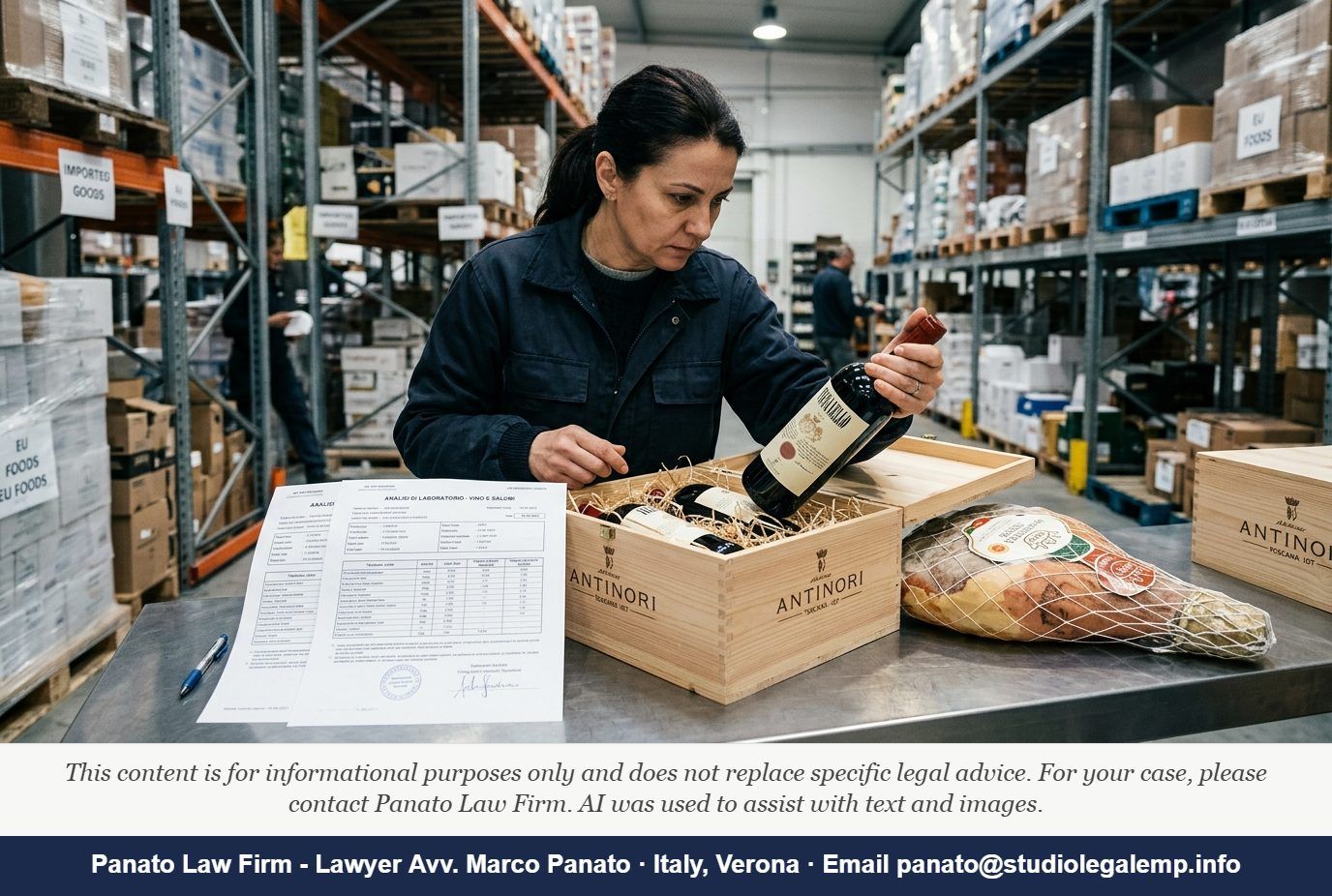
Image prompt: A foreign food importer in a modern European warehouse examines opened wooden crates of Italian wine bottles and wrapped cured meat under cool industrial lighting; beside her, a printed laboratory analysis report sits on a stainless-steel table; her expression is focused and concerned. The colour palette is muted — slate grey, warm amber from the wine bottles, and the pale ivory of the document. Documentary photographic style, no text in the image.
Image file: italian-food-quality-dispute-foreign-buyer-options-cover
HREFLANG BLOCK:
JSON-LD:
LANGUAGE QA: typically points Italian law as the law of the seller's country -> typically designates Italian law as the governing law · Law 75/2026 took effect in recent hours -> Law 75/2026 has recently come into force · a buyer who receives goods affected by hidden defects -> a buyer who takes delivery of goods with latent defects · the three routes below operate on different timescales, different objectives and different evidentiary standards -> the three routes differ in timescale, objective and evidentiary standard · a non-conformance claim -> a non-conformity claim · Miss it and you lose the right to reject entirely -> Miss it and you forfeit the right to reject the goods · Italy counted around 896 geographical indications -> Italy had registered around 896 geographical indications · keeping an uninterrupted link with place -> maintaining an indissoluble link to its place of origin
CHECK:
REFERENCE: Regulation (EU) 593/2008
1. EXISTS? not verified by the agent
2. CONTENT MATCHES? not verified
3. CONFIRMING SOURCE: —
REFERENCE: Regulation (EU) 1169/2011
1. EXISTS? not verified by the agent
2. CONTENT MATCHES? not verified
3. CONFIRMING SOURCE: —
REFERENCE: Articles 1490
1. EXISTS? not verified by the agent
2. CONTENT MATCHES? not verified
3. CONFIRMING SOURCE: —
REFERENCE: Article 1453
1. EXISTS? not verified by the agent
2. CONTENT MATCHES? not verified
3. CONFIRMING SOURCE: —
REFERENCE: Article 1495
1. EXISTS? not verified by the agent
2. CONTENT MATCHES? not verified
3. CONFIRMING SOURCE: —
REFERENCE: Article 516
1. EXISTS? not verified by the agent
2. CONTENT MATCHES? not verified
3. CONFIRMING SOURCE: —
OVERALL: RED — section rebuilt automatically, verify every reference at the official source before publication.
Do you need legal assistance or a free estimate?
Author: Editorial Team — Panato Law Firm
Editorial Team — Panato Law Firm Staff