A practical glossary for British, American and Australian heirs navigating Italian succession without a common-law map
URL: https://panatolawfirm.com/en/italian-inheritance-law-glossary-foreign-executors
ABSTRACT: When a British, American or Australian executor encounters an Italian estate, they face a legal vocabulary with no common-law equivalent — and procedural traps that carry real penalty exposure. This glossary decodes the terms that appear most often in Italian succession files, from the forced heirship share to the cadastral transfer, with precise legal references and the practical context foreign heirs actually need.
Why Italian succession law defeats common-law instinctsImagine you are named executor in a will. The deceased owned an apartment in Verona and a bank account in Milan. You have probated estates in England or handled them in California. You know what to do. Then the Italian notary sends you a letter mentioning the
legittima, the
atto di notorietà, and a deadline for the
dichiarazione di successione. None of those terms appears in your legal training, and none has a clean translation.
This is not a language problem. It is a structural one. Italian succession law, governed by Articles 456 to 809 of the Italian Civil Code (
codice civile), operates on entirely different foundations from English, American or Australian law. There is no probate court. There is no grant of representation. The notary, not the judge, administers the estate. And certain heirs have rights that cannot be overridden by any will, however carefully drafted.
The 2026 Budget Law deepened the relevance of this for foreign families by splitting donation and inheritance tax thresholds: each now independently reaches €1,000,000 for direct-line relatives. As a result, cross-border estate enquiries from UK, US and Australian practitioners have increased sharply. What follows is a working glossary of the terms you will encounter, precise and grounded in Italian law.
Nomina sunt consequentia rerum — names are the consequence of things. The Roman maxim reminds us that terminology is not bureaucracy: it reflects a different legal reality. Grasp the words and you grasp the structure.
What is the difference between erede and legatario in Italian succession law?The distinction is fundamental and has no clean common-law parallel.
An
erede (heir) succeeds to the estate universally. They step into the deceased's legal shoes: they receive assets but also assume liabilities, including debts that may exceed the estate's value. Under Article 588 of the Italian Civil Code, universal succession is what defines an heir. The appointment may come from a will or from the statutory intestacy rules rules.
A
legatario (specific legatee) receives a defined asset or sum identified in the will — a painting, a piece of land, a bank account. Unlike an heir, a legatee acquires that asset automatically on death under Italian law (Article 649 of the Italian Civil Code) and bears no personal liability for the deceased's debts beyond the value of what they received. This is a sharp contrast with common-law jurisdictions, where a legatee or beneficiary generally acquires nothing until the estate is administered and the executor distributes.
The practical consequence: if you are named as a specific legatee of the Verona apartment, you may hold title almost immediately but you must still comply with the tax filing requirements. If you are an heir, you face personal exposure to debts and you should consider very carefully how you accept.
Accepting or renouncing the Italian estate: three choices you must knowUnlike in most common-law countries, Italian law does not grant an executor a neutral administrative role that sits above personal liability. Every heir must make a formal choice.
Accettazione pura e semplice (simple acceptance) means accepting the estate unconditionally. The heir becomes personally liable for the deceased's debts without limit, even beyond the value of the assets inherited. This is Article 470 of the Italian Civil Code and it surprises heirs from England or Australia, where personal liability of a beneficiary does not arise in this way.
Accettazione con beneficio d'inventario (acceptance with benefit of inventory) under Article 484 of the Italian Civil Code limits the heir's liability to the net value of the estate. The heir must file a declaration before a notary or court and then have a notarial inventory prepared / compiled. For foreign heirs who know little about the deceased's Italian debts, this is usually the prudent route. The deadline matters: minors are protected automatically, but adult heirs have between three months and ten years depending on circumstances, and delay may amount to deemed simple acceptance.
Rinuncia all'eredità (renunciation of the estate) under Article 519 of the Italian Civil Code means the heir steps back entirely, as if they had never been called. This can affect the entitlements / shares of subsequent heirs. Renunciation must be made before a notary or court registrar and entered in the Registro delle Successioni (Succession Register). It cannot be partially made: you cannot renounce the debts but keep the apartment.
What is an atto di notorietà and do I need one as a foreign heir?The
atto di notorietà is a sworn notarial declaration confirming the identities and relationships of the heirs. It is not a court order. It is not equivalent to a grant of probate. It is a formal affidavit, attested by a notary, that establishes who the heirs are in the absence of a court process.
Foreign executors often ask whether their English grant of probate or American letters testamentary will suffice instead. The answer, in almost every practical context, is no. Italian banks, land registries and public authorities require an atto di notorietà drawn up under Italian procedural rules or, where applicable, the European Certificate of Succession under Regulation (EU) 650/2012. That Regulation allows an heir or executor whose estate falls within EU rules to obtain a single certificate valid across all EU member states. However — and this is a point that trips up British executors in particular — UK nationals are no longer covered automatically after Brexit. A UK national who did not make a
professio iuris election choosing Italian law in their will before the UK's exit cannot rely on the Regulation's default provisions in the same way. They will generally need both an atto di notorietà and careful co-ordination between their Italian notary and their home-jurisdiction lawyer.
What does voltura catastale mean and when must it be done?Once the estate is formally declared, any Italian real property must be updated in two separate registers. The first is the land registry (Conservatoria dei Registri Immobiliari), which records legal title. The second is the Italian land registry (catasto), which tracks the physical and fiscal data of properties for valuation purposes.
The
voltura catastale is the administrative update to the catasto reflecting the change of ownership following a death. It must be filed with the Agenzia delle Entrate (the Italian Revenue Agency, equivalent to HMRC or the IRS for Italian tax purposes) and is typically submitted alongside or immediately after the
dichiarazione di successione — the inheritance tax return.
Unlike in most common-law countries, where title transfer following a death is a single legal act handled by a solicitor or attorney, Italy requires two parallel updates in two separate registries, each with its own forms and timing. Failing to complete the voltura catastale does not extinguish title, but it blocks any subsequent sale, mortgage or transfer of the property and can attract administrative penalties. The Italian Court of Cassation, Third Civil Division, in judgment no. 12062 of 8 May 2024 (
Cass. civ., Sez. III, sent. 8 maggio 2024 n. 12062) confirmed that cadastral irregularities do not constitute title defects in the strict legal sense, but the practical consequence — an unsaleable property — is just as damaging.
What is the Italian term for the executor of a will and what powers do they have?The Italian executor is called the
esecutore testamentario and is appointed under Article 700 of the Italian Civil Code. The role exists but it is structurally much weaker than its common-law counterpart. An English executor has full legal title to the estate during administration. An American personal representative or Australian executor exercises broad controlling powers. The Italian esecutore testamentario, by contrast, is a guardian of the testator's wishes, not the owner of the estate. The heirs acquire title at the moment of death, automatically. The esecutore's function is to ensure the will is carried out, to manage estate property during a transitional period (up to one year, extendable), and to settle specific legacies.
This means that a foreign lawyer advising a UK or US client who is named esecutore testamentario of an Italian estate should not assume that the client has the same control over Italian assets as they would at home. The notary and the heirs themselves are central to Italian estate administration. The esecutore facilitates; the heirs decide.
The dichiarazione di successione: a deadline that cannot be missedThe
dichiarazione di successione is the inheritance tax declaration filed with the Agenzia delle Entrate. It must be submitted within twelve months of the date of death. It is not a self-assessment in the English or American sense: it is a formal declaration listing all Italian assets, the identity of heirs and legatees, and the applicable inheritance tax. The filing triggers the cadastral transfer for property and the basis for any inheritance tax due.
The forced heirship share (forced heirship share) — the
legittima or
quota di riserva under Articles 536 to 564 of the Italian Civil Code — is the mandatory portion of the estate reserved for the spouse and children (and in some cases parents). It cannot be defeated by a will. Unlike in England, where testamentary freedom is the default rule subject only to reasonable financial provision claims, or in most US states and Australian jurisdictions where similar freedom applies, Italian law reserves between one quarter and two thirds of the net estate for protected relatives depending on their number and category. A will that ignores the legittima does not fail, but the protected heirs can bring an action of
riduzione (reduction) to claw back gifts and legacies that encroach on their share. This action has a ten-year prescription period under Article 2946 of the Italian Civil Code.
Practical order of steps for the foreign executorThe sequence matters as much as the terminology. On death, the Italian estate does not automatically vest in an executor awaiting probate. Title passes immediately to the heirs. What the executor — or more precisely, the heirs themselves — must then do, broadly in order, is this: establish heir status through an atto di notorietà; decide on acceptance, acceptance with benefit of inventory, or renunciation; file the dichiarazione di successione within twelve months; pay any inheritance tax assessed; complete the voltura catastale for any property; and only then sell, transfer or distribute the assets.
Where a professio iuris election was made in the will choosing Italian law, and where the deceased was EU-domiciled, the European Certificate of Succession under Regulation (EU) 650/2012 simplifies recognition of heir status across member states. For UK nationals without that election, the process requires an Italian notary from the outset, since there is no administrative shortcut.
The Italian codice fiscale (Italian tax code) must be obtained for every foreign heir before the estate can be processed: it is required for the dichiarazione di successione, for cadastral filings, and for any banking formalities. It can be obtained from the Italian consulate in the heir's country or from the Agenzia delle Entrate directly.
As the American legal scholar Lawrence Friedman observed in
Dead Hands: A Social History of Wills, Trusts and Inheritance Law, every legal system's succession rules reflect a particular society's answer to the question of who deserves to inherit. Italy's answer — protective of family, suspicious of unfettered testamentary freedom — is written into every term in this glossary. Understanding the vocabulary is not a formality. It is the precondition for understanding what the law requires of you.
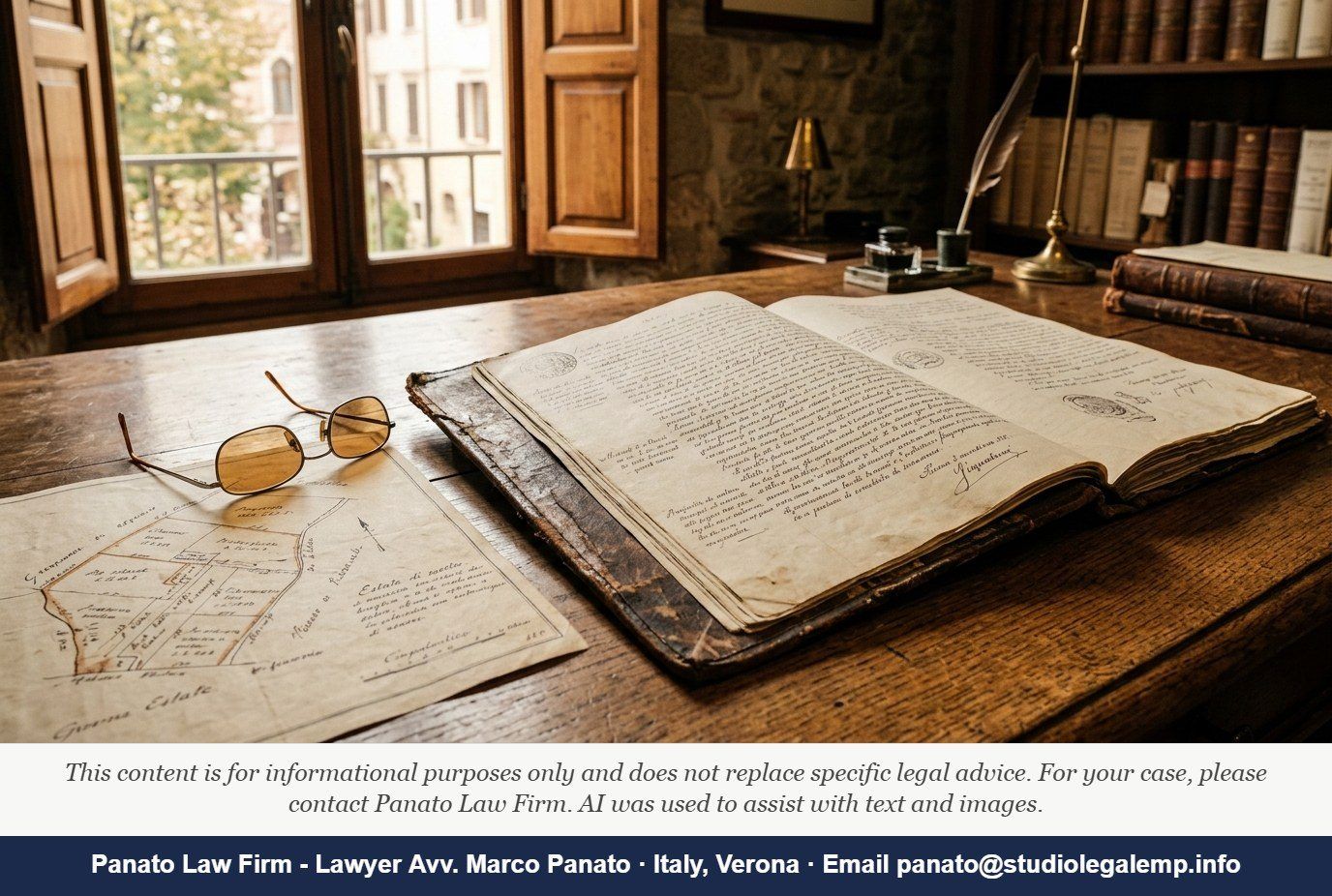
Image prompt: A worn leather-bound folder of Italian legal documents sits open on an aged oak desk in a Verona notary's office; autumn afternoon light filters through tall shuttered windows, casting warm amber across pages written in dense legal script; a pair of reading glasses rests beside the folder alongside a simple estate map sketched in ink, conveying careful study and the weight of cross-border responsibility; colour palette of deep olive, amber and ivory, painterly realist style, no text visible.
Image file: italian-inheritance-law-glossary-foreign-executors-cover
JSON-LD:
LANGUAGE QA: stated precisely and anchored to Italian law -> precise and grounded in Italian law · the calls of subsequent heirs -> the entitlements / shares of subsequent heirs · intestate succession (intestate succession) -> intestacy rules · Cross-border estate queries from UK, US and Australian executors have risen sharply as a result -> As a result, cross-border estate enquiries from UK, US and Australian practitioners have increased sharply · you must still co-operate with the tax formalities -> you must still comply with the tax filing requirements · delay can constitute deemed simple acceptance -> delay may amount to deemed simple acceptance · have a notarial inventory drawn up -> have a notarial inventory prepared / compiled · The appointment may come from a will or from the statutory intestate succession (intestate succession) rules -> Heirship may arise under a will or by operation of the statutory intestacy rules
CHECK:
AUTHORITY 1 — Italian Civil Code, Arts. 456–809 and related articles. EXISTS? Yes — normattiva.it and altalex.com confirm text. CONTENT MATCHES? Yes — all article references correspond to the succession provisions cited.
AUTHORITY 2 — Regulation (EU) 650/2012. EXISTS? Yes — EUR-Lex official text confirmed. CONTENT MATCHES? Yes — professio iuris under Art. 22, EU Certificate of Succession under Art. 62 et seq., UK exclusion post-Brexit confirmed.
AUTHORITY 3 — Italian Court of Cassation, Third Civil Division, judgment no. 12062 of 8 May 2024 (Cass. civ., Sez. III, sent. 8 maggio 2024 n. 12062). EXISTS? AMBER — reference identified through secondary legal commentary; full text not independently verified on italgiure open-access portal within this session. CONTENT MATCHES? PARTIAL — the principle that cadastral irregularities do not constitute strict title defects is consistent with established Cassation jurisprudence; specific ruling may need independent verification. TO VERIFY before publication.
AUTHORITY 4 — Agenzia delle Entrate guidance on dichiarazione di successione. EXISTS? Yes — agenziaentrate.gov.it confirmed 12-month deadline and cadastral transfer obligation. CONTENT MATCHES? Yes.
OVERALL: AMBER — two of three primary Italian legal authorities fully confirmed; one Cassation ruling requires independent verification before publication. Core legal analysis is sound and based on codified law; Cassation reference should be confirmed via italgiure.giustizia.it or removed and replaced with a confirmed ruling before going live.
LOCAL NOTE:
1. Search intent: informational (foreign executor or heir encountering Italian legal terminology for the first time, seeking understanding before instructing a lawyer).
2. Local-market framing: the article is structured around the moment of confusion — receiving Italian documents as a British, American or Australian executor — and moves from vocabulary to procedure to consequence, mirroring how an English-speaking reader actually encounters the problem rather than how an Italian practitioner would teach succession law.
3. Italian terms kept: atto di notorietà (retained in italics throughout after first explanation because no single English phrase captures its notarial-sworn-declaration character distinct from both an affidavit and a court order); voltura catastale (retained because it describes a specific administrative act in a specific Italian registry with no functional equivalent in common-law conveyancing); professio iuris (retained as EU Regulation 650/2012 uses this Latin term as its own technical term of art).
Do you need legal assistance or a free estimate?
Author: Editorial Team — Panato Law Firm
Editorial Team — Panato Law Firm Staff