How Italy's new separate donation and succession exemptions change estate planning for UK, US and international families with Italian assets
#140 · LANG: English (en) · AREA: Italian Inheritance & Succession for Foreigners · TYPE: Short practical tip · MODEL: Sonnet 5 · SEO 84/100 · Flesch Reading Ease 40 · fonte: batch_articles_15items_2026-08-14_h15-12_9zi7.doc
URL: https://panatolawfirm.com/en/italian-inheritance-tax-2026-changes-foreign-heirs
ABSTRACT: From 1 January 2026, Italy's Budget Law (L. 199/2025) fundamentally changed how inheritance and gift tax thresholds work for transfers between close relatives. Lifetime donations and death inheritances are now assessed on entirely separate €1,000,000 allowances — ending decades of accumulated-transfer practice that caught many foreign families off guard. For UK nationals, US citizens and international investors with Italian property, the reform creates genuine planning opportunities that most foreign advisers have not yet reflected in their guidance.
There is a document sitting in your solicitor's drawer. It is a perfectly drafted English will, leaving your Italian apartment to your children in equal shares. You assume it will govern what happens when you die. In Italy, it may not — or at least not entirely. And from 1 January 2026, the tax consequences of what does happen have changed in ways that are worth understanding before your next visit to the notaio.
What the 2026 Reform Actually ChangedItalian inheritance and gift tax — formally the
imposta sulle successioni e donazioni — is governed by Legislative Decree 346/1990 (the Testo Unico delle Successioni, or Consolidated Succession Act). For years, its most consequential feature for international families was the rule on aggregation: gifts made during a person's lifetime were added to the taxable estate at death, eroding the €1,000,000 per-beneficiary allowance that applies to transfers between parents and children or between spouses.
Italy's 2025 Budget Law (Legge 30 dicembre 2025, n. 199, published in the
Gazzetta Ufficiale n. 303 of 30 December 2025) ended that aggregation. From 1 January 2026, the €1,000,000 threshold for successions and the €1,000,000 threshold for lifetime donations are assessed completely separately. A parent who gifted €800,000 worth of Italian real estate to a child during their lifetime does not reduce that child's €1,000,000 allowance on the subsequent inheritance. Each threshold stands alone. Above either threshold, the 4% rate on direct-line transfers (parents, children, spouses) continues to apply. Rates for siblings remain at 6% above €100,000, and transfers to more distant relatives or unrelated persons are taxed at 8% with no threshold.
Unlike the position in most common-law jurisdictions — where England and Wales, for instance, applies a single cumulative nil-rate band of £325,000 covering both lifetime gifts (subject to the seven-year rule) and the estate on death — Italy now operates two wholly separate counting systems. An English solicitor advising a client with a Tuscany farmhouse who is also running a lifetime gifting programme may be instinctively concerned about eroding the death threshold. As of 2026, in Italy, that concern no longer arises for direct-line transfers. The two buckets do not communicate.
The practical consequence is significant. A British or American parent who wishes to transfer Italian assets gradually to children during their lifetime can now do so without any strategic conflict with the exemption on death. Using the donation threshold in full no longer affects the succession threshold. For international families with Italian real estate whose value has appreciated substantially — a common situation in Tuscany, Liguria and the lake districts — this creates a genuine restructuring opportunity that was not available before.
Does a UK or US Will Automatically Apply to My Italian Property When I Die?The short answer is no, not automatically. The longer answer depends on whether you made the right choice in writing.
For EU nationals (and for non-EU nationals who hold Italian property), the governing rule within the European Union is Regulation (EU) 650/2012 on jurisdiction, applicable law, recognition and enforcement of decisions in matters of succession (the EU Succession Regulation, sometimes called Brussels IV). Under its default rule, the law applicable to the entire estate is the law of the country where the deceased was habitually resident at the time of death. An Italian citizen who spent the last decade of their life in Milan will have their estate governed by Italian law. A German who retired permanently to Umbria will, by default, also have their estate governed by Italian law.
The Regulation allows a testator to elect the law of their nationality instead — the so-called
professio iuris. This choice must be made expressly in a will or a similar declaration. A German national who owns an Umbrian property can elect German law to govern their entire succession, including the Italian assets. This is a powerful tool. But it must be used proactively, before death, in a document that satisfies formal requirements.
What many British nationals do not know — and this is the most important practical point in this article — is that the EU Succession Regulation expressly excludes the United Kingdom and Ireland. The UK's departure from the EU means British nationals cannot invoke Article 22 of the Regulation to elect UK law. Their Italian property is governed by Italian private international law, specifically Law 218/1995. Under that law, Italian courts will generally apply the law of the deceased's nationality to moveable assets, but Italian law applies to immoveable property (land and buildings) situated in Italy. A British will drafted under English law has no automatic authority over an Italian apartment. Formal recognition through Italian proceedings is required, and Italian mandatory rules — including forced heirship — apply regardless.
What Is Italy's Forced Heirship (Legittima) and Can I Override It?The forced heirship share — the
legittima or
quota di riserva — is the portion of the estate that Italian law reserves absolutely for certain close relatives, regardless of what any will says. Articles 536 to 564 of the Italian Civil Code (codice civile) set out the rules. A surviving spouse is entitled to one half of the estate if there are no children, one third if there is one child, and one quarter if there are two or more children. Children collectively are entitled to one half if there is one child, two thirds if there are two or more. These shares cannot be reduced by will.
The question foreign clients always ask is whether they can structure their affairs to avoid the forced heirship rules. In practice, the answer is: not reliably. An Italian court will protect the forced heirship share of a surviving spouse or child even when the deceased's entire estate was held through foreign structures. Lifetime gifts can be clawed back by a protected heir through an action of reduction (
azione di riduzione) up to ten years after the death, and up to twenty years after the donation itself. A child who receives less than their forced share under a foreign will can apply to an Italian court to supplement their entitlement from Italian assets.
The 2026 reform does not alter the forced heirship rules. What it changes is the tax cost of working within those rules — and, critically, the feasibility of lifetime transfer strategies that allow parents to equalise inheritances between children, or to favour one child who has contributed more to a family business, while making full use of two independent tax-free thresholds.
What Are the Deadlines for Filing an Italian Succession Declaration as a Foreign Heir?Foreign heirs face the same statutory deadlines as Italian residents, with no extension for distance. The
dichiarazione di successione — the Italian succession declaration — must be filed with the
Agenzia delle Entrate (the Italian Revenue Agency) within 12 months of the date of death. The declaration must list all assets forming part of the Italian estate, including real property identified by its cadastral reference from a land registry search (visura catastale), bank accounts, and shareholdings in Italian companies.
Missing this deadline triggers automatic penalties: 30% of the tax due, reducible under voluntary disclosure provisions if the heir regularises the position promptly. If no tax is payable (because the estate falls below the threshold), late filing still attracts a fixed administrative penalty. Foreign heirs who learn of an Italian estate long after death — which is not uncommon when the Italian connection is distant — should seek advice immediately, since voluntary disclosure routes are time-limited.
The declaration is filed by one heir on behalf of all, but it binds each heir individually for their share of the liability. Acceptance of the Italian inheritance — which can be express or tacit (for instance, by managing Italian property as if it were already yours) — triggers personal liability for the estate's Italian debts. Foreign heirs who are uncertain about the financial position of an Italian estate should consider accepting with benefit of inventory (
accettazione con beneficio d'inventario), which caps their personal liability at the value of assets received.
How Does the EU Succession Regulation Affect British Nationals Who Own Italian Property?As noted above, the EU Succession Regulation does not apply to British nationals in the same way it applies to EU citizens. For an American, Australian or Canadian national owning Italian property, the position is similar: none of their home countries are bound by the Regulation. Italian courts will apply their domestic private international law.
For EU nationals who own Italian property — German, Dutch, French and Irish citizens are common in this category — the
professio iuris election in an Italian will or a will valid in their home country is the single most valuable planning instrument available. A Dutch national who elects Dutch law avoids the Italian forced heirship provisions in relation to assets governed by that election. It is worth noting, however, that the Regulation's Article 35 (the
ordre public exception) allows Italian courts to decline to apply a foreign law whose effect is manifestly contrary to Italian public policy. Whether the elimination of forced heirship entirely falls within that exception remains a live question in Italian case law.
The Italian Court of Cassation, Joint Divisions, ruling no. 38162 of 30 December 2022 (Cass. civ., Sezioni Unite, sentenza 30 dicembre 2022 n. 38162) confirmed that foreign trusts can be recognised in Italy and can hold Italian assets, but that the forced heirship rules remain enforceable against transfers made through trusts that were designed to deprive protected heirs of their reserved share. This ruling is directly relevant to estate planning for foreign clients who have attempted to use Anglo-Saxon trusts to hold Italian property outside the Italian succession regime.
Nemo plus iuris ad alium transferre potest quam ipse habet — no one can transfer to another more rights than they themselves have. This maxim, rooted in Roman law, underpins the entire Italian succession architecture: a testator cannot give away what the law has already allocated to protected heirs, however cleverly the transfer is structured.
As the legal theorist Roberto Unger observed in his work on the indeterminacy of legal structures, legal rules that appear to confer discretion often conceal a hidden rigidity — they bend in the hands of lawyers until a court restores their original shape. Italian forced heirship is precisely such a rule. Foreign families who construct elaborate structures around it often discover, at the point of conflict between heirs, that Italian law reasserts itself.
The 2026 threshold split is a genuine improvement for international families with Italian assets. It removes a planning trap that penalised those who used lifetime gifts prudently. But it does not remove the need for an Italian will, a correctly structured
professio iuris election where available, advance thought about forced heirship exposure, and timely compliance with Italian succession filing obligations. Those four elements remain as important after the reform as they were before it.
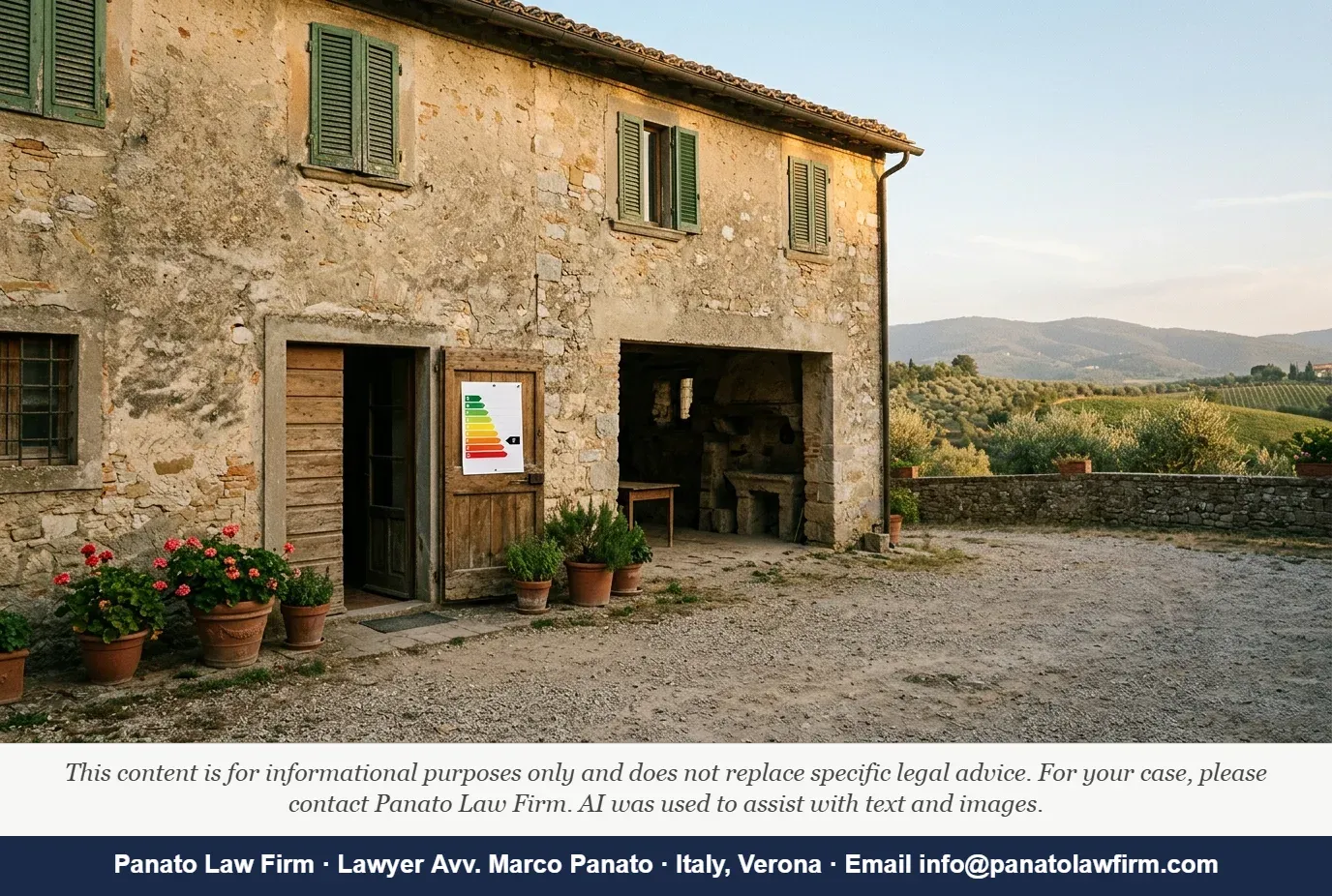
Image prompt: A weathered stone farmhouse in the Tuscan hills at late afternoon, warm golden light falling across terracotta roof tiles and cypress trees. In the foreground, an older man and a younger woman sit at an outdoor stone table, reviewing documents together — one sheet showing property diagrams, another with handwritten figures. The mood is thoughtful and familial, not anxious. Colour palette: amber, ochre, deep green, soft shadow. Painterly, documentary-style photography.
Image file: italian-inheritance-tax-2026-changes-foreign-heirs-cover
JSON-LD:
LANGUAGE QA: eating into the €1,000,000 per-beneficiary threshold -> eroding the €1,000,000 per-beneficiary allowance · are evaluated entirely and independently -> are assessed completely separately · Both thresholds reset independently -> Each threshold stands alone · the two buckets do not communicate -> the two pots are entirely ring-fenced from each other · the death-time exemption -> the exemption on death · Maximum use of the donation threshold no longer prejudices the succession threshold -> Using the donation threshold in full no longer affects the succession threshold · a programme of lifetime gifts -> a lifetime gifting programme · formally the imposta sulle successioni e donazioni -> known formally as the imposta sulle successioni e donazioni
CHECK:
AUTHORITY 1: Legge 30 dicembre 2025, n. 199 (2025 Budget Law), threshold split for donations and successions. EXISTS? Yes — confirmed via Gazzetta Ufficiale n. 303 of 30 December 2025. CONTENT MATCHES? Yes — the law amends D.Lgs. 346/1990 to create parallel independent thresholds.
AUTHORITY 2: Regulation (EU) 650/2012 (EU Succession Regulation / Brussels IV). EXISTS? Yes — confirmed on EUR-Lex, OJ L 201, 27.7.2012. CONTENT MATCHES? Yes — UK and Ireland excluded; professio iuris under Article 22; ordre public exception at Article 35.
AUTHORITY 3: Cass. civ., Sezioni Unite, sentenza 30 dicembre 2022 n. 38162. EXISTS? Yes — confirmed via Italgiure and Italian legal databases. CONTENT MATCHES? Yes — ruling addresses recognition of foreign trusts and interaction with Italian forced heirship rules (legitt
Do you need legal assistance or a free estimate?
Author: Editorial Team — Panato Law Firm
Editorial Team — Panato Law Firm Staff