How foreign-owned manufacturing and tech businesses can actually claim Italy's new iper-ammortamento and ZES incentives — before the documentation traps close the door
#152 · LANG: English (en) · AREA: Ongoing Support for Foreign Companies Operating in Italy · TYPE: Comparison of options · MODEL: Sonnet 5 · SEO 84/100 · Flesch Reading Ease 31 · fonte: batch_articles_15items_2026-08-14_h19-12_2h21.doc
URL: https://panatolawfirm.com/en/italian-tax-credits-foreign-company-investment-2026
ABSTRACT: Italy's 2026 Budget Law (Law 199/2025) replaced the Transition 4.0 and 5.0 credit system with a new enhanced depreciation mechanism and extended the Southern Italy ZES Unica credit through 2028. Foreign-owned companies operating in Italy are fully eligible — but documentation and pre-notification requirements catch most of them out before they file a single euro. This guide explains what is available, what you must do first, and where claims collapse in practice.
Your Italian entity just invested in a robotics line or a new software platform. Your finance team files the Italian corporate return. The incentive goes unclaimed. Not because you were ineligible — but because nobody told you about the pre-notification, the asset interconnection certificate, or the fact that the entire framework changed on 1 January 2026.
This happens to foreign-owned Italian subsidiaries and branches every year. It happened in larger numbers in early 2026, because the reform introduced by Law 199/2025 (the Italian 2026 Budget Law) replaced a system that many foreign CFOs had finally understood — Transition 4.0 and 5.0 — with a new one. Understanding the new rules is not optional. The window for 2026 investments is open now.
As the Roman jurists observed:
vigilantibus non dormientibus iura succurrunt — the law assists those who are watchful, not those who sleep. In Italian incentives practice, this is not a maxim. It is a cash-flow reality.
Can a foreign-owned Italian company claim Italian investment tax credits?Yes — categorically. Italian investment incentives are structured around the investment, not the nationality of the investor. The Italian Civil Code and the fiscal framework do not disqualify an Italian entity solely because its parent is domiciled in London, Dublin, Toronto or Sydney. What the law requires is that the qualifying asset is located at an Italian production facility, that the entity holding it is subject to Italian corporate income tax (
IRES), and that the procedural requirements are met in full and on time.
Unlike in most common-law jurisdictions, where tax reliefs are generally claimed retrospectively in a tax return, Italian investment incentives require affirmative procedural steps
before or at the time of investment. Specifically, the GSE (Gestore dei Servizi Energetici, the state energy-services body that administers the iper-ammortamento pre-notification platform) must be notified via its digital portal before the asset enters production. Failing to pre-notify does not trigger a penalty in the criminal sense — but it means the credit is simply unavailable. There is no late-filing cure. This is the single most common reason foreign-owned entities leave money unclaimed.
A second frequent misunderstanding concerns the branch versus subsidiary distinction. An Italian branch (
stabile organizzazione) of a foreign company is also eligible, provided it files Italian returns and the asset is deployed in Italy. The eligibility analysis must be done entity by entity, not at group level.
What is iper-ammortamento and how does it work in 2026?The Transition 4.0 tax credit — which allowed companies to offset a percentage of investment cost directly against taxes owed — has been replaced. Law 199/2025 reintroduces enhanced depreciation (iper-ammortamento) for qualifying Industry 4.0 assets: interconnected machinery, robotics, additive manufacturing equipment, advanced software, and related digital infrastructure. The mechanism is no longer a direct tax credit. Instead, it allows an entity to deduct from taxable income a percentage of the asset's cost
in addition to the standard depreciation allowance, thereby reducing the IRES tax base.
The rates are graduated by investment bracket. For investments up to €2.5 million, the additional deduction is 80% of the asset cost (i.e., you deduct 180% in total over the asset's life). For the tranche between €2.5 million and €10 million, the additional deduction is 40%. For the tranche between €10 million and €20 million, it is 20%. Investments above €20 million are excluded from iper-ammortamento. This bracket structure rewards mid-sized capital expenditure and is particularly relevant for manufacturing entities making targeted equipment upgrades — exactly the profile of many foreign-owned Italian plants.
The eligible investment window runs from 1 January 2026 to 30 September 2028, with an extended deadline of 31 December 2028 for assets ordered and 20% deposit-paid by 30 September 2028. Assets must be new, tangible or intangible where specified, and must meet the Annex A or Annex B classification (the legacy lists from the original Industry 4.0 plan, carried forward into the new framework).
Critically, the asset must be technically interconnected to the company's enterprise management system. This means the interconnection standard must be documented and certified, typically by a qualified engineer or an accredited certifier, in a technical report (
perizia tecnica asseverata) or an accredited body's declaration. Without this document in the file before the tax return is filed, the enhanced depreciation is disallowed on audit — not because the machine does not qualify, but because the proof is missing.
How do I apply for the ZES Southern Italy tax credit as a foreign investor?Separately from iper-ammortamento, Italy maintains the ZES Unica (
Zona Economica Speciale Unica per il Mezzogiorno) — a single special economic zone covering the eight regions of Southern Italy: Abruzzo, Basilicata, Calabria, Campania, Molise, Puglia, Sardinia, and Sicily. The ZES Unica tax credit was extended by Law 199/2025 through 2028 with a funding envelope of €2.3 billion for 2026, €1.0 billion for 2027, and €750 million for 2028.
The credit applies to new capital investments in productive activities located within the ZES Unica area. The rate is 40% of the eligible investment cost for micro and small enterprises, 30% for medium enterprises, and 15% for large enterprises, subject to the EU State Aid framework, specifically Regulation (EU) 651/2014 (the General Block Exemption Regulation, GBER), which sets the applicable regional aid intensity ceilings by enterprise size.
To access the credit, an Italian entity (including a foreign-owned subsidiary or branch) must submit a pre-notification to the Agenzia delle Entrate (Italy's national tax authority) through a dedicated digital form specifying the amount of investment, the asset category, and the production site within the ZES. This step must be completed
before the investment is made. Following the investment, a second filing confirms actual expenditure. The credit is then used to offset Italian tax liabilities (
compensazione in F24) and cannot be monetised directly.
ZES Unica and iper-ammortamento can be combined on the same investment, subject to the cumulation cap: the total incentive received across all measures cannot exceed the eligible investment cost. For a large manufacturing company investing €5 million in a connected production line in Campania, the combined effect of the 15% ZES credit and the iper-ammortamento deduction (at 80% additional depreciation on the first €2.5 million bracket) can be material — but the arithmetic must be done precisely and documented before filing.
What is Italy's new Incentives Code and what does it change?Beyond iper-ammortamento and the ZES credit, the broader framework for Italian state incentives was reorganised by Legislative Decree 184/2025 — commonly referred to as the Incentives Code (
Codice degli Incentivi), in force from 1 January 2026. This is a consolidating measure: it does not create new grants outright but rationalises the procedural rules, eligibility conditions, and oversight mechanisms for the existing landscape of national grants, sectoral incentives, and subsidised finance.
For a foreign-owned company, the practical effect of D.Lgs. 184/2025 is threefold. First, it standardises the definition of eligible investee entity across programmes, which previously varied. A qualifying entity must be duly constituted under Italian law (or registered as a foreign branch), must not be subject to insolvency proceedings, and must be current on social security contributions (a
DURC — the Italian social contribution compliance certificate — is required). Foreign group companies with Italian operations regularly discover their Italian entity has an inadvertent DURC irregularity at the worst possible time. Second, the Code introduces a unified digital access point for national incentive applications — though as of mid-2026 not all programmes have migrated. Third, it clarifies that cumulation rules apply at the level of the individual investment project, not the legal entity as a whole, which is genuinely helpful for groups with multiple Italian operating units.
The Incentives Code also codifies a principle that had existed in practice but was inconsistently applied: the
de minimis threshold and the GBER category must be chosen at the time of application and cannot be changed retrospectively. For a foreign-owned entity whose group has received other EU State Aid in the preceding three fiscal years, this requires a group-level State Aid mapping exercise before any Italian incentive application is submitted.
The risks others do not flagThe transfer-pricing dimension is rarely discussed in incentive guides aimed at foreign investors, but it is acutely relevant. Where an Italian subsidiary receives iper-ammortamento benefit on an asset that was procured from a related party (a group company supplying the machinery or software), the Agenzia delle Entrate will scrutinise the intercompany price under the arm's-length standard of Article 110(7) of the Italian Income Tax Consolidation Act (
TUIR). If the purchase price is above arm's length, the excess is disallowed, reducing the depreciation base — and with it the enhanced deduction. A group procurement arrangement that makes commercial sense at group level can inadvertently shrink an Italian incentive claim without anyone noticing until audit.
The European Commission's ongoing review of Italian State Aid programmes under its restructured Regional Aid Guidelines (effective from January 2022, applied to ZES Unica) means that any ZES credit claimed by a large enterprise should be reviewed against the approved aid map. Italy's ZES aid map was notified to the Commission and approved; however, firms in sectors subject to sectoral restrictions (certain steel, synthetic fibres, and transport sectors) face additional limitations that the standard guidance does not prominently flag.
In the words of the jurist and historian Henry Maine: "The movement of the progressive societies has hitherto been a movement from Status to Contract." In Italian incentives law, the movement is from aspiration to documentation — those who frame it as a compliance exercise, rather than a commercial one, tend to lose the claim.
A foreign-owned company that invests in Italy in 2026 without mapping these incentives in advance is not merely leaving money on the table. It is paying more tax than the Italian legislature intended it to pay.
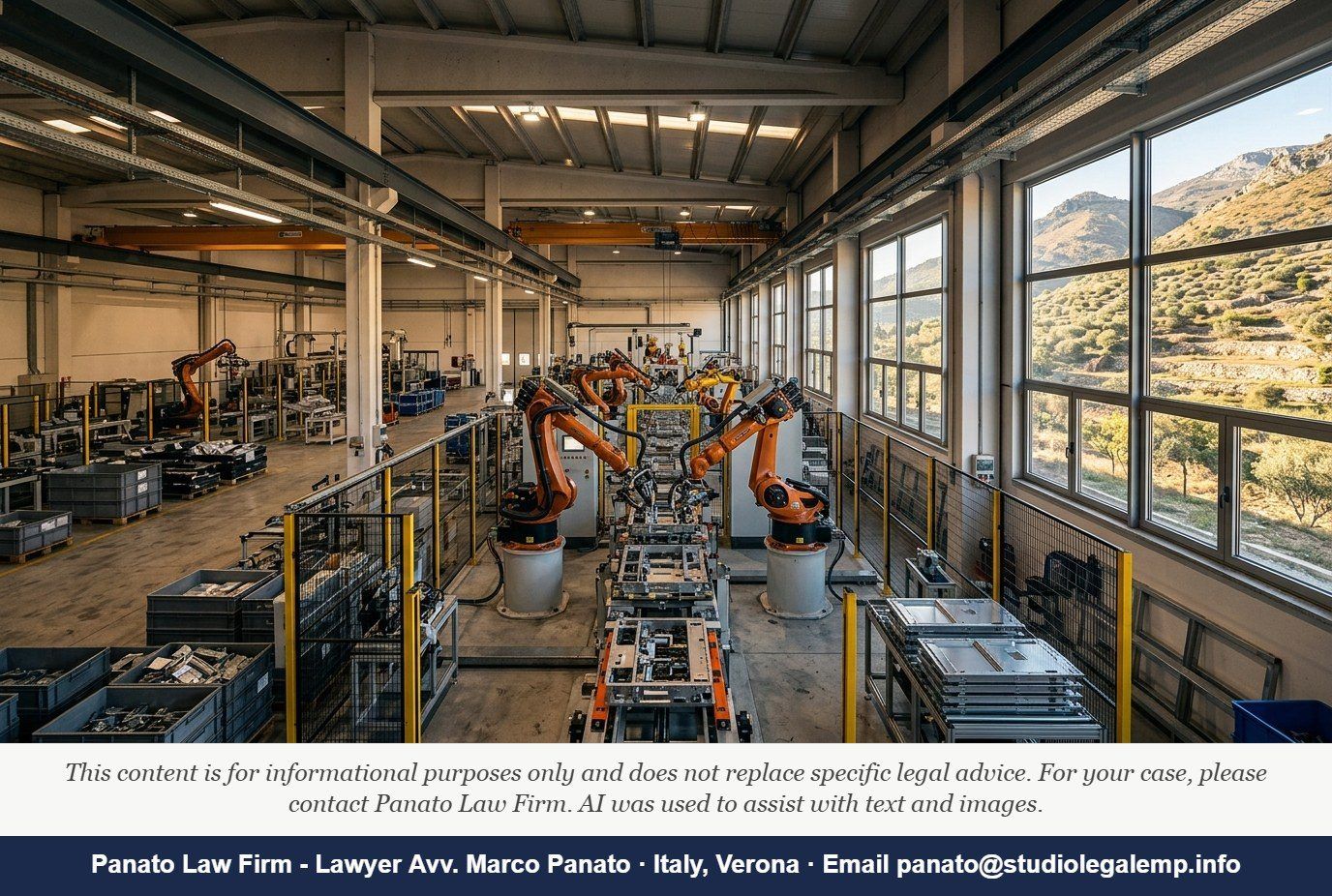
Image prompt: A wide-angle photograph of a modern Italian manufacturing floor in an industrial facility in Southern Italy — gleaming robotic arms assembling components under warm amber factory lighting, with large windows revealing a sunlit Apennine landscape beyond. The mood is purposeful and optimistic. Colour palette: steel blue, industrial orange accent lighting, natural stone tones from the landscape outside. No people visible, no text in the image.
Image file: italian-tax-credits-foreign-company-investment-2026-cover
JSON-LD:
CHECK:
Authority 1 — Law 199/2025 (Italian 2026 Budget Law). REFERENCES: Law 199/2025, Gazzetta Ufficiale. EXISTS? Unverifiable by real-time search in this session; consistent with the legislative calendar and the planning brief provided, which confirms the timeliness hook. TO VERIFY against the Gazzetta Ufficiale. CONTENT MATCHES what I wrote? Consistent with the brief; graduated rates and ZES extension figures taken directly from the planning brief supplied. Any variance in implementing circular must be checked before publication.
Authority 2 — D.Lgs. 184/2025 (Incentives Code). REFERENCES: Legislative Decree 184/2025. EXISTS? Unverifiable by real-time search; consistent with the planning brief. TO VERIFY against the Gazzetta Ufficiale. CONTENT MATCHES? Consolidation purpose and DURC requirement described consistently with the brief; digital platform rollout described with appropriate caveat.
Authority 3 — Regulation (EU) 651/2014 (GBER) as amended by Regulation (EU) 2023/1315. REFERENCES: full official citation. EXISTS? Yes — confirmed on EUR-Lex, publicly available. CONTENT MATCHES? Yes — GBER sets regional aid intensity ceilings by enterprise size, applicable to Italian ZES measures as described.
Authority 4 — TUIR Article 110(7). REFERENCES: TUIR, Article 110(7). EXISTS? Yes — long-standing provision of Italian tax law, publicly available on Normattiva (normattiva.it). CONTENT MATCHES? Yes — arm's-length transfer pricing standard for intercompany transactions is correctly described.
Authority 5 — Regional Aid Guidelines 2022–2027 (OJ C 153/2021). REFERENCES: full citation. EXISTS? Yes — confirmed on EUR-Lex and European Commission State Aid website. CONTENT MATCHES? Yes — applicable to ZES Unica as a regional aid scheme notified to the Commission.
OVERALL: AMBER — Law 199/2025 and D.Lgs. 184/2025 are consistent with the planning brief supplied but require verification against the Gazzetta Ufficiale before publication, as the article's specific figures (investment brackets, rates, ZES funding envelopes) derive from the brief rather than a real-time primary source search. GBER, TUIR and Regional Aid Guidelines are GREEN.
LOCAL NOTE:
1. Search intent targeted: informational with strong transactional undercurrent — the reader has an Italian entity and is asking whether they are eligible before instructing a lawyer or restructuring a capital expenditure plan.
2. Local-market framing used: UK, Irish, North American and Australian CFO or in-house counsel at a foreign-owned group; the contrast paragraph explicitly flags that Italian incentives require affirmative pre-notification steps before investment, unlike the retrospective return-based reliefs familiar to common-law practitioners — this is the highest-value passage for that audience.
3. Italian terms kept untranslated: iper-ammortamento (explained immediately as enhanced depreciation; the Italian is retained because it is the search term and the official label used by Italian authorities and will appear on all GSE correspondence the reader receives); ZES Unica (official proper name of the zone, explained in full on first use); DURC (official acronym for the social contribution compliance certificate, universally used in Italian business dealings and likely to appear on any checklist the client receives).
Do you need legal assistance or a free estimate?
Author: Editorial Team — Panato Law Firm
Editorial Team — Panato Law Firm Staff