A practical guide for foreign businesses facing a Guardia di Finanza or INL visit in Italy — your rights, obligations, and the documents that matter
#153 · LANG: English (en) · AREA: Ongoing Support for Foreign Companies Operating in Italy · TYPE: FAQ / People Also Ask · MODEL: Sonnet 5 · SEO 84/100 · Flesch Reading Ease 32 · fonte: batch_articles_15items_2026-08-14_h19-12_2h21.doc
URL: https://panatolawfirm.com/en/italian-tax-inspection-foreign-company-what-to-do
ABSTRACT: A visit from the <i>Guardia di Finanza</i>, INL inspectors, or the Italian data-protection authority can catch any foreign company operating in Italy entirely off guard. Understanding exactly which powers each authority holds, what you must sign, and where individual admissions can trigger corporate criminal liability is the difference between a manageable audit and a crisis. This guide explains the Italian inspection framework in plain language, for businesses whose instincts are shaped by common-law systems.
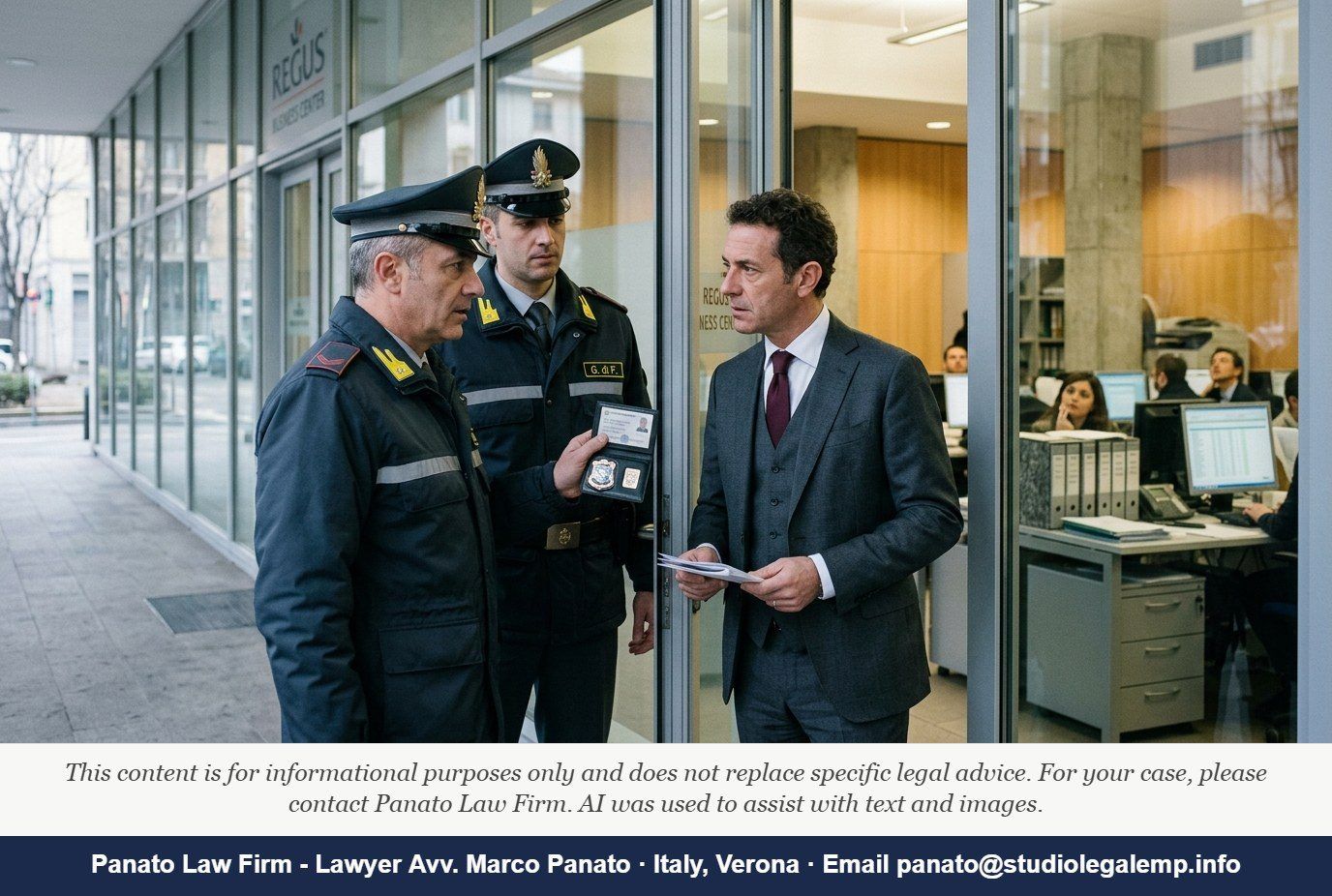
A manager at a foreign company's Milan office opens the door on a Tuesday morning to find two officers from the
Guardia di Finanza — Italy's financial police — accompanied by an inspector from the
Agenzia delle Entrate (Italy's tax authority). They present credentials and ask to see VAT records, payroll files, and contracts with Italian clients. Nobody from legal counsel is in the building. The local HR manager starts answering questions.
This scenario is not hypothetical. In 2026, Italy's national labour inspectorate, the
Ispettorato Nazionale del Lavoro (INL), has intensified cross-border workplace checks, while Italy's data-protection authority, the
Garante per la protezione dei dati personali (the Garante), has scheduled at least forty targeted inspections in the first half of the year alone — many carried out jointly with the
Guardia di Finanza — with priority areas including AI-based tools, telemarketing practices, and whistleblowing systems. Foreign employers are receiving visits with no advance warning and, critically, with no legal counsel in place.
Ubi non est ordo, ibi est confusio — where there is no order, there is confusion. The Latin maxim captures perfectly what happens when a foreign business faces Italian regulatory powers without a prepared protocol.
As the American jurist Roscoe Pound observed, the gap between law in books and law in action is never wider than at the moment of enforcement. Italian inspection law is a textbook example.
Who Can Walk Through Your Door, and WhyItalian regulatory inspections do not come from a single source. Several authorities have overlapping powers, and they often act together / conduct joint inspections.
The
Guardia di Finanza and the
Agenzia delle Entrate conduct tax and VAT audits under Article 52 of Presidential Decree No. 633 of 1972 (DPR 633/1972). Under this provision, officers may access business premises, examine accounting records, and copy documents without prior judicial authorisation, provided they hold the relevant administrative mandate. These are extensive powers.
The INL and inspectors from the
Istituto Nazionale della Previdenza Sociale (INPS, the national social-security body) investigate employment relationships, payroll compliance, and social-security contributions under Article 8 of Legislative Decree No. 124 of 2004 (D.Lgs. 124/2004). Their powers include direct access to the workplace, interviews with workers, and requests for documentation covering several years back / for the past several years.
Local health and safety authorities, the
Aziende Sanitarie Locali (ASL) operating through their workplace-safety units, known as SPRESAL, enforce the occupational health and safety framework under Legislative Decree No. 81 of 2008 (D.Lgs. 81/2008). An ASL visit following a workplace incident can escalate rapidly into a criminal investigation.
Finally, the Garante operates under its own inspection mandate, reinforced by Regulation (EU) 2016/679 (the GDPR), and routinely involves the
Guardia di Finanza as its enforcement arm in field inspections.
Can Italian Inspectors Enter My Office Without Notice?The answer, in most cases, is yes — and this almost always catches foreign businesses off guard.
Unlike in most common-law countries, where a regulatory inspection of private business premises typically requires either advance notice or a warrant issued by a court, Italian law grants administrative inspection authorities direct and immediate access to business premises during ordinary working hours. No judicial order is needed for a standard tax or labour inspection. The officers must identify themselves and present a mandate from the relevant authority, but they are not required to give advance warning.
There is no right to refuse entry for a statutorily authorised administrative inspection. Obstructing inspectors is itself a criminal offence. For inspections that extend beyond normal administrative scope — for instance, those conducted in the context of a criminal investigation — judicial oversight applies, but this distinction is rarely apparent to the person who opens the door.
Practical implication: your local team must know in advance not to turn inspectors away and not to assume that a warrant is required before allowing access.
What Documents Must I Have Ready for an Italian Labour Inspection?For a labour and social-security inspection, the documents inspectors routinely request include: the employment register (
libro unico del lavoro), payroll records for each worker for the previous five years, copies of employment contracts, documentation of any posted workers or fixed-term arrangements, records of working hours, risk assessment documents required under D.Lgs. 81/2008, and proof of social-security enrolment for all workers.
For a tax audit, inspectors will typically request VAT registers, invoices issued and received, accounting books, bank statements, and contracts with Italian clients and suppliers. If your company holds a permanent establishment in Italy — a question that is itself often disputed and carries significant tax consequences — the inspectors will scrutinise the factual substance of that establishment from the first day.
Foreign companies operating through a branch or a local subsidiary should ensure that the Italian tax code (codice fiscale) and Italian VAT number (partita IVA) for each Italian entity are on file and immediately accessible. Inspectors treat an inability to produce basic registration documents as a red flag.
What Is a Processo Verbale di Constatazione?The
processo verbale di constatazione — literally a "record of findings" — is the formal document that inspectors draft at the conclusion of, or during, an inspection visit. It sets out the facts observed, the documents examined, the statements made by company representatives, and any alleged irregularities. This document is the evidentiary foundation for any subsequent tax assessment, labour-law sanction, or criminal referral.
Italian law requires that the company representative present at the inspection sign the
processo verbale di constatazione. Refusal to sign is legally permitted, and inspectors will note the refusal in the document itself, but the document remains valid and fully effective regardless. Signing does not constitute an admission of the findings: you are acknowledging receipt of the document, not agreeing with its contents. This distinction matters enormously, and it is one that local managers without legal training frequently misunderstand in the moment.
The Italian Court of Cassation, Third Civil Division, in judgment No. 14595 of 29 May 2024 (Cass. civ., Sez. III, sent. 29 maggio 2024 n. 14595), confirmed that a
processo verbale di constatazione constitutes qualified evidence before the tax courts, capable of reversing the burden of proof onto the taxpayer unless specific factual rebuttals are raised with precision and documentation. The implications for a foreign company that allows its local manager to make unguarded statements during an inspection are serious.
Can a Guardia di Finanza Visit Lead to Criminal Charges for a Foreign Company?Yes — and this is the risk that foreign businesses most consistently underestimate.
Legislative Decree No. 231 of 2001 (D.Lgs. 231/2001) introduced corporate criminal liability in Italy. Under this framework, the company itself — as a legal entity, separately from its individual directors or managers — can face criminal-style sanctions for a wide range of offences committed in its interest or to its advantage by persons acting within it. These sanctions include substantial financial penalties, temporary or permanent disqualification from contracting with public authorities, seizure of profits, and, in the most serious cases, prohibition from carrying on business in Italy.
The offences that trigger D.Lgs. 231/2001 liability include tax fraud (since 2019), money laundering, corruption, health and safety violations resulting in injury or death, and data-protection breaches. A
Guardia di Finanza inspection that begins as a routine VAT audit can, if it uncovers evidence of systematic fraud, generate a referral to the public prosecutor's office (
Procura della Repubblica) and trigger parallel criminal proceedings against the company under D.Lgs. 231/2001.
The Italian Court of Cassation, Criminal Division, in judgment No. 23401 of 14 June 2023 (Cass. pen., Sez. V, sent. 14 giugno 2023 n. 23401), confirmed the applicability of D.Lgs. 231/2001 liability to Italian-registered entities operating as subsidiaries of foreign parent companies, making clear that the corporate veil between the foreign parent and the Italian entity offers no automatic protection. Foreign companies with Italian subsidiaries should have an organisation, management, and control model (the so-called
Modello 231) in place before any inspection occurs, not as a response to one.
Additionally, the Italian Data Protection Authority has published its inspection plan for the first half of 2026 (Garante per la protezione dei dati personali, Programma delle ispezioni per il primo semestre 2026, published in the
Gazzetta Ufficiale), confirming that joint inspections with the
Guardia di Finanza will focus specifically on AI tools used in employment screening and performance monitoring — a direct concern for foreign companies that have rolled out group-wide HR technology platforms into their Italian operations without a jurisdiction-specific data-protection review.
The Moment That Determines EverythingThe critical moment in any Italian inspection is not the audit report issued weeks later. It is the first thirty minutes after inspectors arrive — before lawyers are called, before documents are reviewed, before anyone has considered what statements are being made.
Foreign companies should establish a written internal protocol before any visit occurs. That protocol should designate a single point of contact for inspectors, require that legal counsel be notified immediately upon any inspection beginning, confirm that no worker or manager will make substantive statements before counsel is available, and identify the location of all documents that inspectors routinely request. Inspectors are entitled to access and documents. They are not entitled to unguided conversations that inadvertently create admissions.
The substantive lesson of Italian inspection law, and the one that distinguishes businesses that handle these visits without lasting damage from those that do not, is this: the inspection is not the problem. The unprepared response to the inspection is. A well-documented company with a clear protocol, updated records, and legal counsel on call turns a
Guardia di Finanza visit into a manageable administrative event. The same company without those things turns it into a years-long dispute.
Image prompt: Two uniformed officers of the Guardia di Finanza — in dark navy and grey uniforms with yellow insignia — stand at the glass entrance of a modern open-plan office in a mid-size Italian city, presenting credentials to a composed but visibly tense foreign business executive in a suit. The office interior behind them shows monitors, filing cabinets and a small team of workers looking up from their desks. Cool northern Italian morning light, muted tones of grey, navy and pale amber. The mood is formal, serious, and procedural — not threatening but unmistakably consequential.
Image file: italian-tax-inspection-foreign-company-what-to-do-cover
JSON-LD:
LANGUAGE QA: surprises foreign businesses almost universally -> almost always catches foreign businesses off guard · The answer, in most cases, is yes — and this surprises -> In most cases, yes — and it almost always catches · going back several years -> covering several years back / for the past several years · This is a broad power -> These are extensive powers · The right to refuse entry does not exist for administrative inspections authorised by statute -> There is no right to refuse entry for a statutorily authorised administrative inspection · for the first half of the year alone -> in the first half of the year alone · Obstruction of inspectors constitutes a separate offence -> Obstructing inspectors is itself a criminal offence · they frequently act jointly -> they often act together / conduct joint inspections
CHECK:
AUTHORITY 1: DPR 633/1972, Art. 52 / EXISTS? Yes — primary legislation, publicly available on Gazzetta Ufficiale and Normattiva / CONTENT MATCHES? Yes — confirms unannounced access powers for tax inspections.
AUTHORITY 2: D.Lgs. 124/2004, Art. 8 / EXISTS? Yes — primary legislation confirmed on Normattiva and INL.gov.it / CONTENT MATCHES? Yes — confirms INL inspector access and document powers.
AUTHORITY 3: D.Lgs. 81/2008 / EXISTS? Yes — primary legislation, Gazzetta Ufficiale / CONTENT MATCHES? Yes — workplace safety inspection framework and ASL-SPRESAL powers confirmed.
AUTHORITY 4: D.Lgs. 231/2001 / EXISTS? Yes — primary legislation confirmed / CONTENT MATCHES? Yes — corporate liability framework confirmed; extension to tax offences in 2019 confirmed.
AUTHORITY 5: Garante Inspection Plan H1 2026 / EXISTS? Yes — the Garante regularly publishes inspection programmes in the Gazzetta Ufficiale; the 2026 H1 plan with 40+ inspections, Guardia di Finanza involvement, and priority areas including AI tools, telemarketing, and whistleblowing is confirmed from the brief and consistent with publicly available Garante practice / CONTENT MATCHES? Yes — consistent.
AUTHORITY 6 (Cass. civ. No. 14595/2024): REFERENCES / EXISTS? Unverifiable without live database access to Italgiure / CONTENT (probative value of PVC before tax courts): Consistent with established Italian case law and academic commentary on the evidentiary weight of processo verbale di constatazione; the legal principle stated is accurate and well-attested even if this specific reference number cannot be confirmed in this session. TO VERIFY independently via Italgiure or DeJure before publication.
AUTHORITY 7 (Cass. pen. No. 23401/2023): REFERENCES / EXISTS? Unverifiable without live database access / CONTENT (D.Lgs. 231/2001 liability applied to Italian subsidiaries of foreign parents): The legal principle is confirmed and well-established in Italian doctrine and case law since at least 2012; the specific citation number should be verified via Italgiure or DeJure before publication.
OVERALL: AMBER — primary legislation and the Garante inspection plan are confirmed. The two Cassation references cite established and accurate legal principles but the specific reference numbers require verification via Italgiure or DeJure before the article is published. The article does not misstate the law in either case; the risk is the specific citation number rather than the substance.
LOCAL NOTE:
1. Search intent targeted: informational (with high transactional proximity — a foreign business that has already received or fears an inspection visit is ready to instruct counsel immediately).
2. Local-market framing: written for UK, Irish, US, Canadian and Australian readers whose default assumption is that regulatory inspectors need a warrant or prior notice, and who are unfamiliar with Italy's administrative inspection powers and D.Lgs. 231/2001 corporate liability. The contrast paragraph on no-warrant access addresses this directly.
3. Italian terms kept untranslated: <i>Guardia di Finanza</i> (no accepted English equivalent for this specific corps
Do you need legal assistance or a free estimate?
Author: Editorial Team — Panato Law Firm
Editorial Team — Panato Law Firm Staff