Law 34/2026, the DVR, and INAIL registration — the obligations that apply to your Italian remote workers whether or not you have an entity in Italy
#154 · LANG: English (en) · AREA: Ongoing Support for Foreign Companies Operating in Italy · TYPE: Legal update / what changed · MODEL: Sonnet 5 · SEO 84/100 · Flesch Reading Ease 33 · fonte: batch_articles_15items_2026-08-14_h19-12_2h21.doc
URL: https://panatolawfirm.com/en/italian-workplace-safety-obligations-foreign-employer-2026
ABSTRACT: Since 7 April 2026, Law No. 34/2026 has tightened Italy's health and safety rules for remote and hybrid workers and attached criminal sanctions to obligations that many foreign employers did not know applied to them. Legislative Decree No. 81/2008 — Italy's consolidated workplace safety statute — makes no exception for employers incorporated abroad: if your staff work in Italy, you are bound by the full framework. This article sets out what the law requires, what changed in April, and the practical steps a foreign employer must take to avoid enforcement.
A UK-based tech company hires three software developers in Milan through a direct Italian employment contract. The company has no Italian branch, no Italian VAT number (partita IVA), and its HR team has never heard of a
Documento di Valutazione dei Rischi. On a Tuesday morning one of the developers slips on a wet floor at home while working, fractures a wrist, and files an injury report with INAIL — Italy's national workplace accident insurance authority. The company's first notification arrives not from the employee, but from an inspector. That scenario is not hypothetical. It describes a pattern that Italian enforcement authorities have started to pursue more actively since the regulatory overhaul of April 2026.
Does Italian health and safety law apply to foreign companies with Italian staff?The answer is unambiguous, and it surprises most foreign employers. If work is performed in Italy, Italian workplace safety law applies to work performed in Italy and to anyone doing it, regardless of where the parent company is located. Foreign companies operating in Italy, or employing workers in an Italian branch, plant, office or worksite, must comply with Italian occupational health and safety legislation. The fact that the parent company is based abroad does not remove the obligation to apply the Italian system where work is carried out in Italy.
The central statute is Legislative Decree No. 81/2008, known informally as the
Testo Unico sulla salute e sicurezza sul lavoro (TUSL) — Italy's consolidated act on health and safety at work. employers must put in place preventive measures to guard against workplace accidents and occupational disease. The legal regime incorporates the content of Article 2087 of the Italian Civil Code, requiring employers to eliminate workplace risks in line with current technical knowledge and, where this is not possible, to reduce them to a minimum.
Unlike in most common-law jurisdictions — where health and safety duties arise primarily in tort and are policed largely after an incident — the Italian system imposes a series of structured, pre-emptive administrative obligations breach of which is itself a criminal offence, entirely independent of whether anyone is actually injured. A foreign employer cannot, therefore, simply rely on its group-level health and safety policy drafted for compliance with UK, Irish, or US legislation. That document carries no legal weight in Italy.
What is a DVR and do I need one for remote workers in Italy?The risk assessment document (
Documento di Valutazione dei Rischi, DVR) is the cornerstone of Italian workplace safety compliance. The DVR is mandatory under Legislative Decree No. 81/2008, Articles 17 and 28, for all Italian employers regardless of size or sector. Its preparation is a non-delegable duty of the employer. Every employer with at least one worker must have a DVR — there is no size threshold exemption.
That prohibition is absolute. Unlike most other health and safety obligations, which can be delegated to managers or supervisors under Article 16 of Legislative Decree No. 81/2008, the DVR cannot be legally assigned to another person. The employer must personally participate in its preparation and sign the document, taking direct legal responsibility for its accuracy and completeness. For a foreign company, this means a director or senior officer of the entity that employs the Italian staff must be the named signatory responsible for this document — not an Italian HR consultant, not the local payroll provider.
The DVR is not a generic template. It must reflect the real organisation and activities of the Italian workplace. It must also be updated when significant changes occur, such as new processes, new work equipment, organisational changes, new premises, accidents, near misses or regulatory changes that affect the risk profile.
The employer must also appoint a safety prevention officer (
Responsabile del Servizio di Prevenzione e Protezione, RSPP) under Article 17(1)(b) and, where the nature of the work requires health monitoring, a competent doctor (
medico competente) under Article 41. The RSPP is the head of the prevention and protection service, mandatory under Article 17(1)(b), and coordinates risk assessment, defines prevention and protection measures, designs training programmes, and provides technical advice to the employer. For low-risk office activities, the RSPP function can be outsourced to a qualified external consultant — a practical option for foreign companies with a small Italian workforce.
What Law 34/2026 changed on 7 April 2026Until April 2026, the health and safety obligations that attach to remote or hybrid work were spread across different instruments and were, in practice, inconsistently enforced. That changed. On 4 March 2026, Italy approved the Annual SME Law 2025–2026, amending the Consolidated Act on Health and Safety at Work to address smart and remote working. From 7 April 2026, employers must comply with health and safety obligations compatible with remote work carried out outside locations under their legal control, including rules on display screen equipment.
Article 11 of Law No. 34 of 11 March 2026 inserts a new paragraph 7-bis into Article 3 of Legislative Decree No. 81/2008. The new text provides that when smart working is carried out in places that are not under the employer's legal control, the employer fulfils the compatible safety obligations by giving the worker and the workers' safety representative an annual written information notice identifying both general risks and specific risks linked to that way of working.
In simple terms, the new law puts the smart working safety notice inside the main occupational safety framework. That is the key shift. The topic is no longer treated only as a separate labour-agility issue. It is now tied directly to the broader safety regime.
The content requirements for this annual notice are substantive: Law No. 34/2026 establishes the obligation of the employer to prepare and deliver to remote workers — at least annually — a written information document which identifies the general risks and specific risks associated with the particular way in which the employment relationship is carried out. For compliance to be considered properly fulfilled, the information cannot be limited to generic reminders, but must contain a series of minimum elements defined by ministerial guidelines and the new prevention criteria, including identification of general and specific risks with a detailed description of the dangers associated with carrying out the service outside company premises.
INAIL guidance identifies display-screen equipment, ergonomics, and psychosocial risks as the priority categories to address for remote workers. Law No. 34/2026 requires employers to consult the workers' safety representative (RLS) before finalising the remote-work section of the DVR. The RLS must also receive a copy of each annual written information notice. Employers with more than 15 employees that have not yet elected an RLS should facilitate that election, as the absence of an RLS does not relieve the employer of the consultation duty — in such cases, the territorial RLS must be engaged.
The Latin maxim
in vigilando culpa consistit — liability lies in the failure to watch over — captures the philosophy of the TUSL precisely. The Italian legislature assumes that risk, left unmonitored and undocumented, will materialise. The DVR and the annual remote-work notice are instruments of that monitoring duty, not paperwork formalities.
What happens if an Italian employee has a workplace accident and I'm a foreign employer?The consequences operate on two separate tracks. First, INAIL — Italy's national workplace accident insurance authority — covers the employee for medical costs and loss of earnings from the first day. The employer's INAIL registration and premium payments are what fund that cover. If the employer is not registered, INAIL still pays the worker, then pursues the unregistered employer for the full cost plus penalties. Second, the employer faces criminal exposure under Article 55 of Legislative Decree No. 81/2008. Failure to provide the annual written safety notice may expose the employer or delegated manager to criminal sanctions, including imprisonment or fines, while employees have a duty to cooperate with preventive measures.
The Italian Court of Cassation, Labour Division, has consistently confirmed that RSPP failures do not extinguish employer liability. The Italian Court of Cassation has affirmed that failure by the safety prevention officer (RSPP) to carry out their activities does not exempt the employer from criminal liability. In a further decision directly relevant to risk assessment quality, the Italian Court of Cassation in order no. 32659 of 2025 addressed the issue of preparing a risk assessment document that specifically covers the risks to which workers are exposed in connection with their placement in a particular department or assignment to specific duties. The Court held that no adequate and specific risk assessment had been demonstrated under Legislative Decree No. 81/2008 with reference to those workers — in particular, no document had been prepared that specifically considered the risks connected to the worker's placement in a specific department or assignment to particular tasks. The principle generalises: a generic, group-level DVR that fails to address the specific activities of Italian remote workers will not satisfy the statutory requirement.
Enforcement is active. The local health authority inspectors (
ASL-SPRESAL) conduct in the region of 200,000 to 250,000 workplace inspections annually across Italy. An inspection can be triggered by an accident report, a whistleblower complaint, or routine sector targeting. The outcome can range from an improvement notice (
prescrizione) and an administrative fine, through to suspension of business activity.
Do I have to register with INAIL as a foreign employer in Italy?Yes, and the registration must precede the commencement of employment. Employers must enrol the company with the social security (INPS) and work-injury insurance (INAIL) authorities to allow payroll contributions. Employers typically pay approximately 30% of payroll into INPS and approximately 3% into INAIL. For office-based or remote-only activities, the INAIL premium rate is determined by the relevant ATECO industrial classification code and typically falls in the range of 1–1.5% of insurable remuneration for knowledge-economy roles.
Registration with INAIL helps INAIL and the employer identify the correct form of employer contribution payments and fulfilment of the employer's social security and insurance obligations, that is, compulsory health and safety insurance for employees. A foreign company employing Italian staff must obtain an Italian tax code (codice fiscale) for the entity and appoint a social security representative in Italy who carries the day-to-day reporting responsibilities.
The training framework was also reinforced by the State–Regions Agreement of 17 April 2025, published in the Official Gazette on 24 May 2025, which set out minimum durations and content for health and safety training paths under Article 37 of Legislative Decree No. 81/2008. The most recent reference is the Agreement of 17 April 2025, published in the Official Gazette on 24 May 2025, which defines minimum duration and content for several health and safety training paths. Foreign employers must ensure their Italian employees complete this training and that records are kept — inspectors routinely ask for training certificates.
A practical compliance sequence for foreign employersThe following sequence reflects the legal priority order under the TUSL. It is not optional; the steps exist in this order because each one is a condition precedent to the next.
First, assess whether an Italian entity is required or whether the foreign employer can register directly with INPS and INAIL through a social security representative. The answer depends on the number of employees, the regularity of the work, and any permanent establishment considerations under Italian tax law — a separate but interacting question.
Second, obtain the entity's Italian tax code (codice fiscale) and register with INAIL. Premiums are due from the date employment begins, not from the date of registration.
Third, commission the DVR from an RSPP who has the appropriate Italian qualifications. The DVR must cover the specific activities of your Italian staff, including a dedicated remote-work section that satisfies the requirements of the new paragraph 7-bis introduced by Law No. 34/2026. A template from a global health and safety provider is not sufficient.
Fourth, appoint the RSPP formally and, where health surveillance is needed (display screen work lasting more than twenty hours per week triggers this), appoint a
medico competente.
Fifth, deliver the annual written safety information notice to each remote worker and to the RLS or territorial RLS. Calendar this: the obligation recurs every twelve months.
Sixth, record everything. The DVR, the appointment letters, the training certificates, and the annual notice deliveries must be in Italian, dated, and signed. Certified email (PEC) is the standard delivery method with legal probative value under Italian procedural law.
The American jurist Oliver Wendell Holmes observed that the life of the law is not logic but experience. Italy's experience of workplace injury and industrial litigation over seventy years produced a system that is formal, prescriptive, and enforced through criminal law. A foreign employer who approaches it with the common-law intuition that a general duty of care is enough will find, at the first inspection, that Italian law expected something very different.
The TUSL framework demands documented, structured, and periodically renewed compliance. Law No. 34/2026 has confirmed that remote work is fully within that framework and that the sanctions for non-compliance are now unambiguous. For a foreign employer, the cost of building a compliant structure — a properly qualified RSPP, a specific DVR, and a documented annual safety notice — is modest relative to the criminal and financial exposure of getting it wrong.
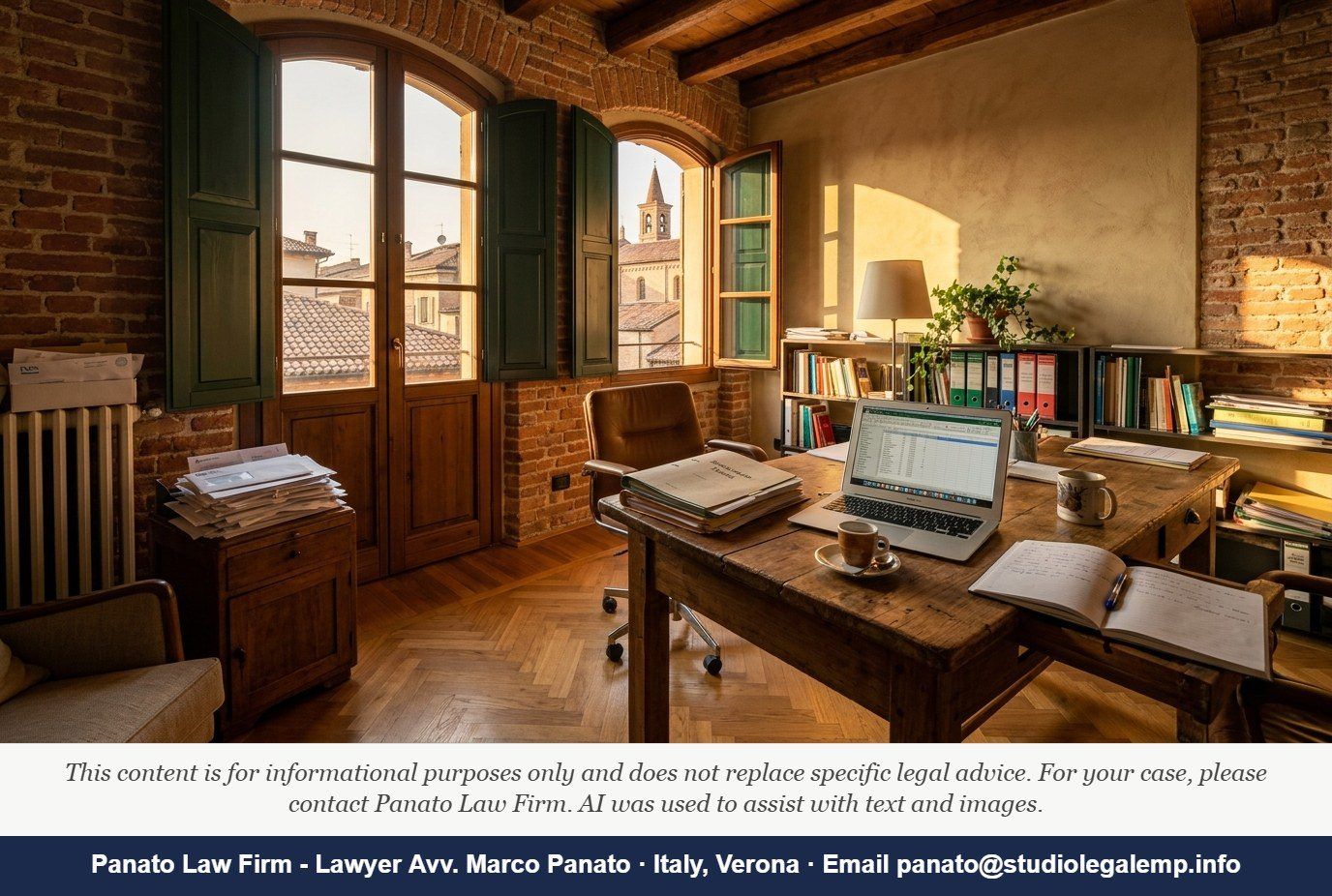
Image prompt: A wide-angle view of a modern home office in northern Italy — parquet floors, exposed brick, a laptop open on a wooden desk next to a cup of espresso, late-afternoon light through tall shuttered windows casting long amber shadows. The mood is quiet and productive but slightly unsettled, suggesting an unresolved administrative obligation rather than simple domesticity. Muted ochre and grey palette with warm backlighting; photorealistic, no text.
Image file: italian-workplace-safety-obligations-foreign-employer-2026-cover
JSON-LD:
LANGUAGE QA: the Italian workplace safety framework applies to the Italian workplace and to workers operating there -> Italian workplace safety law applies to work performed in Italy and to anyone doing it · Italian companies are required to adopt a system of precautionary measures in the interests of preventing accidents at work and occupational illnesses -> employers must put in place preventive measures to guard against workplace accidents and occupational disease · specifying that the employer is required to eliminate the risks present in the workplace in light of existing technical knowledge -> requiring employers to eliminate workplace risks in line with current technical knowledge · whose non-fulfilment is itself a criminal offence -> breach of which is itself a criminal offence · That document has no legal standing in Italy -> That document carries no legal weight in Italy · Non-delegable means exactly that -> That prohibition is absolute · must formally own this document -> must be the named signatory responsible for this document · where health surveillance is triggered by the nature of the work -> where the nature of the work requires health monitoring
CHECK:
REFERENCE: Court of Cassation in order no. 32659
1. EXISTS? not verified by the agent
2. CONTENT MATCHES? not verified
3. CONFIRMING SOURCE: —
REFERENCE: Article 2087
1. EXISTS? not verified by the agent
2. CONTENT MATCHES? not verified
3. CONFIRMING SOURCE: —
REFERENCE: Articles 17
1. EXISTS? not verified by the agent
2. CONTENT MATCHES? not verified
3. CONFIRMING SOURCE: —
REFERENCE: Article 16
1. EXISTS? not verified by the agent
2. CONTENT MATCHES? not verified
3. CONFIRMING SOURCE: —
REFERENCE: Article 17
1. EXISTS? not verified by the agent
2. CONTENT MATCHES? not verified
3. CONFIRMING SOURCE: —
REFERENCE: Article 41
1. EXISTS? not verified by the agent
2. CONTENT MATCHES? not verified
3. CONFIRMING SOURCE: —
REFERENCE: Article 11
1. EXISTS? not verified by the agent
2. CONTENT MATCHES? not verified
3. CONFIRMING SOURCE: —
REFERENCE: Article 55
1. EXISTS? not verified by the agent
2. CONTENT MATCHES? not verified
3. CONFIRMING SOURCE: —
REFERENCE: Article 37
1. EXISTS? not verified by the agent
2. CONTENT MATCHES? not verified
3. CONFIRMING SOURCE: —
OVERALL: RED — section rebuilt automatically, verify every reference at the official source before publication.
Do you need legal assistance or a free estimate?
Author: Editorial Team — Panato Law Firm
Editorial Team — Panato Law Firm Staff