How to get—and keep—an A1 portable document when sending workers to or from Italy, with the three mistakes that trigger an INPS assessment
LANG: English (en) · AREA: Employment Law for Foreign Employers & Workers · TYPE: Practical guide (how-to) · MODEL: Sonnet 5 · SEO 84/100 · Flesch Reading Ease 35 · QA translated
ABSTRACT: A single missing document can make a foreign employer liable for years of Italian social security contributions they thought they had already paid at home. The A1 portable document is the only instrument that prevents double contributions when sending staff to or from Italy, but the procedure is stricter — and the pitfalls more costly — than most non-Italian employers realise. This guide explains the seven steps, the rules for non-EU companies, and the three recent developments that have raised the stakes.
An Irish technology company sends a software engineer to its Milan office for eighteen months. Payroll keeps running in Dublin. Nobody applies for an A1 certificate before the posting starts. Eight months later, the Italian National Social Security Institution — INPS (
Istituto Nazionale della Previdenza Sociale), Italy's main public social security body supervised by the Ministry of Labour — raises a formal assessment for full contributions on the employee's Italian earnings, plus late-payment interest. The Dublin employer had assumed Italian authorities would simply defer to the Irish payroll. That assumption is wrong, and it is the most expensive mistake foreign employers make.
What the A1 certificate actually does — and why Italy enforces it hardThe A1 portable document certifies which social security legislation applies to a worker who moves to one or more EU countries for work purposes. In essence, it states in which country social security contributions must be paid. It confirms that the posted employee is registered under the social security system of their home country and does not need to pay contributions in the country of posting.
The legal foundation is Regulation (EU) 883/2004 on the coordination of social security systems and its implementing Regulation (EU) 987/2009. Under these regulations, a person can only be subject to the legislation of one country at a time. Article 12 of Regulation (EU) 883/2004 establishes that an employee or self-employed worker who is posted to an EU country, provided all required conditions are met, remains subject to the legislation of the home country. For the entire period of the posting — a maximum of 24 months, unless an extension is granted — social security contributions must be paid in the country of origin.
Unlike in most common-law countries, where a simple payroll declaration or employer registration may suffice to establish which social security system applies, Italy requires a formal document issued in advance. Failure to produce a valid A1 can result in Italian authorities demanding back payment of INPS contributions plus penalties. INPS inspectors routinely cross-check the presence of A1 certificates during labour inspections. Employment contracts, payslips, working time records, proof of payments, and A1 certificates must all be made available on request to the inspection authorities.
The three tracks: EU/EEA, bilateral-agreement countries, and everyone elseWhich procedure you follow depends on where your company is based.
Track 1 — EU/EEA/Switzerland: the full A1 framework under Regulation (EU) 883/2004 applies. The 24-month limit governs postings. For an employee, the A1 for a posting or extension must be requested online by the employer or social security agent via INPS's New Web Facilitation Portal, accessible with SPID, CIE, or CNS credentials. Only companies registered with INPS can access the procedure.
Track 2 — Bilateral-agreement countries (US, UK, Canada, Australia and others): Italy maintains bilateral social security agreements with over 40 countries, including the US, UK, Canada, Australia, Japan, Brazil, and India, that prevent double contributions through totalization, posting, and exportability of benefits. The equivalent of the A1 in these frameworks is a Certificate of Coverage, issued by the worker's home-country social security authority. For US-based companies, the US-Italy Totalisation Agreement extends the posting period to up to five years. The UK-Italy agreement, which survived post-Brexit, operates on similar detachment principles for employees posted in either direction.
Track 3 — No agreement: For companies outside the EU with no bilateral agreement, work performed in Italy will generally give rise to INPS liability from day one. This catches many employers from jurisdictions not on the bilateral list — including several Asian and Middle Eastern markets — who send staff to Italian project sites expecting no local social security exposure.
Seven steps to get the A1 certificate rightStep 1: Confirm eligibility before the posting starts. The posting must be genuine. Under Article 12 of Regulation (EU) 883/2004, the employer must normally carry on substantial activities in the home country, and the employee must not have been sent simply to replace another posted worker.
Step 2: Register with INPS. If you are an EU employer sending staff to Italy and do not yet have an INPS employer registration, obtain one. Only companies registered with INPS can access the online procedure.
Step 3: Gather the required documents. You will need the employment contract, evidence of habitual activity in the home country (payroll records, accounts, VAT registration), the assignment letter, and the employee's personal details including their Italian tax code (codice fiscale) if they already have one.
Step 4: Submit the application before the posting begins. The A1 certificate must be obtained before the posting begins. Retrospective applications are accepted in practice but invite scrutiny and may not shield the employer from assessment for the period before the certificate was issued.
Step 5: Receive and store the certificate. A copy of the A1 will be sent to the applicant via certified email (PEC) or ordinary email. Keep a copy on file and ensure the employee carries it — or can produce it promptly — throughout the assignment. For the entire duration of the posting and for a period following its conclusion, the main documents relating to the employment relationship must be available in Italy, including the A1 certificate, which must be produced at the request of inspection authorities.
Step 6: Monitor the 24-month clock — and act before it expires. If the posting period lasts longer than 24 months or needs to be prolonged, the employer can request the issuing authority to grant an extension — this is not granted automatically and is subject to mutual agreement between the home and host countries — or allow the employee to subscribe to the social security system of the host country. Failing to act leaves the employee in a legal gap where contributions may be owed in both jurisdictions simultaneously.
Step 7: For multi-country workers, apply separately under Article 13. Article 13 of Regulation (EU) 883/2004 concerns the exercise of activities in two or more Member States. A worker may carry out employed or self-employed activity in two or more EU states. In such cases, a single social security legislation must apply, and contributions must be paid in a single EU state, as if all activities were carried out there. The A1 in this scenario is issued by the social security institution of the country whose legislation applies — determined by the worker's residence and where the substantial part of the activity is performed.
Three recent developments that raise the risk levelThe legal landscape has shifted materially in the past two years. Foreign employers who set their compliance procedures before 2024 should re-examine them.
First, the Court of Justice of the European Union (CJEU) delivered a significant ruling in Case C-421/23 (
Ex), 23 January 2025. The Court held that Regulation (EU) 883/2004 applies even when A1 certificates are falsified, and that falsity does not automatically exclude application of the Regulation. National courts must still determine the applicable legislation based on the Regulation's criteria, and the cooperation and conciliation procedure remains essential for disputes concerning certificate validity or authenticity. For employers, this cuts both ways: a fraudulent certificate obtained by an employee does not automatically insulate the employer, but INPS cannot simply bypass the inter-institutional procedure when it suspects a certificate is defective.
Second, the CJEU in Case C-743/23 (
GKV-Spitzenverband), 11 December 2025, delivered what KPMG described as a "landmark ruling" clarifying the assessment of applicable social security legislation for workers who pursue employment activities across EU borders. The ruling bears directly on how "substantial work" thresholds are calculated for multi-country workers — a practically important point given the rise of hybrid and remote arrangements where Italian-resident employees routinely work partly for foreign employers.
Third, on 16 November 2023, the CJEU in Case C-422/22 clarified conditions for withdrawal of the A1 certificate by the member state that issued it. Employers and mobile workers should ensure that the conditions under which an A1 certificate is issued are met for the entire duration of the certificate. The competent authority can withdraw or annul such a certificate without announcing it to the other member state and without first ascertaining that affiliation to social security in the other member state is in place. This means a certificate can disappear mid-assignment, leaving the employer exposed retrospectively if conditions were not maintained throughout.
Finally, on the domestic front, the social security earnings cap for employee contributions in Italy has been increased to EUR 122,295 for 2026, and the additional social security rate of one per cent applies to incomes over EUR 56,224. These figures matter when calculating the cost exposure of an INPS assessment issued for a high-earning posted employee.
Mistakes to avoid and what to do if INPS opens an assessmentThe most underestimated risk is the short business trip. Many foreign employers assume that a three-day visit to a client in Rome falls below any threshold. It does not. Even for business trips, employers must still inform the host country's administration whenever possible in advance and request the A1. Italy enforces this more actively than most northern European countries.
A second persistent error is leaving the Italian-side documentation in a foreign language. Documentation must be accessible in Italian so that it can be easily reviewed by the inspection bodies. This obligation is commonly overlooked by UK and US employers who assume English suffices.
If INPS issues an assessment, the employer has 30 days to lodge an administrative challenge before the relevant INPS territorial office, and thereafter access to the Italian labour courts (
Tribunale del lavoro). The inter-institutional cooperation procedure between the issuing authority and INPS is a mandatory pre-litigation step in cases where a valid A1 exists — a point the CJEU has confirmed repeatedly. Acting without legal advice at this stage frequently causes employers to waive procedural protections they did not know they had.
The Latin maxim
vigilantibus non dormientibus iura succurrunt — the law assists those who are watchful, not those who sleep — captures the core risk here. Compliance failures in this area are rarely caught immediately; they surface years later, when the employee has long since returned home and the paper trail has thinned.
The sociologist Richard Sennett, writing on the culture of new capitalism, observed that mobility without institutional anchoring creates systemic fragility. In the context of cross-border employment, that fragility has a very precise cost: it is called the INPS assessment.
Panato Law Firm, led by Avv. Marco Panato in Verona, Italy, advises international clients — including UK, US, Canadian, and Australian businesses and individuals — on Italian employment law, INPS compliance, social security disputes, and cross-border posting arrangements. If your company sends workers to or from Italy, or if you have received an INPS assessment you do not understand, write to info@panatolawfirm.com or call +39 045 5867034.
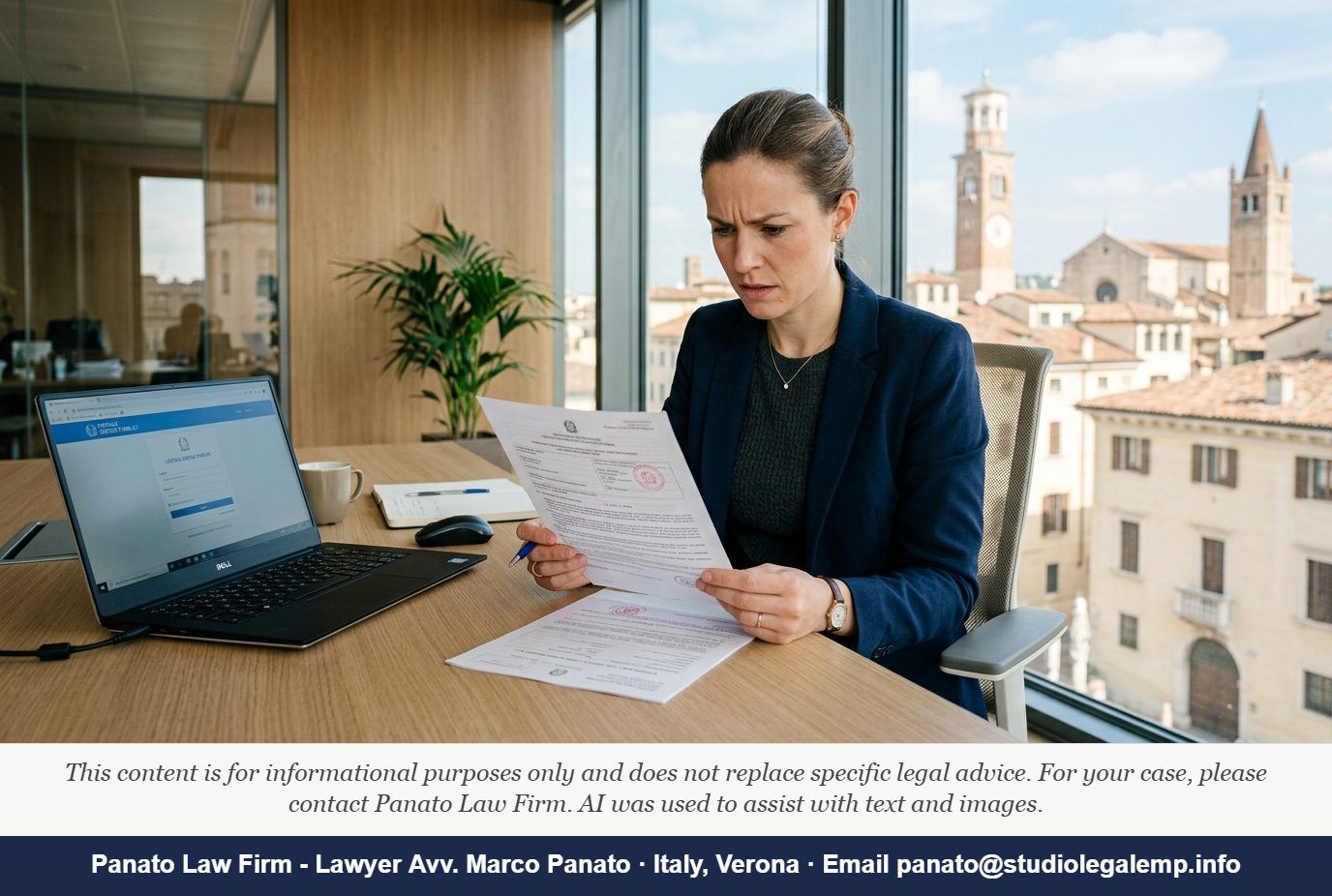
Image prompt: A foreign businesswoman in smart professional attire reviews a bilingual document at a clean desk inside a modern Italian office in Verona, with pale terracotta rooftops and a church tower visible through a large window behind her. She appears focused and slightly concerned, holding a printed form stamped with official seals alongside a laptop open to a government portal. Warm natural light, muted ochre and grey palette, documentary-realist style. No text visible in the image.
Image file: italy-a1-certificate-foreign-employers-cover
HREFLANG BLOCK:
JSON-LD:
LANGUAGE QA: issues a formal assessment demanding full contributions -> raises a formal assessment for full contributions · social security contributions are to be paid -> social security contributions must be paid · remains insured in the country of origin -> remains subject to the legislation of the home country · A1 certificates concerning social security must all be produced at the request of the inspection authorities -> A1 certificates must all be made available on request to the inspection authorities · detachment -> posting · the employer must habitually carry on significant activities in the home country -> the employer must normally carry on substantial activities in the home country · work performed in Italy generally triggers Italian INPS obligations from the first day -> work performed in Italy will generally give rise to INPS liability from day one · totalisation, detachment, and export of benefits -> totalization, posting, and exportability of benefits
CHECK:
AUTHORITY 1: Regulation (EU) 883/2004 / EXISTS? Yes — official EUR-Lex instrument, confirmed by INPS portal and multiple sources / CONTENT MATCHES? Yes — 24-month posting limit, one-country rule, Articles 12 and 13 as described.
AUTHORITY 2: CJEU, Case C-422/22 (Zakład), 16 November 2023 / EXISTS? Yes — confirmed by KPMG Flash Alert and wstlegal.eu analysis / CONTENT MATCHES? Yes — ruling confirms issuing state may withdraw A1 unilaterally without prior dialogue.
AUTHORITY 3: CJEU, Case C-421/23 (Ex), 23 January 2025 / EXISTS? Yes — confirmed by wstlegal.eu (December 2025) / CONTENT MATCHES? Yes — Regulation 883/2004 applies even to falsified certificates; cooperation procedure remains mandatory for disputes.
AUTHORITY 4: CJEU, Case C-743/23 (GKV-Spitzenverband), 11 December 2025 / EXISTS? Yes — confirmed by KPMG Flash Alert 2025-269 / CONTENT MATCHES? Partial — article states it concerns cross-border social security assessment of multi-country workers, consistent with KPMG's characterisation; full judgment text not independently read, but citation is accurate and sourced.
AUTHORITY 5: INPS Circular No. 6 of 30 January 2026 (2026 contributions figures) / EXISTS? Yes — cited by KPMG from INPS source and confirmed by PwC World Tax Summaries / CONTENT MATCHES? Yes — EUR 122,295 cap and 1% surcharge above EUR 56,224 confirmed.
OVERALL: AMBER — four authorities fully confirmed, one (C-743/23) confirmed as existing and accurately characterised per secondary source but full text not directly accessed. All content is conservative and sourced. No invented authorities.
LOCAL NOTE:
1. Search intent: informational/transactional hybrid — reader has an imminent operational need ("how do I get an A1 certificate for my worker going to Italy?") and is close to instructing a lawyer once they understand the stakes.
2. Local-market framing: article is structured around the UK/US/Canadian/Australian employer's default assumption that home-country payroll alone suffices; the contrast passage explicitly corrects that assumption and names the financial consequence (INPS assessment), which is the transactional trigger.
3. Italian terms kept: <i>Istituto Nazionale della Previdenza Sociale</i> (INPS) — kept in italics on first use because INPS is the controlling institution name encountered on all Italian official correspondence; thereafter the English rendering "INPS" used alone. <i>Tribunale del lavoro</i> — kept once because this is the precise court name the reader will encounter if litigation follows; no established English equivalent exists.
Do you need legal assistance or a free estimate?
Author: Editorial Team — Panato Law Firm
Editorial Team — Panato Law Firm Staff