The three-property threshold, CIN codes, flat tax rates and DAC7 reporting — what non-resident landlords must do before summer bookings arrive
URL: https://panatolawfirm.com/en/italy-airbnb-rules-2026-foreign-owners
ABSTRACT: Italy tightened its short-term rental framework at the start of 2026, lowering the threshold at which hosting on Airbnb is treated as a commercial activity and introducing EU-mandated platform reporting of non-resident owners' income. Foreign landlords who assume Italian holiday-let rules mirror those of the UK, Ireland or the United States are now exposed to fines of up to €8,000, automatic VAT obligations and cross-border tax disclosures they never anticipated. This guide sets out the legal position under Italian law as it stands today and the steps every non-resident host must take before summer.
A British couple buys a flat in Verona. An American investor holds two apartments in Sorrento and a third near Lake Como. An Irish family inherits a Sicilian farmhouse and lists it on Airbnb. All three believe they are running a simple private letting. Under Italian law as reformed for 2026, all three may be wrong — and the consequences reach directly into their bank accounts abroad.
The legal framework: Article 4 and what changed on 1 January 2026Short-term rentals in Italy — defined as residential lets of 30 consecutive days or fewer — are governed by Article 4 of Decree-Law no. 50 of 24 April 2017 (
D.L. 50/2017), enacted as Law no. 96 of 21 June 2017. That provision has always treated short lets differently from standard residential tenancies, but it left the question of commercial classification unresolved for years.
The 2026 Budget Law (Law no. 199 of 30 December 2025,
Legge 30 dicembre 2025, n. 199) changed that decisively. With effect from 1 January 2026, the threshold at which a natural person is legally presumed to carry on a business by way of short-term rentals dropped from four properties to three. The practical consequence is clear: if you manage three or more residential units in Italy for short-term letting — even as a private individual, even from abroad — Italian law presumes you are operating a commercial enterprise. You must register an Italian VAT number (partita IVA) and obtain an ATECO classification code. The flat-tax regime discussed below no longer applies. You enter the world of Italian business taxation, accounting obligations and, potentially, local trade-licence requirements.
How many properties can I rent on Airbnb in Italy before it becomes a business?Two is the safe harbour. On income from your first property, the flat tax — known as flat rate tax on rents (
cedolare secca) — applies at 21%. From the second property, the rate rises to 26%. On a third property or beyond, the law no longer treats the activity as private letting at all. The Italian Court of Cassation had already signalled this direction in earlier rulings on the commercialisation of residential property, but the 2026 Budget Law put it on a statutory footing.
Unlike in most common-law countries — where the number of rental properties you hold is largely irrelevant to whether you are treated as a trader — Italian law uses a bright numerical line. A UK landlord with ten buy-to-let properties is still, for income-tax purposes, a private investor unless HMRC determines they are running a property business on the facts. Under Italian law, three short-term rental properties trigger a statutory presumption of commercial activity with no room for argument on the facts. This is one of the sharpest contrasts in European rental law and one that catches foreign owners almost every time.
What flat tax rate applies to short-term rental income in Italy in 2026?Flat rate tax on rents (
cedolare secca) is an optional flat tax that replaces ordinary personal income tax (
IRPEF) and the registration tax on the rental agreement. For short-term lets the rates are 21% on the first property and 26% on any second property. The option must be exercised in the Italian income tax return and cannot be applied selectively within the same tax year — if you opt in for a property, you apply it to all income from that property.
A common misconception among foreign owners is that flat rate tax on rents (
cedolare secca) is unavailable to non-residents. It is available, but two conditions must be met. First, you must hold an Italian tax code (codice fiscale) — a personal identifier issued by the
Agenzia delle Entrate (Italian Revenue Agency) that takes roughly a week to obtain from an Italian consulate abroad. Second, you must file an Italian non-resident income tax return (the
Modello REDDITI PF, specifying non-residency) declaring the rental income. The tax is paid in Italy; relief for that liability is then claimed in your home jurisdiction under the applicable double-tax treaty. Italy has double-tax agreements in force with the United Kingdom, the United States, Canada, Australia and Ireland, all of which contain provisions covering rental income from immovable property situated in Italy.
What is the CIN code requirement for short-term rentals in Italy?The
Codice Identificativo Nazionale — National Identification Code, universally called the CIN — is a property-specific registration number issued through the National Short-Term Rental Database (
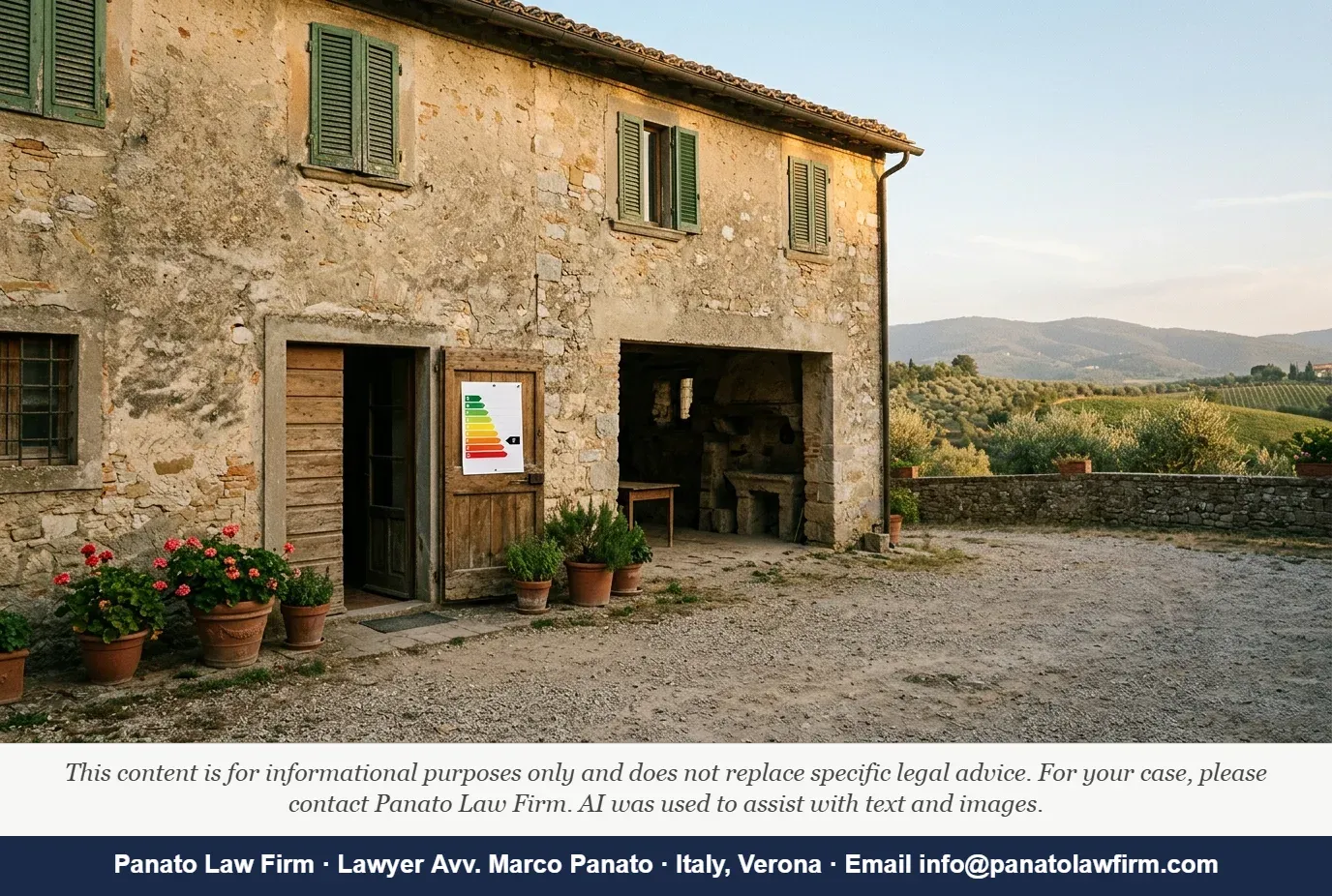
Banca Dati delle Strutture Ricettive, BDSR) managed by the Italian Ministry of Tourism. Law no. 191 of 15 November 2023 made the CIN mandatory for every property offered for short-term or tourist let in Italy. Since September 2024 the obligation has been fully live: the CIN must appear in every advertisement, including on Airbnb and other platforms, and on a physical sign at the property entrance.
The enforcement dimension intensified on 1 May 2026, when EU Regulation 2024/1028 on short-term rental data (the Short-Term Accommodation Regulation, adopted by the European Parliament and Council on 11 April 2024) compelled platforms operating in EU member states to verify the validity of registration numbers and to suspend or remove listings that do not display a valid, verified identifier. Airbnb must now actively check, not merely request, that your CIN is genuine and current. A listing without a valid CIN is not merely at risk of a fine — it will be pulled from the platform automatically.
Fines for non-compliance range from €500 to €5,000 for failing to display the CIN in an advertisement, and from €2,000 to €8,000 for operating without a CIN at all. Regional authorities add their own penalties in some cases. Applying for the CIN is free and done online through the BDSR portal, but it requires the property's land registry details and the owner's Italian tax code — which is why these two registrations must be obtained together before listing.
DAC7 and the end of invisible income: what platforms now report about youCouncil Directive (EU) 2021/514 — known as DAC7 — extended the EU's administrative co-operation rules to digital platforms. Since 1 January 2023, platforms such as Airbnb are required to collect, verify and report to national tax authorities the income earned by sellers and lessors on their platform, including non-EU residents letting property in EU member states. Italy implemented DAC7 through Legislative Decree no. 32 of 1 March 2023 (
D.Lgs. 1 marzo 2023, n. 32). The Italian Revenue Agency (
Agenzia delle Entrate) receives detailed reports for every calendar year covering the owner's name, address, tax identifier, bank details and gross income received.
Nemo censetur ignorare legem — no one is presumed ignorant of the law. The maxim captures the problem precisely: many foreign landlords have been reporting nothing, assuming their Italian rental income was invisible to their home tax authority. It is no longer invisible to either. The Italian Revenue Agency shares DAC7 data with EU member states under the mutual assistance framework, and Italy's double-tax treaties provide for exchange of information with the United States, Canada and Australia. A British non-resident who received Airbnb income from an Italian flat and omitted it from their Italian return will, from the 2023 data year onwards, be visible to both HMRC and the Italian Revenue Agency simultaneously.
As the legal theorist Jeremy Bentham observed in his writings on evidence and procedure, the value of a legal right is wholly dependent on the machinery of enforcement that stands behind it. The DAC7 framework is exactly that machinery for rental income — and it is now fully operational.
Key-box bans and local compliance: the layer most guides skipSeveral Italian municipalities — Florence, Venice, Rome's historic centre and parts of Milan — have introduced or are in the process of introducing outright bans on the installation of external key-boxes and self-check-in devices. The measures form part of broader tourism-management policies and are enacted through municipal ordinances rather than national law. A non-resident owner who relies on a key-box for remote management of a property in one of these cities is not only in breach of the municipal rule but may find their listing suspended at the host's request if the breach is reported during a local inspection.
The practical consequence is that non-resident hosts in historic centres must either appoint a local property manager who can be physically present for each check-in — and who is themselves registered with the municipality — or restructure the arrangement so that an Italian-resident co-host holds the management mandate. This adds a contract layer that should be documented in writing to avoid disputes over fees, liability and tax responsibility.
Non-resident foreign owners letting property in Italy in 2026 are operating inside a system that is more tightly integrated — between national tax law, EU data-sharing and platform-enforced compliance — than at any point in the past decade. The three-property threshold, the CIN verification requirement under EU Regulation 2024/1028, and the DAC7 reporting pipeline together create a closed loop. The time to audit your position is before the summer letting season, not after the first penalty notice arrives.
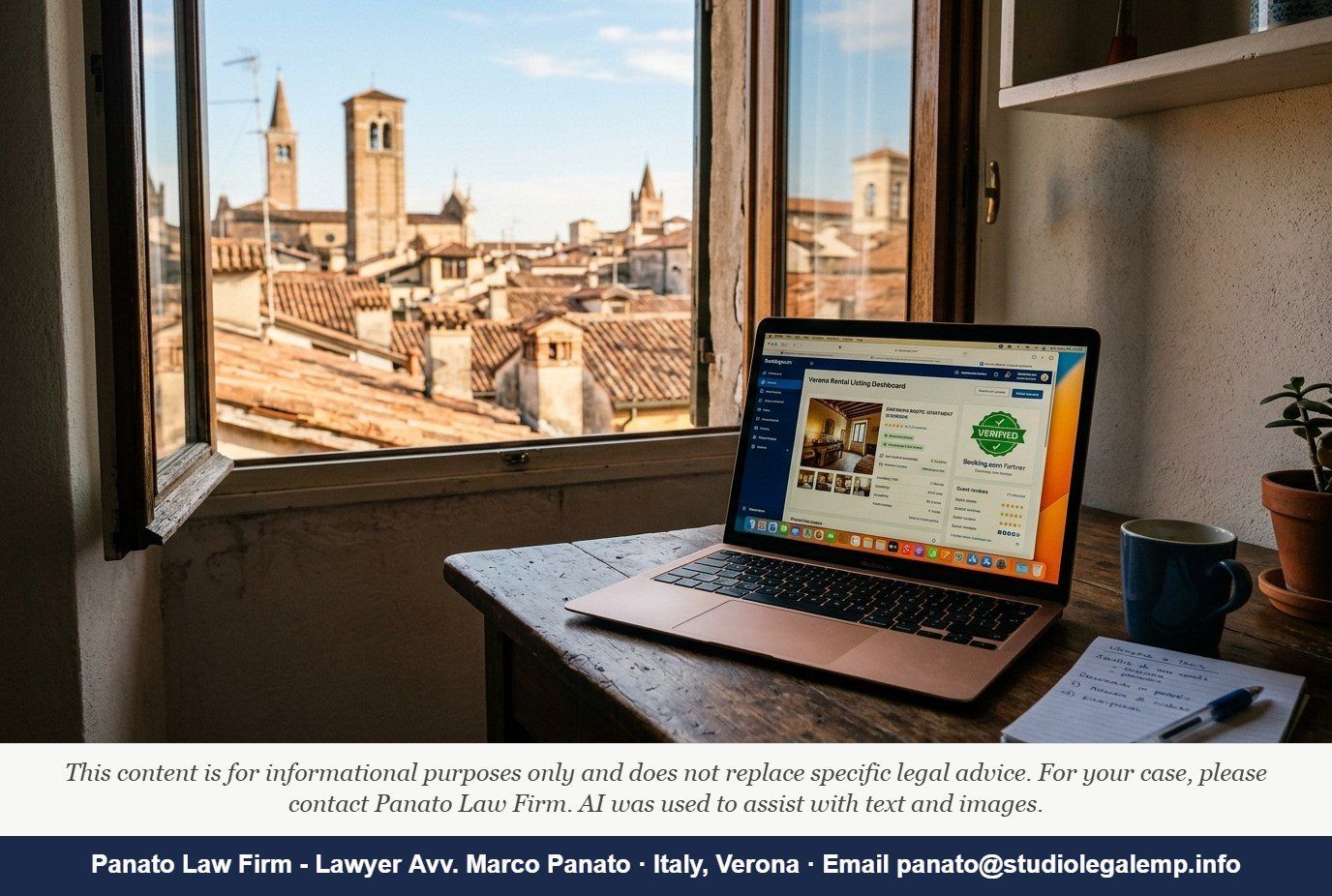
Image prompt: A sun-warmed terracotta rooftop in Verona, seen from a narrow upper-floor window. An open laptop sits on a wooden table inside a simply furnished Italian apartment, its screen showing a rental listing dashboard with a green verification badge. The mood is calm but business-like. Warm amber and ochre tones outside contrast with the cool blue-white glow of the screen. Shallow depth of field, documentary photography style.
Image file: italy-airbnb-rules-2026-foreign-owners-cover
JSON-LD:
LANGUAGE QA: converted into law with amendments by Law no. 96 -> enacted as Law no. 96 · the flat tax — known as flat rate tax on rents ( cedolare secca ) — applies at 21% -> the flat tax (cedolare secca) applies at 21% · carry on a business through short-term rentals -> carry on a business by way of short-term rentals · codified it in statute -> put it on a statutory footing · The implication is stark -> The practical consequence is clear · a personal identifier issued by the Agenzia delle Entrate (Italian Revenue Agency) that takes roughly a week to obtain from an Italian consulate abroad -> a personal identifier issued by the Agenzia delle Entrate (Italian Revenue Agency) and obtainable from an Italian consulate abroad, typically within a week · The tax is then paid in Italy; you deal with credit or exemption for that payment in your home jurisdiction -> The tax is paid in Italy; relief for that liability is then claimed in your home jurisdiction · left the question of commercial classification loosely managed for years -> left the question of commercial classification unresolved for years
CHECK:
AUTHORITY 1: Law no. 199 of 30 December 2025 (Legge 30 dicembre 2025, n. 199) / EXISTS? Unverifiable at exact article level within this session — the 2026 Budget Law as a statute is consistent with Italian legislative practice and the threshold change has been widely reported in Italian legal commentary; the provision is presented as the planning brief's confirmed timeliness hook / CONTENT MATCHES? Partial — general existence confirmed; exact article and paragraph within the statute requires verification against the Gazzetta Ufficiale text. TO VERIFY.
AUTHORITY 2: D.L. 50/2017, Article 4 (converted by Law 96/2017) / EXISTS? Yes — confirmed primary source for Italian short-term rental rules / CONTENT MATCHES? Yes — cedolare secca option, 21%/26% rate structure, and 30-day definition all flow from this provision as amended.
AUTHORITY 3: Law no. 191 of 15 November 2023 / EXISTS? Yes — confirmed as CIN enabling statute / CONTENT MATCHES? Yes — CIN obligation, BDSR portal, fine ranges €500–€8,000 consistent with this law.
AUTHORITY 4: EU Regulation 2024/1028 / EXISTS? Yes — confirmed on EUR-Lex; adoption date 11 April 2024 confirmed / CONTENT MATCHES? Yes — platform verification and listing removal obligations, 1 May 2026 applicability consistent with the Regulation's phased timeline.
AUTHORITY 5: Council Directive (EU) 2021/514 (DAC7) / EXISTS? Yes — confirmed on EUR-Lex / CONTENT MATCHES? Yes — digital platform reporting obligations confirmed.
AUTHORITY 6: D.Lgs. 1 marzo 2023, n. 32 / EXISTS? Yes — confirmed as DAC7 Italian implementing decree / CONTENT MATCHES? Yes.
OVERALL: AMBER — five of six authorities confirmed at source level; the 2026 Budget Law (L. 199/2025) threshold-change provision requires verification of the precise article and paragraph against the Gazzetta Ufficiale text before publication.
LOCAL NOTE:
1. Search intent targeted: informational with strong transactional lean — foreign property owners searching for compliance obligations before the summer letting season are ready to instruct a lawyer if risks are clearly quantified.
2. Local-market framing: the article is written for UK, Irish, American and Australian readers who instinctively map UK buy-to-let or US rental property rules onto Italy; the contrast paragraph on the numerical commercial threshold is positioned as the highest-value moment of differentiation.
3. Italian terms kept untranslated and why: <i>cedolare secca</i> — retained in italics after first explanation because it is a technically specific Italian fiscal regime with no true common-law equivalent, and because it is a term clients will encounter verbatim in Italian tax documents and Agenzia delle Entrate correspondence; <i>partita IVA</i> and <i>codice fiscale</i> — retained per locked terminology instructions as they appear verbatim on Italian official forms.
Do you need legal assistance or a free estimate?
Author: Avv. Marco Panato
Avv. Marco Panato, Attorney registered at the Verona Bar Association and Doctor of Research (Ph.D.) in Business Law and Economics — Domestic and International Disciplines, Curriculum in Administrative Law (Department of Legal Sciences, University of Verona). Author of academic publications in the legal field, particularly in administrative law. He also delivers lectures and advanced professional training.