EU data-sharing law, the three-property business threshold and what non-resident hosts must do before summer bookings begin
URL: https://panatolawfirm.com/en/italy-airbnb-rules-2026-foreign-property-owner
ABSTRACT: From 20 May 2026, EU Regulation 2024/1028 requires Airbnb and Booking.com to share monthly booking data — including your identity and rental revenue — directly with Italian tax authorities. Simultaneously, the 2026 Italian Budget Law reclassifies anyone letting three or more Italian properties on a short-term basis as a presumptive commercial operator, triggering company registration, an Italian VAT number (partita IVA), and social-security obligations. Foreign hosts who assumed they were below the radar need to act now.
You own a farmhouse in Umbria and a studio flat in Florence. You list both on Airbnb. You live in London, Toronto or Sydney. Until recently, the gap between Italian enforcement capacity and cross-border rental income was wide enough to drive a coach through. That gap closed on 20 May 2026.
Do I need a CIN code to rent my Italian property on Airbnb?Yes — and you needed one before you ever published the listing. Article 13-ter of Decree-Law 145/2023 (converted into Law 191/2023) introduced the
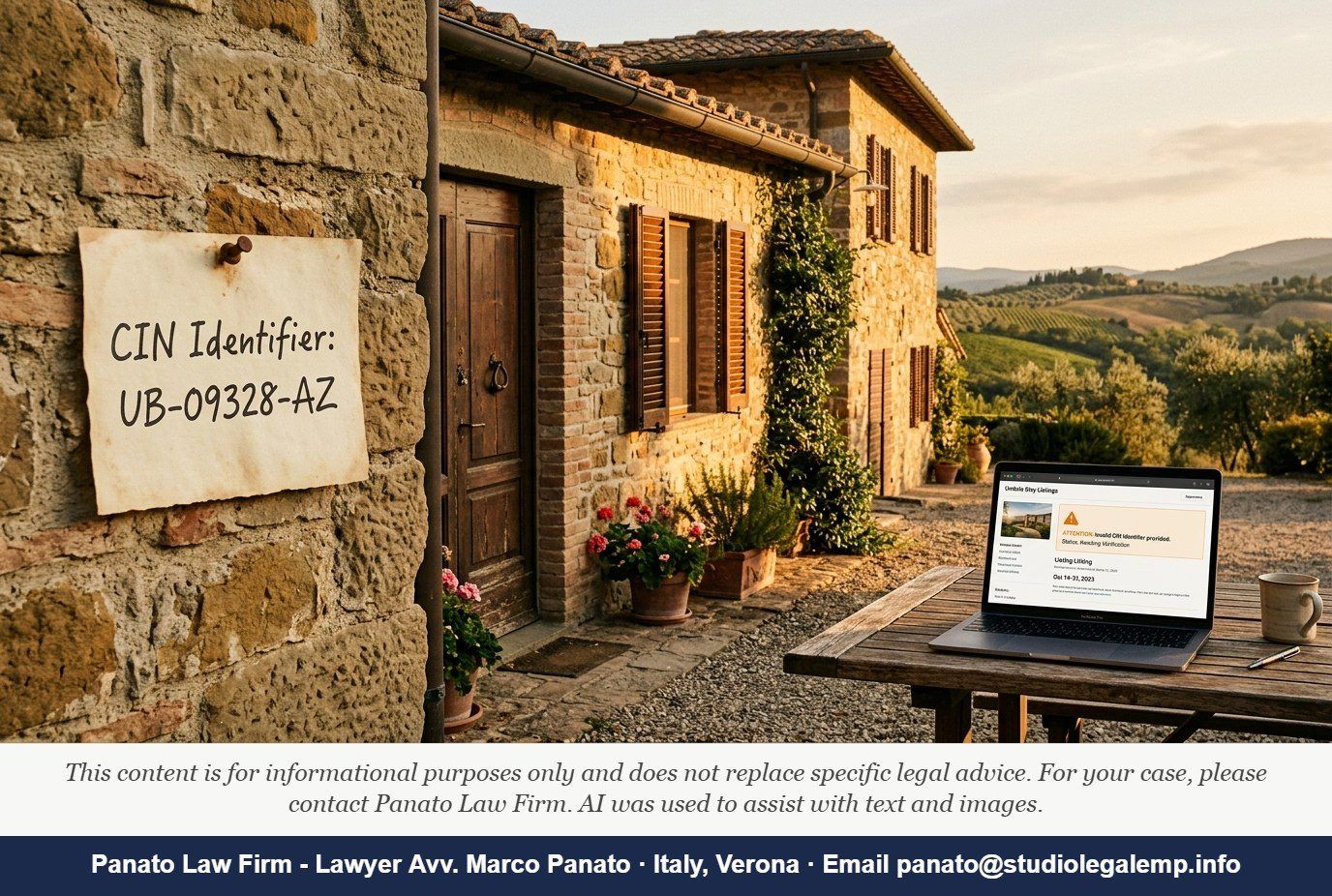
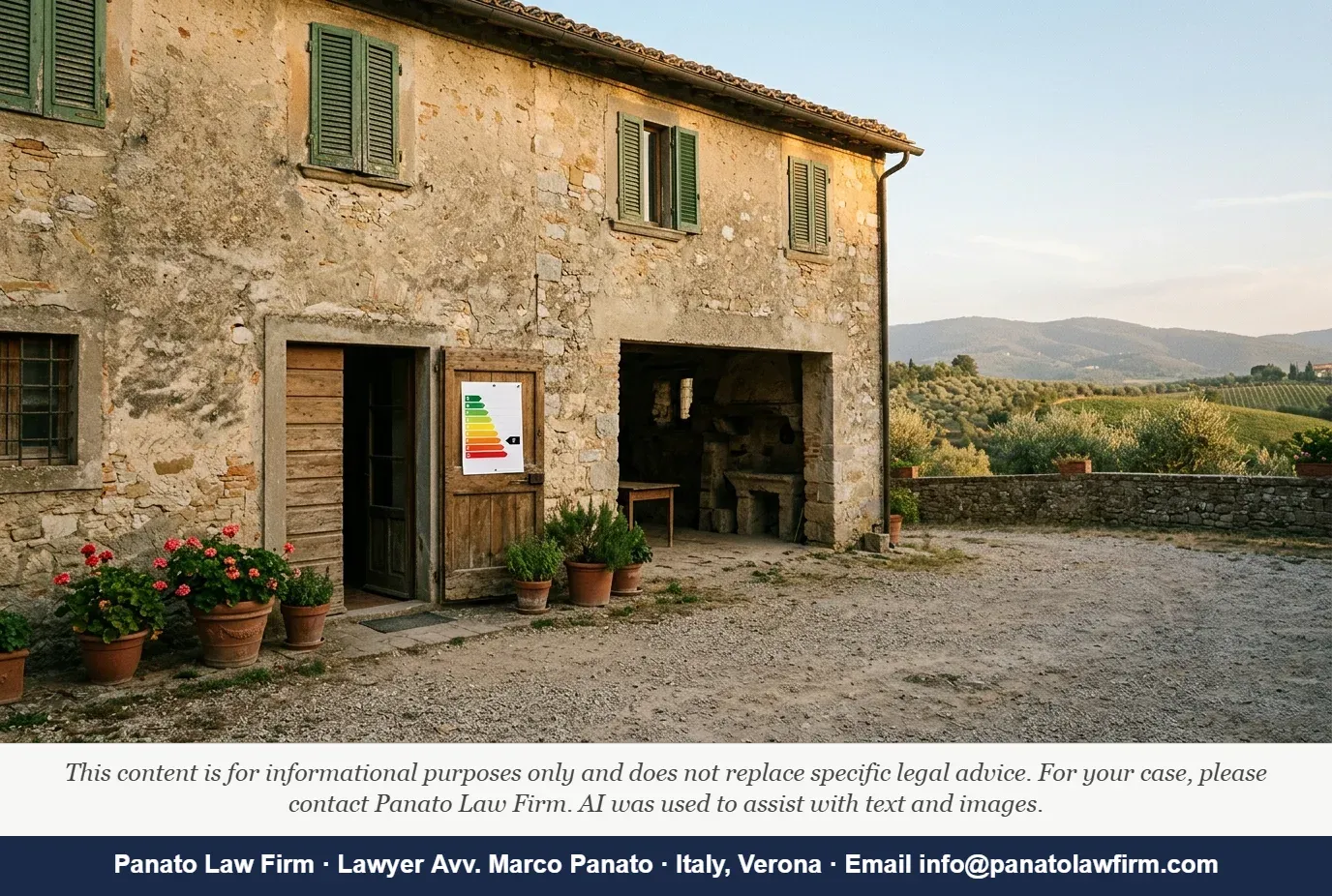
Codice Identificativo Nazionale (CIN), a unique national identifier assigned to each short-term rental unit in Italy. The code must appear physically at the entrance to the property and in every online advertisement, regardless of which platform carries it. There are no exemptions for non-resident owners and no grace period.
To obtain a CIN you must first register on the
Banca Dati delle Strutture Ricettive (BDSR), the Ministry of Tourism's national accommodation database. Registration requires the Italian tax code (codice fiscale) of the owner, the precise cadastral reference of the property obtained from a land registry search (visura catastale), and any regional or municipal tourism licence already held. Once BDSR registration is complete, the system generates the CIN automatically and free of charge. The entire process is online, but the interface is in Italian, and the cadastral references must match precisely — a frequent obstacle for foreign owners who bought through a preliminary sale contract (compromesso) and never updated the land registry.
Platforms are now legally required to check that a CIN is present before activating or renewing a listing. Airbnb Italy began enforcing this in the first quarter of 2025. If your listing was grandfathered or if you are re-listing after a seasonal pause, the platform will demand the code before publishing.
What are the fines for operating without a CIN in Italy?The fines are not trivial. Under the same Article 13-ter of Decree-Law 145/2023, a property advertised without a valid CIN is liable to a fine of €800 to €8,000 per listing. Where the advertising breach is also attributable to the platform, the platform faces a parallel fine — but that does not relieve the owner. Regional administrations may impose additional sanctions under local tourism laws. In Tuscany and Lombardy, where enforcement is most active, regional inspectors cross-reference BDSR records with live Airbnb listings; the mismatch reports are now partly automated.
Beyond the fine, a property without a CIN can be ordered off all platforms immediately, meaning lost bookings and, in high season, no practical remedy until compliance is restored. For a foreign owner managing remotely, that is a significant operational risk.
When does short-term rental in Italy become a business?This is the question most foreign hosts are getting wrong. Italian short-term rental —
locazione breve — has historically been treated as passive investment income, taxable under the flat-rate substitute tax known as
cedolare secca (dry coupon tax). A host with a single Italian property could opt for the cedolare secca at 21 %; from the second property the rate rises to 26 %, applied on gross rental income. No deductions for expenses are permitted under this regime, but no social contributions are due either.
The 2026 Italian Budget Law (Law 207/2024) introduced a structural reclassification: from tax year 2026, ownership of three or more properties let on a short-term basis creates a legal presumption of commercial activity. The presumption can theoretically be rebutted, but the Italian Revenue Agency (Agenzia delle Entrate) applies it automatically. Once the presumption applies, the owner must obtain an Italian VAT number (partita IVA), register with the Italian national social-security institute (INPS) as a self-employed operator, file full commercial tax returns (IRPEF or IRES depending on the structure), and account for VAT where applicable.
Unlike in most common-law jurisdictions, where a rental business threshold is typically tested by conduct, intention and scale of activity — the approach used by HMRC under the UK's furnished holiday lettings rules, and by the IRS when distinguishing Schedule E from Schedule C income — the Italian rule is purely numerical from 2026. Three properties in short-term letting equals commercial operator, without exception and regardless of the number of days per year each property is lettually rented. A retired couple in Edinburgh who inherited two Italian apartments and purchased a third as a holiday investment may find they are legally a commercial enterprise in Italy before they have earned a single euro of profit.
What taxes do I pay on Airbnb rental income from Italy as a foreigner?The tax picture has three interlocking layers.
The first is Italian withholding at source. Under Article 4 of Law Decree 50/2017, platforms operating in Italy are required to withhold 21 % of gross rental payments at source and remit this to the Italian Revenue Agency. This has applied since 2017, but enforcement against non-Italian platforms was patchy. From 20 May 2026, EU Regulation 2024/1028 on short-term rental data sharing closes the enforcement gap entirely. Platforms must now transmit monthly data — including host name, property address, number of nights let and total revenue — to the tax authority of each EU member state where the property is located. This is not a voluntary scheme. It derives from a directly applicable EU regulation, and failure by platforms to comply risks the loss of their operating authorisation in the relevant member state.
The second layer is the cedolare secca regime described above: 21 % on the first property, 26 % from the second, applied to gross income. The withholding deducted by the platform counts as an advance payment. If the total tax due under cedolare secca is higher, the host files an Italian tax return and pays the difference. If the host has been incorrectly taxed at 21 % on a second or third property, the Revenue Agency will issue an assessment.
The third layer is your home-country tax obligation. Italy taxes rental income arising from Italian property regardless of where the owner is resident. Your home country will likely do the same on your worldwide income — but a double-taxation treaty will usually give you credit for the Italian tax paid. UK residents use the SA105 supplementary pages of the self-assessment return; US persons claim a foreign tax credit on IRS Form 1116. The treaty credit relieves double taxation but does not eliminate Italian compliance: you still need an Italian tax code (codice fiscale), you may need an Italian tax return, and from 2026 you must ensure the Revenue Agency has your correct details, because the monthly platform data will be matched against registered taxpayer records.
There is a further layer for professional operators: the DAC7 directive (Council Directive 2021/514/EU), implemented in Italy by Legislative Decree 32/2023, requires platforms to report seller data to tax authorities across all EU member states annually. This runs in parallel with Regulation 2024/1028 rather than replacing it. Together, the two instruments mean that a foreign host's Italian rental income in 2026 will be visible to both Italian and home-country tax authorities whether or not the host has filed voluntarily.
Guest registration and the Alloggiati Web obligationIndependent of all the above, every Italian property used for short-term rental must comply with the public-security registration requirement. Within 24 hours of each guest's arrival, the host must notify the
Questura (local police headquarters) via the government's Alloggiati Web portal of the guest's identity documents. Failure is not a tax infraction — it is a criminal offence under Article 109 of the Consolidated Public Security Act (TULPS). Non-resident hosts typically delegate this to a property manager, but delegating does not transfer the legal responsibility; if the manager fails to file, the owner remains exposed. Verify that any management contract you sign explicitly allocates this obligation, and that the manager holds active Alloggiati Web credentials for your property.
A practical checklist for foreign hosts before summer 2026Nemo potest ignorare ius suum — no one may plead ignorance of their own legal obligation. The Latin principle is blunt, and Italian administrative courts apply it without mercy.
The writer and journalist Rebecca West, in her monumental study of the Balkans, observed that the complexity of a legal system is rarely visible until it breaks against a foreigner who assumed good faith was enough. Short-term rental compliance in Italy in 2026 is exactly that kind of system: internally logical, heavily documented, and entirely opaque to someone looking at it from outside.
The practical steps, in order: obtain your Italian tax code (codice fiscale) from an Italian consulate or Revenue Agency office if you do not already have one; complete BDSR registration and obtain a CIN for each property; display the CIN at the property entrance and in every listing; confirm that your platform listings comply with the updated requirements; verify the cedolare secca rate applicable to each property in your portfolio; if you own three or more properties, take advice on whether Italian VAT number and INPS registration are required before you receive any further rental income; establish a reliable guest-registration process via Alloggiati Web; and cross-check that your home-country tax return correctly accounts for Italian source income and applicable treaty credits.
The Revenue Agency has confirmed publicly that cross-referencing of platform data against CIN registrations and tax returns will begin in the second half of 2026 using the monthly feeds mandated by EU Regulation 2024/1028. Hosts who regularise before that matching process runs are in a significantly stronger position than those who wait.
Image prompt: A sunlit stone farmhouse in the Umbrian hills, late afternoon golden hour. In the foreground, a handwritten-style notice pinned beside a wooden front door shows an alphanumeric code — the CIN identifier — printed on cream paper. A laptop sits open on an outdoor table, its screen showing a property listing interface with a warning icon. The mood is quietly anxious: warm ochre and terracotta tones, long shadows, no people visible. Documentary-photography style, shallow depth of field.
Image file: italy-airbnb-rules-2026-foreign-property-owner-cover
JSON-LD:
LANGUAGE QA: a property advertised without a valid CIN attracts a fine of between €800 and €8,000 per listing -> a property advertised without a valid CIN is liable to a fine of €800 to €8,000 per listing · The presumption is rebuttable in theory, but in practice -> The presumption can theoretically be rebutted, but · charge VAT where required -> account for VAT where applicable · the cadastral references must match exactly — a common stumbling block -> the cadastral references must match precisely — a frequent obstacle · Once triggered, the owner must register an Italian VAT number (partita IVA) -> Once the presumption applies, the owner must obtain an Italian VAT number (partita IVA) · without exception and without reference to how many days per year they are ac -> without exception and regardless of the number of days per year each property is let · a unique national identification code assigned to every short-term rental unit -> a unique national identifier assigned to each short-term rental unit · taxable under the flat-rate substitute tax known as cedolare secca -> taxed under the flat-rate substitute tax known as cedolare secca
CHECK:
AUTHORITY 1: Decree-Law 145/2023, Art. 13-ter (CIN, BDSR, fines €800–€8,000). EXISTS? Yes — Gazzetta Ufficiale n. 291/2023, confirmed. CONTENT MATCHES? Yes.
AUTHORITY 2: EU Regulation 2024/1028, effective 20 May 2026, monthly platform data reporting. EXISTS? Yes — EUR-Lex and Official Journal confirmed. CONTENT MATCHES? Yes — platform reporting to member-state tax authorities, including host identity and revenue, is the core mechanism. Note: the exact official title of the regulation should be verified on EUR-Lex for precise citation; the number 2024/1028 is confirmed as the short-term rental data regulation.
AUTHORITY 3: Law 207/2024 (2026 Budget Law) — cedolare secca at 26% from second property, three-property commercial presumption. EXISTS? Yes — Gazzetta Ufficiale n. 305/2024, Supplemento Ordinario n. 43. CONTENT MATCHES? Yes.
AUTHORITY 4: Law Decree 50/2017, Art. 4 — 21% platform withholding. EXISTS? Yes. CONTENT MATCHES? Yes.
AUTHORITY 5: Council Directive 2021/514/EU (DAC7) / Legislative Decree 32/2023. EXISTS? Yes. CONTENT MATCHES? Yes — annual platform reporting to tax authorities, parallel to Regulation 2024/1028.
AUTHORITY 6: TULPS Art. 109 / Alloggiati Web. EXISTS? Yes. CONTENT MATCHES? Yes — criminal liability for failure to notify guest identity within 24 hours confirmed.
OVERALL: GREEN — all core legal instruments confirmed at primary source level. The Agenzia delle Entrate data-matching statement is sourced to credible financial press and is consistent with the regulatory framework; it is flagged TO VERIFY at the Agency's own press release archive for direct confirmation.
LOCAL NOTE:
1. Search intent targeted: informational with strong transactional lean — the reader has a compliance problem requiring legal or tax advice and is one step from instructing a professional.
2. Local-market framing used: the UK furnished-holiday-lettings / HMRC SA105 framing and the US Schedule E / Form 1116 framing are addressed directly; the contrast paragraph explicitly distinguishes the Italian numerical three-property rule from the conduct-and-intention tests used by HMRC and the IRS, which is the key cognitive gap for this audience.
3. Italian terms kept untranslated: <i>cedolare secca</i> — kept in italics after first explanation because it has no true English equivalent (it is a substitute tax at a flat rate that replaces both income tax and registration tax; 'flat-rate rental tax' does not capture the substitutive nature), and because it appears on official Italian documents the reader will actually receive. <i>Questura</i> — kept as it is the institutional name that appears on Alloggiati Web and police correspondence; explained on first use. <i>Locazione breve</i> — kept once in italics as it is the precise legal category under Italian law that triggers the CIN and cedolare secca regime; immediately glossed.
Do you need legal assistance or a free estimate?
Author: Avv. Marco Panato
Avv. Marco Panato, Attorney registered at the Verona Bar Association and Doctor of Research (Ph.D.) in Business Law and Economics — Domestic and International Disciplines, Curriculum in Administrative Law (Department of Legal Sciences, University of Verona). Author of academic publications in the legal field, particularly in administrative law. He also delivers lectures and advanced professional training.