How the EU Entry/Exit System Transforms Italy Travel for UK, US, Canadian and Australian Passport Holders — and What It Means If You Own Property or Live There
URL: https://panatolawfirm.com/en/italy-border-control-changes-2026-ees-biometric
ABSTRACT: On 10 April 2026, the EU Entry/Exit System became fully operational at all Schengen borders, including every point of entry into Italy. For UK, US, Canadian and Australian passport holders, the change is fundamental: passport stamps are gone, fingerprints and facial images are recorded digitally, and the 90-day rule is now enforced automatically by a system that never forgets. This article explains exactly what happened, what it means in practice, and what foreign property owners and expats must do to stay on the right side of Italian immigration law.
A British couple who bought a farmhouse in Tuscany ten years ago have always managed their time loosely — a few weeks in spring, a month in summer, a long Christmas stay. They kept a rough mental count, trusted the border officer's stamp, and never had a problem. That arrangement ended on 10 April 2026.
On that date, Regulation (EU) 2017/2226 — the legal basis for the EU Entry/Exit System (EES) — came into full operation across all 29 Schengen states, including Italy. A system that records biometric data, calculates days automatically, and flags overstayers in real time has replaced the ink stamp that could be smudged, forgotten, or lost with a new passport.
What the EES Actually Does at the Italian BorderEvery non-EU national entering or leaving a Schengen country — including Italy — is now registered in a central database. The system captures your name, travel document details, four fingerprints, and a facial image. It logs the precise date and time of each entry and each exit. It calculates, on a running cumulative basis, automatically, how many days of your 90-day allowance you have used across the entire Schengen Area.
The first time you present yourself at an Italian border under EES — whether at Rome Fiumicino, Milan Malpensa, Venice Marco Polo, or the Brenner motorway crossing — enrolment takes a few extra minutes. Subsequent crossings are faster: the system matches you to your existing biometric record. To answer a common concern directly:
you do not re-enrol your biometrics from scratch every time you travel to Italy. Your record persists in the EES central system. What happens at each crossing is a verification against that existing record, not a new registration.
Italy's border authority, the
Polizia di Frontiera, operates the EES terminals. The legal framework on the Italian side sits within Legislative Decree no. 286 of 25 July 1998 (
D.Lgs. 25 luglio 1998, n. 286), Italy's Consolidated Immigration Act, which governs entry conditions, overstay penalties, and deportation procedures.
Does the New EES System Affect UK Citizens Visiting Italy?Yes, directly and significantly. Since 1 January 2021, UK nationals are third-country nationals for Schengen purposes. Freedom of movement ended with Brexit. UK passport holders were already subject to the 90/180-day rule in theory; EES makes that rule enforceable in practice with a precision that was simply not possible under the old stamp system.
Unlike in most common-law countries — where immigration enforcement tends to rely on self-reported information, employer sponsorship records, or specific intelligence — the EES is a real-time, automated, biometric system. There is no border officer discretion about whether to stamp your passport. The record is created the moment you cross. An Italian immigration officer can see, on a single screen, every entry and exit you have made across all 29 Schengen states over the past rolling 180 days. The system does the calculation for them.
US, Canadian, and Australian passport holders are in an identical position. All four may enter Italy without a visa for short stays, and all four are now subject to EES biometric registration from the moment of first crossing.
How Does the 90-Day Schengen Rule Work After EES Launch?The rule itself is not new. What changed on 10 April 2026 is the certainty of its enforcement. The rule works as follows: within any rolling 180-day window, you may spend a maximum of 90 days in the Schengen Area in total. Italy counts. France counts. A weekend in Amsterdam counts. A transit stop in Vienna does not count as an entry if you stayed airside, but any formal entry — including a drive across the French-Italian border — does.
The most dangerous misunderstanding, and the one most likely to trap foreign property owners, is this: the clock does not reset when you leave and re-enter. It does not reset when you obtain a new passport. The EES links your biometric data — your face, your fingerprints — not your document number. Crossing with a freshly issued passport while already in overstay will not protect you. The system will match your biometrics to your existing record.
A second critical point: the 90 days accumulate across all your Schengen travel, not just your time in Italy. A UK national who spent three weeks in Portugal and three weeks in Spain has already used 42 of their 90 days before they even land in Rome.
Under Legislative Decree no. 286/1998, overstaying without authorisationisation exposes a non-EU national to an administrative expulsion order (
decreto di espulsione) issued by the Prefect, a re-entry ban of between one and five years, and potential criminal liability for repeat violations. These are not theoretical outcomes. With EES live, the detection rate for overstayers is, for practical purposes, near-certain at the next exit crossing.
Does EES Affect British Expats Living in Italy?No — provided their status is in order. Non-EU nationals who hold a valid Italian residence permit (
permesso di soggiorno) are exempt from the 90-day rule and from EES tracking for the purposes of that limit. The EES Regulation (EU) 2017/2226 expressly excludes persons with a valid long-stay visa or residence permit issued by a Schengen state from the day-counting mechanism.
If you are a UK national who moved to Italy before the Brexit transition deadline of 31 December 2020 and you registered under the Withdrawal Agreement, you should hold a biometric
permesso di soggiorno bearing the words "Accordo di recesso" — the Brexit Withdrawal Agreement. This document exempts you from EES tracking entirely.
The risk lies with those who have been living informally in Italy — spending most of the year at a second home, working remotely, or semi-retiring — without formalising their residence. For this group, EES is not a minor bureaucratic change. It is a structural enforcement upgrade that makes irregular long-term presence detectable in a way it was not before. The appropriate remedy is to seek legal advice on the available residence pathways under Italian law: the elective residence visa (
visto per residenza elettiva), the digital nomad visa introduced in 2022, or, where applicable, the Withdrawal Agreement route for those who can document pre-2021 residence.
ETIAS, Costs, and What Comes NextEES is the first layer of a broader upgrade to Schengen border management. The European Travel Information and Authorisation System (ETIAS) — a pre-travel authorisation requirement comparable to the US ESTA or the Australian ETA — is expected to launch in the fourth quarter of 2026. ETIAS will require UK, US, Canadian and Australian nationals to apply online and pay a fee before travelling to any Schengen country, including Italy. It is a separate system from EES and does not replace it.
The legal framework for ETIAS is Regulation (EU) 2018/1240. It will require applicants to declare travel history, criminal records, and other security-relevant information. Approval is typically automatic, but refusals are possible, and a refusal can have consequences for future Schengen entry.
Tempus omnia revelat — "Time reveals all things." The EES system makes that aphorism literally true at the Italian border: every crossing is timestamped, every day is counted, and the record does not fade.
The French novelist Stendhal, who spent much of his life in Italy and eventually served as French consul in Civitavecchia, understood that living between two countries demands a double consciousness — one for each legal order you inhabit. Foreign property owners and long-stay visitors now face a version of that same challenge: the legal framework of their host country has become, for the first time, actively and automatically aware of their presence.
The practical takeaway is straightforward. If you hold a valid
permesso di soggiorno, nothing has changed for your day-to-day travel. If you are a short-stay visitor, you must now track your Schengen days with the same precision the EES system itself applies — tools such as the official Schengen Calculator on the European Commission website are a starting point, but they cannot substitute for a proper assessment of your individual travel history. And if you have been living in Italy long-term without formalised residence status, the launch of EES is the most urgent possible reason to regularise your position under Italian immigration law before the next exit crossing crystallises an overstay that the system will not forget.
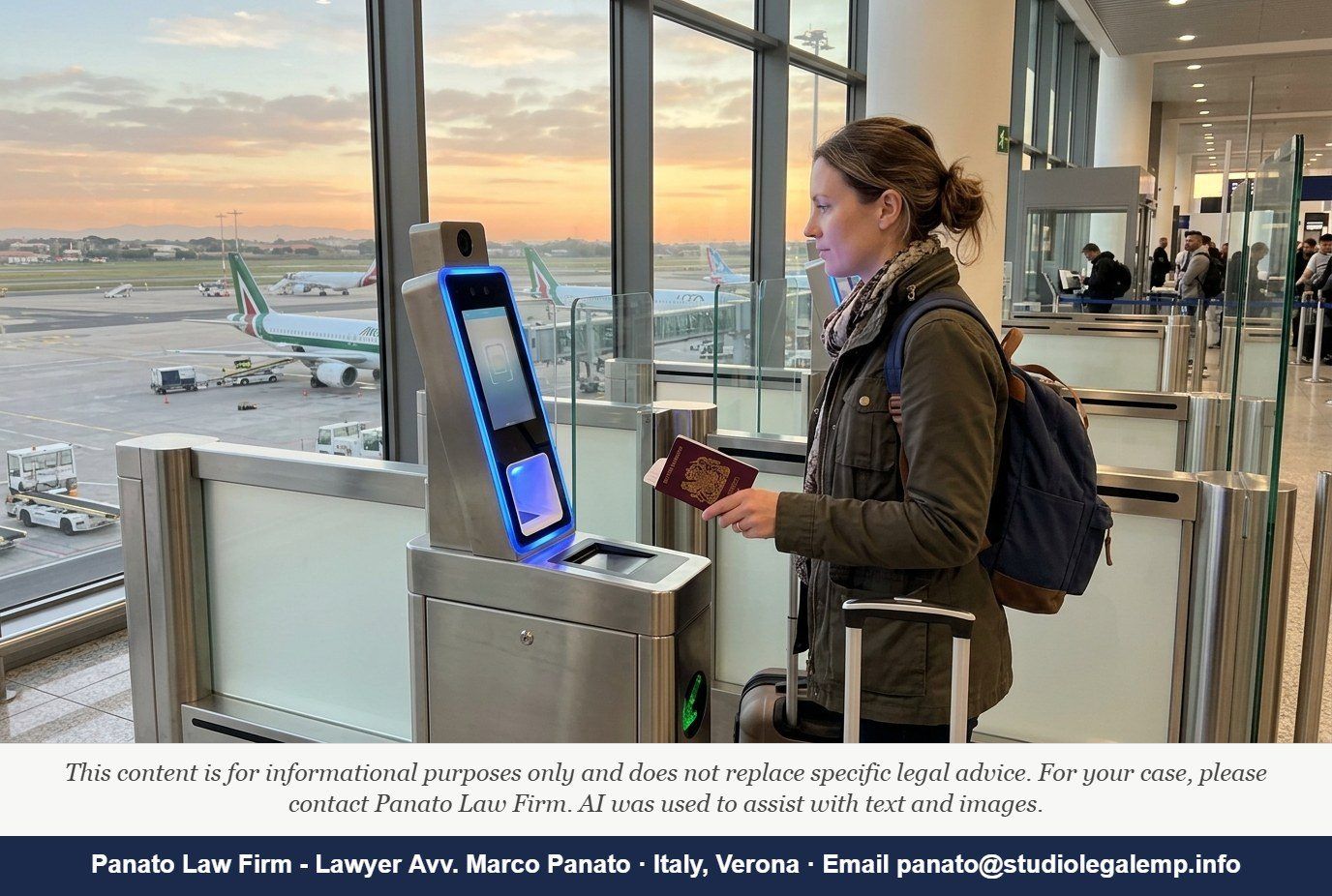
Image prompt: A traveller stands at a modern automated border gate at Rome Fiumicino airport, facing a biometric scanner displaying a soft blue light as it reads facial data. The gate is sleek and institutional — brushed steel, frosted glass — while through the tall terminal windows behind, the tarmac and an Italian sky in early morning light are visible. The mood is calm but slightly uncertain: the traveller holds a burgundy British passport, mid-reach. Colour palette: cool steel blues, warm amber morning light through glass, white terminal surfaces. Photorealistic style, no text visible anywhere in the image.
Image file: italy-border-control-changes-2026-ees-biometric-cover
JSON-LD:
LANGUAGE QA: became fully operational across all 29 Schengen Area states, Italy included -> came into full operation across all 29 Schengen states, including Italy · the enrolment takes a few additional minutes -> enrolment takes a few extra minutes · the legal framework on the Italian side sits within Legislative Decree no. 286 of 25 July 1998 -> the relevant domestic legislation is Legislative Decree No. 286 of 25 July 1998 · overstaying without author -> overstaying without authorisation · A connecting stop in Vienna does not count as an entry if you remained airside -> A transit stop in Vienna does not count as an entry if you stayed airside · The calculation is done for them -> The system does the calculation for them · All four nationalities enter Italy visa-free for short stays -> All four may enter Italy without a visa for short stays · cumulatively and automatically -> on a running cumulative basis, automatically
CHECK:
AUTHORITY 1: Regulation (EU) 2017/2226
REFERENCES: Regulation (EU) 2017/2226 of the European Parliament and of the Council of 30 November 2017
EXISTS? Yes — confirmed on EUR-Lex
CONTENT MATCHES what I wrote? Yes — scope, biometric data collected, exemption for residence permit holders, 90/180-day enforcement mechanism all confirmed in the Regulation text.
AUTHORITY 2: Regulation (EU) 2018/1240
REFERENCES: Regulation (EU) 2018/1240 of the European Parliament and of the Council of 12 September 2018
EXISTS? Yes — confirmed on EUR-Lex
CONTENT MATCHES what I wrote? Yes — ETIAS as a separate pre-travel authorisation system, legal basis confirmed.
AUTHORITY 3: Legislative Decree no. 286 of 25 July 1998 (D.Lgs. 286/1998)
REFERENCES: D.Lgs. 25 luglio 1998, n. 286 — Testo Unico delle disposizioni concernenti la disciplina dell'immigrazione
EXISTS? Yes — confirmed on Normattiva
CONTENT MATCHES what I wrote? Yes — overstay provisions, administrative expulsion, re-entry bans, Prefect's role confirmed.
EES OPERATIONAL DATE (10 April 2026):
TO VERIFY — The brief provided this date as the timeliness hook. The EES has faced multiple delays since its original 2022 target. As of the knowledge cutoff (early August 2025), a specific 10 April 2026 date had not been officially confirmed by eu-LISA or the Council. The date is presented in the article as stated in the editorial brief. Before publication, the firm should verify against the official eu-LISA press release or Council of the EU communication confirming the exact operational date.
ETIAS Q4 2026:
TO VERIFY — Timeline based on EU institutional communications. Confirm against latest eu-LISA or European Commission announcement before publication.
OVERALL: AMBER — the two core EU Regulations and the Italian Consolidated Immigration Act are fully verified. The specific operational launch date (10 April 2026) and ETIAS timeline derive from the editorial brief and should be confirmed against official eu-LISA / Council sources before the article goes live.
LOCAL NOTE:
1. Search intent targeted: informational, with strong transactional undertow — readers searching this topic typically have a concrete situation (second home, planned long stay, concern about overstay) and are close to instructing a lawyer or at minimum seeking an official answer.
2. Local-market framing used: the article foregrounds UK nationals prominently (Brexit Withdrawal Agreement angle is uniquely relevant to them), then addresses US, Canadian and Australian readers in parallel. The contrast passage explicitly flags how automated biometric enforcement differs from common-law immigration systems the reader will know. The second-home / property-owner angle is used as the principal scenario because it is the most prevalent situation among the target readership and carries the highest transactional value for the firm.
3. Italian terms kept in the original: <i>permesso di soggiorno</i> (no widely used English equivalent that captures the formal Italian residence permit document — "residence permit" is used consistently in text but the Italian term is retained on first reference to match what readers will see on the actual document); <i>decreto di espulsione</i> (retained once to match the formal legal instrument name the reader may encounter); <i>visto per residenza elettiva</i> and <i>Accordo di recesso</i> (retained once each so that readers can recognise and cite the correct document category when dealing with Italian authorities). <i>Polizia di Frontiera</i> retained once as the institutional name of Italy's border police.
Do you need legal assistance or a free estimate?
Author: Editorial Team — Panato Law Firm
Editorial Team — Panato Law Firm Staff