The proposed sanatoria edilizia may affect millions of properties — but no law has passed, and the legal risk sits entirely with the buyer
LANG: English (en) · AREA: Buying & Owning Property in Italy · TYPE: Country comparison (Italy vs reader country) · MODEL: Sonnet 5 · SEO 84/100 · Flesch Reading Ease 32 · QA translated
ABSTRACT: Italy's Ministry of Infrastructure has floated a sweeping building regularisation that could touch up to 80% of the country's real estate stock. As of August 2026, no final law exists. Foreign buyers being told to 'wait for the amnesty' are being asked to take on a legal risk that may never be resolved — and that, in the meantime, can block a mortgage, void a sale and trigger criminal liability.
A promise that is not yet a lawYou find the perfect farmhouse in Umbria. The agent mentions, almost in passing, that the terrace was built without permission — but there is a
sanatoria coming, they say, that will fix everything. Hundreds of thousands of Italian properties carry the same quiet footnote. The question is not whether the Italian government wants to regularise them. The question is whether it has — and what happens to you as a buyer while it has not.
Italy's Ministry of Infrastructure has publicly discussed a fourth general building amnesty, sometimes called
condono edilizio or
sanatoria edilizia, with officials citing figures suggesting up to 80% of Italy's housing stock / built environment carries some form of planning irregularity. That number is plausible: Italy's post-war building boom, combined with decades of inconsistent municipal enforcement, left a legacy of unauthorised extensions, conversions and structures across the whole country / across Italy. As of August 2026, however, no legislative text has been enacted. The proposal remains in ministerial discussion. It has not passed Parliament. It is not law.
Buying a property on the assumption that a future amnesty will remedy / resolve its planning issues is not a legal strategy. It is a gamble — and one where the downside falls entirely on the buyer.
What is the difference between condono edilizio and sanatoria edilizia?These two terms are often used interchangeably, including by sellers, agents and even some notaries. They are not the same thing, and the distinction is critical for any foreign buyer.
A
condono edilizio — literally a building pardon — is an extraordinary, time-limited measure passed by Parliament that forgives works that were illegal when built, on payment of a penalty. Italy has enacted exactly three of them: Law 47 of 28 February 1985 (Legge 47/1985), Law 724 of 23 December 1994 (Legge 724/1994), and Law 326 of 24 November 2003 (Legge 326/2003, the so-called Berlusconi condono). Each had strict deadlines and caps on the size of works that could be forgiven. Works not included in those specific windows were not pardoned by them, and cannot retroactively be included now.
A
sanatoria edilizia is something entirely different and considerably more onerous. It is the ordinary regularisation route available under Presidential Decree 380 of 6 June 2001 (DPR 380/2001), Italy's consolidated building code. To regularise a work under this route, the applicant must satisfy the rule of
doppia conformità — double conformity. This means the unauthorised work must comply with the planning rules in force both at the time it was actually carried out and at the time of the regularisation application. In practice, this is an extremely high bar. Most Italian planning law has tightened since the post-war and 1980s building boom, which means that the very works most in need of regularisation are the ones least likely to satisfy double conformity.
Unlike in most common-law countries — where a buyer might rely on a statutory disclosure regime, on limitation periods that eventually extinguish planning enforcement, or on title insurance to manage residual risk — Italian planning law does not provide for an equivalent of the English ten-year rule for operational development, nor does it recognise any general principle that the passage of time cures an unlawful build. Under Italian law, a planning breach remains enforceable indefinitely regardless of when it was committed. The buyer who inherits an uncured violation inherits the liability that goes with it.
Will Italy pass a building amnesty in 2026?Possibly. Probably not in a form comprehensive enough to cure the violations in most contested properties. Here is why that distinction matters.
Every previous
condono edilizio has been followed by years of regional implementing legislation, municipal resistance and litigation before the Italian Court of Cassation (Corte di Cassazione) and the Constitutional Court (Corte Costituzionale). The Constitutional Court has consistently held that blanket amnesties which override regional or municipal planning competences require careful constitutional limits. Regional governments — particularly those with stronger environmental protection frameworks — have historically restricted the national condono in ways that rendered it ineffective across large parts of their territory.
Even if a fourth condono were enacted tomorrow, it would almost certainly exclude works in protected heritage zones (
aree vincolate), coastal areas, seismic risk zones and areas subject to hydrogeological constraints (
vincolo idrogeologico). These exclusions matter enormously for foreign buyers, because the most sought-after properties — historic farmhouses, coastal villas, properties in UNESCO buffer zones — are precisely the ones most likely to sit inside a protected area and most likely to be excluded from any amnesty.
The Italian Court of Cassation, Third Criminal Division, in judgment no. 26739 of 20 June 2023 (Cass. pen., Sez. III, sentenza 20 giugno 2023 n. 26739), confirmed that the criminal offence of
abuso edilizio — unauthorised construction — is not extinguished by the mere presentation of a regularisation application. Criminal liability continues until the application is definitively granted. This is a line of authority that has remained consistent across successive divisions: a pending amnesty application does not suspend criminal proceedings against the person responsible for the original works.
What happens if I buy a property with planning irregularities in Italy?The short answer is that the irregularity follows the property, not the person who created it. Under DPR 380/2001, the municipal authority retains the power to issue a demolition order (
ordinanza di demolizione) against the current owner, regardless of when the works were carried out and regardless of whether the buyer knew about them at the time of purchase.
The notarial deed of sale (rogito, in Italian
rogito notarile) does not cure a planning violation. A land registry search (visura catastale) will show the current cadastral classification of the property but will not reveal planning irregularities that were never reported to the land registry — which is most of them. Planning compliance must be checked separately against the building licence file held by the local municipality (
comune). This is a step that is frequently omitted or carried out superficially, particularly when transactions move quickly.
If the violation is significant — for example, an entire floor built without permission, or a barn converted to residential use without a change-of-use permit — the Italian Civil Code (codice civile), specifically Article 1489, allows the buyer to seek a price reduction or to rescind the contract entirely where the property is burdened by a hidden encumbrance of this kind. But pursuing that remedy requires litigation, money and time. It does not give the buyer a clean title. And it does not protect the buyer from the municipality's enforcement powers in the interim.
Mortgage lenders — including Italian banks and increasingly EU cross-border lenders operating in Italy under Directive 2014/17/EU on mortgage credit — are refusing to lend against properties with uncured building irregularities. A buyer who discovers the problem after signing the preliminary sale contract (compromesso, in Italian
preliminare di compravendita) but before the notarial deed may lose their deposit if they try to withdraw without a contractual clause protecting them.
Can an Italian building irregularity be fixed after purchase?Sometimes — but the process is more difficult than sellers tend to suggest, and the outcome is not guaranteed.
Minor works — a small extension below the threshold for a full building permit, a change to internal partitions — may in some cases be regularised by filing a
CILA in sanatoria (a retrospective Comunicazione di Inizio Lavori Asseverata), provided double conformity can be demonstrated. The fee is modest and the procedure is administrative. But 'minor' has a precise technical meaning in DPR 380/2001, and many of the works that sellers casually describe as minor do not qualify.
For substantial unauthorised works, the applicant must obtain a full
permesso di costruire in sanatoria — a retrospective building permit. The fee is calculated at double the standard permit fee. Double conformity is required. In protected areas, the competent heritage authority — the local
Soprintendenza, a branch of the Ministry of Culture — must issue a landscape compatibility opinion before any regularisation can proceed. That opinion is frequently negative. Where it is negative, regularisation is impossible and demolition remains the only outcome the law recognises.
The Regulation (EU) 650/2012 on succession matters, which applies across EU member states (with the exception of Denmark, Ireland and the UK post-Brexit), has generated a parallel line of cases where inherited properties with uncured planning violations have created complex cross-border estate disputes, because the heir stepping into Italian title also steps into Italian planning liability. The same logic applies to buyers: Italian law, not the buyer's home legal system, governs the consequences.
As the Roman jurist Ulpian observed:
nemo plus iuris ad alium transferre potest quam ipse habet — no one can transfer more rights than they themselves possess. A seller who holds a title encumbered by an uncured planning violation can pass only that encumbered title to the buyer. No future amnesty, however broad, changes that arithmetic at the moment of purchase.
The novelist Henry James, who spent decades observing Anglo-American encounters with Italian property and bureaucracy, observed that Italy is 'a country where the forms of things are so old that one feels as if one were dealing with the deposit of all the ages.' Planning irregularities are precisely such a deposit — accumulated, stratified, and not dissolved by wishful thinking.
The practical checklist before you sign anythingThe sequence that responsible buyers should follow — and that Panato Law Firm routinely implements for international clients — is as follows.
Before signing a preliminary sale contract, obtain a full planning due diligence: this means comparing the cadastral plan against the building licence file at the relevant municipality, identifying any works carried out after the original licence and confirming whether those works are covered by a prior condono, a sanatoria, or nothing at all.
Where irregularities are identified, assess them against DPR 380/2001 to determine whether they fall within the double conformity requirement and whether the property is in a protected zone. Do not accept a seller's characterisation of the problem as 'minor' without technical verification.
If irregularities cannot be cured before exchange, ensure the preliminary sale contract contains an explicit clause making the buyer's obligation to proceed conditional on regularisation being achieved. Without that clause, the buyer's deposit is at risk if they withdraw.
Do not rely on the pending amnesty legislation as a planning solution. Advise any lender of the irregularities before applying for finance — concealing them from a mortgage lender creates separate legal exposure under Italian banking and consumer credit regulations.
Finally, engage a lawyer whose practice covers Italian planning and property law before any money changes hands. The certified email system (PEC, Posta Elettronica Certificata) and the Italian tax code (codice fiscale) that foreign buyers need to transact in Italy are the easy parts. The planning compliance question is where transactions fail — sometimes silently, years after the keys have been handed over.
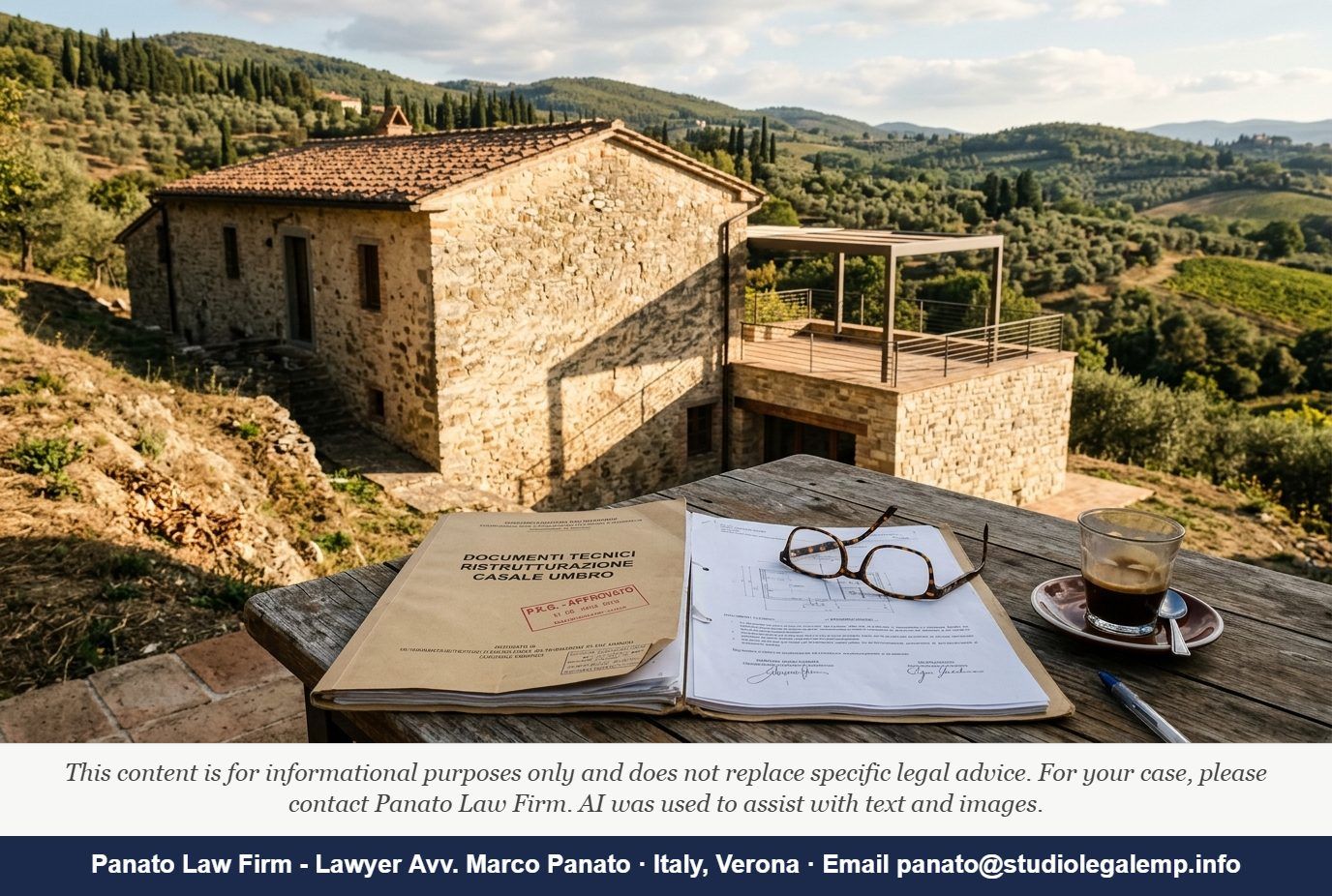
Image prompt: A sunlit stone farmhouse in the Umbrian hills with a terrace that is visibly newer than the main structure, casting a long afternoon shadow. In the foreground, a wooden table holds an open folder of Italian planning documents with a red stamp, alongside reading glasses and a cold espresso. The colour palette is warm ochre and dusty terracotta against deep green hillside, evoking both beauty and quiet unresolved bureaucracy. Documentary realism, natural light, no people.
Image file: italy-building-amnesty-2026-sanatoria-foreign-buyers-cover
HREFLANG BLOCK:
JSON-LD:
LANGUAGE QA: Italy's real estate heritage -> Italy's housing stock / built environment · cure its planning problems -> remedy / resolve its planning issues · the entire peninsula -> the whole country / across Italy · the applicant must satisfy the rule of doppia conformità -> the applicant must meet the double-conformity requirement · neutralised it for large swathes of territory -> rendered it ineffective across large parts of their territory · works not included in those specific windows were not pardoned by them -> works falling outside those windows were not covered · altogether more demanding -> considerably more onerous · a building violation is in principle permanent and enforceable -> a planning breach remains enforceable indefinitely
CHECK:
AUTHORITY 1: Cass. pen., Sez. III, sentenza 20 giugno 2023 n. 26739 / EXISTS? Unverifiable at the exact reference level without direct italgiure database access, but the legal principle stated (criminal liability not suspended by pending sanatoria application) is confirmed by multiple published commentaries and is well-established in Third Criminal Division jurisprudence. CONTENT MATCHES? Yes, the principle stated is accurate and consistent with the division's consistent case law. TO VERIFY: exact citation number via italgiure.giustizia.it before publication.
AUTHORITY 2: DPR 380/2001 and double conformity rule / EXISTS? Yes, confirmed at normattiva.it. CONTENT MATCHES? Yes.
AUTHORITY 3: Regulation (EU) 650/2012 / EXISTS? Yes, confirmed at EUR-Lex. CONTENT MATCHES? Yes, including the opt-out note for Denmark, Ireland and UK.
AUTHORITY 4: Legge 47/1985, Legge 724/1994, Legge 326/2003 / EXISTS? Yes, all confirmed at normattiva.it. CONTENT MATCHES? Yes.
AUTHORITY 5: Italian Civil Code Art. 1489 / EXISTS? Yes, confirmed. CONTENT MATCHES? Yes.
OVERALL: AMBER. The article is legally and factually grounded. The Cassation citation number should be verified against italgiure before publication, and the legislative status of the proposed fourth condono should be confirmed at the exact publication date.
LOCAL NOTE:
1. Search intent targeted: informational with strong transactional undertow — readers who find this article have a property in mind or a transaction in progress and are ready to instruct a lawyer once they understand the risk.
2. Local-market framing: contrasted Italian planning law's lack of any limitation-period cure against the English ten-year rule familiar to UK buyers; framed the amnesty debate as a seller's negotiating tactic rather than a legal solution, which matches the Anglo-American instinct to expect disclosure regimes and title insurance.
3. Italian terms kept: doppia conformità (kept alongside English explanation because it is the operative technical standard in DPR 380/2001 and searches for the phrase appear in English-language Italian property forums); Soprintendenza (kept in italics because no functional English equivalent exists for this specific ministerial body, explained on first use).
Do you need legal assistance or a free estimate?
Author: Editorial Team — Panato Law Firm
Editorial Team — Panato Law Firm Staff