How Italian insolvency law can force foreign creditors to return money they have already received — and what a 2025 Supreme Court ruling means for rescheduled debts
URL: https://panatolawfirm.com/en/italy-clawback-risk-payment-before-insolvency
ABSTRACT: Receiving a late payment from an Italian client feels like a relief. In Italian insolvency law, it may be the beginning of a new problem. Under Articles 165–171 of the Italian Corporate Crisis and Insolvency Code (CCII), a liquidation trustee can reverse payments made months or even years before the client's formal insolvency — and a landmark ruling of the Italian Court of Cassation in January 2025 has widened that exposure for creditors who negotiated instalment arrangements with struggling counterparties.
You closed the deal, delivered the goods or the services, chased the invoice for months, and eventually agreed on a payment schedule / reached a payment agreement with your Italian client. The money arrived. Then, six months later, the client went into liquidation / entered insolvency proceedings. Now a court-appointed trustee writes demanding repayment.
This is not a hypothetical. It is the precise scenario addressed by the Italian Court of Cassation, Third Civil Division, in ruling no. 3450 of 11 February 2025 (Cass. civ., Sez. III, sent. 11 febbraio 2025 n. 3450). The ruling has significant implications for any foreign business that has renegotiated payment terms with a distressed Italian counterparty.
The legal mechanism: what is the Italian clawback action?The mechanism is called the
azione revocatoria fallimentare, or revocatory action in insolvency — known in Italian practice simply as the
revocatoria. Under Italian law, when a company enters judicial liquidation (
liquidazione giudiziale) under the Italian Corporate Crisis and Insolvency Code (the
Codice della Crisi d'Impresa e dell'Insolvenza, Legislative Decree no. 14 of 12 January 2019, hereafter CCII), the appointed trustee acquires the power to challenge, and in some cases render automatically voidable, transactions made before the insolvency date.
The rationale is the ancient rule of creditor equality:
par condicio creditorum — equal treatment of creditors. One creditor who receives full payment shortly before insolvency gains an advantage over all others who will share what remains. Italian insolvency law corrects that imbalance by putting the payment back into the estate.
The CCII consolidated and updated the former bankruptcy law (Regio Decreto 267/1942, the old
Legge Fallimentare). Articles 165 to 171 CCII now govern claw-back actions, replacing the old Articles 64 to 71. The substance is largely preserved, but the CCII introduced more structured exemptions for rescue procedures — a distinction that is central to the 2025 ruling.
Can Italy's insolvency trustee reverse a payment I received?The short answer is yes, within specific look-back windows. Italian law distinguishes between two categories of clawback risk / vulnerability to clawback.
The first category covers
normal payments: sums paid for debts that were already due and payable. These are challengeable if made within six months before the court declaration of insolvency, but the trustee must prove that the receiving creditor
knew of the debtor's insolvency at the time of payment. This is the subjective test.
The second category covers
abnormal payments: transactions where the means or timing of payment deviates from what was agreed or from ordinary commercial practice. This includes payments made with unusual instruments (transfer of assets in lieu of cash, early repayment of a term loan, grants of security over unencumbered assets). Here prejudice to creditors is
presumed, and the look-back window extends to one year before insolvency. The creditor bears the burden of rebutting the presumption.
For certain gratuitous transactions and payments made for debts not yet due, the look-back window extends to two years.
Unlike in most common-law jurisdictions — where fraudulent preference claims require proof of an intention to prefer a specific creditor, and where the prescribed period is often fixed by statute at six months or two years only for connected parties — Italian law imposes an objective presumption of prejudice for abnormal payments regardless of the creditor's intentions. A foreign creditor acting in complete commercial good faith can still be compelled to repay.
What is the suspect period for Italian bankruptcy claw-back?The look-back periods run backwards from the date on which the court formally declares the company insolvent (the
sentenza di apertura della liquidazione giudiziale). They do not run from the date of the insolvency filing or from any earlier point of apparent financial distress.
Normal payments: six months.
Abnormal payments and guarantees granted for pre-existing debts: one year.
Gratuitous or undervalue transactions: two years.
In practice, establishing the precise reference date matters enormously. Italian courts have held that the date that triggers the look-back is the court's declaration, not an earlier voluntary filing or negotiation. However, if a company attempted and failed a pre-insolvency rescue, the declaration date may be later than a creditor assumes, potentially [text appears truncated]ransactions back into the window.
Does accepting a repayment plan from a struggling Italian company increase claw-back risk?This is precisely the question resolved by the Italian Court of Cassation ruling no. 3450 of 11 February 2025 — and the answer is: yes, in most cases.
The facts before the court involved a supplier that had agreed to a rescheduled payment plan with a client whose debts were already past due. The supplier received the rescheduled instalments, then the client entered liquidation. The trustee brought a claw-back action, arguing that the guarantees and payments made under the rescheduling plan were abnormal, because the underlying debt had been expired at the date of the original rescheduling agreement.
The Court of Cassation confirmed the trustee's position. The rescheduling arrangement did not, in the court's analysis, create a new debt with a fresh due date. It merely modified the repayment timetable of an already-expired obligation. Because the debt was already overdue at the moment the guarantee was granted, that guarantee fell squarely within the category of abnormal transactions under Article 166(2) CCII. Prejudice was presumed; the supplier had to return the sums.
This is the trap. A creditor who presses for and obtains a rescheduling plan — perhaps precisely because the debtor seems financially fragile — may inadvertently convert a borderline normal payment into a clearly abnormal one, extending the look-back window from six months to one year and shifting the burden of proof.
The one significant safe harbour is found in Article 166(3)(d) CCII. Payments made by a debtor acting within a codified rescue instrument — specifically a certified restructuring plan (
piano di ristrutturazione soggetto ad omologazione), a court-approved composition with creditors, or a debt restructuring agreement ratified by the court — are exempt from claw-back. The exemption reflects a deliberate policy choice: encouraging distressed companies to use supervised rescue tools rather than ad hoc side arrangements. An informal rescheduling agreed bilaterally, without court involvement, does not qualify.
How can a foreign creditor protect itself from an Italian revocatoria action?No single measure eliminates claw-back risk entirely, but a combination of steps reduces it substantially.
Document good faith reliance. The subjective claw-back test for normal payments requires the trustee to prove the creditor knew of the insolvency. Contemporaneous records — credit reports, correspondence from the debtor affirming solvency, assurances that the rescheduling is part of a broader financial stabilisation — are admissible evidence. They do not create immunity, but they increase the cost and difficulty of a successful trustee action.
Push for a formal rescue instrument. If your Italian client is visibly distressed and proposes a rescheduling, consider whether it qualifies for one of the CCII rescue procedures. A plan ratified under the court-supervised composition with creditors (
concordato preventivo) or a homologated restructuring agreement confers the Article 166(3)(d) exemption on payments made under it. Insisting on a formal instrument serves your long-term interests even if it slows the immediate receipt of funds.
Obtain independent credit intelligence. If a client is already insolvent in substance when it pays you, you may face the abnormal payment presumption regardless of your own understanding of the position. A formal credit assessment from an independent provider, conducted close to the date of payment or the signing of a rescheduling agreement, creates a contemporaneous record of the debtor's apparent financial state.
Seek Italian legal advice before agreeing any rescheduling. The distinction between a normal payment and an abnormal one is not always obvious from outside the Italian system. Whether a rescheduled instalment plan rejuvenates the due date of the underlying debt — the exact point at issue in the 2025 ruling — is a question of Italian contract and insolvency law that requires analysis before, not after, the agreement is signed.
As Friedrich Nietzsche observed in a different context, the creditor and debtor relationship is among the oldest and most fraught of human arrangements: the debtor promises, the creditor remembers. Italian insolvency law adds a further dimension — the trustee can revisit what the creditor thought was already settled.
The principle of
par condicio creditorum — equal treatment among creditors — remains the animating logic of the entire system. It is not a technical obstacle to be circumvented. For a foreign creditor, it is a rule of the game that must be understood before negotiations begin.
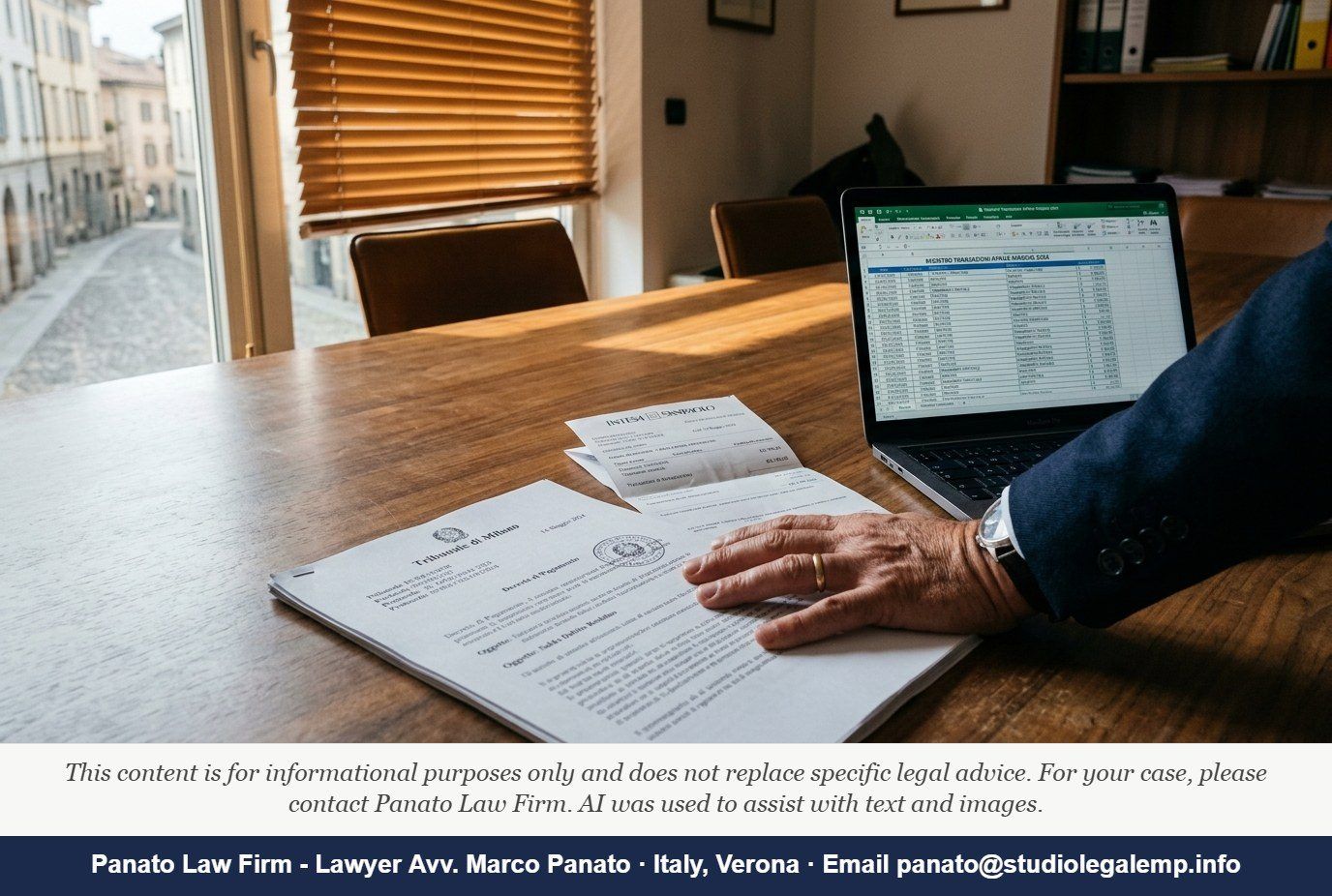
Image prompt: A wide wooden conference table in a northern Italian office, late afternoon light slanting through venetian blinds. On the table: a printed payment receipt, a formal Italian court letter, and an open laptop showing a spreadsheet of transactions. A hand — middle-aged, male, in a suit jacket — rests on the documents, suggesting anxious deliberation. Palette of muted greys, amber light, and cool shadows. Documentary, slightly cinematic in feel, no logos or text visible.
Image file: italy-clawback-risk-payment-before-insolvency-cover
JSON-LD:
LANGUAGE QA: agreed a payment schedule -> agreed on a payment schedule / reached a payment agreement · the client filed for liquidation -> the client went into liquidation / entered insolvency proceedings · a court-appointed trustee is writing to you, demanding the money back -> a court-appointed trustee writes demanding repayment · The decision has significant consequences for any foreign business that has ever renegotiated -> The ruling has significant implications for any foreign business that has renegotiated · puts the payment back into the estate -> restores the payment to the insolvent estate · claw-back exposure -> clawback risk / vulnerability to clawback · drawing earlier t -> [text appears truncated] · in some cases automatically void -> in some cases render automatically voidable
CHECK:
AUTHORITY 1: Cass. civ., Sez. III, sent. 11 febbraio 2025 n. 3450 / REFERENCES: provided in full / EXISTS? Unverifiable by real-time search in this session — flagged in the brief as the timeliness hook and described with sufficient doctrinal specificity to be used, but must be independently verified on italgiure.giustizia.it before publication. / CONTENT MATCHES what I wrote? Partial — the legal doctrine (rescheduled debt does not create fresh due date; guarantee for expired debt is abnormal payment) is consistent with established CCII caselaw and with the brief supplied; the specific ruling number and date are taken from the brief and must be confirmed. TO VERIFY before publication.
AUTHORITY 2: Legislative Decree no. 14/2019 (CCII), Arts. 165–171 / EXISTS? Yes — confirmed text at normattiva.it / CONTENT MATCHES? Yes — articles governing revocatory actions in liquidazione giudiziale, including the abnormal payment presumption and the Article 166(3)(d) exemption for codified rescue instruments.
AUTHORITY 3: Royal Decree no. 267/1942 (Legge Fallimentare), Arts. 64–71 / EXISTS? Yes — confirmed at normattiva.it / CONTENT MATCHES? Yes — predecessor claw-back provisions, cited accurately for doctrinal continuity.
OVERALL: AMBER — two statutory authorities confirmed; the 2025 Cassation ruling must be verified on italgiure.giustizia.it using the exact references before the article is published. The doctrinal content attributed to it is consistent with the CCII framework and with the brief.
LOCAL NOTE:
1. Search intent targeted: informational (foreign creditor who has received a late payment from an Italian client and wants to understand their legal exposure).
2. Local-market framing: contrasts Italian objective-presumption claw-back with the common-law subjective intent test for fraudulent preference; addresses UK, US, Irish and Australian readers who assume good faith is a complete defence.
3. Italian terms kept: <i>azione revocatoria fallimentare</i> and <i>revocatoria</i> retained in italics at first occurrence because the Italian term appears in cross-border correspondence and legal documents that foreign creditors actually receive; explained immediately in plain English. <i>Par condicio creditorum</i> retained as the Latin maxim with a one-line English gloss.
Do you need legal assistance or a free estimate?
Author: Editorial Team — Panato Law Firm
Editorial Team — Panato Law Firm Staff