Retention of title, payment orders, asset attachment and insolvency claims — a decision framework for foreign suppliers dealing with an Italian buyer in default
#77 · LANG: English (en) · AREA: Debt Recovery & Enforcement in Italy · TYPE: Comparison of options · MODEL: Sonnet 5 · SEO 76/100 · Flesch Reading Ease 40 · fonte: batch_articles_debt_recovery_enforcement_in_italy_20items_2026-08-15_h18-51_7f03.doc
URL: https://panatolawfirm.com/en/italy-debt-recovery-foreign-creditor
ABSTRACT: When an Italian buyer defaults, a foreign supplier faces a genuine fork in the road: reclaim the goods under a retention of title clause, chase money through a payment order, freeze assets, or file a claim in insolvency. Each route has different preconditions, timelines and risks. This article maps the four options against a single practical decision criterion — what do you actually have in your hands right now? — and explains the one trap in Italian insolvency law that nullifies a seemingly watertight retention of title clause.
Your Italian distributor has gone quiet. Forty-three days after the payment date, the invoices are still unpaid. The goods — industrial machinery, or textile stock, or branded consumer goods — are sitting in a warehouse in Lombardy. You are in Manchester, or Toronto, or Sydney, and your contract says "title does not pass until full payment". You have, you think, a clean case.
You do not have a clean case yet. You have options, and the choice between them will determine whether you recover the goods, the money, part of the money, or nothing.
Nemo dat quod non habet — you cannot give what you do not have — is the maxim that underpins retention of title, but Italian law surrounds it with conditions that most foreign suppliers discover only after the fact.
The decision criterion: what do you have in your hands right now?Before choosing a recovery route, answer four questions. First: is there a written retention of title clause, and does it have a provable date? Second: are the goods still identifiable and physically present in Italy? Third: is the buyer still trading, or is it already insolvent? Fourth: how much time has passed since the default?
Your answers determine the map. The four routes are: (A) reclaim the goods under a retention of title clause (
patto di riservato dominio); (B) obtain a payment order (
decreto ingiuntivo) and then enforce it; (C) freeze the buyer's assets directly through attachment of assets (
pignoramento); and (D) file a claim in the buyer's insolvency proceedings. They are not mutually exclusive, but they have radically different preconditions, and choosing the wrong one wastes months.
Route A: retention of title — powerful, but only if the paperwork existsA retention of title clause (
patto di riservato dominio) is a clause under Article 1523 of the Italian Civil Code by which the seller retains ownership of goods until the buyer makes full payment of the purchase price. That sentence looks reassuring. The complication lies in the word "provable".
Under Article 1523 of the Italian Civil Code, a properly drafted retention of title clause allows the seller to retain legal ownership of goods until the buyer pays the full purchase price, but the clause is only as strong as the evidence behind it. The decisive factor — especially in Italian insolvency proceedings — is whether the supplier can demonstrate
data certa, a date certain at law, for every invoice, contract and delivery note, established before the onset of the buyer's insolvency.
The reservation of ownership is enforceable against the buyer's creditors only if the date of the clause is shown to be earlier than the date of the attachment of assets (pignoramento). In plain terms: a retention of title clause typed into a standard-form PDF and emailed across is not automatically good enough. Italian law requires the clause's date to be legally certain —
data certa — which in practice means a certified email (PEC), a notarised document, a registered post receipt, or registration with the relevant authority before the buyer's insolvency event occurs.
Unlike in most common-law countries, where a simple written contract is ordinarily sufficient evidence of title, Italian law imposes this additional evidentiary layer on the seller. An English supplier using its standard terms and conditions — signed electronically and stored in a CRM — will almost certainly lack
data certa unless those terms were exchanged by certified email (PEC) or attached to a formally dated delivery note.
Route A is therefore the right first choice when: the goods are identifiable and still unsold; the clause exists in writing with provable date; and the buyer is solvent or only recently insolvent. It is the fastest route when it works, because it is a property claim, not a debt claim: you are not queuing behind other creditors, you are asserting ownership.
The insolvency curator's right to step in — the trap that defeats Route AHere is the passage that almost every article for foreign suppliers omits. When the Italian buyer enters judicial liquidation (
liquidazione giudiziale) under Italy's Business Crisis and Insolvency Code (Legislative Decree 12 January 2019, no. 14, as amended by Legislative Decree 13 September 2024, no. 136 — the so-called
Correttivo-ter), the picture changes significantly.
In a sale with retention of title, upon the opening of the buyer's judicial liquidation, if the price is still due in instalments or at a future date, the insolvency curator may elect to step into the contract with the authorisation of the creditors' committee. The seller may demand a security deposit, unless the curator pays the full remaining price immediately with a discount at the statutory interest rate.
If instead the curator elects to withdraw from the contract, the seller must return the instalments of the price already received, subject to a right to equitable compensation for the buyer's use of the goods, which may be set off against the obligation to return payments already made.
In other words: if the curator decides the goods are commercially valuable to the estate, the estate can keep them and pay — on terms the curator controls. Your "ownership" right turns into a queue for compensation. This is not an Italian eccentricity; it mirrors the general European approach to
ipso facto clauses in insolvency (see also the EU proposed Directive on the harmonisation of certain aspects of insolvency law, currently under examination). But it is a shock to foreign suppliers who assumed their property right was absolute.
Under the Business Crisis and Insolvency Code, a sale with retention of title where the buyer enters judicial liquidation falls into the category of contracts that remain suspended, with the curator having the free choice to continue or withdraw.
The Italian Court of Cassation, Third Criminal Division, judgment no. 28101 of 2024 (Cass. pen., Sez. III, sent. 2024 n. 28101), confirmed a related principle: even where goods were acquired under a retention of title clause and therefore not yet fully owned by the buyer, their transfer at an undervalue was treated as a fraudulent act (
bancarotta fraudolenta) harmful to creditors, because the buyer's disponibility of the goods formed part of the company's assets for insolvency purposes. The economic and legal position of goods held under retention of title is therefore not a legal vacuum — it sits squarely within the insolvency estate.
Route B: the payment order — the right tool when the buyer is still tradingWhen the buyer is solvent and simply not paying, a payment order (decreto ingiuntivo) under Articles 633–656 of the Italian Code of Civil Procedure is the correct primary weapon. It is a summary ex parte procedure: it enables a creditor to obtain an enforceable court order in a relatively short time when the claim is supported by written evidence. It is a summary process because it allows the creditor to secure an enforceable title for debt recovery without starting full ordinary litigation and without the debtor's initial participation.
Under Article 642 of the Code of Civil Procedure, if the debt is evidenced by a signed contract, invoice, or bank instrument, the creditor can request
provvisoria esecuzione — immediate provisional enforcement before the opposition window closes. This is the critical upgrade: with provisional enforceability, you can proceed to attachment of assets (pignoramento) before the debtor has exhausted opposition rights.
Route B is the right choice when: you have written documentary evidence of the debt (invoices, a signed contract, delivery receipts); the buyer is still active; the goods are no longer separately identifiable (mixed stock, processed materials); or you want money rather than goods back.
Route C: direct attachment of assets — skipping the queueAttachment of assets (pignoramento) is not a standalone procedure: it requires an enforceable title first. Once you have a payment order with provisional enforceability, or a final court judgment, you can attach the buyer's bank accounts (
pignoramento presso terzi), movable assets, or real property. Under Brussels I Recast (Regulation EU 1215/2012), any judgment from an EU member state is directly enforceable in Italy without exequatur proceedings, which means a creditor who already holds a judgment from an EU court can proceed straight to pignoramento in Italy without re-litigating. Non-EU creditors do not have this shortcut and must first obtain an Italian enforceable title.
Route C is the right choice when: you have, or are about to obtain, an enforceable title; the buyer has known bank accounts or real property in Italy; and insolvency has not yet been declared (once judicial liquidation opens, individual enforcement actions are automatically stayed).
Route D: the insolvency claim — last resort, not a write-offWhen the buyer has already entered judicial liquidation or court-supervised composition with creditors (
concordato preventivo), individual enforcement is blocked. The only path is to file a proof of claim (
domanda di ammissione al passivo) before the deadline set by the liquidation judge. A valid retention of title clause, if properly established, may allow you to reclaim shipped goods before the liquidator sells them to pay domestic tax authorities. This is the one scenario where having Route A paperwork in order still matters inside insolvency: a property claim (
rivendicazione) is handled separately from the ordinary creditors' queue.
There are no court filing fees or taxes to submit a proof of claim, but creditors must budget for translation, apostilles, and legal fees. Foreign creditors operating under the EU Regulation on Insolvency Proceedings (Regulation EU 2015/848) benefit from a harmonised framework for cross-border claims, including the right to file in their own language subject to translation requirements.
The decision table: which route, and whenIf the buyer is solvent and you want the goods back: choose Route A, but only if you have
data certa documentation. If the buyer is solvent and you want money: choose Route B immediately, request provisional enforceability, then proceed to Route C. If the buyer is insolvent and the goods are still identifiable: attempt Route A as a property claim within the insolvency, and simultaneously file a proof of claim under Route D as a fallback. If the buyer is insolvent and the goods have been mixed, sold on, or cannot be identified: abandon Route A, file Route D only, and focus on maximising your position as a creditor with documentary evidence.
The cardinal mistake foreign creditors make is to wait. Foreign businesses risk their recovery by misunderstanding Italian court procedures and deadlines. Standard international debt collection practices fail once a formal insolvency procedure begins in Italy. Acting before insolvency is declared — even three weeks earlier — can be the difference between recovering goods and receiving cents on the euro years later.
As the legal philosopher Lon Fuller observed in
The Morality of Law (1964), a legal system fails its subjects when it makes compliance impossible through obscurity and retroactive change. The Italian rules on retention of title are not obscure — they are codified precisely in the Italian Civil Code and the Business Crisis and Insolvency Code — but they are genuinely invisible to foreign suppliers who drafted their contracts without Italian counsel.
Panato Law Firm, led by Avv. Marco Panato in Verona, Italy, advises international clients on debt recovery, enforcement proceedings, and insolvency claims in Italy. If your Italian buyer has defaulted and you need to act quickly, write to info@panatolawfirm.com or call +39 045 5867034 to discuss your position and the options available under Italian law.
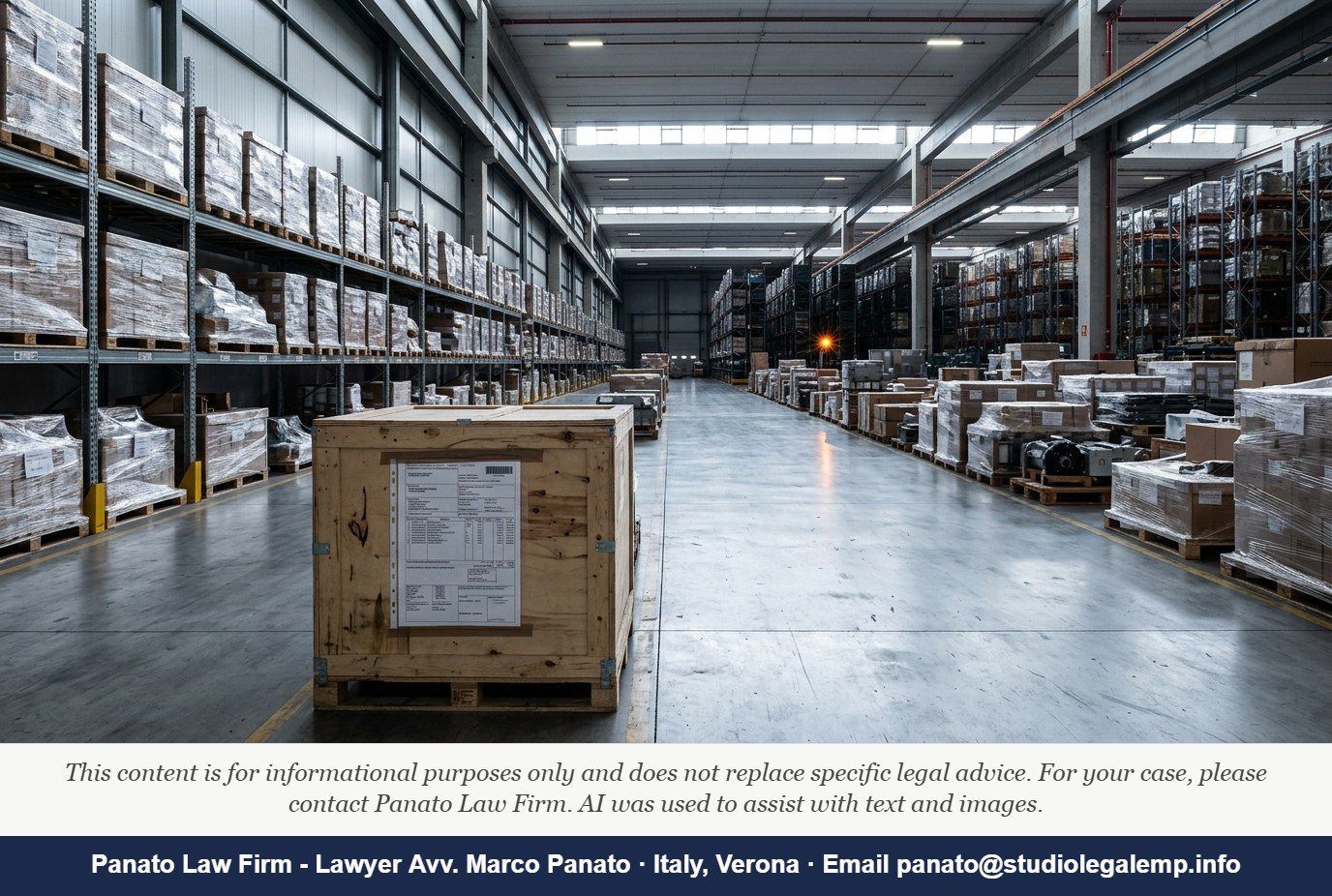
Image prompt: A wide-angle photograph of a modern Italian industrial warehouse interior — rows of shrink-wrapped pallets under high fluorescent lighting, a single sealed shipping crate in the foreground bearing a multi-language commercial invoice taped to its side. The mood is tense and still, the colour palette cool steel-grey and white with a single amber warning light visible in the background. Photorealistic style, no people, no text visible on documents.
Image file: italy-debt-recovery-foreign-creditor-cover
JSON-LD:
LANGUAGE QA: the decision criterion: what do you have in your hands right now? -> The deciding factor: where do you stand right now? · a contractual provision under Article 1523 of the Italian Civil Code whereby the seller retains ownership -> a clause under Article 1523 of the Italian Civil Code by which the seller retains ownership · the decisive factor — especially in Italian insolvency proceedings — is whether the supplier can demonstrate data certa, a date certain at law, for every invoice, contract and delivery note, established before the buyer's crisis event -> split into two sentences; 'established before' dangles and 'crisis event' is a calque of 'evento di crisi' · buyer's crisis event -> onset of the buyer's insolvency · the reservation of ownership is enforceable against the buyer's creditors only if the date of the clause is shown to be earlier than the date of the attachment of assets -> the clause binds the buyer's creditors only if its date pre-dates the attachment of assets · unlike in most common-law countries, where a simple written contract is ordinarily sufficient evidence of title, Italian law imposes this additional evidentiary layer on the seller -> In most common-law jurisdictions a written contract suffices to prove title; Italian law adds an extra evidentiary requirement. · the trap that nullifies Route A -> the trap that defeats Route A · the position shifts dramatically -> the picture changes significantly
CHECK:
AUTHORITY 1: Article 1523, Italian Civil Code (Codice civile)
REFERENCES: Art. 1523 c.c.
EXISTS? Yes — verifiable on normattiva.it and confirmed by multiple sources including globallawexperts.com and italylawfirms.com
CONTENT MATCHES what I wrote? Yes — seller retains title until full payment; risk passes from delivery.
AUTHORITY 2: Business Crisis and Insolvency Code, D.Lgs. 12 January 2019, no. 14, as amended by D.Lgs. 13 September 2024, no. 136 (Correttivo-ter), Article 178 (vendita con riserva di proprietà in judicial liquidation of buyer)
REFERENCES: D.Lgs. 12 gennaio 2019 n. 14, Art. 178 CCII; D.Lgs. 13 settembre 2024 n. 136
EXISTS? Yes — confirmed on altalex.com (full text of Art. on vendita con riserva di proprietà), dirittoeconomiaimpresa.it, aprilacademy.it PDF; Correttivo-ter legislative reference confirmed on fiscooggi.it and assonime.it
CONTENT MATCHES what I wrote? Yes — curator may step in or withdraw; seller must return instalments received minus equitable compensation for use; confirmed.
AUTHORITY
Do you need legal assistance or a free estimate?
Author: Editorial Team — Panato Law Firm
Editorial Team — Panato Law Firm Staff