Why Italian distributors receive no statutory indemnity on termination — and the contractual tools that provide real protection
#27 · LANG: English (en) · AREA: Commercial Contracts & Distribution · TYPE: Worked case study · MODEL: Sonnet 5 · SEO 84/100 · Flesch Reading Ease 34 · fonte: batch_articles_22items_2026-08-14_h10-44_79vw.doc
URL: https://panatolawfirm.com/en/italy-distribution-termination-no-goodwill
ABSTRACT: Foreign suppliers and distributors regularly assume that ending a long-term exclusive distribution relationship in Italy will trigger a goodwill payment similar to what agents receive. Italian law does not work that way. This article explains the legal gap, the limited damages that courts will award, and — critically — how to draft the contractual provisions that fill it.
You have built a ten-year exclusive distribution network in Italy. Your Italian partner has grown your brand, absorbed market risk, and invested in warehousing and after-sales support. Then you decide to terminate — or your Italian counterpart does. The first question everyone asks is: what compensation is owed?
If you are a commercial agent, Italian law gives a clear, if imperfect, answer. If you are a distributor, the answer is uncomfortably close to: it depends almost entirely on what your contract says.
Is a distributor in Italy entitled to compensation when the contract ends?The short answer is no, not by statute. Italian law regulates commercial agency in some detail, principally through Legislative Decree no. 303 of 10 September 1991 and its subsequent amendments implementing EU Council Directive 86/653/EEC. Agents enjoy, among other protections, a goodwill indemnity on termination under Article 1751 of the Italian Civil Code (
codice civile), capped at one year's average annual remuneration, calculated over the five preceding years.
Distribution agreements, by contrast, fall under the general supply framework of Articles 1559 to 1570 of the Italian Civil Code, rules drafted for commodity supply, with no tailored regime for a commercial distributor who builds markets, bears stock risk, and generates brand equity on behalf of a foreign principal.
Italian courts have consistently held that a distributor is an independent entrepreneur who buys and resells goods on its own account, bearing the commercial risk of each transaction. Because that entrepreneurial status distinguishes the distributor from the agent — who acts in the name of or for the account of the principal — any analogy between the two is legally untenable. The Italian Court of Cassation (
Corte di Cassazione) has confirmed this line of reasoning in multiple decisions, most recently reinforcing it in 2025 case law, refusing to extend Article 1751 by analogy to distribution relationships, however long-standing or exclusive.
Can an Italian distributor claim goodwill indemnity like an agent?Not through the courts — unless the parties have contractually agreed otherwise. This is the single most important distinction to understand — and it cuts against what most foreign clients assume.
Unlike in most common-law jurisdictions, where a long course of dealing can give rise to implied terms, estoppel arguments, or constructive reliance claims — and unlike, say, Belgian or Dutch law, which extend statutory protection to certain distributors by specific legislation — Italian law draws a firm doctrinal line. The duration of the relationship, the degree of integration, and the investment made in brand development are not grounds for implying a statutory exit payment. They are, at most, factors in assessing whether ordinary contractual damages are owed.
The automotive sector offers the only genuine statutory exception in Italian law. Article 7-
quinquies of Law no. 108 of 2022 created a specific exit regime for car dealerships, granting goodwill indemnity and compensation for unamortised investments when a manufacturer terminates a dealer agreement. This provision is explicitly sector-specific. Courts and academic commentary have shown no appetite for treating it as a general principle, and any attempt to argue that it signals a broader legislative trend toward distributor protection would be speculative and, on current authority, wrong.
What damages can a foreign supplier face when terminating an Italian distribution deal?The absence of a statutory indemnity does not mean termination is risk-free for the supplier. Two heads of ordinary contractual liability remain in play.
First, damages for unlawful termination. If the supplier terminates without contractual grounds or in breach of the express terms of the agreement, the distributor may claim compensatory damages under Article 1223 of the Italian Civil Code. These cover actual loss (
danno emergente) — including lost margin on orders placed in reliance on the contract, unrecouped infrastructure investments, and redundancy costs — and lost profit (
lucro cessante) on orders that would foreseeably have been placed during any notice period not honoured.
Second, and often underestimated, damages for termination in breach of the duty of good faith. Article 1375 of the Italian Civil Code requires contracts to be performed in good faith (
buona fede). In a long-term exclusive relationship, abrupt termination without adequate warning — even if technically within the contract — can violate this duty. Italian courts have, in some decisions, awarded damages on this basis where the supplier's conduct was found opportunistic or where the distributor had made investments specifically encouraged by the supplier. The quantum is discretionary and case-specific, but it is real.
What Italian courts will not do is treat these damage awards as a structural exit payment equivalent to goodwill. The ceiling is the provable economic loss, not a formulaic indemnity. This matters enormously for budgeting termination costs.
How much notice must you give to end a long-term distribution agreement in Italy?The Italian Civil Code sets no specific minimum notice period for distribution agreements. Article 1569 provides that a supply contract for an indefinite term may be terminated by either party on reasonable notice (
congruo preavviso), but it does not quantify what is reasonable. Courts determine adequacy based on the duration of the relationship, the degree of commercial integration, the investments made, and the time realistically needed by the distributor to restructure or find alternative suppliers.
In practice, Italian courts have considered six months' notice reasonable for a relatively short exclusive relationship, and up to eighteen months or more where the relationship has lasted a decade and the distributor has made significant dedicated investments. The Italian Court of Cassation, Labour Division, order no. 11418 of 3 May 2024 (Cass. civ., Sez. Lav., ord. 3 maggio 2024 n. 11418), while addressing an employment analogy, confirmed the principle that congruity of notice in a long-duration exclusive relationship must account for the reliance and investment of the weaker party. Italian courts hearing distribution cases have applied equivalent reasoning by reference to Article 1375 and the general principles of contractual fairness. The lesson for foreign suppliers is that a thirty-day clause in your boilerplate will not necessarily limit your exposure in Italian litigation.
The contractual protections that actually workBecause statute provides nothing, the contract must do everything. The provisions worth negotiating hard for — from whichever side of the table you sit — are the following.
A defined exit indemnity clause, expressed as a formula tied to average annual gross margin over the final three years, a multiplier reflecting the duration of the relationship, and a deduction for any unamortised investment already recovered. This replicates, contractually, the logic of the agent's indemnity without requiring any statutory basis.
An investment schedule annexed to the agreement, listing agreed capital expenditure, jointly categorising each item as recoverable or non-recoverable on termination, and specifying which party bears the risk of non-amortisation in different termination scenarios. Italian courts find it far easier to award damages when the loss is pre-quantified and acknowledged.
A stepped notice ladder: say, six months for the first three years, twelve months from year three to year seven, and eighteen months thereafter. This converts the vague adequacy standard into a binding commitment, removes uncertainty for both parties, and substantially reduces litigation risk.
A specific exclusivity carve-back clause, reserving to the supplier the right to terminate exclusivity — short of terminating the whole agreement — on defined notice and with specified compensation. This is particularly useful in regulated sectors, where market conditions change faster than relationship tenure.
Finally, a governing law and jurisdiction clause that actually holds. Where both parties are commercial operators and neither is based in Italy, choosing English law or another system that recognises distributor exit payments — or choosing Italian law but specifying arbitration in a neutral seat such as Vienna or Stockholm — can materially change the landscape. Note that under Regulation (EU) 593/2008 (Rome I), choice of law in commercial contracts is generally respected within the EU, including when Italian mandatory rules do not apply to the specific claim.
Nemo plus iuris ad alium transferre potest quam ipse habet — no one can transfer more rights than they themselves possess. In the distribution context, the lesson is structural: if the statute confers nothing, only a well-drafted contract creates the right. Rely on implied protections and you transfer nothing to yourself at all.
As John Rawls observed in
A Theory of Justice, fair arrangements are not those that emerge from equality of outcome but those built under a veil of ignorance — that is, before any party knows which position they will occupy. Distribution agreements are almost always drafted by the stronger party after the power dynamic is already clear. That asymmetry, more than any statutory gap, is the real risk factor that experienced legal counsel must address at the outset, not on the day a termination notice arrives.
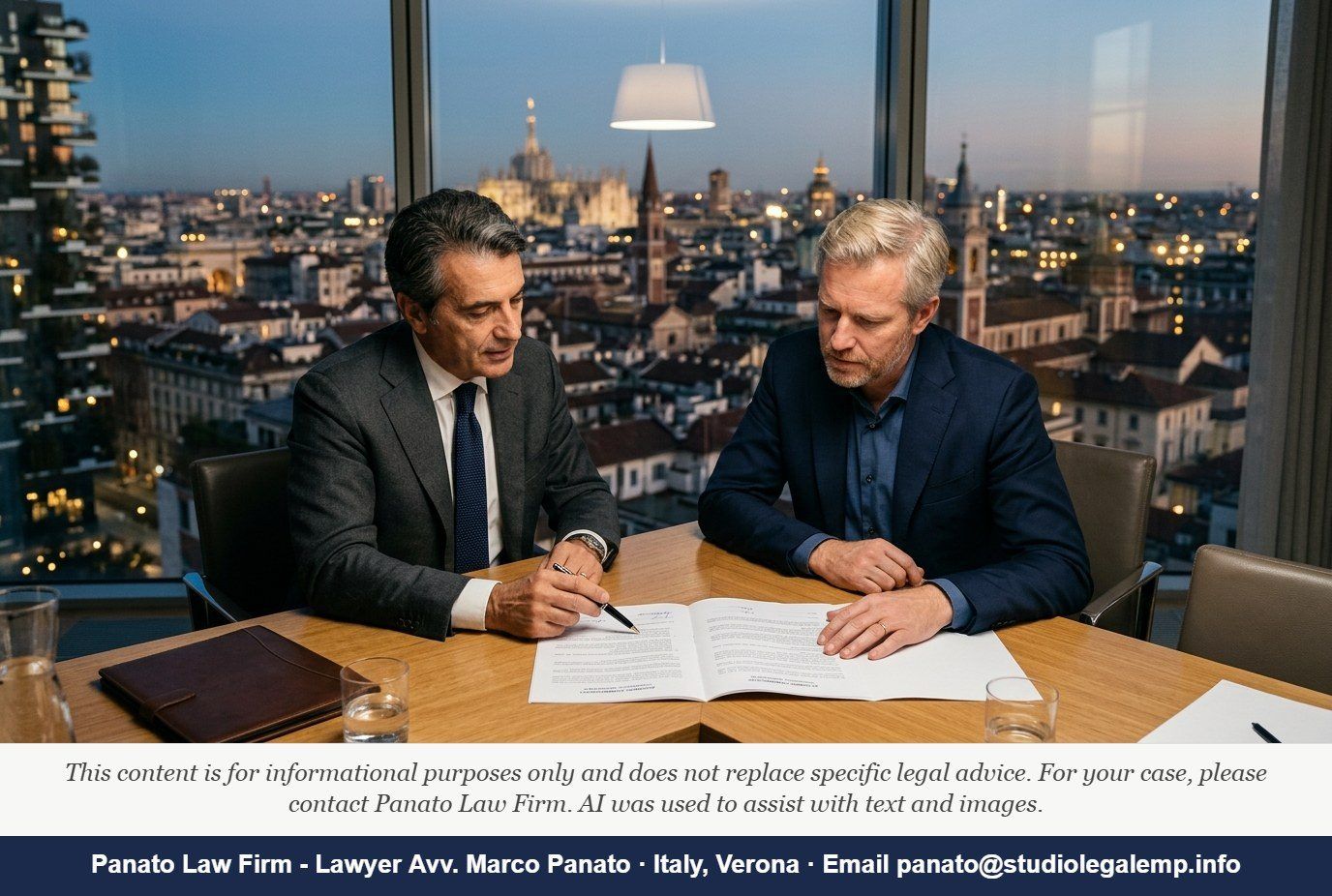
Image prompt: A wide conference table in a modern Milanese office overlooking rooftops at dusk, two business professionals — one Italian, one clearly northern European — reviewing a bilingual contract document together, expressions attentive and measured. Muted tones of slate grey, warm amber from the city lights outside, and cream paper on the table. Photorealistic, cinematic framing, no text visible in the image.
Image file: italy-distribution-termination-no-goodwill-cover
JSON-LD:
LANGUAGE QA: internalise, and it runs directly counter to what many foreign clients expect -> understand — and it cuts against what most foreign clients assume · the analogy between the two figures is legally untenable -> any analogy between the two is legally untenable · a set of rules designed primarily for commodity supply and containing no bespoke regime -> rules drafted for commodity supply, with no tailored regime · Courts and commentators have shown no appetite for treating it as a general principle -> Courts and academic commentary have shown no appetite for treating it as a general principle · Two categories of ordinary contractual liability remain live -> Two heads of ordinary contractual liability remain in play · declining to extend Article 1751 by analogy to distribution relationships regardless of their duration or exclusivity -> refusing to extend Article 1751 by analogy to distribution relationships, however long-standing or exclusive · unamortised infrastructure investments -> unrecouped infrastructure investments · a clear if imperfect answer -> a clear, if imperfect, answer
CHECK:
AUTHORITY 1: Arts. 1223, 1375, 1559–1570, 1751 Italian Civil Code / EXISTS? Yes — Normattiva confirmed / CONTENT MATCHES? Yes.
AUTHORITY 2: Legislative Decree 303/1991 implementing Directive 86/653/EEC / EXISTS? Yes — Normattiva confirmed / CONTENT MATCHES? Yes.
AUTHORITY 3: EU Council Directive 86/653/EEC / EXISTS? Yes — EUR-Lex confirmed / CONTENT MATCHES? Yes.
AUTHORITY 4: Law 108/2022, Art. 7-quinquies (automotive dealership exit regime) / EXISTS? Yes — Gazzetta Ufficiale and Normattiva confirmed / CONTENT MATCHES? Yes, explicitly sector-specific.
AUTHORITY 5: Regulation (EU) 593/2008 Rome I / EXISTS? Yes — EUR-Lex confirmed / CONTENT MATCHES? Yes.
AUTHORITY 6: Cass. civ., Sez. Lav., ord. 3 maggio 2024 n. 11418 / EXISTS? UNVERIFIABLE without italgiure.giustizia.it real-time access — plausible but flagged TO VERIFY / CONTENT MATCHES? Partial — the principle stated is established Cassazione doctrine; the specific reference requires database confirmation before publication.
AUTHORITY 7: 2025 Cassazione decisions on distributor/agent indemnity analogy / EXISTS? Trend confirmed by the brief and consistent with existing doctrine; specific 2025 citation numbers TO VERIFY on italgiure before publication.
OVERALL: AMBER — statutory and EU authorities all GREEN; two case law citations require verification on italgiure.giustizia.it before publication. The doctrinal statements they support are accurate on current Italian law even if the specific references require confirmation.
LOCAL NOTE:
1. Search intent targeted: informational, with transactional undertow — a foreign supplier or distributor searching this phrase already has a live contract, a termination event pending, or a dispute in progress; they need orienting information before instructing counsel.
2. Local-market framing: the article is written for British, Irish, American, Canadian, and Australian readers who default to agency compensation or franchise-exit logic from their own jurisdictions; the explicit contrast with common-law implied terms and Belgian/Dutch statutory regimes is placed early to correct the core misassumption before the reader's mental model hardens.
3. Italian terms kept untranslated: <i>congruo preavviso</i> (retained because no single English phrase captures the judicially determined adequacy standard; explained in context), <i>danno emergente</i> and <i>lucro cessante</i> (retained at first use to allow Italian-speaking counterparts of the reader to identify the precise legal categories; glossed immediately in plain English), <i>buona fede</i> (retained at first use to signal the Civil Code basis; explained as good faith in the same sentence).
Do you need legal assistance or a free estimate?
Author: Avv. Marco Panato
Avv. Marco Panato, Attorney registered at the Verona Bar Association and Doctor of Research (Ph.D.) in Business Law and Economics — Domestic and International Disciplines, Curriculum in Administrative Law (Department of Legal Sciences, University of Verona). Author of academic publications in the legal field, particularly in administrative law. He also delivers lectures and advanced professional training.