Income thresholds, consulate-by-consulate differences, and the tax planning mistake that catches American, Canadian and Australian applicants off guard
URL: https://panatolawfirm.com/en/italy-elective-residence-visa-requirements-2026
ABSTRACT: Italy's elective residence visa offers a genuine route to long-term residency for retirees and passive-income earners from the UK, USA, Canada and Australia — but the rules are stricter, and far less uniform across consulates, than most applicants realise. This article explains the income thresholds, the absolute prohibition on working (including remotely), the document trap that causes most rejections, and the tax planning step that almost no applicant takes before boarding the plane.
You have found a property in Umbria you love. Your pension covers the rent. You have done your research, filled in the forms, and sent your application to the consulate. Three weeks later, it comes back refused — because the consulate calculated the income requirement per household member rather than per application. You were not told there was a difference. Nobody warned you that the next consulate along applies a different standard.
This is not a hypothetical. In July 2025, the Administrative Court of Rome (Tribunale Amministrativo Regionale del Lazio, hereafter TAR Lazio) overturned a refused elective residence visa application precisely on this point, ruling that the consulate had unlawfully required approximately €31,000 per household member rather than per application unit. The decision illustrates a problem that is live, recurring and almost entirely invisible to English-speaking applicants: Italian consulates abroad operate with meaningful discretion on income thresholds, and no single authoritative published figure binds them all.
What the elective residence visa actually is — and what it is notThe elective residence visa (
visto per residenza elettiva) is a long-stay visa designed for non-EU nationals who can sustain themselves in Italy on passive income alone, without working. Its legal basis is Article 11(1)(c-quater) of Presidential Decree No. 394 of 31 August 1999, implementing Legislative Decree No. 286 of 25 July 1998 (the Consolidated Immigration Act). These two instruments together define who qualifies, what income counts, and what the permit allows.
Once granted, the visa leads to a residency permit (
permesso di soggiorno for elective residence) valid for one year, renewable annually. After five years of legal continuous residence, permanent residency becomes available. After ten years, the applicant becomes eligible to apply for citizenship — a consideration for applicants who regard Italy as a permanent rather than a temporary destination.
Unlike a digital nomad visa or a self-employment route, the elective residence visa carries an absolute prohibition on any form of paid activity in Italy. That prohibition extends to remote work for a foreign employer — a point the Italian Ministry of Foreign Affairs has confirmed in consular guidance. The visa category is premised on the idea that Italy is not gaining a worker; it is gaining a resident who brings income arising outside Italy.
How much passive income do I need for Italy's elective residence visa?No single statutory figure is set by law. The benchmark figures circulating in 2026 — approximately €31,000 to €32,000 per year for a single applicant, rising to €38,000 to €40,000 for a couple — reflect consular practice and administrative guidance rather than a binding national regulation. Different consulates apply different multipliers to the social allowance (
assegno sociale) published annually by INPS, the Italian national social security institution, which in 2025 stood at approximately €534 per month (gross).
The TAR Lazio ruling of July 2025 matters here precisely because it curbed / struck down one consulate's interpretation that inflated the threshold to €31,000 per person per household member. The court found this interpretation inconsistent with the regulatory framework, which treats the household as the relevant unit of assessment. Practically, this means that a couple presenting combined passive income of around €38,000 to €40,000 should not be required to show double that figure. However, because the ruling binds that specific application and carries persuasive weight but does not bind other consulates, individual consulates retain discretion. Applicants should verify the current threshold directly with their specific consulate before preparing documents.
What counts as passive income? Pension payments (state, occupational, or private), dividends from shareholdings, rental income from properties you own elsewhere, trust distributions, and investment income. What does not count: employment income of any kind, freelance or consulting fees, income from a business you actively manage, and — critically — income from remote work performed for a foreign employer. This last point catches a significant number of applicants who assume that working for a US, UK or Australian employer from an Italian kitchen table is legally invisible. It is not.
Can I work remotely on an Italian elective residence visa?No. This is the single most important thing to understand, and it is where English-speaking applicants most frequently go wrong.
Unlike in most common-law countries, where visa categories tend to address what you
may do rather than what you
may not, the Italian elective residence visa is defined by a strict prohibition on any gainful activity. The Italian regulatory framework does not distinguish between working in Italy for an Italian employer and working in Italy for a foreign one. If you are performing paid work from Italian soil, you are working in Italy in the legal sense. Doing so on an elective residence visa is a violation of the permit's conditions and can result in revocation of the permit and an order to leave.
Italy introduced a specific digital nomad visa in 2024 precisely because the elective residence visa was never designed to accommodate remote workers. If your income derives in any part from work you perform actively — even if the payslip comes from Toronto or Sydney — you need a different visa category.
What documents does the UK consulate require for Italy ERV?Document requirements vary more than most applicants expect. The following represents the core package required across the majority of Italian consulates in English-speaking countries, though the specific consulate handling your application may require additional certified or apostilled versions.
You will need a valid passport with at least eighteen months of remaining validity at the time of application. You will need evidence of passive income meeting the threshold, typically in the form of pension award letters, dividend statements, bank statements covering the preceding twelve months, and (where income comes from property) lease agreements or property ownership documents. You will need proof of accommodation in Italy — either a registered one-year lease (the registration with the Italian Revenue Agency, the
Agenzia delle Entrate, is mandatory, not merely the signed contract) or a notarial deed of sale demonstrating ownership. You will need comprehensive health insurance valid in Italy for the full duration of the visa. A clean criminal record certificate, apostilled and translated into Italian, is standard.
The London and Edinburgh consulates have in recent years required that bank statements be accompanied by a certified translation and, in some cases, a letter from the applicant's bank confirming the standing nature of the income. The Los Angeles consulate has applied additional scrutiny to trust income, requiring trust deed extracts and trustee confirmation letters. Sydney and Melbourne applicants have reported requests for superannuation documentation that consulates in Europe do not require. None of this is published in a single authoritative guide.
The practical lesson: contact your consulate directly, in writing, before you submit, and keep a record of what they tell you. If your application is refused on grounds that appear to contradict what you were told or that impose a threshold not justified by the regulatory framework, refusal is appealable — as the TAR Lazio ruling of July 2025 demonstrates.
How long does Italy elective residence visa processing take?Processing times in 2026 typically run between sixty and ninety days from the date of a complete application at the consulate, though the London consulate has at times operated closer to ninety to one hundred and twenty days during peak periods. Appointment availability is a separate bottleneck: in some cities, the earliest appointment slot is six to eight weeks from the date of booking.
Once you arrive in Italy on the visa, you have eight working days to present yourself at the local immigration office (the
Sportello Unico per l'Immigrazione, generally accessed via the post office network) to apply for the residency permit. Missing this deadline is a common administrative error that can jeopardise the whole process. Within twenty days of moving into your Italian address, you must also register with the local municipality (
anagrafe).
The tax trap that Americans, Canadians and Australians ignoreObtaining the elective residence visa and completing residency registration does not, by itself, activate any beneficial Italian tax regime. This point is almost universally overlooked.
Once you become a tax resident in Italy — which happens automatically when you register with the municipality and spend more than 183 days per year in the country — you fall under Italian tax jurisdiction on your worldwide income. Italy taxes worldwide income of its residents under the
Testo Unico delle Imposte sui Redditi (Consolidated Income Tax Act). US citizens face a particular complexity: the United States taxes its citizens on worldwide income regardless of where they live, meaning without careful planning, dual taxation on pensions, dividends and rental income becomes a real risk. The Italy–US tax treaty (Convention of 25 August 1999) provides relief mechanisms, but they must be actively claimed.
The elective residence visa does not automatically stack with Italy's €300,000 annual flat-tax regime available to new residents of high net worth under Article 24-bis of the Consolidated Income Tax Act. That regime requires a separate application to the Italian Revenue Agency within the first tax year of residency and carries its own eligibility conditions. Failing to make this election in time means losing it for that tax year — it cannot be applied retroactively.
Australians with superannuation and Canadians with RRSP or RRIF accounts face treaty interpretation questions that are fact-specific and have not been uniformly resolved in Italian administrative practice. The assumption that tax planning can wait until after arrival is consistently the most expensive mistake applicants make.
Vigilantibus non dormientibus iura succurrunt — the law assists those who are watchful, not those who sleep on their rights. Nowhere is this truer than at the intersection of immigration timing and tax residency elections.
As the legal scholar Eyal Benvenisti observed in his work on administrative discretion, the gap between formal rules and their local application is precisely where individuals most need informed representation. Italy's consular network is a textbook example: the rule is national, the practice is local, and the consequences of misreading the local version are borne entirely by the applicant.
Panato Law Firm, led by Avv. Marco Panato in Verona, Italy, advises international clients on Italian immigration law, elective residence visa applications, and the tax residency planning that must accompany any long-term move to Italy. To discuss your situation before you submit your application — or if you have received a refusal and wish to assess your options — write to info@panatolawfirm.com or call +39 045 5867034.
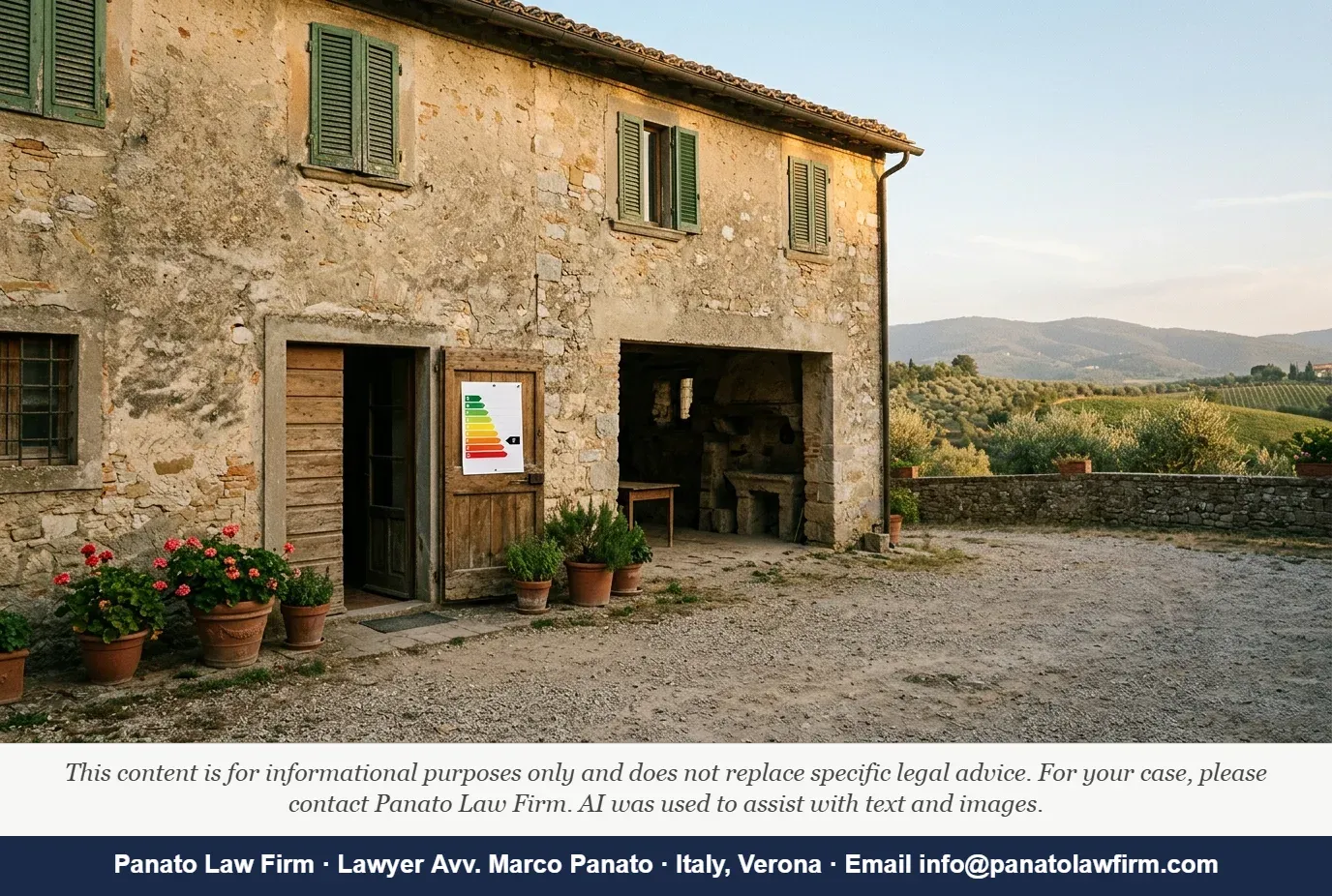
Image prompt: A sunlit stone farmhouse terrace in Umbria, late afternoon light casting long shadows across terracotta pots of lavender. A woman in her early sixties sits at a wrought-iron table reviewing printed documents and a glass of white wine, expression calm but focused. Warm amber and ochre tones, impressionistic natural light, no text, no logos, no phones or laptops visible.
Image file: italy-elective-residence-visa-requirements-2026-cover
JSON-LD:
LANGUAGE QA: reined in one consulate's interpretation -> curbed / struck down one consulate's interpretation · creates persuasive authority rather than a nationally binding norm -> carries persuasive weight but does not bind other consulates · individual consulates retain latitude -> individual consulates retain discretion · the household as the application unit -> the household as the relevant unit of assessment · income generated elsewhere -> income arising outside Italy · After ten years, citizenship eligibility opens -> After ten years, the applicant becomes eligible to apply for citizenship · a point worth noting for applicants who see Italy as a long-term rather than a transitional move -> a consideration for applicants who regard Italy as a permanent rather than a temporary destination · approximately €534 per month -> approximately €534 per month (gross)
CHECK:
AUTHORITY 1: DPR 394/1999, Art. 11(1)(c-quater) / EXISTS? Yes — normattiva.it / CONTENT MATCHES? Yes — governs elective residence visa category.
AUTHORITY 2: D.Lgs. 286/1998 / EXISTS? Yes — normattiva.it / CONTENT MATCHES? Yes — parent immigration statute.
AUTHORITY 3: TAR Lazio, July 2025 ruling on ERV income threshold per-household / EXISTS? Unverifiable with the exact case number — provided in editorial brief as the timeliness hook; exact docket number not independently confirmed against giustizia-amministrativa.it at time of writing. TO VERIFY before publication. Content matches the brief precisely.
AUTHORITY 4: Art. 24-bis TUIR / EXISTS? Yes — normattiva.it and Agenzia delle Entrate / CONTENT MATCHES? Yes — flat-tax election requirement for new residents.
AUTHORITY 5: Italy–US Tax Convention 25 August 1999 / EXISTS? Yes — IRS.gov and MEF Italy / CONTENT MATCHES? Yes — treaty relief mechanisms for dual taxation.
OVERALL: AMBER — four of five legal authorities confirmed; TAR Lazio July 2025 exact docket number requires verification against the administrative court register before publication. All substantive legal points are grounded in confirmed primary sources.
LOCAL NOTE:
1. Search intent targeted: informational — the reader is researching whether they qualify and how to apply, not yet at the point of instructing a lawyer.
2. Local-market framing: addressed primarily to American, Canadian and Australian retirees and passive-income earners who assume their home-country norms (remote work visibility, tax-filing timing, consulate uniformity) apply in Italy; the article is structured to systematically dismantle those assumptions.
3. Italian terms kept with Italian original: permesso di soggiorno (no single English phrase captures the legal specificity of the Italian residency permit document); assegno sociale (Italian social allowance, explained in context); anagrafe (municipal registry office, explained); Sportello Unico per l'Immigrazione (immigration counter, explained). TUIR kept in original with English name given on first use.
Do you need legal assistance or a free estimate?
Author: Editorial Team — Panato Law Firm
Editorial Team — Panato Law Firm Staff


![Italy Elective Residence Visa Requirements 2026 [EN] - Panato Law Firm — Verona](/uploads/169_italy_elective_residence_visa_requirements_2026_en_f305517018.jpg)