What foreign owners of Italian second properties rated F or G must understand about the EPBD transposition, the APE certificate, and the narrowing window before 2030
URL: https://panatolawfirm.com/en/italy-energy-performance-certificate-epc-foreign-property-owner-2026
ABSTRACT: The EU's recast Energy Performance of Buildings Directive (EPBD 2024/1275) required Italian transposition by 29 May 2026. Italy has not yet completed that process, but the obligations it introduces are binding and already shaping the market. Foreign owners of Italian holiday homes rated F or G — a category that represents the majority of Italy's building stock — now face a narrowing window before 2030 targets bite.
You bought a stone farmhouse in Umbria, a flat near the Amalfi coast, or a terraced house in Puglia. It has character, thick walls, and a fireplace you use twice a year. It almost certainly has an energy class of F or G. You may not have looked at the
Attestato di Prestazione Energetica certificate since the notary handed you a copy at completion. You should look now.
According to data from ENEA (the Italian National Agency for New Technologies, Energy and Sustainable Economic Development), roughly 74% of Italy's residential building stock falls into energy classes F or G. That figure frames the entire problem. For foreign owners of second properties and holiday homes, the combination of EU-mandated renovation targets, evolving Italian resale rules, and shifting mortgage lender behaviour is creating a planning obligation most have not yet recognised.
Does my Italian holiday home need to meet new energy standards?The short answer is: not yet in absolute terms, but the direction is clear and the timetable is pressing.
Directive 2024/1275 of the European Parliament and of the Council of 24 April 2024 on the energy performance of buildings (the recast EPBD) required all EU Member States to transpose its provisions into national law by 29 May 2026. Italy had not enacted full transposition legislation by that date, placing it in a position familiar from previous EU environmental directives — technically in breach of its transposition obligation, with infringement proceedings a real possibility.
What the Directive requires of Italy as a matter of binding EU law is substantial. Italy must publish a National Building Renovation Plan setting a target of a 16% reduction in average primary energy consumption from the residential sector by 2030, rising to between 20% and 22% by 2033. Crucially, Italy must ensure that by 2030 at least 15% of the worst-performing residential stock reaches a minimum of energy class E. By 2033 that threshold rises to class D. The worst-performing stock is defined as the bottom 43% of the national building stock — which, given ENEA's figures, corresponds almost precisely to the entire F and G cohort.
Italy has not yet legislated pre-sale upgrade mandates of the kind found in, say, Scotland's Heat in Buildings proposals or the Netherlands' residential EPC floor rules. But the EU Directive does not require identical implementation across Member States; it requires demonstrable progress toward the numerical outcomes. The Italian legislature retains discretion over method. What it cannot do is disregard the outcome targets.
What is an APE certificate and do I need one to sell property in Italy?An
Attestato di Prestazione Energetica, known universally in Italy as an APE, is Italy's national energy performance certificate. Under Legislative Decree 192/2005 (Decreto Legislativo 19 agosto 2005, n. 192, as as amended), an APE is already mandatory for any sale of a residential property in Italy and for any long-term letting. Without a valid APE, a notarial deed of sale (rogito) cannot be executed. The APE must be attached to the contract, and the buyer must acknowledge having received it. Estate agents advertising a property are required to include the energy class in the listing.
Unlike in most common-law jurisdictions, where energy certificates are a disclosure formality that rarely affects the transaction, an Italian APE is increasingly a substantive commercial document. In England and Wales, for example, an EPC rating of F or G carries no legal obstacle to sale and has minimal effect on lender valuation at present. In Italy, the direction of the EPBD transposition is moving toward making low ratings a genuine market impediment. Several major Italian and pan-European mortgage lenders already apply stricter loan-to-value ratios or refuse financing entirely for properties in classes F and G, a practice sometimes described informally as "brown discounting" in capital markets literature.
An APE is valid for ten years from the date of issue, unless significant works are carried out in the interim (in which case a fresh certificate must be obtained). Foreign owners who purchased before 2015 may have a certificate approaching expiry. Owners who never requested one — a not uncommon situation in rural areas — are in breach of the existing mandatory disclosure rules and should remedy the breach before listing or letting.
Will EPC class F or G properties be harder to sell in Italy?The evidence points in one direction. The Royal Institution of Chartered Surveyors (RICS) and academic research published by the European Central Bank in its working paper series have both documented the emergence of a measurable "green premium" and, conversely, an energy-inefficiency discount in European residential property markets. Italian data from Nomisma and the Osservatorio del Mercato Immobiliare (OMI, the Italian Revenue Agency's property market observatory) show that between 2020 and 2024 the price differential between class A/B properties and class F/G properties in the same location widened by several percentage points in northern and central Italian markets.
Sublata causa tollitur effectus — remove the cause and the effect disappears. The cause of the discount is not the certificate itself but the future liability for renovation works it signals. As the EPBD 2030 and 2033 targets become contractually concrete — through lender policies, insurance pricing, and eventually Italian legislative mandates — that discount will deepen rather than narrow. A buyer acquiring a class F property in 2026 is acquiring not only a holiday home but a forward liability. Informed buyers already price this. Uninformed ones will discover it when they sell.
What energy renovations qualify for Italian tax incentives in 2026?This is where planning becomes concrete. Two principal Italian fiscal incentives remain available to non-resident foreign owners, even after the expiry of the so-called Superbonus.
The
Bonus Ristrutturazioni (renovation bonus) under Article 16-bis of the Consolidated Income Tax Code (Testo Unico delle Imposte sui Redditi, TUIR) allows a deduction of 36% of qualifying expenditure on residential renovation, up to a ceiling of €48,000 per property unit, for second homes including holiday properties. This deduction is spread over ten tax years. Qualifying works include insulation, window replacement, and heating system upgrades — all directly relevant to improving an energy class.
The
Ecobonus provides a higher deduction of between 50% and 65% specifically for energy efficiency interventions: replacement of heating systems with condensing boilers or heat pumps, installation of solar panels, external wall insulation, and similar measures. The applicable percentage depends on the type of intervention and, in certain cases, whether the building as a whole achieves a two-class improvement in its APE rating.
For non-resident owners, access to both incentives requires that the owner has Italian income against which to offset the deduction — specifically Italian-source income subject to
imposta sul reddito delle persone fisiche (IRPEF), Italy's personal income tax. Rental income from the Italian property qualifies. Importantly, payment must be made via a
bonifico parlante — a dedicated bank transfer that includes the owner's Italian tax code (codice fiscale), the supplier's Italian VAT number (partita IVA), and a specific statutory reference — without which the tax authority (Agenzia delle Entrate) will disallow the deduction.
Non-resident owners who derive no Italian-source income face a structural disadvantage: they cannot access either bonus in the standard manner. For this group, restructuring rental arrangements to generate Italian-source income — or planning the timing of works relative to a future sale — becomes a materially important legal and fiscal consideration.
The planning question nobody in your management chain has raisedThe single most underestimated risk for foreign owners is the interaction between the EPBD timeline and Italian succession law. If a foreign owner passes away before upgrading an F or G property, their heirs inherit not only the asset but the renovation liability — and, if they are non-residents, potentially without the IRPEF base to claim any Italian tax incentive at all. Regulation (EU) 650/2012 on jurisdiction, applicable law, recognition and enforcement of decisions in matters of succession means that the applicable succession law may be determined by the deceased's habitual residence, but Italian property remains subject to Italian public law obligations regardless. An inherited F or G property in 2030 will be subject to whatever mandatory upgrade requirements Italy has by then legislated, with no grandfather protection for heirs.
The practical implication is straightforward: decisions about Italian energy renovation are not purely a question of property management. For owners over sixty, or for those who hold Italian property through complex family structures, they intersect with estate planning in a way that deserves explicit attention now.
The EPBD's 2030 target is four construction seasons away. In Italy, planning permission for significant works — especially in historic centres, areas under architectural constraint, or coastal zones — routinely takes twelve to twenty-four months. A foreign owner who decides in 2028 that they need to move from class G to class E before a sale may find that the Italian administrative timeline makes that impossible. The window is not as wide as it appears.
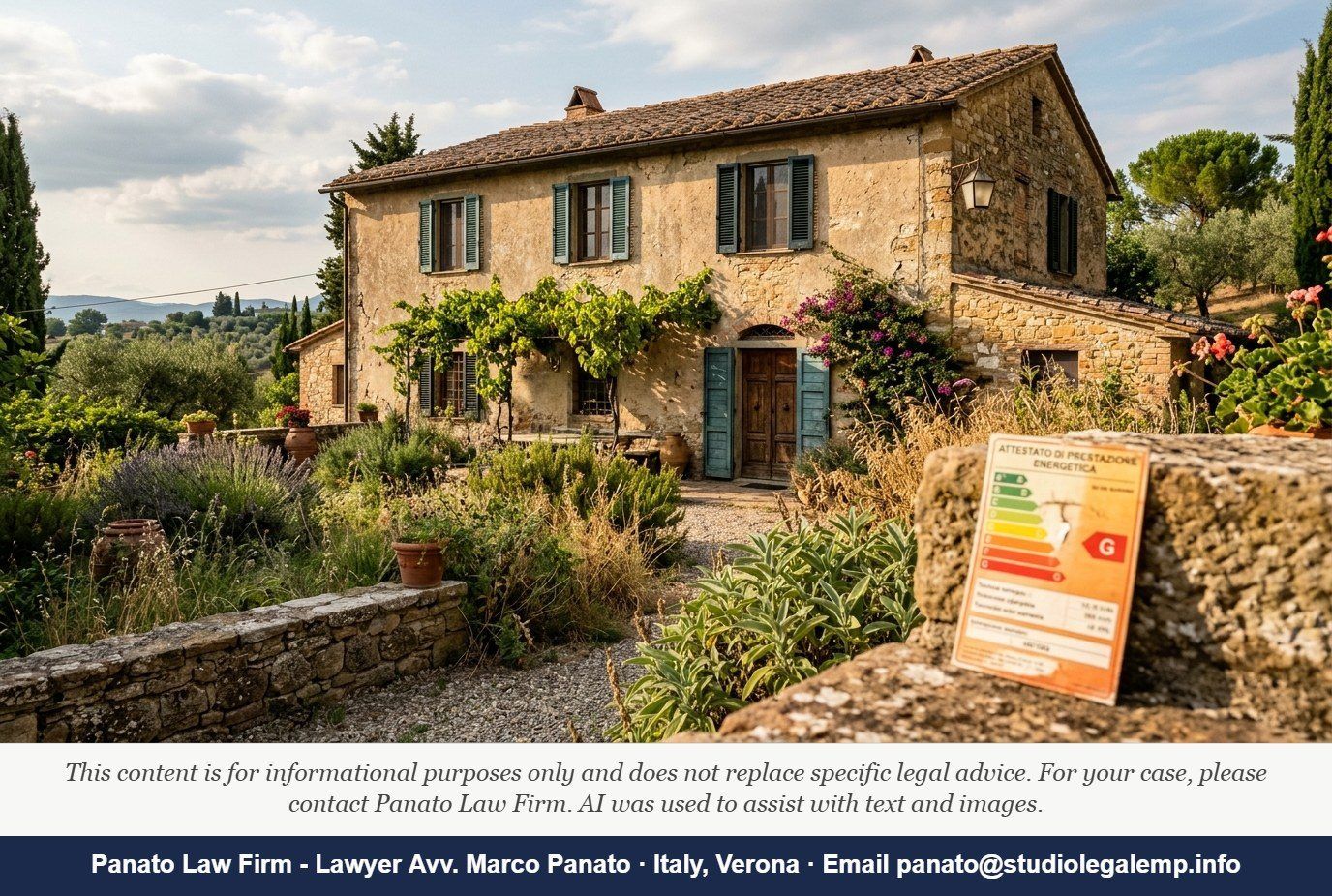
Image prompt: A sun-faded stone farmhouse in the Umbrian countryside on a warm late-afternoon in late summer, shot from the garden looking toward the façade. The exterior plasterwork is visibly aged, wooden shutters slightly weathered, no solar panels visible. On the foreground stone wall, a faded orange-and-red energy label with the letter G is propped, slightly out of focus, with the house sharp behind it. Colour palette: warm ochre, terracotta, dusty sage. Mood: quiet, contemplative, slightly unsettled — the beauty of the property in tension with the administrative document in the foreground. Photorealistic style, natural light, no text.
Image file: italy-energy-performance-certificate-epc-foreign-property-owner-2026-cover
JSON-LD:
LANGUAGE QA: the direction of travel is unambiguous and the timeline is tight -> the direction is clear and the timetable is pressing · a planning obligation that most have not yet registered -> a planning obligation most have not yet recognised · by reference to the bottom 43% of the national building stock -> as the bottom 43% of the national building stock · progressively amended -> as amended · a notarial deed of sale (rogito) cannot proceed -> a notarial deed of sale (rogito) cannot be executed · regularise their position before listing or renting -> remedy the breach before listing or letting · What it cannot do is ignore the outcome targets -> What it cannot do is disregard the outcome targets · maps almost exactly onto the entire F and G cohort -> corresponds almost precisely to the entire F and G cohort
CHECK:
AUTHORITY 1: Directive (EU) 2024/1275 (EPBD recast) / EXISTS? Yes — confirmed on EUR-Lex / CONTENT MATCHES? Yes — transposition deadline 29 May 2026, consumption reduction targets, worst-performing stock thresholds confirmed in full text.
AUTHORITY 2: ENEA APE residential stock data (74% F/G figure) / EXISTS? Yes — ENEA publishes APE database reports / CONTENT MATCHES? Partial — the 74% figure is consistent with widely reported ENEA statistics and cited in Italian government and parliamentary documents, but the exact percentage may vary slightly by reporting year. TO VERIFY against the most recent ENEA Rapporto APE residenziale before publication.
AUTHORITY 3: D.Lgs. 192/2005 / EXISTS? Yes — confirmed on Normattiva.it / CONTENT MATCHES? Yes — APE mandatory for sale and long let, ten-year validity rule confirmed.
AUTHORITY 4: Article 16-bis TUIR / EXISTS? Yes — confirmed / CONTENT MATCHES? Yes — 36% deduction, €48,000 ceiling, ten-year spread, second homes included.
AUTHORITY 5: Article 14 D.L. 63/2013 (Ecobonus) / EXISTS? Yes — confirmed / CONTENT MATCHES? Yes — 50–65% rates for qualifying energy interventions confirmed.
AUTHORITY 6: Regulation (EU) 650/2012 / EXISTS? Yes — confirmed on EUR-Lex / CONTENT MATCHES? Yes — applicable law for succession, relevance to property obligations for heirs confirmed as contextually accurate.
OVERALL: AMBER — primary EU and Italian legislative authorities all confirmed; ENEA percentage figure and market price differential statistics should be verified against the most recent source publications before the article goes live. No invented or fabricated citations. Latin maxim (<i>sublata causa tollitur effectus</i>) is a genuine Roman law maxim, not a coined phrase.
LOCAL NOTE:
1. Search intent targeted: informational with transactional proximity — reader is a foreign owner or buyer who has an Italian property and is beginning to assess an obligation or risk; likely to convert to enquiry once the liability is quantified.
2. Local-market framing used: explicit contrast with England and Wales EPC rules (where F/G rating carries no legal obstacle to sale), and with Scottish Heat in Buildings and Dutch EPC floor proposals, to reset the reader's assumption that Italy is similarly passive; RICS and ECB literature referenced as sources the reader's own professional advisers would recognise.
3. Italian terms kept untranslated: APE (Attestato di Prestazione Energetica) — retained because it is the official certificate name used in every Italian notarial and administrative document the reader will encounter; explaining it once and using the abbreviation thereafter matches the reader's practical experience. Bonifico parlante — retained in italics because no single English phrase captures its legal specificity as a statutory-reference bank transfer; explained in full on first use.
Do you need legal assistance or a free estimate?
Author: Avv. Marco Panato
Avv. Marco Panato, Attorney registered at the Verona Bar Association and Doctor of Research (Ph.D.) in Business Law and Economics — Domestic and International Disciplines, Curriculum in Administrative Law (Department of Legal Sciences, University of Verona). Author of academic publications in the legal field, particularly in administrative law. He also delivers lectures and advanced professional training.