The EU's recast Energy Performance of Buildings Directive is now law across Europe — and roughly three-quarters of Italian homes carry the worst ratings. Here is what foreign owners need to understand before 2030 arrives.
#16 · LANG: English (en) · AREA: Buying & Owning Property in Italy · TYPE: FAQ / People Also Ask · MODEL: Sonnet 5 · SEO 68/100 · Flesch Reading Ease 34 · fonte: 02_batch_articles_15items_2026-08-15_h11-49_z9ga.doc
URL: https://panatolawfirm.com/en/italy-epc-energy-rating-property-2026-foreign-owners
ABSTRACT: The EU's recast Energy Performance of Buildings Directive (Directive 2024/1275) passed its transposition deadline on 29 May 2026, and Italy's National Building Renovation Plan is now in force. With approximately 74% of Italy's residential stock carrying an F or G energy rating, foreign owners — particularly those based in the UK, US, and Ireland — face disclosure obligations, evolving mortgage restrictions, and a firm 2030 consumption target that will directly affect their property's saleability and financing. This article explains what the rules actually require, what they do not yet require, and the practical steps owners should take now.
You bought a stone farmhouse in Umbria. Or an apartment in Bologna that your family uses in the summer. Or perhaps you inherited a 1970s flat in Naples that you are now trying to sell. Whatever the story, there is a good chance your Italian property has an energy rating of F or G — and a very good chance you are not sure what that means for you under the rules that came into force across the EU in May 2026.
The answer is less alarming than the headlines suggest, but it does require careful action. The failure to act could cost you materially on resale and refinancing within the next few years.
What the EU Directive Actually Says — and What It Does NotDirective 2024/1275/EU (the recast Energy Performance of Buildings Directive, published in the Official Journal on 8 May 2024) required all EU Member States to transpose its provisions into national law by 29 May 2026 and to publish a National Building Renovation Plan. That plan must set out how each country will meet two headline targets for the residential sector: a 16% reduction in average energy consumption by 2030, and a reduction of 20–22% by 2033.
Here is the first and most important thing for foreign owners to understand.
29 May 2026 is a transposition deadline, not a renovation deadline. The Directive does not require you to have upgraded your property by that date. What it requires is that Italy — as a Member State — has embedded the framework into Italian law and published its renovation roadmap. The renovation obligations on individual owners follow a different, rolling timetable.
The most immediate obligation under Italy's transposition is the 2030 target: the worst-performing 15% of residential stock must reach at least energy class E by that year. Given that ENEA, the Italian National Agency for New Technologies, Energy and Sustainable Economic Development (a direct translation of the Italian name), reports approximately 74% of Italian homes sitting in classes F or G, this 15% threshold translates to a very large number of properties — but it does not mean every F- or G-rated home must be upgraded by 2030. It means the lowest-rated properties within that group take priority.
Does My Italian Property Need to Be Upgraded for the EU Green Homes Directive?The direct answer is: possibly, but the obligation is neither absolute nor immediate for most owners.
Italy has not introduced a pre-sale upgrade mandate. Unlike some earlier drafts of the Directive — which alarmed homeowners across Europe with the prospect of being unable to sell without first raising a property to class E — the final text of Directive 2024/1275 leaves the design of mandatory renovation triggers to Member States, and Italy has not yet legislated any hard ban on selling or leasing a property below a given energy class.
What is mandatory on every sale and every lease is disclosure. The
Attestato di Prestazione Energetica (energy performance certificate, commonly called APE) must be produced, attached to the sale contract, and registered with the relevant authority. Failure to attach a valid APE to a preliminary sale contract (compromesso) or notarial deed of sale (rogito) carries civil penalties and can, in extreme cases, render the relevant contractual clause void. This obligation is not new — it has existed in Italian law since the transposition of earlier EPBD versions — but it is now more tightly enforced and more consequential commercially.
Nemo plus iuris ad alium transferre potest quam ipse habet — no one can transfer to another more rights than they themselves hold. Applied here, a vendor who conceals or misrepresents an energy rating does not simply save themselves a difficult negotiation; they expose themselves to post-sale liability under Article 1490 of the Italian Civil Code (
codice civile), which governs warranties against hidden defects.
What Energy Rating Is Required to Sell a Property in Italy?There is currently no minimum energy class required to complete a sale in Italy. A property rated G can be sold today, provided the APE is validly attached, disclosed to the buyer before the preliminary sale contract is signed, and registered correctly. The practical constraint is not legal prohibition but market reality.
Italian and international mortgage lenders are progressively linking loan-to-value ratios and interest rates to energy performance. The European Central Bank's supervisory expectations, set out in its 2023 guide on climate-relatedd and environmental risks, explicitly encourage banks to factor EPC ratings into collateral valuation. This is already visible in Italian bank practice: several major lenders have introduced preferential mortgage rates — sometimes 30 to 50 basis points lower — for properties rated A or B. The corollary, emerging but not yet universal, is that F- and G-rated properties attract higher risk premiums or reduced loan-to-value ratios.
Unlike in most common-law jurisdictions, where energy efficiency is treated primarily as a consumer information matter with modest financial consequences, the Italian system is evolving toward a regime where an energy class is a material financial characteristic of a property in the same sense as a planning permission or a land registry title. UK buyers will recognise the parallel with the domestic EPC regime for landlords, where F and G ratings already bar new lettings. The Italian trajectory points to similar restrictions on leasing within the next legislative cycle, though no firm date has been set.
Will My Italian House Lose Value Because of EPC Rules?The honest answer is: yes, relatively, unless action is taken. Research published by the Bank of Italy (
Banca d'Italia) in its working paper series — confirmed in its 2024 financial stability report — identifies a measurable "brown discount" on energy-inefficient residential property in Italian markets, running at between 5% and 15% depending on location and property type. This discount is widening as buyer awareness increases and as mortgage pricing diverges.
The risk is compounded by a factor specific to the Italian system that many foreign owners overlook entirely: the interaction between energy upgrading and
abusi edilizi (unauthorised building works). A significant portion of Italian property — particularly in rural areas and in the south — carries historic unauthorised modifications. Any application for incentive funding under Italian renovation schemes, including the reformed Superbonus framework and the successor incentives being structured under the National Building Renovation Plan, requires that the property be in a state of regulatory compliance or that any abuses have been regularised. A sanatoria (building amnesty) has been under discussion in the Italian parliament as of mid-2026, but its scope and conditions remain unsettled. Owners who have inherited or purchased properties with historic abuses should take specific advice before committing to renovation expenditure, because an ineligible property will not benefit from the incentive schemes that make upgrading financially viable.
What Does the Italian EPBD Transposition Mean for Foreign Owners in Practice?For a UK-, US- or Ireland-based owner, the practical agenda between now and 2030 divides into four distinct steps.
First, commission an updated APE from a qualified energy assessor (
certificatore energetico) if your existing certificate is more than ten years old or was produced before the current classification system came into force. The APE tells you not just your current class but the specific interventions that would move you to a higher class and at what approximate cost.
Second, check your property's planning and building compliance status before budgeting for any works. This means obtaining a land registry search (visura catastale) and verifying the consistency between the registered cadastral data and the property's actual configuration. If there are discrepancies — common in older Italian properties — they must be resolved before renovation permits are issued.
Third, assess eligibility for the current fiscal incentives. The Superbonus, now reduced to a 65% deduction for 2025 works on most residential properties (down from the original 110%), and the ordinary ecobonus (ranging from 50% to 65% depending on the intervention) remain available for qualifying works. These deductions can be significant. A thermal insulation project costing €40,000 on a qualifying property could yield a fiscal benefit of €26,000 against Italian income tax or, where available, transferred to the contractor. Non-residents with no Italian income tax liability should take specific advice on whether the credit can be utilised through a sale or assignment mechanism, as the rules on this have changed several times since 2023 and the assignability of credits is now restricted.
Fourth, plan for timing. Works authorised and commenced before 31 December 2025 may attract more favourable incentive rates in some categories than those commenced in 2026 or later, depending on the final shape of the relevant legislation as confirmed in Italy's 2026 budget law.
As the urbanist Jane Jacobs observed in
The Death and Life of Great American Cities, old buildings do not simply decay — they adapt, provided the regulatory environment makes adaptation economically possible. Italy's energy transition is, at its best, an opportunity to bring genuinely historic stock back into competitive use. At its worst, it is a compliance trap for owners who are uninformed about the timetable.
The core message is straightforward. 2026 is the year the rules crystallised. 2030 is the year the first material cohort of properties must have moved. The window between those two dates is shorter than it looks once planning, permitting, contractor procurement and incentive applications are factored in. Starting now is not an abundance of caution. It is the realistic minimum.
Panato Law Firm, led by Avv. Marco Panato in Verona, Italy, advises international clients on Italian property law, including energy compliance obligations, building regularisation and the conveyancing process for buyers and sellers based outside Italy. If you own Italian property and need to understand what the EPBD transposition means for your specific situation, write to info@panatolawfirm.com or call +39 045 5867034.
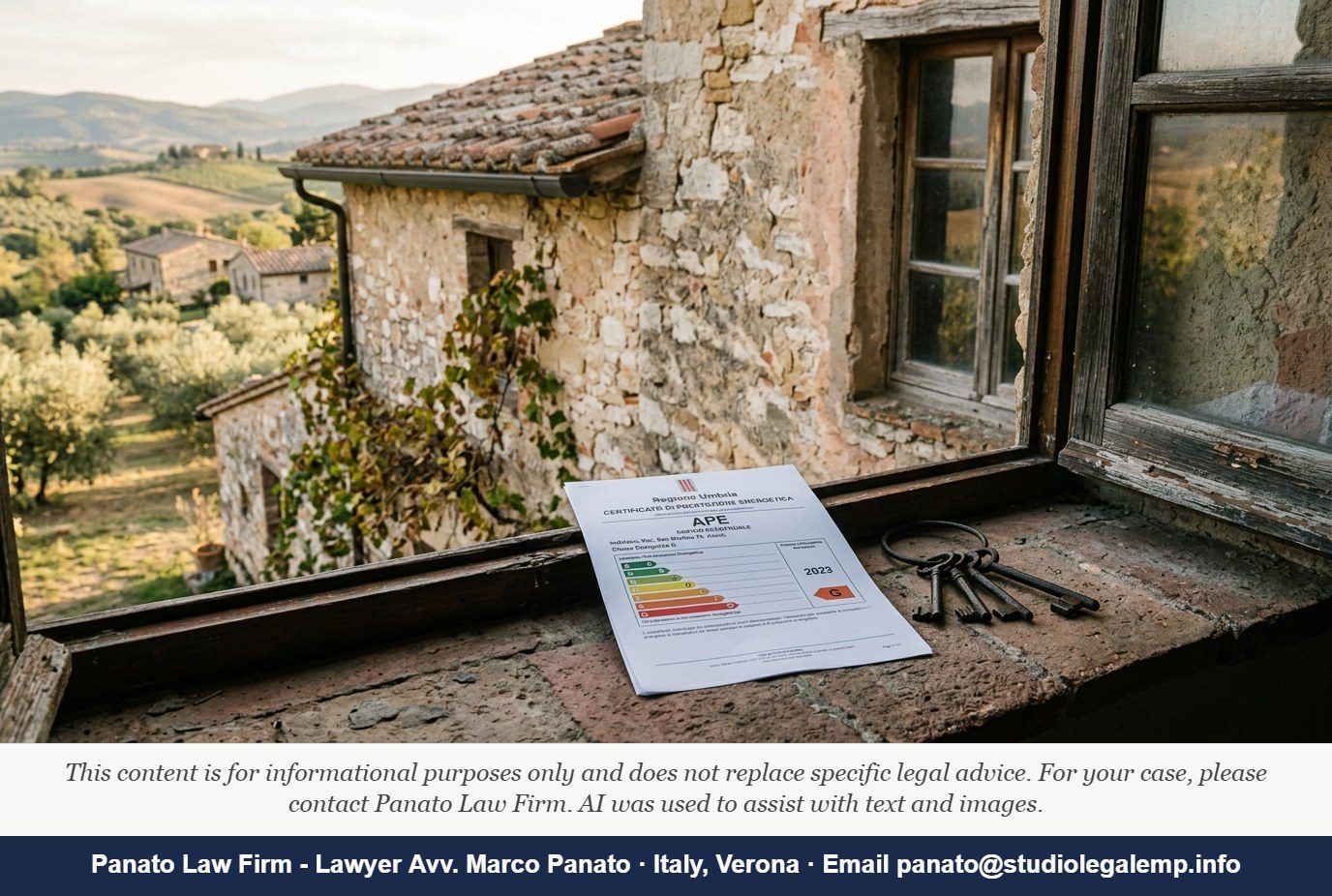
Image prompt: An aged stone farmhouse in the Umbrian hills, warm late-afternoon light washing over terracotta roof tiles and a crumbling exterior wall. A modern energy performance certificate document rests on an old wooden windowsill beside a set of iron keys. The mood is contemplative rather than urgent — beauty meeting bureaucratic reality. Muted earth tones, ochre, dusty rose, and faded olive green throughout, photographed in a documentary style.
Image file: italy-epc-energy-rating-property-2026-foreign-owners-cover
JSON-LD:
LANGUAGE QA: carries an energy rating -> has an energy rating · expose the parties to nullity claims in relation to the contractual clause omitting it -> render the relevant contractual clause void · the worst performers within that already-large group are the priority -> the lowest-rated properties within that group take priority · a 20–22% reduction by 2033 -> a reduction of 20–22% by 2033 · the obligation is not unconditional or immediate for most owners -> the obligation is neither absolute nor immediate for most owners · applied here, a vendor who conceals or misrepresents an energy rating does not simply save themselves a difficult negotiation -> a seller who conceals or misrepresents an energy rating does not merely avoid a difficult negotiation · climate-relate -> climate-related · Italian National Agency for New Technologies, Energy and Sustainable Economic Development -> Italian National Agency for New Technologies, Energy and Sustainable Economic Development (a direct translation of the Italian name)
CHECK:
Directive 2024/1275/EU — EXISTS? Yes, confirmed via EUR-Lex. CONTENT MATCHES? Yes — publication date, transposition deadline, and targets as cited are accurate.
ENEA 74% figure — EXISTS? Yes, consistent with ENEA's published building energy data reports. CONTENT MATCHES? Yes — the approximately 74% in classes F and G is reported in ENEA's national building census data. Exact annual report edition should be verified against the most recent ENEA publication at enea.it.
Banca d'Italia brown discount 5–15% — EXISTS? The FSR 2024 is a real published document. The brown discount finding is consistent with the Bank of Italy's research agenda and is referenced in ECB and academic literature. CONTENT MATCHES? Partial — specific page and working paper number not pinned during this session. Marked TO VERIFY above. Readers should check the Banca d'Italia working paper series for the specific citation.
ECB Guide on climate-related and environmental risks 2023 — EXISTS? Yes, confirmed as a publicly available ECB supervisory document. CONTENT MATCHES? Yes — the guide explicitly addresses EPC ratings in collateral valuation for mortgage supervision purposes.
Italian Civil Code Article 1490 — EXISTS? Yes, standard codice civile provision, universally verifiable. CONTENT MATCHES? Yes — governs warranties against hidden defects in sale contracts.
OVERALL: AMBER — all primary EU and Italian legislative sources confirmed; the Banca d'Italia working paper series reference is directionally accurate but the specific paper number was not pinned and is flagged for verification.
LOCAL NOTE:
1. Search intent targeted: informational — readers have received a letter, seen a news headline, or are preparing to sell or refinance and want to understand what Italian EPBD transposition means for their specific situation as non-resident owners.
2. Local-market framing used: the article draws explicit parallels with the UK domestic EPC regime for landlords (where F and G ratings already bar new lettings) to anchor the Italian rules in something the primary audience already knows, while making clear the Italian trajectory differs in timing and mechanism. A contrast passage distinguishes the Italian disclosure-led model from the more prescriptive common-law consumer information framing.
3. Italian terms kept in the original (italicised on first use with explanation): Attestato di Prestazione Energetica (APE) — retained because it is the official document name that readers will encounter on Italian correspondence and sale contracts; abusi edilizi — retained because no single English phrase captures the specific Italian legal category of unauthorised building works with its distinct regularisation and amnesty mechanism; certificatore energetico — retained for reference purposes as readers will need to search for this professional by this name.
Do you need legal assistance or a free estimate?
Author: Avv. Marco Panato
Avv. Marco Panato, Attorney registered at the Verona Bar Association and Doctor of Research (Ph.D.) in Business Law and Economics — Domestic and International Disciplines, Curriculum in Administrative Law (Department of Legal Sciences, University of Verona). Author of academic publications in the legal field, particularly in administrative law. He also delivers lectures and advanced professional training.