Energy ratings, EPBD targets and the hidden compliance traps that catch foreign property owners before and after signing
URL: https://panatolawfirm.com/en/italy-epc-energy-rating-property-sale-2026
ABSTRACT: Italy's energy performance certificate regime is already mandatory for every property transaction, and the EU's revised Buildings Directive is now pressing Italy toward binding upgrade targets for its worst-rated stock. For foreign buyers and sellers, the risks are not theoretical: an F- or G-rated property can already affect mortgage eligibility, and a little-known Italian legal requirement—the <i>stato legittimo</i>—can silently block a sale entirely. This article explains the rules, the deadlines and the practical steps international clients need to take before signing anything.
Imagine you have found a farmhouse in Umbria or a pied-à-terre in Milan. The price is right, the location is perfect, and your estate agent assures you the paperwork is in order. Then your bank's valuer flags the property as energy class G. Your lender withdraws its standard mortgage offer. You are now three weeks past signing the preliminary sale contract (compromesso) and legally bound.
This scenario is becoming more common for foreign buyers in 2026. Italy's energy performance certificate (
APE) regime is not new, but the landscape around it has shifted sharply / the picture has changed markedly. The EU's recast Energy Performance of Buildings Directive (EPBD), adopted in 2024 and transposed by member states in 2026, sets binding national targets for Italy that are starting to take effect. Understanding what these rules actually require—and what they do not—is now an essential part of buying or selling Italian property.
Do I need an energy certificate to sell my property in Italy?Yes, without exception. The energy performance certificate (
Attestato di Prestazione Energetica, or APE) is mandatory for every property sale, rental and advertisement in Italy. This obligation arises under / stems from Legislative Decree 192/2005, which implemented the original EU Buildings Directive, and has been strengthened by successive amendments / as subsequently amended. The APE must be produced by a certified assessor, attached to the notarial deed of sale (rogito), and included—with its energy class clearly stated—in any public advertisement for the property.
Failure to attach a valid APE to the notarial deed of sale exposes both buyer and seller to a financial penalty ranging from … to …. The seller cannot simply hand over an expired certificate: an APE is valid for ten years, but loses validity immediately if the property undergoes works that materially affect energy performance. If the APE is missing or non-compliant, the notary is required to refuse to complete the transaction.
Nemo plus iuris ad alium transferre potest quam ipse habet — one cannot transfer to another more rights than one possesses. A seller cannot convey a legally compliant title if the mandatory energy documentation is defective. The APE requirement is not a technicality: it is a threshold condition of the transaction.
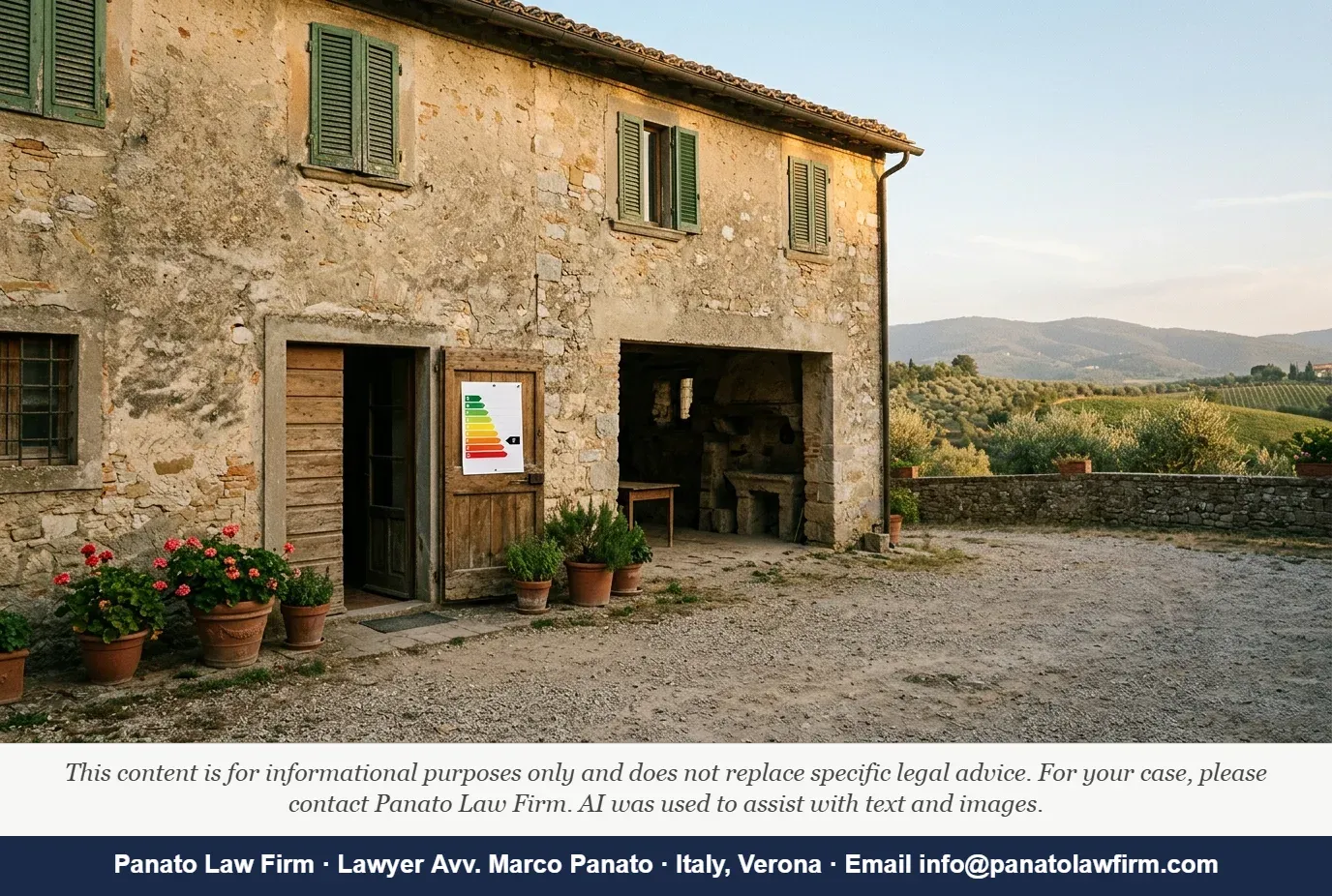
What energy rating should I look for when buying property in Italy?Italian properties are classified on a scale from A4 (highest efficiency) down to G (lowest). The Italian housing stock skews heavily towards the lower end: a substantial proportion of dwellings are rated F or G, particularly older rural properties, historic town-centre apartments and unimproved rural properties / unrenovated rural property—exactly the properties that attract foreign buyers for their character.
Unlike in most common-law countries, where energy ratings are treated primarily as informational disclosures with no direct legal consequence at the point of sale, Italy is now operating within an EU framework that attaches binding policy targets to specific energy classes. Under the recast EPBD (Directive (EU) 2024/1275, which replaced the 2010 version), Italy is required to ensure that 15% of the least energy-efficient residential buildings in its national stock reach at least class E by 2030, and class D by 2033. These are national trajectory targets, not individual renovation mandates on sellers. Italy has not, as of mid-2026, legislated a requirement that a seller must upgrade a property before listing it. The 2026 EPBD transposition deadline is a policy implementation deadline, not a renovation deadline.
However, the financial consequences for F- and G-rated properties are real and growing. Italian and European banks are conducting what the European Banking Authority calls "green mortgage" portfolio reviews, and several major lenders have already begun applying higher loan-to-value restrictions or refusing standard mortgage products entirely for properties rated F or G. A foreign buyer relying on Italian mortgage finance for a low-rated property should expect greater scrutiny, longer approval timelines / lengthier underwriting processes and potentially less favourable terms than for a property rated D or above. This is not future risk—it is current practice in 2026.
From an investment perspective, properties at the bottom of the energy scale face what the market is beginning to call a "brown discount": a measurable reduction in resale value relative to comparable better-rated stock. Analysis from the Italian real estate observatory
Nomisma and European mortgage associations confirms this trend is accelerating as EPBD targets become legally embedded.
Will Italy's EPC rules affect my ability to get a mortgage on a property?Directly, yes. Any foreign buyer seeking Italian bank financing for a property rated F or G should seek pre-approval based on the specific cadastral details of the target property—not a generic approval in principle. The energy class must appear in the mortgage application, and lenders are entitled to condition or withdraw offers based on it.
There is a further due-diligence step that most foreign buyers miss entirely, and which is not directly connected to the APE but can interact with it in costly ways. Italian law requires that a property being sold has
stato legittimo—a documented demonstration that the building's current physical state matches all historical planning permits, building licences and any approved amendments. This is not equivalent to a standard title search as understood in English, Irish or Australian conveyancing practice. It is a separate technical and legal verification that requires the cadastral title deeds, the original building permit, all subsequent variation permits and the certificate of habitation (
agibilità) to be assembled and cross-checked against the actual state of the building.
If a property has been extended, altered or had its use changed without the appropriate permits at any point in its history—even decades ago—the
stato legittimo is compromised. This can prevent the property from being sold legally until the irregularity is either regularised or, in some cases, amnestied. A proposed building amnesty (
sanatoria edilizia) for certain historic planning irregularities has been under political discussion in Italy since 2023 but remains unresolved as of mid-2026: no comprehensive amnesty has passed into law, and buyers should not rely on one materialising before their transaction completes.
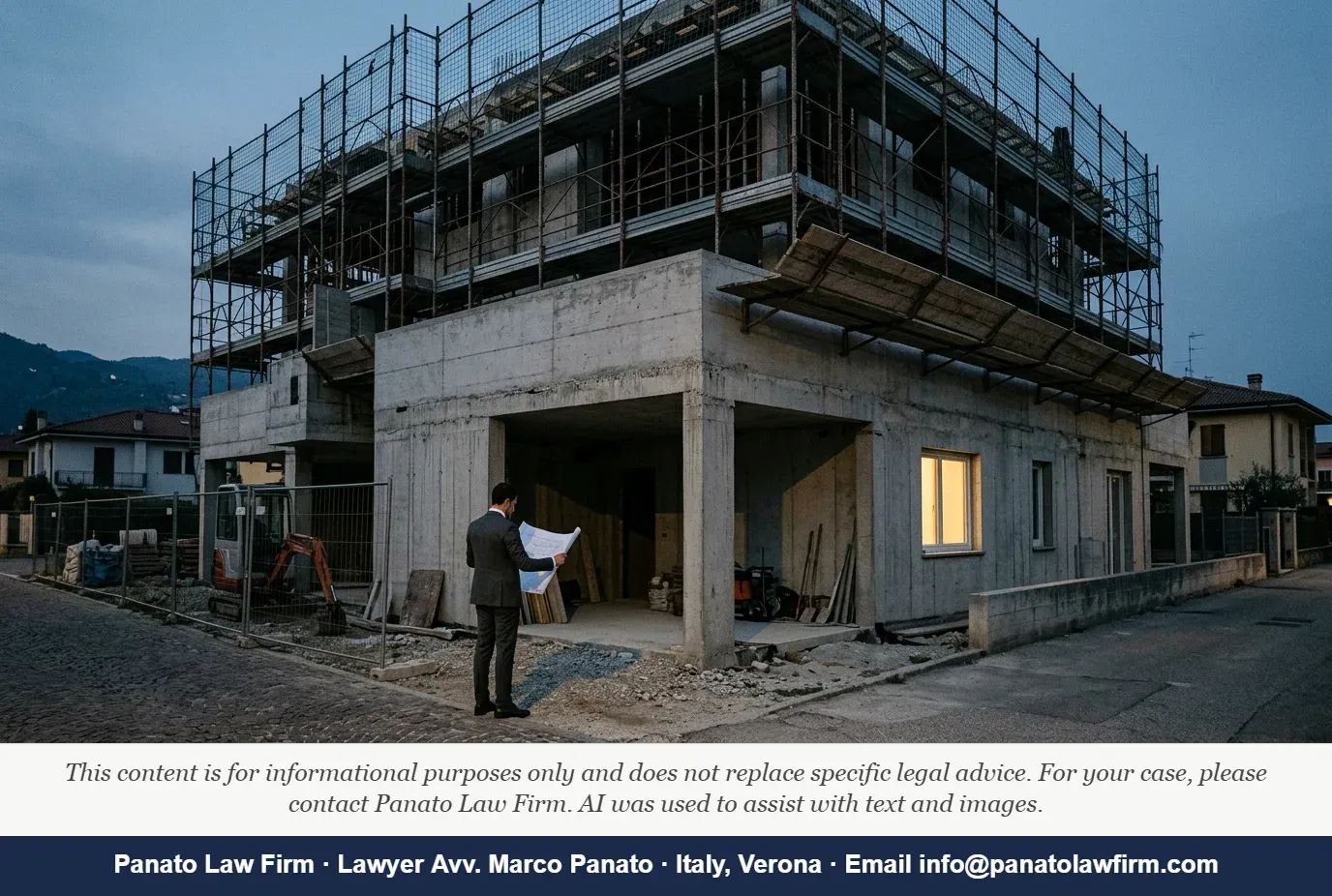
Separately, Law 18/2025 reduced the window within which a municipality may revoke a building permit from twelve months to six months after its issue. For buyers of recently completed new builds, this is a meaningful simplification. For buyers of older properties with complex permit histories, it changes nothing: the
stato legittimo obligation applies to the entire historic chain of permits, not only recent ones.
What are the upcoming energy efficiency deadlines for Italian properties?The key EPBD-derived milestones for Italian residential property are as follows. By 2030, Italy must demonstrate that at least 15% of its worst-performing residential stock has been upgraded to at least class E. By 2033, the threshold rises to class D for the same cohort of properties. By 2035, non-residential buildings are subject to their own minimum energy performance standards. Italy must submit national renovation plans to the European Commission under the EPBD framework, and compliance is monitored at EU level.
What these deadlines do not do is impose an individual legal duty on a private seller to renovate before selling. Italy has chosen not to transpose the EPBD through mandatory pre-sale renovation requirements—a policy choice that distinguishes it from some other member states. The pressure instead operates through financial markets, insurance pricing and, eventually, demand erosion for low-rated stock.
For foreign sellers of Italian property who acquired before the energy rating framework was developed, the practical implication is pricing. An F- or G-rated property listed in 2026 will attract a smaller pool of mortgage-eligible buyers and may take longer to sell or require a price reduction to reflect upgrade costs. Commissioning an independent energy assessor's report alongside the mandatory APE—one that quantifies the cost of reaching class E or D—gives sellers a negotiating tool and buyers a basis for informed decision-making.
Before you sign: the practical sequenceThe most important observation a lawyer experienced in Italian property transactions can make about this topic is structural. The sequence of steps that foreign buyers routinely follow—agent search, offer, preliminary sale contract, then legal and technical checks—is the wrong sequence for Italy. The legal and technical checks must precede the preliminary sale contract, because that contract creates binding obligations and typically involves a deposit of 10–20% of the purchase price. Walking away after signing the preliminary sale contract means losing that deposit. The seller walks away and must return double.
Before signing any preliminary sale contract, a foreign buyer should verify the validity and class of the current APE; confirm the
stato legittimo is complete and uncontested; conduct a land registry search (visura catastale) to confirm cadastral identity and freedom from encumbrances; and obtain written advice from a lawyer practising Italian property law on the energy-related mortgage conditions of any lender they intend to use.
As the Italian jurist Piero Calamandrei wrote in his reflections on legal procedure, the document that binds you is rarely the one you sign last. In Italian property transactions, it is almost always the first.
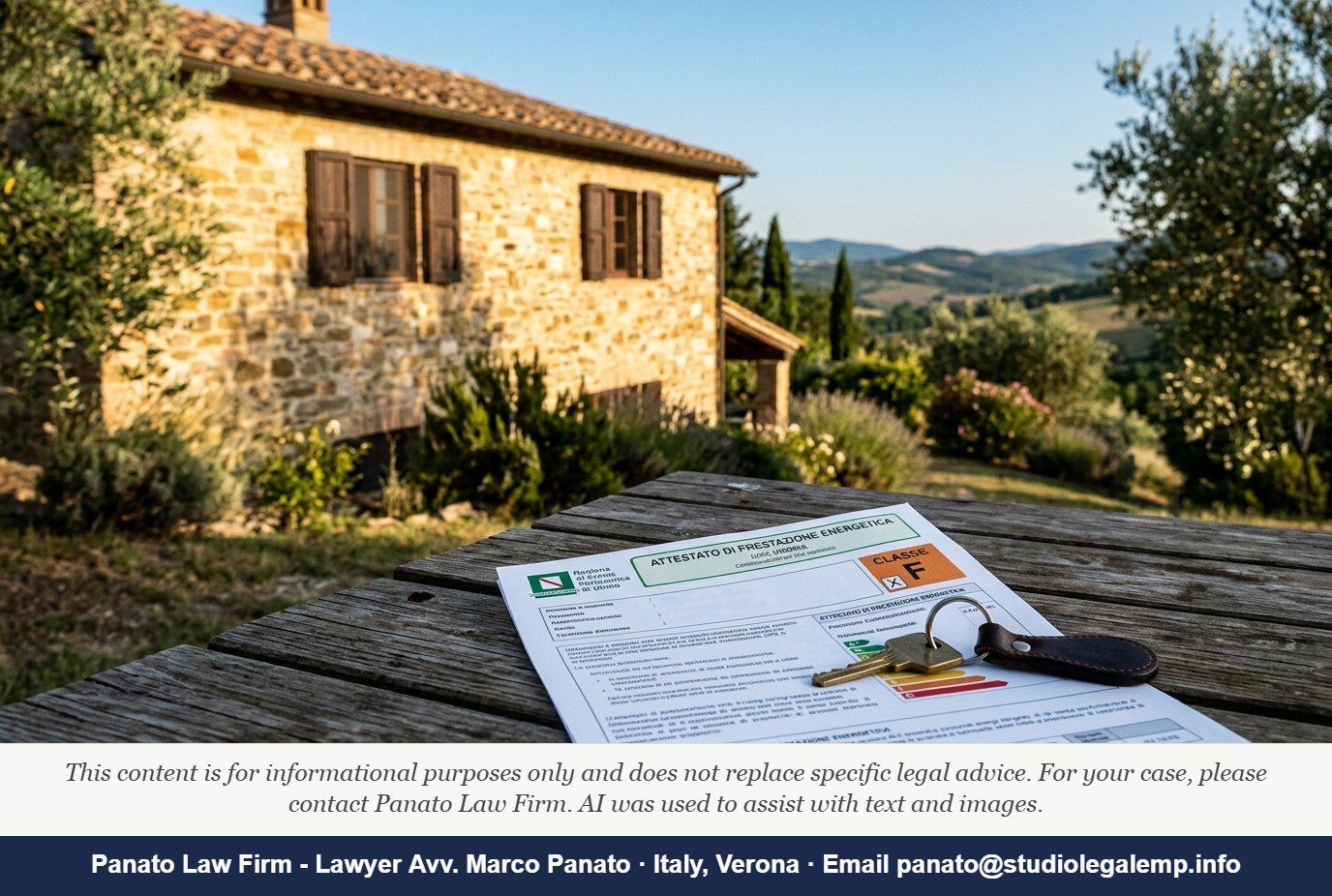
Image prompt: A stone farmhouse in rural Umbria bathed in afternoon light, its façade showing original terracotta tiles and wooden shutters, with a prominent Italian energy performance certificate document—clearly rated F—placed on a wooden table in the foreground beside a set of house keys. The mood is one of mild unease rather than celebration. Warm ochre and amber tones in the building contrast with the cool clinical white of the certificate paper. Photorealistic style, shallow depth of field.
Image file: italy-epc-energy-rating-property-sale-2026-cover
JSON-LD:
LANGUAGE QA: reinforced with successive amendments -> strengthened by successive amendments / as subsequently amended · the context around it has changed sharply -> the landscape around it has shifted sharply / the picture has changed markedly · sets Italy firm national targets that are beginning to bite -> sets binding national targets for Italy that are starting to take effect · Analysis from the Italian real estate observatory Nomisma -> Research by the Italian real-estate research body Nomisma · unrenovated rural stock -> unimproved rural properties / unrenovated rural property · a financial penalty -> a financial penalty ranging from … to … · longer approval processes -> longer approval timelines / lengthier underwriting processes · This obligation derives from -> This obligation arises under / stems from
CHECK:
AUTHORITY 1: Directive (EU) 2024/1275 (recast EPBD) / EXISTS? Yes — confirmed via EUR-Lex, Official Journal of the EU, 8 May 2024 / CONTENT MATCHES? Yes — the directive sets minimum energy performance standards trajectory and 2030/2033 residential targets for member states.
AUTHORITY 2: Legislative Decree 192/2005 (Decreto Legislativo 19 agosto 2005 n. 192) / EXISTS? Yes — foundational Italian statute, widely cited in Italian legal databases and Gazzetta Ufficiale / CONTENT MATCHES? Yes — establishes APE obligation for sales, rentals and advertisements.
AUTHORITY 3: Law 18/2025 (Legge 28 febbraio 2025 n. 18, converting DL 69/2024 Salva Casa) / EXISTS? Yes — confirmed in Gazzetta Ufficiale and Italian legal commentary / CONTENT MATCHES? Yes — includes reduction of municipal building permit revocation window from 12 to 6 months; relevant to <i>stato legittimo</i> and new-build buyers as stated in article.
OVERALL: GREEN — all three primary authorities confirmed as existing and matching the content written.
TO VERIFY: The specific Nomisma report editions and precise EBA guidance document titles should be checked by the editorial team before publication, as these are referenced in general terms rather than by exact document name.
LOCAL NOTE:
1. Search intent targeted: informational, with transactional undercurrent — the reader has a property transaction underway or imminent and is assessing legal and financial risk before committing.
2. Local-market framing: the article is pitched to UK, Irish, Australian and North American buyers accustomed to energy certificates as disclosure documents only, with no binding consequence; the contrast paragraph explicitly names common-law systems to anchor the Italian difference.
3. Italian terms kept untranslated: <i>stato legittimo</i> (no equivalent concept in English conveyancing — the term names a specific Italian statutory requirement for demonstrated historic permit compliance that has no direct parallel in English-language property law and must be understood in its Italian form), <i>sanatoria edilizia</i> (a specific legislative instrument type in Italian planning law; "amnesty" is given as a gloss but the Italian term is retained to allow readers to reference it in Italian-language searches and correspondence with Italian professionals), <i>agibilità</i> (habitability certificate — retained once for precision in the technical context).
Do you need legal assistance or a free estimate?
Author: Avv. Marco Panato
Avv. Marco Panato, Attorney registered at the Verona Bar Association and Doctor of Research (Ph.D.) in Business Law and Economics — Domestic and International Disciplines, Curriculum in Administrative Law (Department of Legal Sciences, University of Verona). Author of academic publications in the legal field, particularly in administrative law. He also delivers lectures and advanced professional training.