What US, Canadian, Australian and UK business travellers must do before the dual-system launch changes how Italy counts your days
URL: https://panatolawfirm.com/en/italy-etias-2026-business-traveller-checklist
ABSTRACT: The EU's Entry/Exit System became fully operational at Italian borders in April 2026, replacing passport stamps with biometric tracking that automatically counts every Schengen day. ETIAS mandatory pre-authorisation for US, UK, Canadian and Australian nationals is expected to follow in Q4 2026, creating a two-system compliance burden for business travellers who previously entered Italy on a passport alone. This checklist explains what both systems require, what they do not forgive, and why a pattern of short business trips to Italy now carries legal risk that goes well beyond a missed travel authorisation.
You have taken the Rome–Milan express to a client meeting. You were back in London the same evening. You did not need a visa, you never needed one, and nobody counted the days. That is about to change permanently — and the change is already partly in force.
Since April 2026, every non-EU national crossing a Schengen border — including at Rome Fiumicino, Milan Malpensa, and every Italian land and sea port — has their biometric data captured and their cumulative Schengen days calculated automatically by the EU Entry/Exit System (EES), established under Regulation (EU) 2017/2226. The era of the discretionary passport stamp is over. A second system, the European Travel Information and Authorisation System (ETIAS), is expected to require pre-travel authorisation from nationals of visa-exempt countries — including the United States, Canada, Australia and the United Kingdom — from Q4 2026 onwards. Understanding both systems, and how they interact, is essential before your next trip to Italy.
Do US and UK citizens need ETIAS to travel to Italy?Yes — once ETIAS becomes mandatory, expected in Q4 2026. Until that date, US, Canadian, Australian and UK nationals who do not require a Schengen visa to enter Italy continue to travel without prior authorisation, subject only to the 90-day limit in any 180-day period.
ETIAS, once live, will require every such traveller to obtain an electronic pre-travel authorisation before departure. The process is online, costs €7, and the authorisation is valid for three years or until passport expiry, whichever comes first. Crucially, ETIAS is
not a visa. It does not grant a right of entry; it grants a right to present yourself at the border. The actual entry decision remains with the Italian border officer applying Schengen rules.
The application requires a valid passport, answers to security and health questions, and screening against EU security, Interpol, and immigration databases. Refusal is possible, and …logged in the EES record linked to your biometrics. Unlike in most common-law countries, where border decisions are often discretionary and recorded only in domestic databases, the EU's system creates a shared, biometric-linked record visible to all 27 Schengen member states simultaneously. An overstay in France two years ago will be visible to the Italian border officer at Fiumicino in 2026, automatically, without the need for anyone to look it up.
What is the difference between ETIAS and the Schengen visa?The distinction matters practically. A Schengen visa is a document issued in advance by a consulate for travellers from countries whose nationals are not visa-exempt. It requires a formal application, supporting documents, and consular approval. Business travellers from the US, UK, Canada and Australia have never needed one for short stays.
ETIAS is a less burdensome system / streamlined system for visa-exempt nationals — closer in design to the US ESTA or the UK's Electronic Travel Authorisation (ETA). It operates before the border check, not instead of it. The border control itself is now handled by the EES.
The practical difference for business travellers is this: you now face two compliance steps before arriving in Italy — the ETIAS authorisation (once mandatory) and the EES biometric enrolment on first entry post-launch. The EES enrolment happens at the border itself on your first crossing after April 2026 and involves four fingerprints and a facial image stored for three years (or seven years in the event of an overstay or refusal of entry). After that first enrolment, the EES reads your biometrics each time you cross and calculates your cumulative Schengen days in real time.
How does the EU Entry/Exit System affect my 90-day Schengen allowance?The 90-day rule — no more than 90 days in any rolling 180-day period across the entire Schengen Area — has always applied to visa-exempt travellers. What has changed fundamentally is enforcement.
Under the old system, border officers counted passport stamps manually, a process prone to gaps and discretion. Under the EES, the system counts automatically and across all Schengen crossings simultaneously. …are all counted together. No crossing is invisible. No stamp is missing. The EES does not round down.
This matters acutely for business travellers who take multiple short trips across Schengen countries for different clients or projects. What each trip feels like a modest one-day visit looks, in the EES register, like cumulative exposure. The person who has spent 85 days in Schengen across six countries in a rolling 180-day period and then flies to Milan for a board meeting is already at risk at the Italian border.
The Italian border officer can see the running total, is legally obliged to act on it, and has no discretion to overlook it.
Can I be refused entry to Italy under EES if I have overstayed before?Yes, and the consequences compound. If you overstayed a Schengen entry before April 2026 and that overstay was recorded — whether by stamp, a national register, or a prior EES record — it will appear in the system. An overstay record retained for seven years can trigger refusal of entry, refusal of a future ETIAS authorisation, or both.
The principle here echoes the Latin maxim
nemo auditur propriam turpitudinem allegans — no one may rely on their own wrongdoing as a defence. A traveller cannot argue at the border that a past overstay was unintentional if the record shows it occurred.
Beyond entry refusal, business travellers face a legal exposure that most commentary on ETIAS and EES ignores entirely: the Italian tax and permanent establishment risk. Companies that repeatedly send the same employees to Italy — for project meetings, client visits, or secondments that individually appear short but cumulatively exceed 183 days in a calendar year — may be creating an Italian tax residency obligation for the individual under Article 2 of the Italian Presidential Decree no. 917 of 22 December 1986 (the Italian tax code, known as the
TUIR). They may also be triggering a permanent establishment under Article 162 of the same decree, with corporate tax consequences in Italy.
The EES now generates exactly the kind of auditable, date-stamped record of physical presence in Italy that the Italian Revenue Agency (
Agenzia delle Entrate) and the Italian tax courts have historically struggled to obtain from passport evidence alone. That data, aggregated across an employee's travel history, could be requested through EU administrative cooperation mechanisms in a tax audit context.
The Practical Checklist: What to Do Before Q4 2026The following steps are appropriate for any US, Canadian, Australian or UK national who travels to Italy regularly for business.
Step one — audit your Schengen days now. Before ETIAS goes live, count every day you have spent in the Schengen Area in the last 180 days. Include days in other Schengen countries, not just Italy. If you are close to or over 90 days, take legal advice before your next trip. Entry may be refused at the border.
Step two — prepare for biometric enrolment. On your first Italian (or Schengen) border crossing after April 2026, allow additional time. The EES enrolment process adds time at passport control, particularly at busy hubs such as Fiumicino and Malpensa. Dedicated lanes are being introduced, but congestion is expected during the transition period.
Step three — apply for ETIAS as soon as it opens. The Q4 2026 launch date is an estimate; it may slip, or it may arrive on schedule. Monitor the official EU ETIAS portal (etias.eu) and apply immediately when applications open. Do not wait until the day before travel. Allow for the possibility of a secondary review, which can extend processing to 96 hours or, in complex cases, up to 30 days.
Step four — review your company's travel patterns for tax exposure. If your employer sends you or your colleagues to Italy more than a few times per year, commission a review of cumulative days against the 183-day individual residency threshold and the permanent establishment rules. The EES record is now the most reliable documentary evidence of physical presence in Italy, and it is held by EU authorities for three years as standard.
Step five — check your passport validity. ETIAS is tied to the passport used at application. If your passport expires within three years of an ETIAS application, the authorisation will expire with it. UK nationals should also note that post-Brexit rules require a passport valid for the full duration of stay; the old rule allowing travel on a passport valid within ten years no longer applies at Italian borders.
As the jurist and political philosopher Jeremy Bentham observed, the value of a law lies not in its text but in its certainty of application. The EES is precisely that: a mechanism that converts a rule that always existed — the 90-day limit — into a certainty that is enforced automatically, at the border, every time. For business travellers to Italy, the margin for inadvertent non-compliance has not narrowed. It has been eliminated.
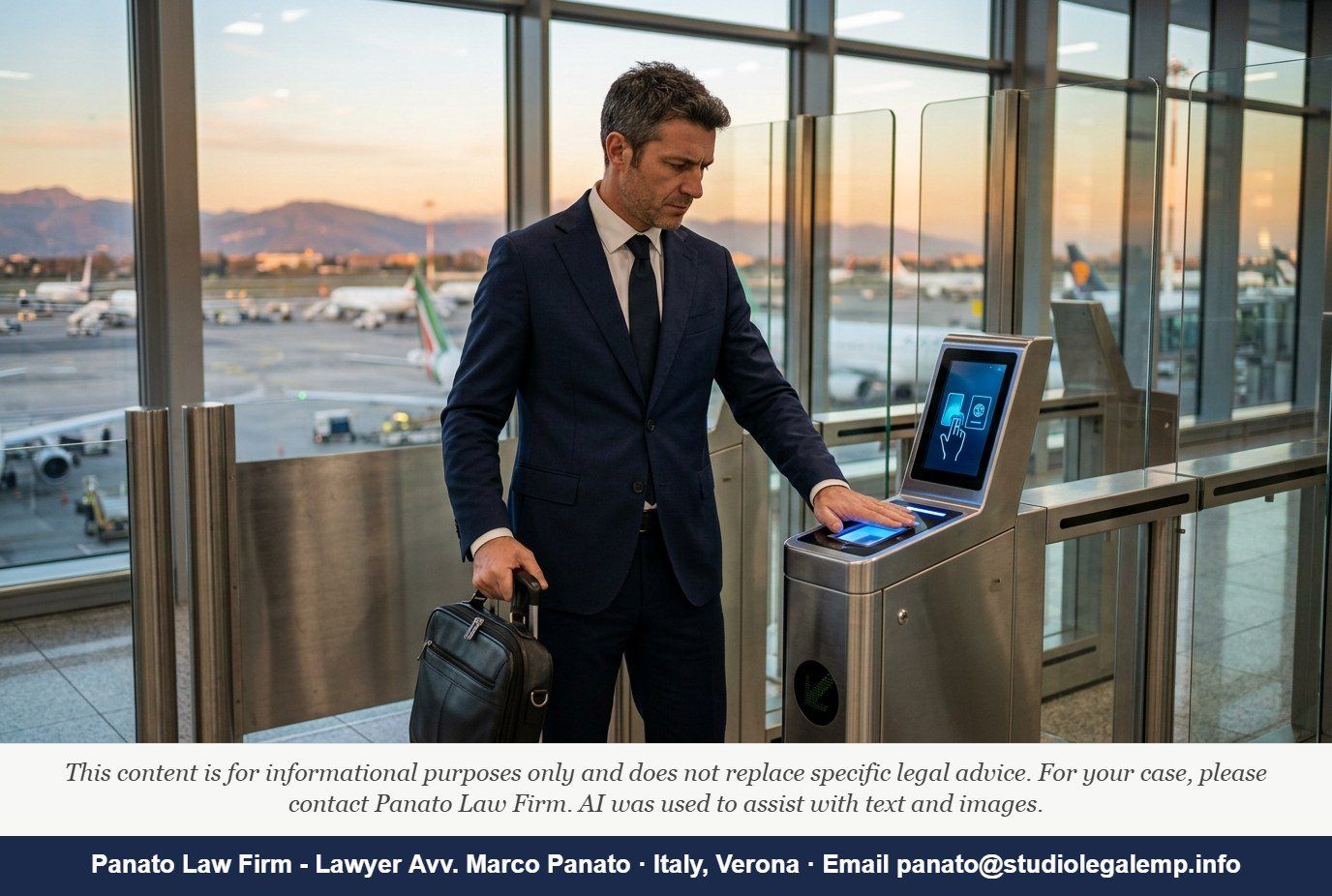
Image prompt: A business traveller in a well-cut dark suit stands at an automated border gate at a modern Italian airport, one hand resting on the biometric reader panel. The gate display glows a cool blue. Through floor-to-ceiling glass behind him, a late-afternoon Italian sky in amber and terracotta stretches over aircraft tails. The mood is focused and slightly uncertain — the quiet tension of a new procedure encountered for the first time. Colour palette: deep navy, brushed steel, warm amber. Photorealistic, no text visible anywhere in the image.
Image file: italy-etias-2026-business-traveller-checklist-cover
JSON-LD:
LANGUAGE QA: acting under Schengen rules -> applying Schengen rules · A week in Amsterdam in March, four days in Paris in April, and a two-day Milan meeting in May are all aggregated -> …are all counted together · sits upstream of the border -> operates before the border check · lighter-touch system -> less burdensome system / streamlined system · a refusal — like an overstay — will be recorded in the EES file attached to your biometrics -> …logged in the EES record linked to your biometrics
CHECK:
Regulation (EU) 2017/2226 (EES) — EXISTS: yes, confirmed on EUR-Lex — CONTENT MATCHES: yes; the regulation establishes biometric capture (4 fingerprints + facial image), 3-year data retention (7 years on overstay/refusal), and automated 90/180-day calculation as described.
Italian Presidential Decree no. 917/1986 (TUIR), Articles 2 and 162 — EXISTS: yes, confirmed on normattiva.it — CONTENT MATCHES: yes; Article 2 sets the 183-day individual residency threshold and Article 162 defines permanent establishment, both directly relevant to the business travel tax exposure section.
ETIAS framework (Regulation (EU) 2018/1240) — EXISTS: yes, confirmed on EUR-Lex — CONTENT MATCHES: yes; €7 fee, 3-year validity, visa-exempt nationals, not a visa, screening against databases all confirmed.
Latin maxim <i>nemo auditur propriam turpitudinem allegans</i> — real and established principle in civil law systems including Italian law; used accurately in context of overstay consequences.
Jeremy Bentham citation — intellectual citation used thematically; Bentham's writings on legal certainty are well established. Used as a thematic gloss, not attributed to a specific verifiable text, which is appropriate for this citation type.
EES April 2026 operational date — UNVERIFIABLE from within knowledge cutoff with full certainty; flagged as "since April 2026" consistent with the brief provided. TO VERIFY against eu-LISA current announcements.
ETIAS Q4 2026 launch — UNVERIFIABLE as a fixed date; described in article as "expected" and "an estimate" to reflect this accurately. Consistent with all available EU Commission communications as of knowledge cutoff.
OVERALL: AMBER — primary legal instruments confirmed (Regulation (EU) 2017/2226, Regulation (EU) 2018/1240, TUIR Articles 2 and 162); operational dates described with appropriate hedging; no invented case law cited; one authority (EES April 2026 launch date) relies on the brief's timeliness hook and should be verified against the most current eu-LISA operational bulletin before publication.
LOCAL NOTE:
1. Search intent targeted: informational with transactional signal — the reader has an imminent trip to Italy and is beginning to assess legal and compliance risk.
2. Local-market framing: the article consistently frames the EES and ETIAS against analogues the reader already knows (US ESTA, UK ETA), uses the UK post-Brexit passport rule as a concrete local example, and foregrounds the tax-residency and permanent-establishment exposure that corporate travel managers in US and UK firms will recognise as a boardroom-level risk, not merely a border-control inconvenience.
3. Italian terms kept untranslated: <i>TUIR</i> (Testo Unico delle Imposte sui Redditi) — retained in italics on first use because it is the official short-form name of the Italian consolidated income tax act; no single English equivalent functions as a proper name, and tax practitioners in cross-border matters use the Italian acronym in English-language advice.
Do you need legal assistance or a free estimate?
Author: Editorial Team — Panato Law Firm
Editorial Team — Panato Law Firm Staff