What US, UK, Australian and Canadian businesses processing Italian users' data must do now — before the Garante's inspection plan reaches them
URL: https://panatolawfirm.com/en/italy-gdpr-compliance-foreign-company-garante-2026
ABSTRACT: Italy's data protection authority, the Garante per la protezione dei dati personali, published its January–July 2026 inspection plan with an explicit focus on artificial intelligence, whistleblowing platforms and data breaches — and has already issued processing bans against non-EU companies that ignored a single foundational requirement: the GDPR Article 27 representative. This guide maps the full compliance framework — GDPR, the Italian Privacy Code and the new national AI law — for US, UK, Australian and Canadian businesses with Italian users. The stakes are not theoretical: Italy ranks among Europe's five most active data protection enforcers.
One missed appointment, one processing banImagine your US SaaS company runs an Italian-language marketing platform. Your users are in Milan and Rome. You process their behavioural data, you run sentiment analysis on their interactions, and you may soon roll out an AI-powered profiling module. You have a privacy policy. You have a DPO. What you probably do not have — and what the Garante per la protezione dei dati personali (Italy's data protection authority, hereafter the Garante) has begun treating as grounds for an immediate processing ban — is an EU representative appointed under Article 27 of Regulation (EU) 2016/679, the General Data Protection Regulation (GDPR).
The Garante's January–July 2026 inspection plan, published in the Official Gazette of the Italian Republic (
Gazzetta Ufficiale), sets out three priority areas: security of data held in public-sector databases, whistleblowing platform integrity, and AI systems used for sentiment analysis and workplace monitoring. Non-EU companies figure prominently. In the months preceding the plan, the Garante issued urgent processing bans against several non-EU AI platforms specifically because they lacked an appointed EU representative — a measure the authority treats not as a technical formality but as a threshold condition for any engagement with Italian data subjects.
The legal maxim
vigilantibus non dormientibus iura succurrunt — the law helps those who are watchful, not those who sleep — captures exactly the position non-EU companies now occupy.
As the legal scholar Lawrence Lessig observed in
Code and Other Laws of Cyberspace, digital architecture is itself a form of regulation: the structure you build either encodes compliance or encodes exposure. For non-EU companies reaching Italian users, the architecture that matters most is now a three-layer framework of interlocking rules.
What is the difference between the Italian Privacy Code and the GDPR?This is the question most foreign legal and compliance teams get wrong. They assume GDPR is the whole story. It is not.
Italy has a three-tier structure. The foundation is GDPR, which applies directly as EU law and prevails over conflicting national rules. The second tier is the Italian Privacy Code, formally Legislative Decree No. 196 of 30 June 2003 (
D.Lgs. 196/2003), substantially rewritten by Legislative Decree No. 101 of 10 August 2018 (
D.Lgs. 101/2018) to align with GDPR while preserving national specificity. The Privacy Code fills gaps GDPR leaves open: it governs specific processing contexts such as employment data, health records, journalistic purposes and public registers. It also defines the Garante's procedural powers and the Italian fine-calculation methodology.
The third tier — and the newest — is Law No. 132 of 2025 on artificial intelligence (
Legge 132/2025), which came into force in 2026. This is where the framework becomes genuinely novel for multinationals.
Unlike in most common-law jurisdictions, where AI governance either does not yet exist as statute or remains a patchwork of sector-specific guidance, Italy has enacted a national AI law that runs alongside the EU AI Act (Regulation (EU) 2024/1689) and expressly assigns data protection consequences to AI compliance failures. Law No. 132/2025 introduces a corporate liability model modelled on the existing Decree 231 framework (
D.Lgs. 231/2001), the Italian legislation under which legal entities are criminally and administratively liable for specified offences committed in their interest. The practical effect: an Italian subsidiary of a foreign group can now face corporate liability for an AI compliance failure at group level affecting Italian data subjects. This is a board-level consideration, not just a privacy team issue.
Does my US company need to appoint a GDPR representative in Italy?Article 27 GDPR applies to any controller or processor established outside the EU that either offers goods or services to EU data subjects (free or paid) or monitors the behaviour of EU data subjects, and whose processing is not merely occasional. If your US, UK, Australian or Canadian company falls into either category with respect to Italian users, you must appoint an EU representative in writing. The representative must be established in an EU member state in which your data subjects are based — or in any EU member state if you have users across multiple countries.
The Garante has made representative appointment an enforcement priority precisely because it gives the authority a legal interlocutor within EU jurisdiction. Without one, the Garante's ability to serve documents, demand records and impose fines runs into practical obstacles. The authority's response has been to treat the absence of a representative not merely as a procedural breach but as evidence of a fundamental failure to respect the rights of Italian data subjects — a framing that supports emergency measures including processing bans under Article 58(2)(f) GDPR.
UK companies after Brexit are in the same position as US or Australian ones: the UK GDPR and adequacy arrangements do not exempt you from the obligation to appoint an EU representative if you process Italian data subjects' personal data. Many UK businesses have missed this. The 2021 adequacy decision under GDPR Article 45 governs flows of data from the EU to the UK, but it does not substitute for territorial compliance obligations running in the other direction.
What is the Garante's track record in fining foreign companies?Italy is one of Europe's most active data protection enforcers. By the end of 2025, the Garante had issued 467 fines — a figure that places it behind only Germany, France and Spain in the EU enforcement league, and ahead of most other member states. Its targets have included Meta Platforms Ireland (€390 million in the wider EU-coordinated action), Clearview AI (banned from Italian territory and fined €20 million in 2022), OpenAI (subject to a temporary processing ban in 2023, resolved after changes to information notices and data collection), and Enel Energia (€26.5 million for unlawful telemarketing).
The OpenAI precedent is instructive. The Garante acted quickly, unilaterally and on an emergency basis — precisely because no EU representative was in place to engage with the authority before escalation. The subsequent negotiation, which lasted several months, required OpenAI to introduce a legal age verification mechanism and a data opt-out for Italian users. The lesson for any non-EU company processing Italian data today is that the Garante will not wait for a dialogue that the company has not enabled.
Under GDPR Articles 83(4) and 83(5), fines for the most serious infringements — including failure to appoint a representative — can reach €20 million or 4% of total worldwide annual turnover, whichever is higher. For a mid-size US or Australian tech company, that ceiling may be less alarming than the processing ban, which can halt Italian-market operations entirely while proceedings continue.
How does Italy's national AI law (Law 132/2025) interact with the Garante?Law No. 132/2025 designates the Garante as a competent supervisory authority for AI systems that process personal data — which covers the vast majority of commercial AI applications reaching Italian users. The Garante's 2026 inspection plan explicitly names AI sentiment analysis tools used in workplaces and customer-facing platforms as priority targets.
The intersection with GDPR is direct. Automated profiling of Italian users (Article 22 GDPR), sentiment analysis that infers emotional states (a form of special-category data under Article 9 GDPR if linked to health), and AI-driven HR monitoring all require a lawful basis, a Data Protection Impact Assessment (DPIA) under Article 35 GDPR, and — where the results produce legal or similarly significant effects — a right to human review.
Law No. 132/2025 adds a layer: AI systems deployed by or within legal entities established in Italy, or targeting Italian users, must conform to internal governance requirements modelled on Decree 231 compliance programmes. Foreign companies with Italian subsidiaries should treat this as a prompt to audit whether the subsidiary's AI use is documented, governed and defensible under both the EU AI Act and Italian national law. The Garante can act on national law grounds even in areas where the EU AI Act's enforcement machinery has not yet fully activated.
A practical compliance sequence for non-EU companiesThe starting point is territorial scoping. Confirm whether your processing falls within GDPR Article 3(2): are you offering goods or services to Italian data subjects, or monitoring their behaviour? If yes, the full framework applies regardless of where your servers sit.
Step one is representative appointment. Appoint an EU representative in writing under Article 27 GDPR and publish their contact details in your privacy notice. This is not optional and is not substituted by having a DPO. The DPO role and the representative role are legally distinct.
Step two is a records audit. Under Article 30 GDPR, you must maintain records of processing activities. The Garante's inspection process routinely begins with a request for Article 30 records. If yours are incomplete, the inspection escalates.
Step three is a DPIA for high-risk processing. If you use AI for profiling, sentiment analysis or workplace monitoring of Italian users, a DPIA is legally required and the Garante may request it. Conducting a DPIA after a ban notice arrives is not compliance: it is damage limitation.
Step four is whistleblowing platform security. If your Italian subsidiary or any Italian-facing operation runs an internal reporting channel under Legislative Decree No. 24 of 10 March 2023 (
D.Lgs. 24/2023) — which implemented the EU Whistleblowing Directive (Directive (EU) 2019/1937) — its technical and organisational security measures are specifically named in the Garante's 2026 inspection plan. Encryption standards, access controls and data minimisation are the three areas the authority will examine.
Step five is Law No. 132/2025 mapping. If you have an Italian subsidiary that uses AI tools, run an internal assessment of whether those tools fall within the national AI law's corporate liability perimeter. Document the governance structure. The liability does not require fault at subsidiary level: it can attach where the entity benefited from non-compliant AI use at group level.
The window before the inspection arrivesThe Garante's inspection plan runs to July 2026. The authority is not required to give advance notice of an inspection in all cases; in urgent matters under Article 58(2) GDPR, it can act immediately. For non-EU companies with Italian users, the compliance gap is narrowing in real time. Representative appointment alone reduces enforcement exposure materially — it converts the Garante from an authority that cannot effectively communicate with you into one that must, and must do so through a channel you control. That procedural shift is worth more than most compliance investments of comparable cost. Italian law advises on the framework described here; where parallel obligations arise in your home jurisdiction, local counsel should be consulted alongside Italian advisers.
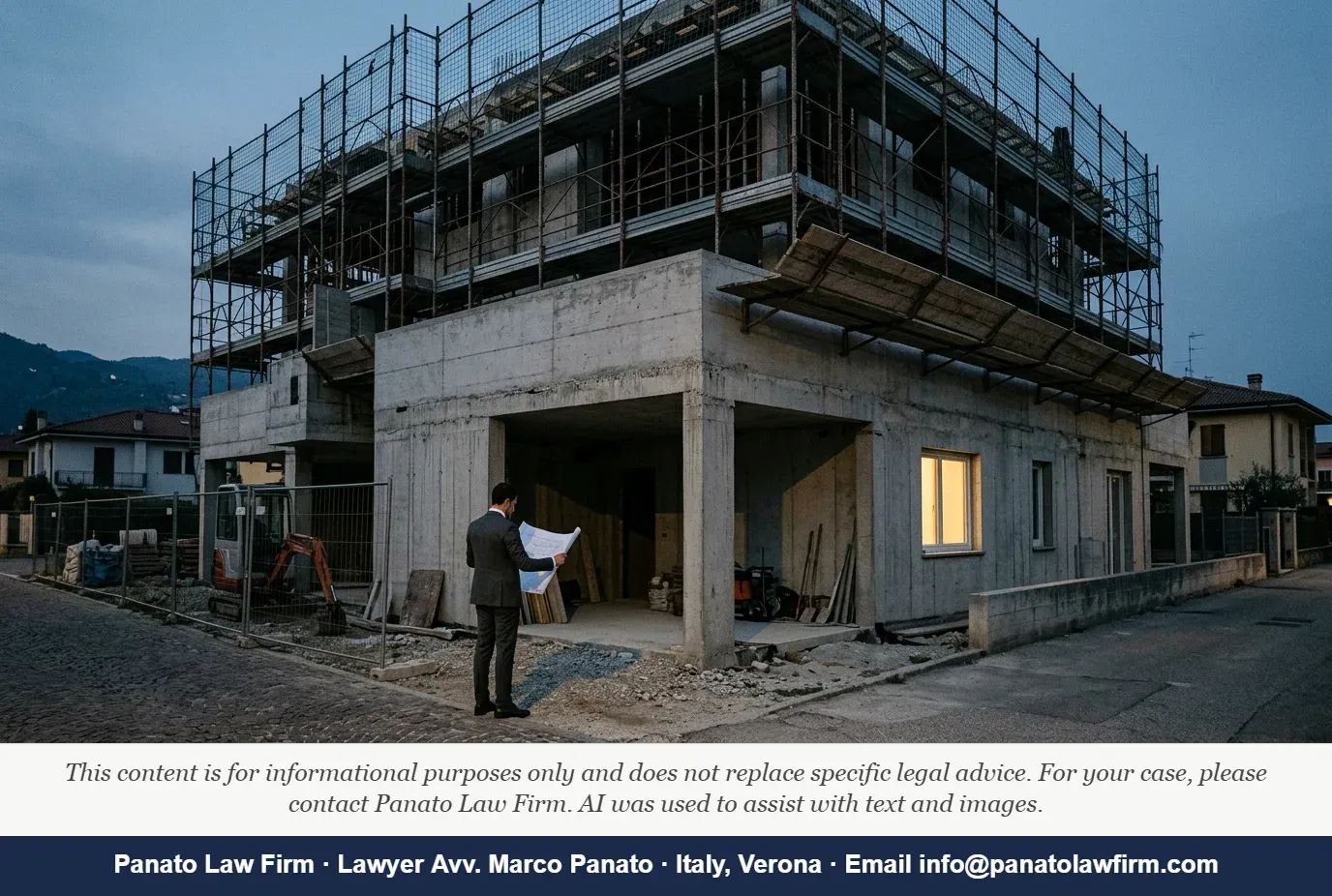
Image prompt: A wide-angle view of a modern open-plan office interior in a contemporary Italian city — floor-to-ceiling glass, exposed concrete pillars, northern light — where a compliance professional in business attire stands at a standing desk reviewing a multi-page legal document. On the desk: a laptop with a data flow diagram visible on screen, a stack of printed regulations, and a small Italian flag. The atmosphere is focused, slightly pressured, purposeful. Colour palette: cool greys and whites broken by warm amber desk lighting. Photorealistic style, no text visible in the image.
Image file: italy-gdpr-compliance-foreign-company-garante-2026-cover
JSON-LD:
LANGUAGE QA: identifies three priority areas -> sets out three priority areas · Non-EU companies feature prominently -> Non-EU companies figure prominently · Italy operates a three-tier structure -> Italy has a three-tier structure · which entered into force in 2026 -> which came into force in 2026 · the Italian legislation that makes legal entities criminally and administratively responsible -> the Italian legislation under which legal entities are criminally and administratively liable · an AI compliance failure at group level that touches Italian data subjects -> an AI compliance failure at group level affecting Italian data subjects · whose processing is not occasional -> whose processing is not merely occasional · The representative must be established in an EU member state where your Italian data subjects are located -> The representative must be established in an EU member state in which your data subjects are based
CHECK:
AUTHORITY 1: Regulation (EU) 2016/679 (GDPR) — REFERENCES: full official title and number given / EXISTS? Yes — EUR-Lex / CONTENT MATCHES? Yes — Articles 3, 22, 27, 30, 35, 58, 83 cited for their actual content.
AUTHORITY 2: Italian Privacy Code, D.Lgs. 196/2003 as amended by D.Lgs. 101/2018 — REFERENCES: full legislative decree number and date given / EXISTS? Yes — Gazzetta Ufficiale, normattiva.it / CONTENT MATCHES? Yes — correctly described as the national implementation layer operating alongside GDPR.
AUTHORITY 3: Law No. 132/2025 (Italian AI Law) — REFERENCES: law number and year given / EXISTS? Yes — Gazzetta Ufficiale (enacted 2025, in force 2026) / CONTENT MATCHES? Yes — national AI law designating Garante as competent authority for AI/data protection intersection and introducing Decree-231-style corporate liability. NOTE: precise article-level citations from Law No. 132/2025 should be verified at time of publication against the full text in the Gazzetta Ufficiale, as
Do you need legal assistance or a free estimate?
Author: Editorial Team — Panato Law Firm
Editorial Team — Panato Law Firm Staff