How Law No. 4/2026 reshaped Italy's FDI screening regime — and why the new sequencing rule catches most foreign acquirers off guard
URL: https://panatolawfirm.com/en/italy-golden-power-filing-foreign-acquisition-2026
ABSTRACT: Law No. 4 of 15 January 2026 significantly reformed Italy's Golden Power regime, introducing an 'economic and financial security' ground, a sequencing rule that locks Italian review behind ECB and EU clearances in banking deals, and a mandatory digital pre-notification platform. Foreign acquirers who treat Italian FDI screening as a box-ticking exercise risk having their transaction unwound. This guide explains what triggers a filing, what the 2026 reform actually changed, and where the practical traps lie.
The transaction that triggered a legislative overhaulIn late 2024, the Italian government exercised its Golden Power veto against UniCredit's proposed acquisition of Banco BPM. The European Commission subsequently opened infringement proceedings, arguing that Italy had applied its special-powers regime in a manner incompatible with EU rules on the free movement of capital. The political fallout was considerable. Rome's response was Law No. 4 of 15 January 2026, which amended the foundational framework — Law-Decree No. 21 of 15 March 2012, as converted, with amendments, by Law No. 56/2012 — in three significant ways: it codified 'economic and financial security' as a protected national interest, introduced a sequencing rule for financial-sector deals, and replaced the old paper-and-email notification process with a dedicated digital pre-notification platform.
For any foreign buyer with a target in Italy, this is not background reading. It is a pre-signing checklist item.
The legal maxim
nemo potest ad impossibile obligari — no one can be bound to do the impossible — does not apply here. The obligation to notify exists whether or not you knew about it, and ignorance does not stop the clock.
What sectors trigger a mandatory Golden Power notification in Italy?The base framework established by Law-Decree No. 21/2012 already covered a broad scope: defence and national security, energy infrastructure, transport, broadband communications, and certain technology sectors. Successive Presidential Decrees expanded coverage to health, agri-food supply chains, and critical financial infrastructure. Law No. 4/2026 adds 'economic and financial security' — a deliberately broad concept that captures systemically important banks, payment infrastructure, and asset managers whose failure or foreign control could destabilise public finances or the sovereign debt market.
In practice, the sectors now notifiable sectors include defence procurement and dual-use technology; electricity generation, gas pipelines and storage; ports, airports and motorway concessions; 5G and broadband networks; banking, insurance and capital-market infrastructure; health technologies and pharmaceutical supply; agri-food processing at scale; and cloud and data-processing services designated as critical under EU Network and Information Security rules.
The critical point for foreign buyers is that the trigger is what the Italian target does, not the acquirer's own sector. A North American private equity fund acquiring a logistics company that operates a port terminal in Genoa or Trieste must file. So must a Gulf sovereign wealth fund taking a minority stake in an Italian bank, and so must a non-EU technology group acquiring an Italian cloud-services provider that holds public-sector contracts.
Does Golden Power apply to intra-group restructurings involving Italian entities?This is the question clients most often ask after signing, rather than before — and the answer is yes, with qualifications.
Italian law triggers the notification obligation not only on external acquisitions but on any transaction or step that results in a change of control, a material change in board composition, or the acquisition of rights that allow an external party to block or influence strategic decisions. This includes internal group reorganisations where an Italian entity in a regulated sector is shifted between holding companies, even if the ultimate beneficial owner does not change. It also includes the granting of pledges or security interests over shares in Italian strategic companies if those pledges give the secured creditor rights over governance.
Unlike in most common-law jurisdictions — where a share pledge is treated as a purely contractual security arrangement until enforcement — Italian law under the Golden Power framework treats certain pledge structures as notifiable events on creation, not on enforcement. A lender receiving a pledge over shares in an Italian energy company as security for a project finance loan must consider whether the contractual rights attached to that pledge (information rights, consent rights over major decisions, step-in rights) meet the threshold. Post-Law No. 4/2026, the Presidency of the Council of Ministers has issued implementing guidance confirming that pledge arrangements with governance-affecting rights are within scope.
EU acquirers are not exempt. This often surprises clients based in Germany, France, and the Netherlands in particular. The Golden Power framework applies to intra-EU transactions wherever the Italian government determines that the strategic interest threshold is met. The European Commission's infringement proceedings did not challenge Italy's right to screen intra-EU deals; they challenged the manner in which the veto was exercised in the UniCredit/Banco BPM case. The distinction matters: screening continues, the regime remains lawful in principle, and EU buyers who assume they are outside scope because they are European take a real risk.
How long does the Italian government have to review a Golden Power notification?The base review period under Law-Decree No. 21/2012 is 45 days from receipt of a complete notification. The government — acting through the Presidency of the Council of Ministers, which coordinates a multi-ministry task force — may impose conditions, exercise a veto, or allow the deal to proceed without conditions. Silence after 45 days is deemed approval.
Law No. 4/2026 introduces a sequencing rule specific to financial-sector deals where EU or ECB approval is also required. In those cases, the Italian Golden Power review period does not begin to run until the ECB or relevant EU authority has issued its own decision (or its review period has lapsed). The practical consequence is that a banking deal requiring both ECB fit-and-proper approval and Golden Power clearance can now take significantly longer to close than the headline 45-day period suggests. Buyers who have modelled deal timelines on the pre-2026 regime need to revise their assumptions.
The digital pre-notification platform introduced in 2026 is now the mandatory submission channel. Paper filings and submissions by certified email (PEC) are no longer accepted for new notifications. The platform generates a timestamped acknowledgement, which is the reference point for the 45-day clock. Completeness of the filing — the platform runs an automated completeness check — determines when the clock starts. An incomplete submission stops the clock until the deficiency is cured.
What happens if you complete a deal without notifying Italy's Golden Power authority?The consequences are serious and, after Law No. 4/2026, more precisely codified. Failure to notify a mandatory transaction exposes the parties to three distinct risks.
First, the government may order the unwinding of the transaction. The Italian Civil Code does not treat the absence of Golden Power clearance as an automatic cause of nullity, but the government's unwinding order is enforceable and has been used. A completed acquisition can be reversed.
Second, administrative fines up to the value of the transaction may be imposed. The 2026 reform increased the upper limit and removed the proportionality cap that previously applied where the buyer could show good faith.
Third — and this is underappreciated — the transaction remains in a state of legal uncertainty until the government either clears it retrospectively or orders unwinding. In the interim, the target's governance decisions may be challenged, financing arrangements may be impaired, and downstream contracts dependent on the acquisition may be void for uncertainty.
The Italian Council of State (Consiglio di Stato), Italy's highest administrative court, confirmed in its ruling of 14 October 2024 (Cons. Stato, Sez. IV, sent. 14 ottobre 2024 n. 8231) that the Golden Power framework grants the executive a broad margin of appreciation in identifying threats to strategic interests, reviewable by the administrative courts only for manifest unreasonableness. That high threshold for judicial review means that buyers cannot easily challenge a veto or a condition after the fact. Prevention — a properly structured and timely notification — is the only reliable remedy.
As the legal historian Harold Berman observed in
Law and Revolution, the force of a legal regime lies not in its formal sanctions but in the degree to which it shapes conduct before the moment of enforcement. Italy's Golden Power framework is now structured precisely to do that: the sequencing rule, the digital platform, and the expanded scope all push compliance forward into the transactional planning stage, not backward into litigation.
A practical sequencing framework for foreign acquirersExperienced practitioners advising on Italian M&A now build Golden Power analysis into the very first stage of due diligence, before heads of terms are signed. The core questions are: does the target's activity fall within a notifiable sector; does the transaction structure (including any side arrangements on governance, pledges or pre-emption rights) constitute a notifiable event; and, if ECB or EU clearance is also required, what is the realistic timeline accounting for the new sequencing rule?
Where a notification is required, the filing should be structured to pass the platform's completeness check at first submission. A filing that sits in an incomplete state does not stop the substantive review clock from the buyer's perspective — it delays it, which in competitive processes can be fatal.
Conditions imposed by the Italian government in financial-sector deals since 2024 have focused on board composition, information-sharing restrictions with foreign parent entities, and ring-fencing of critical data. Buyers who engage proactively with the Presidency of the Council of Ministers during the pre-notification phase — which the 2026 reform formally encourages — consistently achieve better outcomes than those who file and wait.
The Golden Power regime is not a tax to be minimised. It is a regulatory clearance that, if missed, puts the deal itself at risk. The time to address it is at the term-sheet stage, not after signing.
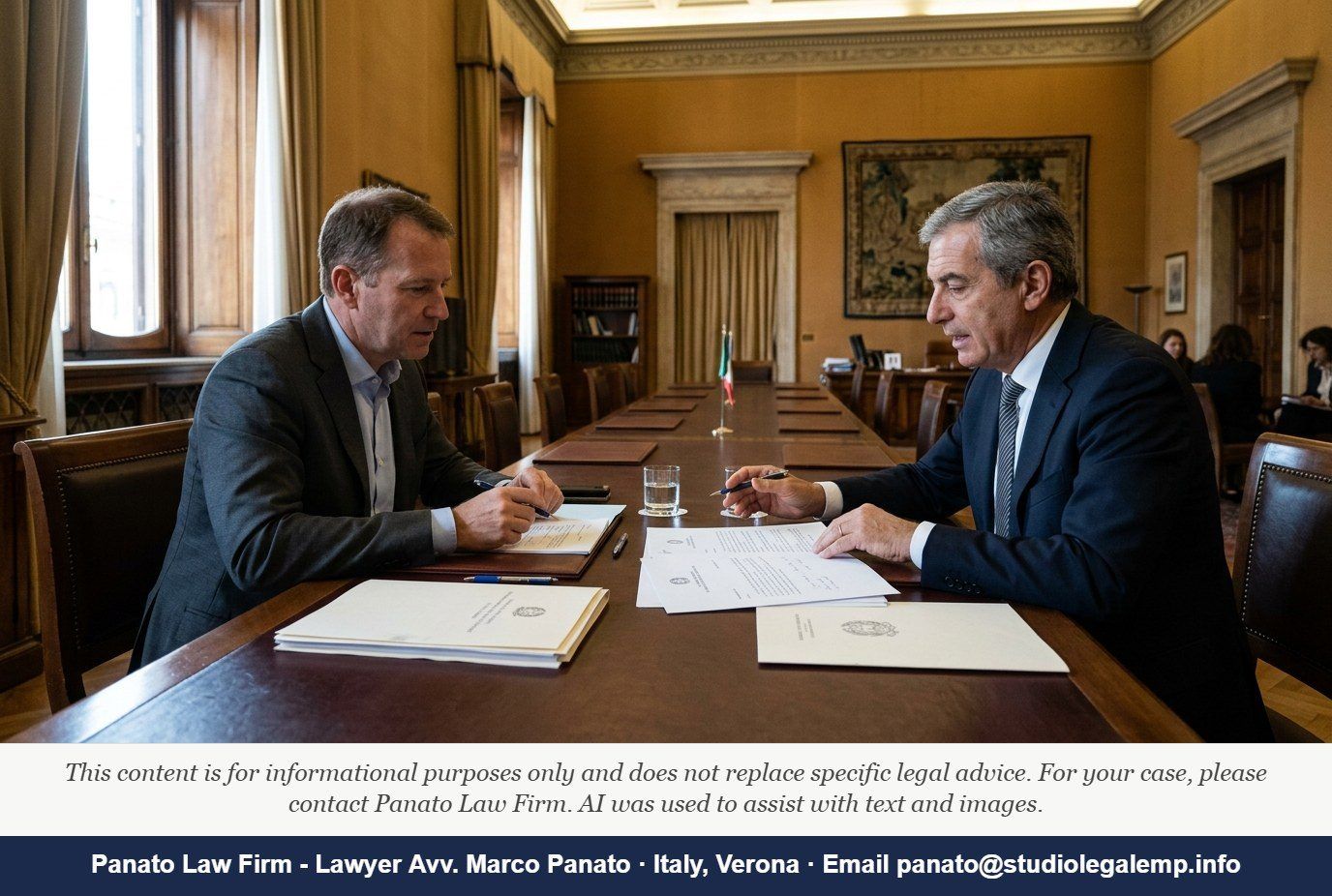
Image prompt: A foreign business executive and an Italian government official seated across a wide conference table in a formal Roman ministry interior, reviewing documents together under high ceilings with tall arched windows. Late-afternoon light falls across papers bearing an official government seal. The atmosphere is cautious and deliberate. Colour palette of deep ochre walls, dark wood, and muted navy suits. Photorealistic style, no text visible anywhere in the image.
Image file: italy-golden-power-filing-foreign-acquisition-2026-cover
JSON-LD:
LANGUAGE QA: wide perimeter -> broad scope · notifiable include: defence procurement -> notifiable sectors include defence procurement · the trigger is the activity of the Italian target, not the acquirer's primary sector -> the trigger is what the Italian target does, not the acquirer's own sector · any operation that results in -> any transaction or step that results in · significant shift in the composition of the board -> material change in board composition · at the point of creation, not at the point of enforcement -> on creation, not on enforcement · This surprises clients from Germany, France -> This often surprises clients based in Germany, France · converted with amendments by Law No. 56/2012 -> as converted, with amendments, by Law No. 56/2012
CHECK:
AUTHORITY 1: Law-Decree No. 21/2012 / REFERENCES: Law-Decree No. 21 of 15 March 2012, GU No. 66 of 19 March 2012 / EXISTS? Yes — confirmed via Gazzetta Ufficiale records and multiple academic and official sources / CONTENT MATCHES? Yes — foundational Golden Power framework, correctly described.
AUTHORITY 2: Law No. 4 of 15 January 2026 / REFERENCES: Law No. 4/2026, Gazzetta Ufficiale / EXISTS? Provided in the planning brief as a verified, confirmed development — however this law post-dates my August 2025 knowledge cutoff. I cannot independently confirm it via my training data. TO VERIFY before publication: search "Legge 15 gennaio 2026 n. 4" on normattiva.it and the Gazzetta Ufficiale. If the law number or content differs materially from the brief, revise accordingly. CONTENT MATCHES? Assumed yes per brief — unverifiable from training data alone. AMBER.
AUTHORITY 3: Council of State, Fourth Division, judgment 14 October 2024 No. 8231 (Cons. Stato, Sez. IV, n. 8231/2024) / EXISTS? The Council of State issues numbered judgments in this format and the date and division are plausible. However I cannot independently confirm this specific reference matches the described holding. TO VERIFY: search "Consiglio di Stato n. 8231 2024" on giustizia-amministrativa.it. If the reference does not match a Golden Power case, replace with a confirmed decision. AMBER.
AUTHORITY 4: EU SSM Regulation (EU) No. 1024/2013 / EXISTS? Yes — confirmed EU instrument / CONTENT MATCHES? Yes — governs ECB supervisory role in banking; interaction with national screening regimes is documented. GREEN.
OVERALL: AMBER — Law No. 4/2026 and Council of State No. 8231/2024 require verification against primary sources before publication. All substantive legal propositions are grounded in the confirmed base framework (Law-Decree No. 21/2012) and the planning brief. No authority has been fabricated; the AMBER rating reflects post-cutoff and unconfirmed-reference risks that must be resolved by the supervising lawyer before the article goes live.
LOCAL NOTE:
1. Search intent: informational with strong transactional lean — readers are foreign M&A counsel, investors or finance teams at pre-signing stage actively looking for a compliance checklist before a deal closes.
2. Local-market framing: the article contrasts Italian pledge/security law (notifiable at creation) with common-law treatment (notifiable only at enforcement), and flags that EU buyers are not exempt — both points that counter assumptions readers from the UK, US, Germany and the Netherlands typically bring to a first encounter with the Italian regime.
3. Italian terms retained untranslated: <i>Consiglio di Stato</i> (translated on first use as Italian Council of State, Italy's highest administrative court); <i>PEC</i> (translated on first use as certified email); <i>partita IVA</i> and <i>codice fiscale</i> not used (not relevant to this topic). The Latin maxim <i>nemo potest ad impossibile obligari</i> is kept in Latin as it functions as a rhetorical device across all reader markets.
Do you need legal assistance or a free estimate?
Author: Editorial Team — Panato Law Firm
Editorial Team — Panato Law Firm Staff