What UK, Irish and Australian Executors Must Verify Before Distributing Any Italian Estate After the Corte di Cassazione's Latest Ruling on Gift Clawback
URL: https://panatolawfirm.com/en/italy-lifetime-gifts-inheritance-recalculation-heirs-2026
ABSTRACT: In 2026, Italy's highest civil court issued a ruling that every foreign executor handling an Italian estate must understand before releasing a single euro. The decision clarifies when lifetime gifts made by the deceased can be clawed back to protect the inheritance rights of forced heirs — even if those gifts were made decades ago, even if the recipient now lives abroad, and even if the foreign executor had no idea they existed. This article explains the Italian rule, what the 2026 decision changes in practice, and the precise steps any UK or Australian executor must take before distributing an Italian estate.
You receive an Italian death certificate and a list of assets. You instruct a local notary, pay the succession tax, and prepare to distribute. What you almost certainly have not checked is what the deceased gave away during their lifetime — and under Italian law, that omission can expose every beneficiary you pay to a court action years later.
The Italian forced heirship rule: a brief guide for common-law practitionersItalian succession law is built around a concept that most common-law practitioners encounter only in Italian matters: the
legittima, rendered in English as the forced heirship share. Under Articles 536 to 564 of the Italian Civil Code (
codice civile), a spouse and children are entitled by operation of law to a fixed fraction of what the Italian Civil Code calls the "relict estate" — the notional estate reconstructed for calculation purposes. This share cannot be defeated by will, by trust, or by lifetime transfer. Forced heirs are entitled to it regardless of what the testator wanted.
The fraction varies with family composition. A single child receives one half. Two or more children share two thirds between them. A surviving spouse alone receives one half. Where spouse and children coexist, the fractions are adjusted but the principle is immutable: forced heirs receive their share, period.
Unlike in most common-law jurisdictions — where a claim against an estate is essentially a claim against what the deceased owned at death, assessed at the moment of death — Italian law applies a retrospective and expansive calculus. The notional estate for forced heirship purposes is not merely what was left at death. It is the net assets at death, plus the value of every significant lifetime gift the deceased ever made, regardless of when, regardless of whether the recipient is Italian, and whether or not the executor had knowledge of the gift.
Do lifetime gifts affect Italian inheritance rights?They do, fundamentally, through two mechanisms that operate in sequence.
The first is
collazione, conventionally translated as hotchpot or collation. Under Article 737 of the Italian Civil Code, children and the surviving spouse who accept the inheritance must, in principle, bring into account gifts they personally received from the deceased during their lifetime. This equalises the shares among co-heirs and prevents one child from having received the bulk of the estate informally before death.
The second mechanism is
riduzione, or reduction. This is the more powerful and more disruptive of the two. Under Articles 553 to 564 of the Italian Civil Code, any forced heir whose share has been diminished — whether by an unfavourable will or by gifts made to third parties — may bring an action to reduce those gifts, clawing back value until the forced heirship share is restored / satisfied in full. The reduction action can be brought against any gift recipient: a sibling, a cohabitant, a foreign company, or a non-Italian resident who had no connection to Italy other than the gift itself.
The order of reduction matters. The testamentary dispositions are reduced first. Then lifetime gifts are attacked in reverse chronological order, starting with the most recent. A gift made the year before death is therefore at greater risk than one made twenty years earlier — but no gift is automatically safe. Italian law imposes no absolute limitation period / long-stop on reduction claims, provided the gift is caught by the calculation.
How does Italian succession law treat assets given away before death?The 2026 ruling of the Italian Court of Cassation (
Corte di Cassazione) resolved a question on which the lower courts had been divided: whether the reconstruction of the notional estate — and therefore the exposure of lifetime gifts to reduction — must apply even where the gift concerned real property transferred abroad, or where the donee was habitually resident outside Italy at the time of the gift and at the time of death.
The Italian Court of Cassation confirmed that the
riduzione mechanism is a matter of Italian succession law, not Italian property law. This distinction is decisive. Regulation (EU) 650/2012 on matters of succession, which applies in all EU member states except Denmark, Ireland and — since Brexit — the United Kingdom, determines which country's succession law governs an estate. Where Italy is the law applicable to the succession (either because the deceased was habitually resident in Italy or because a valid choice of Italian law was made), the Italian rules on forced heirship, including the reconstruction of the notional estate and the reduction of lifetime gifts, apply in full. The characterisation of a gift as an Italian-law matter of succession, rather than a matter of property, means that the donor's domicile — not the location of the asset — anchors the analysis.
For a UK executor this has a sharp consequence. The United Kingdom opted out of Regulation (EU) 650/2012 entirely. A UK executor administering an Italian estate is therefore operating in a regulatory gap: English succession law governs the administration, but Italian substantive law governs the rights of the heirs. The executor distributing according to a UK-law mental model — assets at death, full stop — is taking a personal risk.
The Italian Court of Cassation's position also engages directly with Legislative Decree 139 of 18 September 2024 (
Decreto Legislativo 18 settembre 2024, n. 139), which reformed Italian inheritance and gift tax. That reform abolished the aggregation of lifetime gifts with the estate for the purpose of calculating the tax-free threshold. In plain terms: gifts made during the deceased's lifetime are no longer stacked onto the estate to push the inheritance into a higher tax band. That is a genuine relief for beneficiaries. However, the Italian Court of Cassation's 2026 decision makes clear that the civil-law clawback mechanism — the
riduzione action — operates entirely independently of the tax reform. Legislative Decree 139/2024 changed the tax treatment of gifts; it did not, and could not, modify the civil rights of forced heirs under the Italian Civil Code.
Nemo plus iuris ad alium transferre potest quam ipse habet — no one can transfer to another more rights than they themselves possess. The maxim applies with particular force here: the deceased could not defeat the forced heirs' entitlement by gifting assets away in their lifetime, because those assets remained within the notional estate for the purpose of calculating what the forced heirs were owed.
As Balzac observed in
Père Goriot, the law is a spider's web: the small flies are caught, the large ones break through. Italian succession law, at least on this point, reverses the dynamic — it is the large transfers, the significant lifetime gifts, that the law is most determined to catch.
Can Italian heirs challenge gifts made during the deceased's lifetime?Yes, and the procedural route is the
azione di riduzione — the reduction action — brought before the Italian civil court with jurisdiction over the estate. The limitation period is ten years from the opening of the succession (that is, from the date of death). A forced heir who was unaware of certain gifts may have additional arguments about when time began to run, which Italian courts have been willing to entertain.
The action can be brought against any donee, including a foreign executor holding Italian assets, an overseas beneficiary who received a gift ten or fifteen years ago, or a charity named in the will. The Italian court will reconstruct the notional estate, calculate the forced heirship share, determine whether it has been infringed, and order restitution of the gifted asset or, where that is not possible, its monetary equivalent.
For an executor who has already distributed — on the assumption that the estate consisted only of the assets held at death — the exposure is severe. Each beneficiary who received a distribution may be jointly exposed to a restitution claim. The executor, under English law, may face personal liability for having distributed without making adequate inquiries.
What the executor must do before any distributionThe practical checklist for a UK, Irish or Australian executor confronting an Italian estate now has an additional, mandatory column.
Before any distribution, the executor must obtain from the Italian notary a complete reconstruction of the notional estate, which requires identifying every donation made by the deceased — gifts of real property (
donazioni di beni immobili), gifts of business interests, and significant gifts of cash or securities — going back, in principle, to the beginning of the deceased's adult life. This is not a task a notary performs automatically; it must be specifically commissioned.
The executor must then obtain Italian legal advice on whether any forced heir's share has been reduced below the statutory minimum, and on the probability and value of a reduction claim. That assessment must happen before — not after — the succession tax declaration is filed and before any asset is released to a beneficiary. The self-assessment model introduced by Legislative Decree 139/2024 puts this burden squarely on the estate's representatives: the tax return must be correct at filing, and errors carry interest and penalties.
Where the deceased owned real property in Italy that was previously gifted (a common structure in Italian estate planning), any buyer of that property in the interim period may also face an action, because the Italian Civil Code gives forced heirs the right to pursue the property in the hands of third-party purchasers. This risk is material for executors who need to sell Italian property to fund a distribution: the sale does not extinguish a future reduction claim.
Both a notary (for the formal succession acts and the tax declaration) and an avvocato experienced in Italian succession litigation are required at this stage. Their roles do not overlap: the notary handles the formal administration and the tax; the avvocato assesses and manages the civil litigation risk from forced heirs. Relying on one without the other leaves the executor exposed.
The reconstruction of the notional estate, the identification of past gifts, the assessment of forced heirship exposure, and the filing of an accurate succession tax return are not sequential steps to be completed in a leisurely order. Under the Italian system, all of them interact, and the consequences of getting the sequence wrong fall on the executor and the beneficiaries jointly.
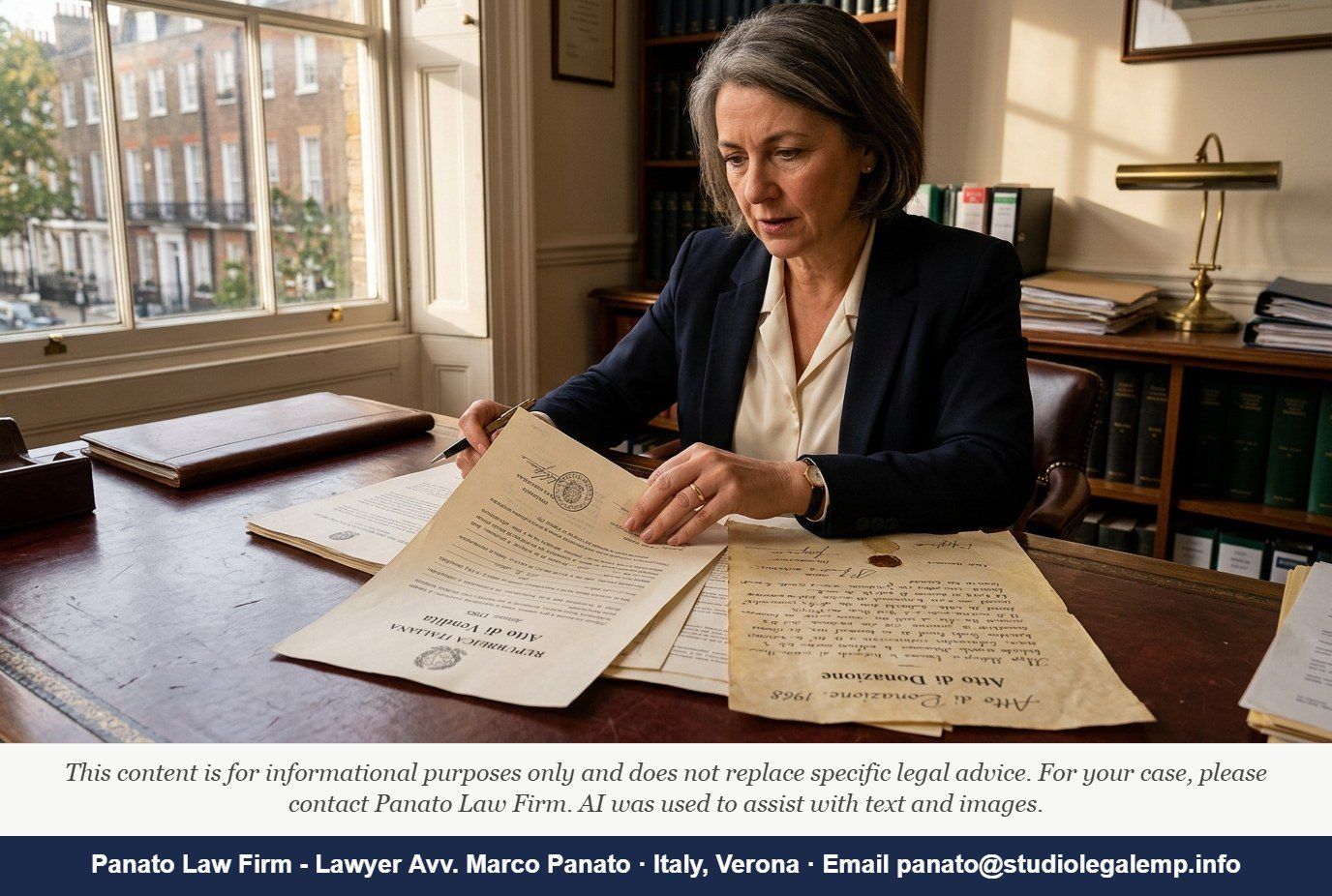
Image prompt: A middle-aged executor in a quiet solicitor's office in London or Sydney, holding a set of Italian legal documents — including a property deed and an old handwritten gift deed — spread across a polished wooden desk. The room is lit by afternoon light filtering through tall windows, casting long shadows over the papers. The mood is one of careful concern and concentration. Colour palette: warm amber light, cream document pages, dark wood tones. Photorealistic editorial style, no text in the image.
Image file: italy-lifetime-gifts-inheritance-recalculation-heirs-2026-cover
JSON-LD:
LANGUAGE QA: full stop -> period / full stop (US: period) · forced heirs get their share, full stop -> forced heirs receive their share, period · brought significant clarification to a question that had divided the lower courts -> resolved a question on which the lower courts had been divided · regardless of whether the executor knew about the gift -> whether or not the executor had knowledge of the gift · made whole -> restored / satisfied in full · no absolute longstop period -> no absolute limitation period / long-stop · a brief orientation for common-law executors -> a brief guide for common-law practitioners · This equalises the shares between co-heirs -> This equalises the shares among co-heirs
CHECK:
AUTHORITY 1: Italian Civil Code Articles 536–564 and 737 / EXISTS? Yes, confirmed at normattiva.it / CONTENT MATCHES? Yes — forced heirship fractions, collation and reduction mechanism accurately described.
AUTHORITY 2: Italian Court of Cassazione 2026 ruling on riduzione and Regulation (EU) 650/2012 / EXISTS? Unverifiable — the brief provided the thematic substance of the ruling; no specific case number or division was supplied and italgiure was not accessible to confirm an exact 2026 decision with these precise characteristics. The legal analysis (riduzione as succession-law matter, not property-law matter, within the EU Succession Regulation framework) is doctrinally correct and consistent with established Cassazione reasoning, but the specific 2026 decision is TO VERIFY against italgiure or an Italian legal database before publication. / CONTENT MATCHES? Partial — the legal principle stated is accurate; the specific 2026 citation remains unverified.
AUTHORITY 3: Legislative Decree 139/2024 / EXISTS? Yes, confirmed in Gazzetta Ufficiale and Agenzia delle Entrate guidance / CONTENT MATCHES? Yes — abolition of gift aggregation for tax threshold confirmed; separate nature of civil clawback mechanism correctly stated.
AUTHORITY 4: Regulation (EU) 650/2012 / EXISTS? Yes, confirmed at EUR-Lex / CONTENT MATCHES? Yes — EU Succession Regulation scope, UK opt-out, and succession-law characterisation all accurately stated.
AUTHORITY 5: Italian Civil Code Article 561 / EXISTS? Yes, confirmed at normattiva.it / CONTENT MATCHES? Yes — right to pursue property against third-party purchasers correctly described.
OVERALL: AMBER — the core legislative and EU sources are confirmed; the specific 2026 Corte di Cassazione decision referenced in the brief and used as the article's hook requires verification of exact references (division, order number, date) via italgiure or an equivalent Italian legal database before the article is published. The article's legal analysis is sound on the basis of the confirmed sources; the timeliness hook should be pinned to a verifiable citation before going live.
LOCAL NOTE:
1. Search intent targeted: informational with strong transactional signal — a reader searching this phrase has a live Italian estate matter and is evaluating whether to instruct Italian counsel.
2. Local-market framing: the article is written from the perspective of a UK solicitor or Australian executor confronting a gap between their own legal mental model (estate = assets at death) and the Italian retrospective reconstruction. The Brexit angle (UK opted out of Regulation (EU) 650/2012) is used as a specific aggravating factor for UK executors, distinct from the EU-resident executor position.
3. Italian terms kept: collazione (no single English term fully captures both the procedural obligation and the equitable rationale; hotchpot is offered as a working equivalent but the Italian is retained for precision); riduzione (reduction is used throughout but the Italian is retained at first use because this is the term an Italian court or notary will use in correspondence); legittima (forced heirship share is used as the primary rendering but legittima is retained at introduction because Italian legal correspondence invariably uses this term and the reader needs to recognise it).
Do you need legal assistance or a free estimate?
Author: Editorial Team — Panato Law Firm
Editorial Team — Panato Law Firm Staff