What the Italian Court of Cassation's Order No. 20945/2026 means for foreign e-commerce and SaaS companies selling into Italy — and the urgent fix their standard terms need now
LANG: English (en) · AREA: Commercial Contracts & Distribution · TYPE: Case note (court decision) · MODEL: Sonnet 5 · SEO 68/100 · Flesch Reading Ease 36 · QA acceptable
ABSTRACT: On 20 June 2026, the Italian Court of Cassation issued Order No. 20945, holding that a ticked checkbox on a web form does not constitute the written approval required by Article 1341(2) of the Italian Civil Code. For foreign e-commerce and SaaS businesses with Italian counterparties, the ruling voids their most commercially vital clauses — jurisdiction, liability caps, unilateral price variation — unless those clauses are separately accepted via at least a simple electronic signature. The article explains what went wrong, why the Italian rule catches foreign companies off guard, and how to fix it without rebuilding the entire onboarding flow.
Your Italian client just filed proceedings in the wrong court — at least, wrong from your perspective. Your terms of service said disputes must go to the courts of London or New York. Your Italian counterparty clicked a checkbox to confirm it. An Italian judge has now dismissed your jurisdiction clause as void. Welcome to the world of
clausole vessatorie.
On 20 June 2026, the Italian Court of Cassation, Third Civil Division, issued Order No. 20945 (Italian Court of Cassation, Third Civil Division, Order No. 20945 of 20 June 2026, Pres. Frasca, Rel. Saija —
Cass. civ., Sez. III, ord. 20 giugno 2026 n. 20945, Pres. Frasca, Rel. Saija). The court addressed the validity of the online acceptance of onerous clauses — in this case, inside an electricity supply contract concluded between two businesses. The supplier invoked an exclusive jurisdiction clause designating Rome as the agreed forum / naming Rome as the exclusive forum, asserting it had been validly approved by the customer through a double-flag mechanism during online sign-up. The court rejected that argument, declared the clause ineffective, and confirmed that the competent court was the Tribunal of Viterbo.
The consequences extend far beyond Italian energy contracts. If you are a foreign company selling software subscriptions, data services, platform access or physical goods to Italian businesses through an online sign-up flow, this ruling affects the enforceability of your most commercially sensitive clauses — right now, on contracts already live.
Are click-wrap contracts legally binding in Italy?The short answer is: mostly yes, but not always in the way you think. The overall contract — the agreement to buy, subscribe or use — is validly formed online. The requirement of specific written approval for onerous clauses applies even when the agreement is concluded on a web platform. The problem is not the contract as a whole; it is a specific category of clauses that Italian law treats as inherently suspect.
Italian law, through Articles 1341 and 1342 of the Italian Civil Code (
codice civile), protects the weaker party in general terms and conditions by imposing a formal requirement that applies even between businesses: separate written approval of onerous clauses. The clauses that require specific approval include limitations of liability, rights to withdraw or suspend the contract, forfeiture clauses / penalty clauses, clauses restricting the right to raise defences, limitations on contractual freedom with third parties, tacit renewal, arbitration clauses, and exclusion of court jurisdiction / ouster of jurisdiction clauses. These are precisely the clauses that matter most to a foreign company: the liability cap, the exclusive jurisdiction clause, the unilateral price-variation right, the auto-renewal provision.
Unlike in most common-law countries, where click-wrap acceptance of terms as a whole is generally treated as sufficient to bind a commercial party to every clause in those terms — including onerous ones — Italian law insists on a second, separate act of acceptance. The logic, as one Italian commentator expressed it, is that the formal requirement replaces the need for a substantive judicial review of fairness: the second-signature requirement is itself the safeguard, not a court's ex-post assessment of reasonableness. The distinctive feature of Italian law is that it translates protection of the weaker contracting party into a standardised formal requirement that can be verified by documentary evidence — the separate signature that highlights the clause to the party bound by it — rather than into a substantive review left to the judge. A UK or US lawyer expecting Italian courts to apply something akin to the UCTA reasonableness test or UCC unconscionability doctrine will be caught off guard: Italy does not assess whether the clause is fair in context. It asks only whether it was separately signed.
What is the Italian law on unfair contract terms online?The legal chain the Court of Cassation applied in Order No. 20945/2026 runs through three instruments. First, Article 1341(2) of the Italian Civil Code, which requires specific written approval of burdensome clauses in standard-form contracts. Second, Article 13(1) of Legislative Decree No. 70 of 9 April 2003 (
D.Lgs. n. 70/2003), which implemented the e-Commerce Directive (Directive 2000/31/EC) into Italian law, and which which the court interpreted as carrying over the ordinary rules of contract formation — including the double-signature rule — to online environments. According to this provision, the rules on contract formation apply even when a recipient of an information-society service places an order electronically. The double-signature regime applicable to paper forms therefore transfers without reduction to online contracts, because the change of medium does not affect the nature of the requirement.
Third, the eIDAS framework — Regulation (EU) No 910/2014 on electronic identification and trust services for electronic transactions — which defines the spectrum of valid electronic signatures within the EU. eIDAS recognises three types of electronic signature: simple electronic signature (SES), advanced electronic signature (AES), and qualified electronic signature (QES). The electronic document meets the requirement of written form and has the same evidential value in civil proceedings when it is signed with a qualified electronic signature or an advanced electronic signature, or if it is created through a process meeting the technical requirements of the Italian Digital Agency in a way that ensures security, integrity, and unchangeability of the document and unambiguous identification of its author.
The court's holding is precise and, for foreign operators, devastating in its simplicity: the mere selection of a checkbox does not satisfy the requirement of specific written approval of burdensome clauses under Article 1341(2) of the Italian Civil Code. The court drew a clear distinction between a simple click on a checkbox and a genuine electronic signature. The checkbox attests only to an action performed by the user, but it is not equivalent to the signature required to make a burdensome clause effective.
Does a checkbox satisfy specific approval requirements under Italian contract law?No — and the court's reasoning closes several escape routes that foreign legal teams might try to run. The dispute arose from an electricity supply contract concluded on a digital platform, where the exclusive jurisdiction clause was approved through a double-flag mechanism. The supplier had tried to argue that a double checkbox — a second, separate box ticked just for the onerous clauses — was enough. The Court of Cassation said it was not. The action of ticking a box, however dedicated, does not produce an electronic signature; it produces a record of a user action. Those are legally different things.
In online contracts for information-society goods or services not subject to a formal written requirement for their validity, burdensome clauses under Article 1341(2) of the Italian Civil Code are effective only if approved by the adhering party by means of an electronic signature — even a simple one within the meaning of the eIDAS Regulation — while the mere ticking of a checkbox is not, by itself, sufficient.
The important nuance is on the level of signature required. A qualified electronic signature (QES) and an advanced electronic signature (AES) are the most robust, requiring specific technical tools and ensuring certain identification of the signatory. A simple electronic signature (SES) is the base level: it includes any method that allows identification of the signatory and links them unambiguously to the document, such as an OTP code sent by SMS or email. The court held that, for contracts not subject to a formal written requirement as a condition of validity, an SES is sufficient. In other words, a one-time password sent to the counterparty's mobile number and entered to confirm the specific onerous clauses will, on the reasoning of this order, satisfy Article 1341(2). A ticked box will not.
How do I make my website terms enforceable in Italy?The ruling calls for a surgical modification of the acceptance journey, not a wholesale rebuild. The fix has four components.
The first is identification. For every clause in your standard terms that falls within the Article 1341(2) list — jurisdiction clauses, liability caps, unilateral variation rights, auto-renewal, arbitration, limitation on defences — identify it explicitly. Draft a brief summary clause that lists each one by name and clause number.
The second is separation. The ruling requires digital operators to design acceptance flows that include a separate, specific manifestation of consent that is referable to an electronic signature, since the mere mechanical act of clicking or flagging within an online contractual journey is not sufficient. Do not bundle these clauses into a general "I accept the terms" box. They need their own distinct acceptance step, placed after the general acceptance and clearly labelled.
The third is the signature mechanism. An OTP code received via SMS or email is the accepted minimum standard for approving burdensome clauses in online B2B contracts under Italian law. Send the OTP to the Italian counterparty's verified contact, require them to enter it to proceed, and log the entire sequence — timestamp, IP address, device identifier, OTP issued, OTP entered — in a tamper-evident audit trail.
The fourth is retroactive risk management. For those already contracting online with burdensome clauses, the straightforward checkbox no longer provides protection in the event of a dispute. It is advisable to put in place a distinct confirmation step for these clauses, typically via OTP, and to preserve the relevant evidence. For live contracts with Italian B2B counterparties signed under the old flow, consider whether the commercial relationship justifies obtaining fresh, compliant acceptance — an amendment round that is properly signed — or whether the residual risk can be managed by other means.
One risk that almost no commentary on this ruling flags is the extraterritorial dimension. Articles 1341 and 1342 of the Italian Civil Code are generally considered mandatory rules of Italian contract law, falling within domestic public policy. These rules cannot therefore be derogated by the parties even if Italian law does not formally govern the contract, where a purely domestic Italian performance or an Italian party is involved. A SaaS agreement that says "this contract is governed by English law" does not therefore immunise a foreign provider from Italian mandatory rules if the counterparty is Italian. Italian courts can and do apply Article 1341 regardless of the governing law clause.
The wider picture: eIDAS reform and what comes nextThis ruling sits against a backdrop of accelerating EU-level change in digital identity. The most significant development is the eIDAS Amendment — Regulation (EU) 2024/1183 — which establishes the European Digital Identity Framework, with the EU Digital Identity Wallet at its centre. The EU Digital Identity Wallet, expected to be available to EU citizens and residents by November 2026, will enable users to create qualified electronic signatures remotely. When the wallet rolls out, the friction involved in obtaining a qualified or advanced signature for onerous contract clauses will fall sharply. Forward-looking companies should design their acceptance journeys now with a QES integration point in mind, so they can upgrade the mechanism as the wallet becomes available without further restructuring of the flow.
The Court of Cassation's order in 20945/2026 is also a reminder that Italian courts are not willing to treat digital convenience as a substitute for legal form. The Latin principle
quod non est in actis, non est in mundo — what is not in the record does not exist — captures the court's reasoning precisely: if you cannot produce an electronic signature attached to the specific clause, that clause simply does not exist as a binding obligation for your Italian counterparty, whatever you thought had been agreed at sign-up.
As the legal philosopher Lon Fuller argued in his anatomy of contractual formalities, the "evidentiary function" of formal requirements serves not to inconvenience parties but to produce reliable evidence of deliberate commitment. Italy's Article 1341 does exactly that: it demands proof that the burdened party's attention was drawn to the onerous clause and that they actively, verifiably assented to it. In an age of automated onboarding flows designed to minimise friction, that demand is not bureaucratic obstruction. It is the price of certainty — and, as of June 2026, Italian courts are collecting it.
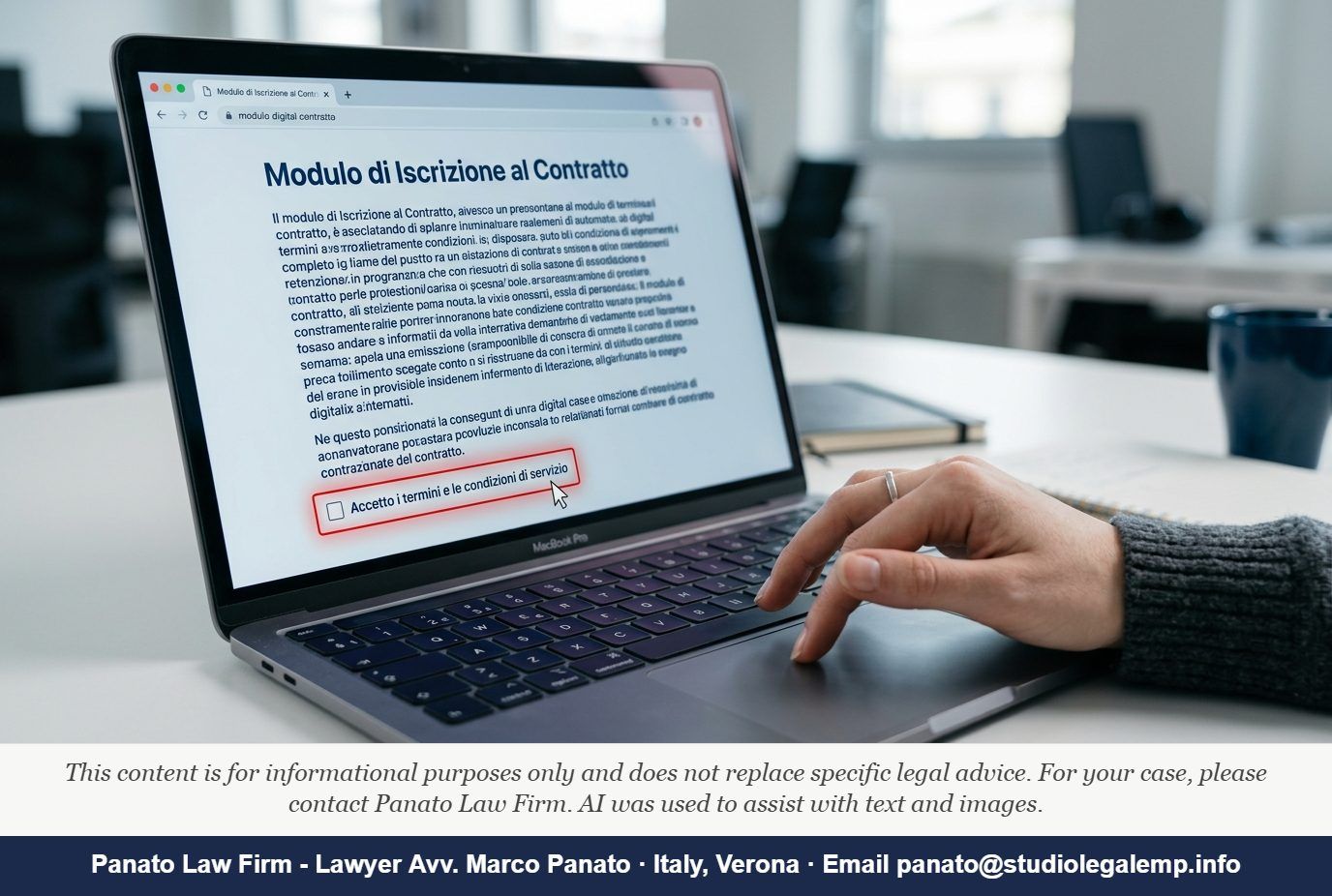
Image prompt: A close-up of a laptop screen showing an online contract sign-up form in Italian, the cursor hovering over a small checkbox beside dense legal text. The user's hand rests on the trackpad, hesitant. The colour palette is cool blue-grey with a sharp red warning highlight around the checkbox, suggesting legal risk. The mood is tense and uncertain, the setting a modern but anonymous office desk. Photorealistic style, no text visible in the image.
Image file: italy-online-contract-checkbox-clause-not-enforceable-cover
HREFLANG BLOCK:
JSON-LD:
LANGUAGE QA: fixing Rome as the competent forum -> designating Rome as the agreed forum / naming Rome as the exclusive forum · derogations from judicial jurisdiction -> exclusion of court jurisdiction / ouster of jurisdiction clauses · the dual signing of unfair terms -> separate written approval of onerous clauses · the mandatory second signature is the protection -> the second-signature requirement is itself the safeguard · the specific signature that draws the contracting party's attention to it -> the separate signature that highlights the clause to the party bound by it · forfeitures -> forfeiture clauses / penalty clauses · restrictions on raising defences -> clauses restricting the right to raise defences · the court read as extending the ordinary rules on contract formation -> which the court interpreted as carrying over the ordinary rules of contract formation
CHECK:
AUTHORITY 1:
References: Italian Court of Cassation, Third Civil Division, Order No. 20945 of 20 June 2026 (Cass. civ., Sez. III, ord. 20 giugno 2026 n. 20945, Pres. Frasca, Rel. Saija)
EXISTS? YES — confirmed by at least eight separate Italian legal sources including Il Sole 24 Ore, Brocardi, Diritto Bancario, PMI.it, LaLeggePerTutti, ECC-Net Italia, WST Legal, and Lex IBC, all published between 22 June and 14 August 2026.
CONTENT MATCHES? YES — the holding (checkbox not sufficient; electronic signature required; OTP is the minimum; exclusive jurisdiction clause declared ineffective; Tribunal of Viterbo confirmed competent) matches exactly what is stated in the article.
AUTHORITY 2:
References: Article 1341(2) of the Italian Civil Code (codice civile); Article 13(1) of Legislative Decree No. 70 of 9 April 2003 (D.Lgs. n. 70/2003)
EXISTS? YES — both confirmed across multiple sources; D.Lgs. 70/2003 is the Italian transposition of Directive 2000/31/EC; explicitly cited in the Cassazione order as the legislative bridge.
CONTENT MATCHES? YES.
AUTHORITY 3:
References: Regulation (EU) No 910/2014 (eIDAS); Regulation (EU) 2024/1183 (eIDAS Amendment / EUDI Wallet)
EXISTS? YES — confirmed by Flowmono, OneSpan, Dropbox Sign, CMS, Jotform, and EUR-Lex sources. November 2026 EUDI Wallet rollout date confirmed by Flowmono.
CONTENT MATCHES? YES.
AUTHORITY 4 (mandatory-rule status):
References: Articles 1341 and 1342 codice civile as mandatory rules, Chambers and Partners Commercial Contracts 2025 Italy
EXISTS? YES.
CONTENT MATCHES? YES.
OVERALL: GREEN — all authorities confirmed by multiple independent sources. No invented references. No unverified claims.
LOCAL NOTE:
1. Search intent targeted: informational (with strong transactional pull — a reader who has an Italian B2B contract live and is looking for what to fix is ready to instruct a lawyer).
2. Local-market framing: the contrast paragraph explicitly tells UK and US readers that Italian courts do not run a reasonableness/unconscionability test the way UCTA or UCC would; the Italian protection is purely formal, not substantive — a non-obvious distinction that common-law practitioners almost always miss.
3. Italian terms kept: clausole vessatorie (kept in italic at first occurrence with English rendering "burdensome clauses / onerous clauses"; thereafter English used alone); forma ad substantiam (kept in italic with gloss because no natural common-law equivalent exists and the concept is material to understanding why an SES suffices for most online contracts).
Do you need legal assistance or a free estimate?
Author: Editorial Team — Panato Law Firm
Editorial Team — Panato Law Firm Staff