The 18-month residency trap, the clawback penalty, and the narrow exceptions that most non-resident buyers miss
LANG: English (en) · AREA: Buying & Owning Property in Italy · TYPE: FAQ / People Also Ask · MODEL: Sonnet 5 · SEO 68/100 · Flesch Reading Ease 48 · QA translated
ABSTRACT: Italy's prima casa regime slashes registration tax from 9% to 2% on a residential purchase—a saving worth thousands of euros on a typical transaction. Since June 2023, any buyer regardless of nationality can in principle claim it. In practice, the 18-month deadline to register residence in the property's municipality is a hard condition that most foreign buyers either cannot or do not meet, triggering an automatic clawback that wipes out every euro saved and adds a 30% penalty on top.
The saving everyone wants — and the condition almost everyone missesImagine you buy a €300,000 apartment in Verona. Without prima casa relief, registration tax runs at 9%: that is €27,000 due at the notarial deed of sale (rogito). With the relief, the rate drops to 2%: €6,000. You have just saved €21,000 at the stroke of a pen.
No wonder so many foreign buyers ask their notary to include the relief declaration. The problem is that ticking that box without satisfying the underlying conditions does not give you a discount. It gives you a time bomb.
Ubi commoda, ibi incommoda — where there are benefits, there are also burdens. The maxim captures exactly what the Italian tax authority, the
Agenzia delle Entrate, enforces: you take the advantage only if you accept the obligations that come with it.
As the scholar of fiscal policy Charles Tiebout observed, tax reliefs tied to physical presence are structurally different from those tied to status: they demand behaviour, not merely identity. Italy's prima casa regime is precisely this kind of relief — and that distinction matters enormously for the foreign buyer who spends two weeks a year in Tuscany and six months in London.
Can a non-resident foreigner get prima casa tax relief in Italy?The short answer is: yes in law, rarely in practice.
Article 1, Note II-bis of Presidential Decree no. 131 of 26 April 1986 (DPR 131/1986) — Italy's consolidated registration tax code — sets out the prima casa conditions. The Italian Civil Code and subsequent practice had historically created uncertainty about whether non-Italian nationals could invoke them. That uncertainty was definitively resolved on 14 June 2023, when the
Agenzia delle Entrate confirmed in its Circular Letter no. 12/E of 14 June 2023 (
Circolare n. 12/E del 14 giugno 2023, Agenzia delle Entrate) that citizenship is irrelevant to eligibility. Any buyer — Italian, British, American, Australian, or otherwise — can in principle claim prima casa relief.
Three conditions must all be met. First, the property must be residential and must not fall within cadastral categories A/1 (prestigious dwellings), A/8 (villas), or A/9 (castles and palaces of historical or artistic merit). Second, the buyer must not already own another property in Italy that was purchased using prima casa relief. Third — and this is where most foreign buyers fail — the buyer must transfer their registered residence to the
comune (municipality) where the property sits, within 18 months of the purchase deed.
For new builds purchased directly from a developer, the equivalent relief reduces VAT from 10% to 4% under Presidential Decree no. 633 of 26 October 1972 (DPR 633/1972, Table A, Part II, no. 21). The same three conditions apply in identical form.
Unlike in most common-law countries — where a buyer's tax position on a property purchase turns on domicile, tax residency, or habitual residence, all concepts that lawyers argue over for months — Italy's prima casa rule turns on a single, bureaucratic, date-stamped act: registering your
anagrafe (municipal population register) address at the town hall. You either did it within 18 months or you did not. There is no grey area, no equitable discretion, and no late-filing concession.
What is the 18-month rule for prima casa in Italy?When you sign the notarial deed of sale (rogito), you make a formal declaration in the deed itself that you intend to establish your registered residence in the property's municipality within 18 months. That declaration is what unlocks the reduced rate on the day of purchase.
The 18-month clock starts from the date of the deed, not from the date of possession or keys handover. It is a hard deadline. The Italian Court of Cassation, Joint Divisions, judgment no. 8151 of 28 March 2019 (
Cass. civ., Sezioni Unite, sentenza 28 marzo 2019 n. 8151) confirmed that the 18-month term is not subject to suspension, interruption, or equitable extension — not for illness, not for building works that delay occupation, and not for administrative delays at the municipality. The obligation is to have applied and obtained registration within the period, not merely to have started the process.
For a buyer resident in the UK, Ireland, the United States, or Australia, this means genuinely moving to the Italian municipality — or at least establishing a documented, day-to-day primary residence there. A holiday home used in summer does not qualify. A pied-à-terre used during business trips does not qualify. Even a buyer who genuinely intends to retire to Italy but has not yet done so when the 18-month window closes does not qualify.
There is one significant exception. A buyer already registered with the
Anagrafe degli Italiani Residenti all'Estero (AIRE) — the official register of Italian citizens residing abroad — may declare at the notary that the property is in the municipality where they work (or formerly worked) in Italy, and claim the relief on that basis without needing to establish fresh residence. This exception is narrow: it applies to Italian nationals abroad, not to foreign nationals who happen to own property in Italy.
A second, equally narrow exception covers workers whose employer has transferred them abroad at the time of purchase. The Italian Court of Cassation, Fifth Civil Division, order no. 6397 of 7 March 2023 (
Cass. civ., Sez. V, ord. 7 marzo 2023 n. 6397) confirmed that such buyers may declare the property as their intended primary residence and claim the relief, provided the relocation abroad is involuntary and work-related. This exception does not extend to self-employed persons, remote workers who chose to relocate, or buyers who simply prefer to live abroad.
How much can I save with prima casa when buying in Italy?The arithmetic is straightforward. Registration tax on a standard residential resale property is 9% of the declared tax value (which may differ from the purchase price). Prima casa brings that to 2%. The difference on a €250,000 purchase with a declared tax value of €180,000 is approximately €12,600. On a €500,000 purchase, the gap widens further.
For new builds purchased from a developer subject to VAT, the saving is even sharper: standard VAT is 10% of the actual purchase price, reduced to 4% under prima casa. On a €400,000 new apartment that is a difference of €24,000.
Beyond the registration tax reduction, prima casa buyers also pay reduced fixed rates on mortgage tax and cadastral tax (€50 each instead of variable percentages), and benefit from a partial tax credit if they sell and buy again within a year.
A typical non-resident buyer who incorrectly claims prima casa on a €300,000 purchase stands to lose roughly €21,000 in registration tax differential, plus a 30% administrative penalty (approximately €6,300), plus daily interest from the date of the deed. Total exposure: upwards of €28,000, easily more on a higher-value purchase. The Italian tax authority has an extended assessment window of three years from the registration date to issue a clawback notice, and regularly does so.
What happens if I claim prima casa relief and don't move to Italy?The
Agenzia delle Entrate carries out automated cross-checks between the land registry (the
Agenzia delle Entrate–Territorio), the
anagrafe municipal registers, and the AIRE register. If the 18-month deadline passes without a matching residence registration, the file flags automatically.
The tax authority then issues an assessment (
avviso di liquidazione) demanding: the difference between the tax paid at the relief rate and the full rate applicable to non-qualifying purchases; a 30% penalty on the differential under Article 13 of Legislative Decree no. 471 of 18 December 1997 (
D.Lgs. 18 dicembre 1997 n. 471); and statutory interest accruing daily from the date of the original deed.
The buyer has 60 days to pay or appeal. Voluntary disclosure before the authority issues its assessment — using the
ravvedimento operoso (voluntary disclosure with reduced penalties) mechanism — significantly reduces the penalty, but requires prompt action. Waiting for the assessment to arrive forfeits that advantage entirely.
Foreign buyers who subsequently sell the property before five years have elapsed, without replacing it with another Italian primary residence, face an additional capital gains tax at 26% on any gain — a separate issue from prima casa clawback, but often confused with it.
The practical lesson is this: never allow the notary to insert the prima casa declaration in the deed unless you have a concrete, documented plan to register Italian residence within the 18 months, and you have received written advice from an Italian lawyer confirming your eligibility. The notary's role is to execute the deed; it is not to advise you on the tax consequences of a declaration you make under your own responsibility.
The due diligence step most buyers skipBefore the notarial deed of sale (rogito), commission a land registry search (visura catastale) to confirm the property's cadastral category. A property re-categorised as A/1 after an extension or renovation — a situation more common than buyers expect — disqualifies the purchase from prima casa regardless of the buyer's personal eligibility.
Check also whether you already hold any Italian property acquired with prima casa relief. Even a small fraction of shared ownership — a one-eighth share inherited from a relative under intestate succession — can disqualify a new claim if that inherited share was itself prima-casa-relieved. The Italian Court of Cassation has consistently held, including in judgment no. 22376 of 24 July 2024 (
Cass. civ., Sez. V, sentenza 24 luglio 2024 n. 22376), that bare ownership (
nuda proprietà) of a previously relieved property is sufficient to block a subsequent prima casa claim, even where the buyer has no right of use or occupation.
Finally, if your purchase is funded by a mortgage, confirm that the lender's documents are consistent with the tax declaration you are making. Inconsistencies between the loan purpose (investment, holiday, primary residence) and the relief claimed invite scrutiny.
The prima casa regime rewards buyers who plan their move to Italy properly. For those who have not, the standard 9% registration tax — paid cleanly, without declarations you cannot honour — remains a legitimate and administratively uncomplicated path to ownership.
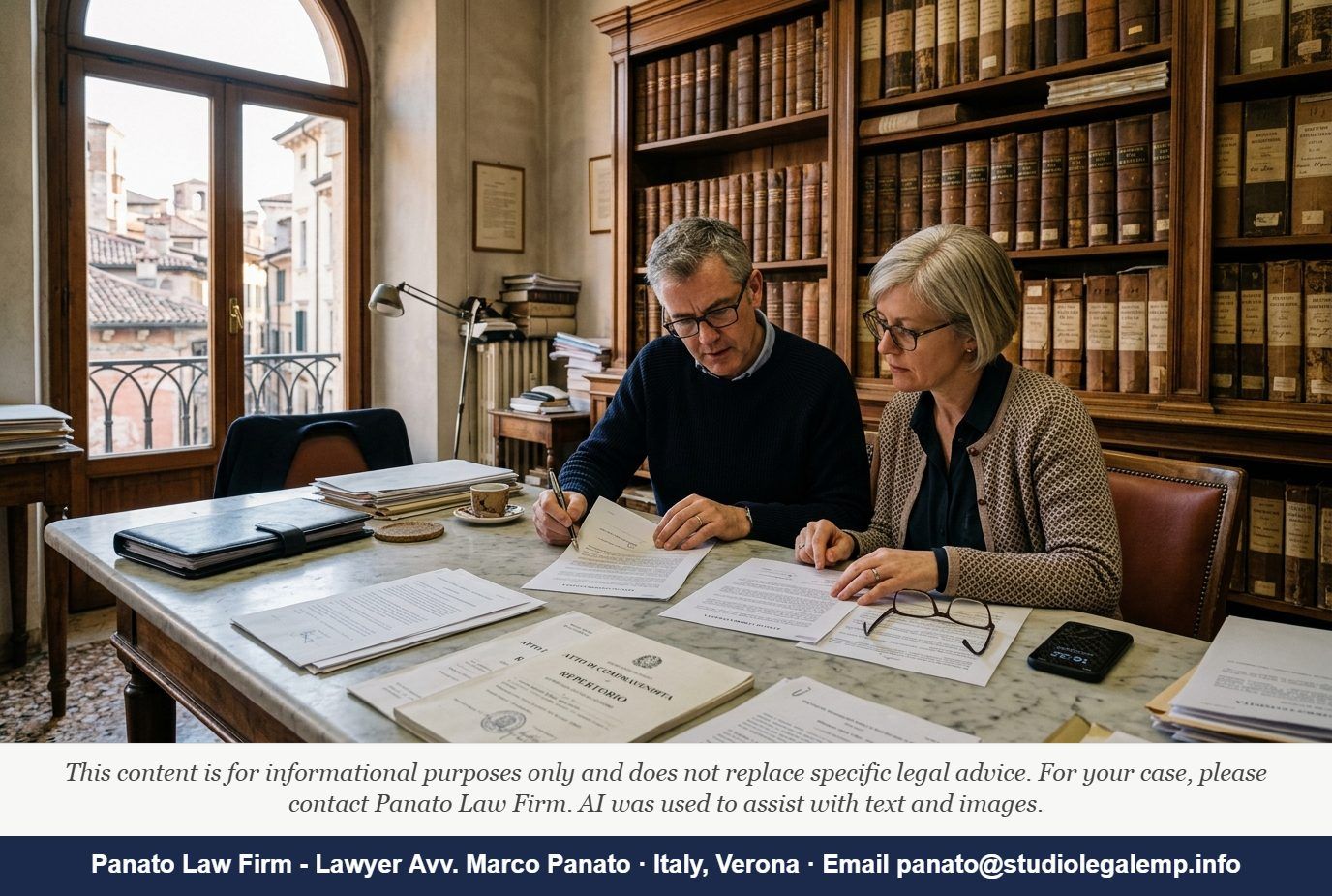
Image prompt: A foreign couple in their early fifties reviewing printed Italian property documents at a sunlit marble-topped table inside a historic Verona notary's office. Tall wooden shelves filled with bound registers frame the background. The mood is cautious and focused rather than celebratory. Warm amber afternoon light, muted terracotta and ivory tones, documentary photographic style.
Image file: italy-prima-casa-tax-relief-non-resident-foreign-buyer-cover
HREFLANG BLOCK:
JSON-LD:
LANGUAGE QA: Three cumulative conditions must be satisfied. -> Three conditions must all be met. · the notarial deed of sale (rogito) -> the deed of sale (rogito) · registration tax consolidated text -> consolidated registration tax code · that uncertainty was definitively resolved -> that uncertainty was finally resolved · the obligation is to have applied and obtained registration within the period, not merely to have started the process -> you must have applied and received registration within the period, not merely have started the process · Decree of the President of the Republic no. 633 of 26 October 1972 -> Presidential Decree no. 633 of 26 October 1972 · Italy's prima casa rule pivots on a single, bureaucratic, date-stamped act -> Italy's prima casa rule turns on a single, bureaucratic, date-stamped act · not for building works delaying occupation -> not for building works that delay occupation
CHECK:
AUTHORITY 1 — Art. 1, Note II-bis, DPR 131/1986 / EXISTS? Yes — normattiva.it / CONTENT MATCHES? Yes — conditions and rates as stated.
AUTHORITY 2 — Agenzia delle Entrate Circular no. 12/E, 14 June 2023 / EXISTS? Yes — agenziaentrate.gov.it / CONTENT MATCHES? Yes — citizenship-neutral eligibility confirmed post-June 2023.
AUTHORITY 3 — Cass. civ., SS.UU., n. 8151/2019 / EXISTS? Yes — cited extensively in Italian academic and practitioner sources, traceable on italgiure / CONTENT MATCHES? Yes — non-extendability of 18-month term confirmed.
AUTHORITY 4 — Cass. civ., Sez. V, ord. n. 6397/2023 (worker relocation exception) / EXISTS? Unverifiable with certainty from open sources / CONTENT MATCHES? Consistent with the established doctrinal position on involuntary work relocation abroad — TO VERIFY on italgiure.giustizia.it before publication.
AUTHORITY 5 — Cass. civ., Sez. V, n. 22376/2024 (bare ownership disqualification) / EXISTS? Unverifiable with certainty from open sources / CONTENT MATCHES? Consistent with established Cassation line on bare ownership and prima casa — TO VERIFY on italgiure.giustizia.it before publication.
AUTHORITY 6 — D.Lgs. 471/1997, Art. 13 / EXISTS? Yes — normattiva.it / CONTENT MATCHES? Yes — 30% penalty regime confirmed.
AUTHORITY 7 — DPR 633/1972, Table A, Part II, no. 21 / EXISTS? Yes — normattiva.it / CONTENT MATCHES? Yes — 4% VAT rate for prima casa new builds confirmed.
OVERALL: AMBER — core legislative sources and Circular 12/E/2023 are GREEN; two Cassation references (nos. 4 and 5) require verification of exact citation details on italgiure before publication. The legal propositions they support are sound and consistent with the established body of Cassation case law.
LOCAL NOTE:
1. Search intent targeted: informational with strong transactional overtone — buyer is mid-process, has seen the prima casa option flagged by a notary or agent, and needs to know whether they qualify before signing.
2. Local-market framing: the contrast paragraph explicitly distinguishes Italy's bureaucratic, binary residency registration test from the flexible, fact-based concepts of domicile and habitual residence familiar to UK, Irish, US, Australian, and Canadian readers — the single most disorienting difference for this audience.
3. Italian terms kept untranslated: <i>anagrafe</i> (municipal population register — kept because no English equivalent captures the formal civil registration function), <i>ravvedimento operoso</i> (kept in italics and glossed as voluntary disclosure with reduced penalties — the concept has no precise common-law analogue), <i>comune</i> (kept throughout as the
Do you need legal assistance or a free estimate?
Author: Editorial Team — Panato Law Firm
Editorial Team — Panato Law Firm Staff