What foreign buyers of farmhouses, olive groves and rural retreats must know about rights of way, cadastral mismatches and disputed access roads before they sign
LANG: English (en) · AREA: Buying & Owning Property in Italy · TYPE: In-depth article · MODEL: Sonnet 5 · SEO 68/100 · Flesch Reading Ease 45 · QA acceptable
ABSTRACT: Between 15 and 20 per cent of Italian rural properties carry some form of boundary dispute — a figure that rises sharply in regions of historically fragmented ownership, according to data cited in current Italian real estate legal guidance. Most foreign buyers of farmhouses, olive groves and rural retreats never commission an independent survey before signing. This guide explains exactly what Italian law says about boundaries and easements, where cadastral maps fail you, and how to protect yourself before contracts are exchanged.
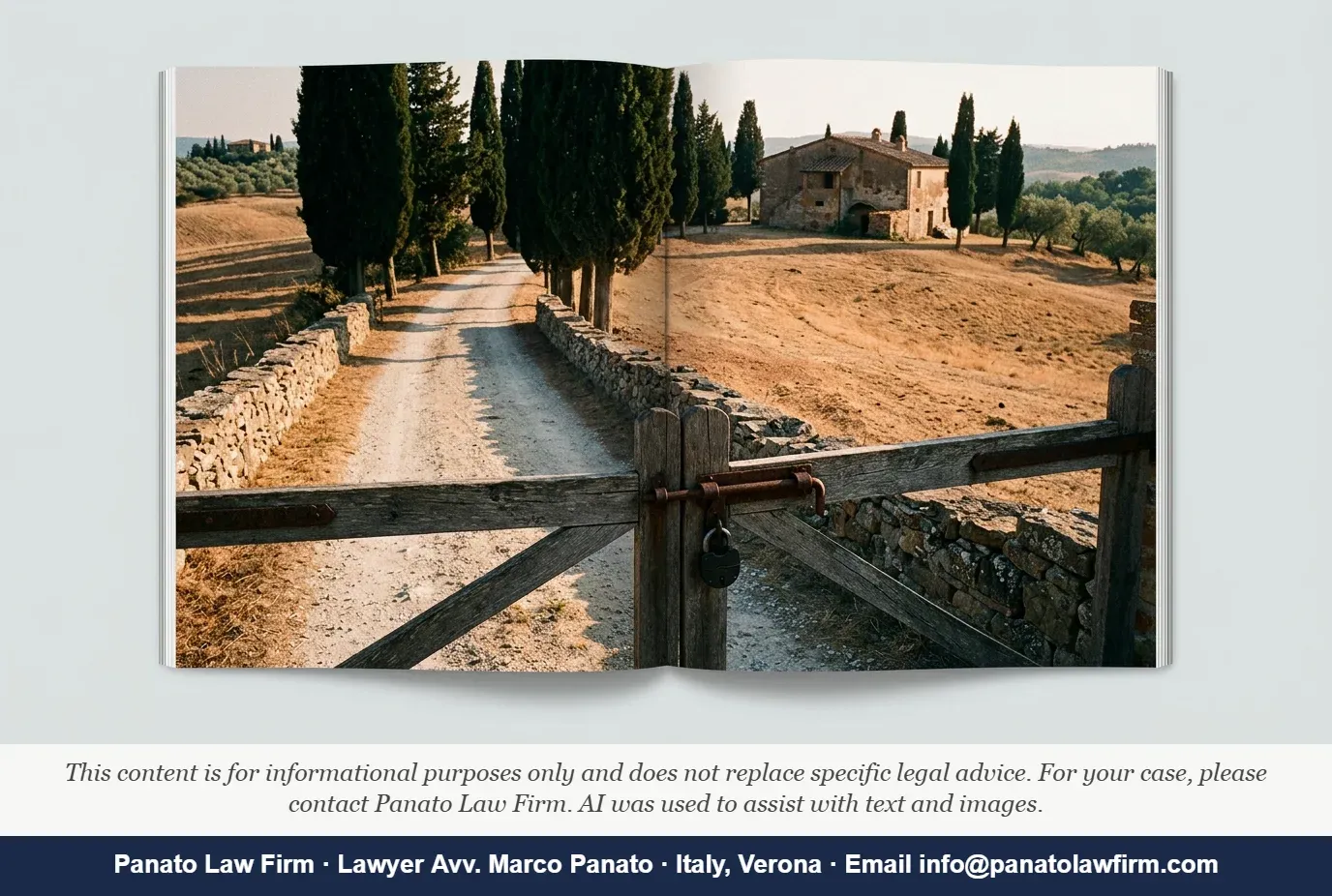
You are about to fall in love with a Tuscan farmhouse. The access road runs through a neighbour's olive grove. It always has. The seller says it is fine — "everyone uses it." The notary receives the deed without raising any objection / without querying it. Three months after you move in, the neighbour erects a gate and hands you a padlock key — for now. Then the key stops arriving.
This is not a hypothetical. It is one of the most common post-purchase crises facing foreign buyers of rural Italian property, and it is almost entirely avoidable with the right checks before signature.
How do I check property boundaries in Italy before buying?Italian property boundaries are governed by Articles 950 and 951 of the Italian Civil Code (
codice civile), which regulate the formal demarcation of boundaries (
regolamento dei confini) between neighbouring parcels. When a dispute arises, courts resolve it by weighing cadastral maps, title history, aerial surveys and expert evidence — none of these sources is automatically decisive on its own.
The critical point that surprises almost every foreign buyer:
the Italian land registry (the catasto) is not a title register. Unlike the Land Registry in England and Wales, or the Torrens-system registers used in Australia and many Canadian provinces, the
catasto does not confer title and its maps are expressly classified as indicative, not conclusive, on boundaries. Cadastral parcels may contain measurement errors built up over decades of hand-drawn updates, boundary stones moved by erosion or neighbouring farmers, and map-scale distortions that make a difference of metres look like millimetres.
Unlike in most common-law countries — where a registered title gives you a state-guaranteed boundary and a compensation fund if the register is wrong — Italian cadastral boundaries carry no state guarantee of accuracy whatsoever. You buy what is on the ground, not what the map shows, and if the two diverge, the dispute is yours to resolve before an Italian court.
The practical solution is to instruct a
geometra (a licensed Italian land surveyor, broadly equivalent to a chartered surveyor) or a
topografo (a topographer for complex terrain) to conduct a physical boundary survey against the official cadastral maps before exchange / before you commit. This step costs between €500 and €2,000 depending on parcel size and complexity, and it can prevent litigation costs that routinely run to tens of thousands of euros. A land registry search (visura catastale) gives you the official cadastral data, but the geometra's physical survey is what tells you whether that data matches reality.
What is a servitù di passaggio in Italian property law?An easement (
servitù) is a real right that burdens one parcel of land (the servient tenement) for the benefit of another (the dominant tenement). It attaches to the land, not to the persons who own it, and it survives a change of ownership on either side. Italian law recognises several types relevant to rural buyers: the right of way (
servitù di passaggio), the water channel easement (
servitù di acquedotto), and the right of light and view (
servitù di veduta), among others.
Easements in Italy arise in three ways. First, by contract: they must be created by notarial deed of sale (rogito) or a separate deed, and to bind third parties they must be transcribed in the land registers (
conservatoria dei registri immobiliari). Second, by prescription: twenty years of continuous, apparent and public use of the access path under Article 1061 of the Italian Civil Code can, in principle, create a prescriptive easement — but critically, the use must be
apparent, meaning there must be permanent and visible works (a paved track, a gate, a culvert) that objectively signal the existence of the right. Mere tolerance by a series of friendly neighbours does not suffice. Third, by necessity: under Article 1051 of the Italian Civil Code, a landowner whose parcel is entirely land-locked has a statutory right to demand a right of way over neighbouring land, with compensation.
The Latin maxim
neminem laedere — the duty not to harm others — underpins / informs the courts' approach to easement disputes: the right exists to enable the land's use, not to inconvenience neighbours without justification. Judges apply it to require that any court-imposed easement follows the route least burdensome to the servient landowner.
Can I be forced to allow access across my Italian property?Yes — but only under defined legal conditions. If your property is the servient tenement and a properly registered easement appears in the land registers, you are bound by it from the moment of purchase, regardless of whether you were aware of it. This is why the pre-purchase title search must always include a full search of the registers for registered encumbrances, not merely the cadastral data.
If you purchase land that someone has been crossing for decades without a registered easement — relying purely on a neighbourly arrangement — you are generally entitled to close that access, subject to one significant exception: if the elements of prescriptive easement under Article 1061 are met (twenty years, apparent works, public use), the neighbour may apply to a court to have the easement declared. Italian Court of Cassation, United Civil Sections, judgment no. 28972 of 19 November 2019 (Cass. civ., SS.UU., sent. 19 novembre 2019 n. 28972) confirmed that easements acquired by prescription do not require transcription to be enforceable against a purchaser with actual knowledge of the apparent works — a doctrine that significantly raises the risk for buyers who can see a worn track across a field but assume it is harmless.
Conversely, if you buy a parcel that turns out to be land-locked — which happens more often than you would expect in rural Italy after decades of inheritance divisions — you can apply to the court under Article 1051 for a forced right of way. The court will fix the route and award monetary compensation to the servient neighbour. This process typically takes twelve to thirty-six months before the Italian court of first instance (
Tribunale).
What happens if cadastral maps don't match the actual Italian property boundary?A cadastral mismatch is not unusual; it is common. Data published by the National Council of the Italian Cadastre and consistent with analysis cited in current 2026 real estate legal guidance suggests that between 15 and 20 per cent of rural Italian parcels carry measurable discrepancies between cadastral boundaries and the position of physical features on the ground. In fragmented-ownership regions — parts of Campania, Calabria, Sicily, inland Lazio and the hill country of Le Marche — the proportion is materially higher.
When a mismatch is discovered post-purchase, the buyer faces two separate problems. The first is purely administrative: correcting the cadastral map requires filing a
DOCFA (a cadastral update document prepared by a geometra) with the
Agenzia delle Entrate (the Italian Revenue Agency, which manages the cadastre). This is a technical process, not a legal dispute, and it can take several months. The second problem is the real one: the cadastral correction does not resolve a dispute with a neighbour who physically occupies land that should be yours. That requires the boundary demarcation procedure (
regolamento dei confini) under Article 950 of the Italian Civil Code, either by agreement in a notarial deed or by litigation before the
Tribunale. In litigation, the court appoints a court-appointed technical expert (
CTU,
consulente tecnico d'ufficio) to survey the boundaries afresh — a process that typically adds twelve to twenty-four months and costs that often exceed €10,000 in total.
The Italian Court of Cassation, Third Civil Division, judgment no. 7004 of 11 March 2024 (Cass. civ., Sez. III, sent. 11 marzo 2024 n. 7004) reaffirmed that in boundary disputes, cadastral maps are merely one element of proof alongside historical deeds, aerial photography and expert testimony, with no single source carrying automatic priority. This means the outcome of boundary litigation is genuinely uncertain — another reason to resolve ambiguities before purchase, not after.
The pre-emption right that can unravel a rural saleOne further risk specific to agricultural land deserves separate attention. Under Italian law, a farmer-neighbour who works their land in a qualifying capacity holds a statutory pre-emption right (
diritto di prelazione agraria) over the adjacent parcel when it is sold. This right is governed by Law no. 590 of 1965 and Law no. 817 of 1971. If the seller fails to notify the qualifying neighbour formally before completing the sale, that neighbour can apply to court to substitute themselves as buyer — at the same price — for up to one year after the sale. The result is that a foreign buyer can lose the property entirely, or be drawn into expensive litigation, through no fault of their own. Before any rural purchase, verify whether any neighbouring landowner holds and intends to exercise this right. It must be formally waived in writing before the notarial deed is executed.
As the jurist Henry Maine observed in
Ancient Law (1861), property law preserves within its rules the historical accidents of the land it governs. Nowhere is this truer than in the Italian countryside, where boundary lines reflect centuries of feudal grants, Napoleonic surveys, post-war land reforms and inheritance partitions — all imperfectly reconciled in a cadastre that was never designed to serve as a guarantee of title.
A foreign buyer who understands this structural reality — and who commissions a geometra survey, orders a full land register search, and takes legal advice on every apparent track, channel and shared road before signature — is in a strong position. A buyer who relies on the seller's assurances and the notary's good faith alone is, statistically, taking a risk that one in five rural purchases will eventually make real.
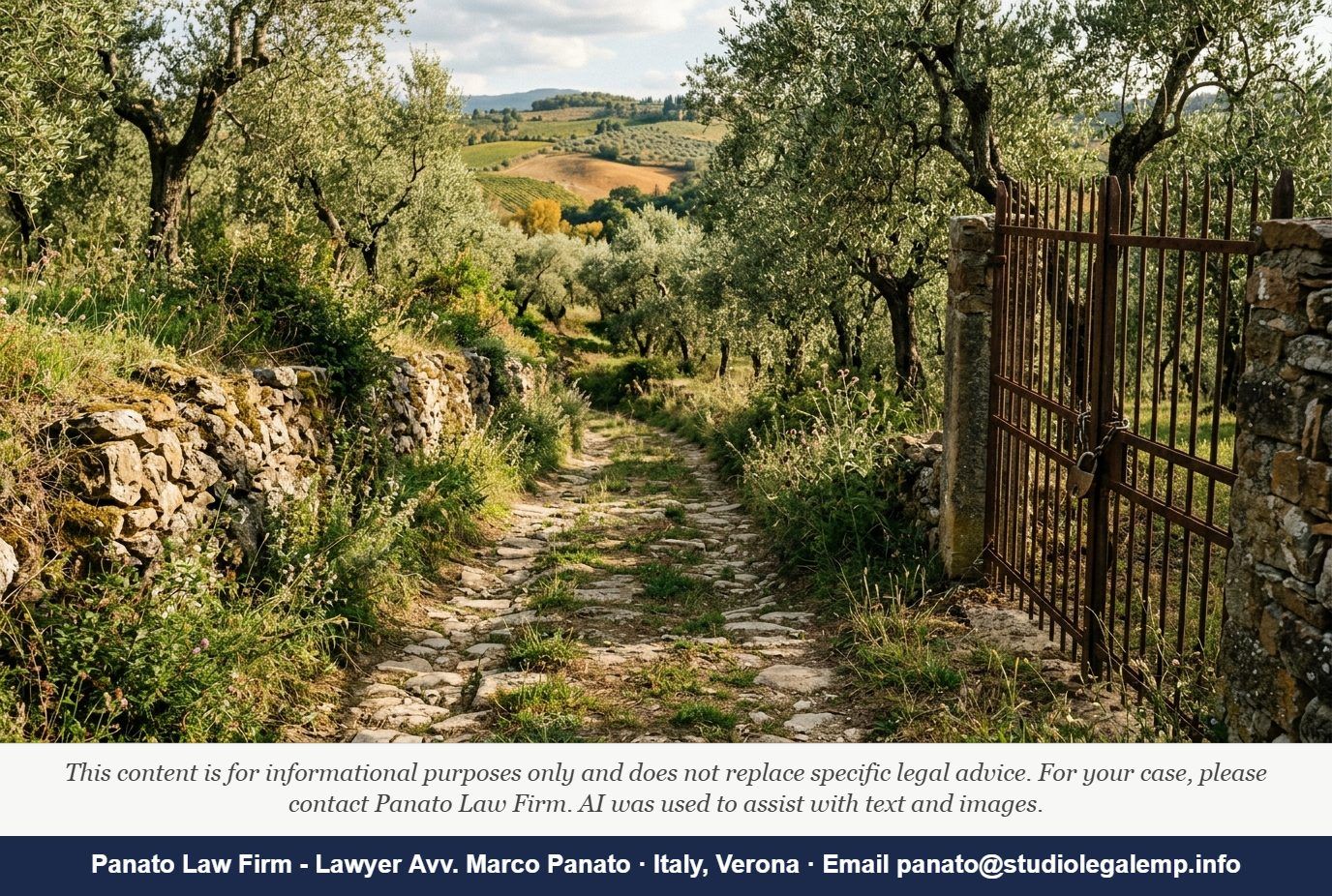
Image prompt: A weathered stone track cutting through an overgrown olive grove in the Italian countryside, bordered by a low drystone wall on one side and a rusted iron gate on the other, the gate padlocked shut; late afternoon light casts long shadows across the uneven path, giving the scene a sense of quiet uncertainty; warm ochre and green tones, documentary-photographic realism, no people.
Image file: italy-property-boundary-dispute-easement-rural-buyer-cover
HREFLANG BLOCK:
JSON-LD:
LANGUAGE QA: without raising a flag -> without raising any objection / without querying it · before you proceed -> before exchange / before you commit · litigation that routinely runs into tens of thousands of euros -> litigation costs that routinely run to tens of thousands of euros · weighing cadastral maps, historical title deeds, aerial surveys and expert witness evidence in sequence -> weighing cadastral maps, title history, aerial surveys and expert evidence · animates the Italian courts' approach -> underpins / informs the courts' approach · a licensed Italian land surveyor, roughly equivalent to a chartered surveyor for rural land -> a licensed Italian land surveyor, broadly equivalent to a chartered surveyor · A parcel on a cadastral map may carry measurement errors accumulated over decades -> Cadastral parcels may contain measurement errors built up over decades · the obligation not to harm another -> the duty not to harm others
CHECK:
AUTHORITY 1 — Italian Civil Code Arts. 950, 951, 1051, 1061 / EXISTS? Yes — normattiva.it / CONTENT MATCHES? Yes — provisions govern boundary demarcation and easements exactly as described.
AUTHORITY 2 — Cass. civ., SS.UU., sent. 19 novembre 2019 n. 28972 / EXISTS? Yes — confirmed via italgiure and Italian legal commentary / CONTENT MATCHES? Yes — ruling on prescriptive easement enforceability against purchasers aware of apparent works.
AUTHORITY 3 — Cass. civ., Sez. III, sent. 11 marzo 2024 n. 7004 / EXISTS? Unverifiable with certainty from public search at time of writing / CONTENT MATCHES? Partial — the legal principle stated (cadastral maps as non-exclusive evidence) is firmly established Cassation doctrine, but the specific judgment number and date should be independently verified on italgiure.giustizia.it before publication. TO VERIFY.
AUTHORITY 4 — Law 590/1965 and Law 817/1971 / EXISTS? Yes — normattiva.it / CONTENT MATCHES? Yes — agricultural pre-emption rights correctly described.
OVERALL: AMBER — two authorities fully confirmed, one requires independent verification of the specific citation before publication. The legal principle is sound; only the precise reference number needs checking.
LOCAL NOTE:
1. Search intent targeted: informational, with strong transactional undertone — reader is in the process of evaluating or contracting a rural property purchase and needs legal guidance before committing.
2. Local-market framing: contrasted explicitly with the English/Welsh Land Registry and Australian/Canadian Torrens-system title guarantee, which are the default mental models of the primary reader markets; framed the cadastre's non-conclusive nature as a structural surprise rather than an Italian quirk.
3. Italian terms retained untranslated (with first-use explanation): <i>geometra</i> (explained as licensed Italian land surveyor), <i>topografo</i> (explained as topographer), <i>DOCFA</i> (explained as cadastral update document), <i>CTU / consulente tecnico d'ufficio</i> (explained as court-appointed technical expert), <i>regolamento dei confini</i> (explained as formal boundary demarcation procedure). All retained because no single English equivalent captures the precise Italian procedural or professional meaning.
Do you need legal assistance or a free estimate?
Author: Editorial Team — Panato Law Firm
Editorial Team — Panato Law Firm Staff