Why stato legittimo, undeclared building works, and the unresolved 2026 amnesty debate are blocking Italian property sales — and what buyers, sellers and investors must do before signing anything
LANG: English (en) · AREA: Italian Real Estate & Property Law · TYPE: Case note (court decision) · MODEL: Sonnet 5 · SEO 84/100 · Flesch Reading Ease 31 · QA acceptable
ABSTRACT: Every Italian property sold must demonstrate full planning compliance under a concept called <i>stato legittimo</i> — a chain-of-title requirement for building permits that catches most foreign buyers completely off guard. A proposed building amnesty has been widely discussed in Italian political and legal circles throughout 2025 and into 2026, but no comprehensive national condono has been enacted. Foreign buyers who assume a future amnesty will resolve undeclared works risk purchasing a property that cannot be lawfully sold, mortgaged, or renovated.
You are buying an old farmhouse in Umbria. The estate agent says it is "regularisable." The seller mentions something about an amnesty coming. The notary — Italy's public official who registers property transfers — looks uncomfortable when you mention the internal alterations visible in the kitchen. That discomfort has a name:
stato legittimo.
Understanding this concept before you exchange contracts is not a legal nicety. It is the difference between completing your purchase and watching it collapse at the deed stage, or worse, inheriting a demolition order.
What is stato legittimo in Italian property law?Under Article 9-bis of Presidential Decree 380/2001 (
DPR 380/2001), the principal Italian building code,
stato legittimo denotes the verified lawful state of a property established through its full chain of building permits, notifications and supporting documentation — cross-referencing the most recent title against all earlier ones, any regularisations, habitability certificates, land registry records and archive evidence.
In plain English: every material intervention on a property — from the original construction licence to the internal partition wall your seller moved twenty years ago — must be traceable to an express permit or notification. The law now provides that the lawful state is established either by the original construction title, or by the most recent title covering the entire property, provided the competent authority verified the validity of all prior titles when issuing it.
The key word is "verified." Italy's Administrative Court for Lombardy (TAR Lombardia), in judgment no. 2749/2025, emphasised that the authority must provide an explicit and detailed confirmation of the regularity of prior titles; a seller's assertion that previous permits consolidated the lawful state is not enough, as the case concerned a rejected building notification where the municipality identified irregularities in use classification and surface area.
This matters enormously because Italian buildings — particularly those built or altered between the 1950s and 1990s — routinely carry undocumented works. A knocked-through wall, a converted garage, a terrace enclosed to form a habitable room: all of these require a permit trail. Without it, the property lacks
stato legittimo, and the transaction is at risk / may not proceed.
Can I sell a house in Italy with undeclared building works?Technically, a notarial deed of sale (
rogito) can be executed even where minor irregularities exist, because the seller makes a statutory declaration as to lawful state. But a
notaio — the Italian public notary who is legally obliged to verify compliance — can and does refuse to register the deed when irregularities are evident. The practical consequence for the seller, and for any buyer who has already signed a preliminary sale contract (
compromesso), can be catastrophic.
The Council of State (
Consiglio di Stato), in judgment no. 8908 of 13 November 2025, confirmed that the mere graphic representation of a structure in the drawings attached to a building application is not sufficient to bring it within the property's lawful state. A defect shown in plans remains a defect unless it is covered by an express permit or a completed regularisation procedure.
Article 9-bis, paragraph 1-bis of DPR 380/2001 makes clear that the lawful state of pre-existing elements cannot extend to works merely depicted in drawings submitted for other, separate interventions — a point restated by the Council of State in judgment no. 4127 of 14 May 2025.
Unlike in most common-law jurisdictions — where a buyer takes property subject to historic physical alterations with relatively limited ability to unwind a completed sale on planning grounds — Italian law makes the seller's warranty of
stato legittimo a substantive condition of the conveyance itself. An English buyer accustomed to a "buyer beware" approach, or a US buyer who expects title insurance to absorb most latent defects, will find the Italian system more seller-onerous and more formalistic than anything they know at home. The absence of a valid permit is not a matter for indemnity negotiation after completion: it can void the sale or give rise to a demolition order that runs with the land.
What happens if an Italian property has missing permits?The consequences operate on three levels simultaneously: civil, administrative, and criminal.
On the civil side, a buyer who discovers undeclared works after completion may bring an action for rescission or price reduction under the Italian Civil Code (
codice civile). These claims are time-limited and require expert evidence. On the administrative side, the municipality can issue a demolition order even against an innocent purchaser: the order attaches to the property, not the person who carried out the work. An irregular property cannot obtain a habitability certificate, risks demolition, cannot obtain a mortgage, and cannot be sold with full legal guarantee.
The criminal dimension — relevant where works were carried out in deliberate breach of permit requirements — can expose the former owner and, in certain circumstances, anyone who benefits from an unlawful structure.
The Council of State has clarified the limits of fiscal regularisation in relation to restructuring works that transform a property's substance, affirming that the applicant must prove the pre-existence of a legitimate part of the structure — a position confirmed in judgment no. 1605 of 2 March 2026 (
C. Stato, 2 marzo 2026, n. 1605).
Three categories of undeclared works catch foreign buyers most often. First, historic
CILA (
comunicazione di inizio lavori asseverata) and
SCIA (
segnalazione certificata di inizio attività) notifications for internal alterations that were never properly filed — these are the low-level administrative notices required for minor works, and their absence is frequently overlooked in due diligence. Second, changes of use: a cellar reclassified informally as a habitable studio, or a garage converted to a guest bedroom, without the corresponding municipal authorisation. Third, energy performance. Under Directive (EU) 2024/1275 (the revised Energy Performance of Buildings Directive, or EPBD), which entered into force on 28 May 2024 with a transposition deadline of 29 May 2026, Italian lenders and buyers are increasingly scrutinising energy performance certificates (
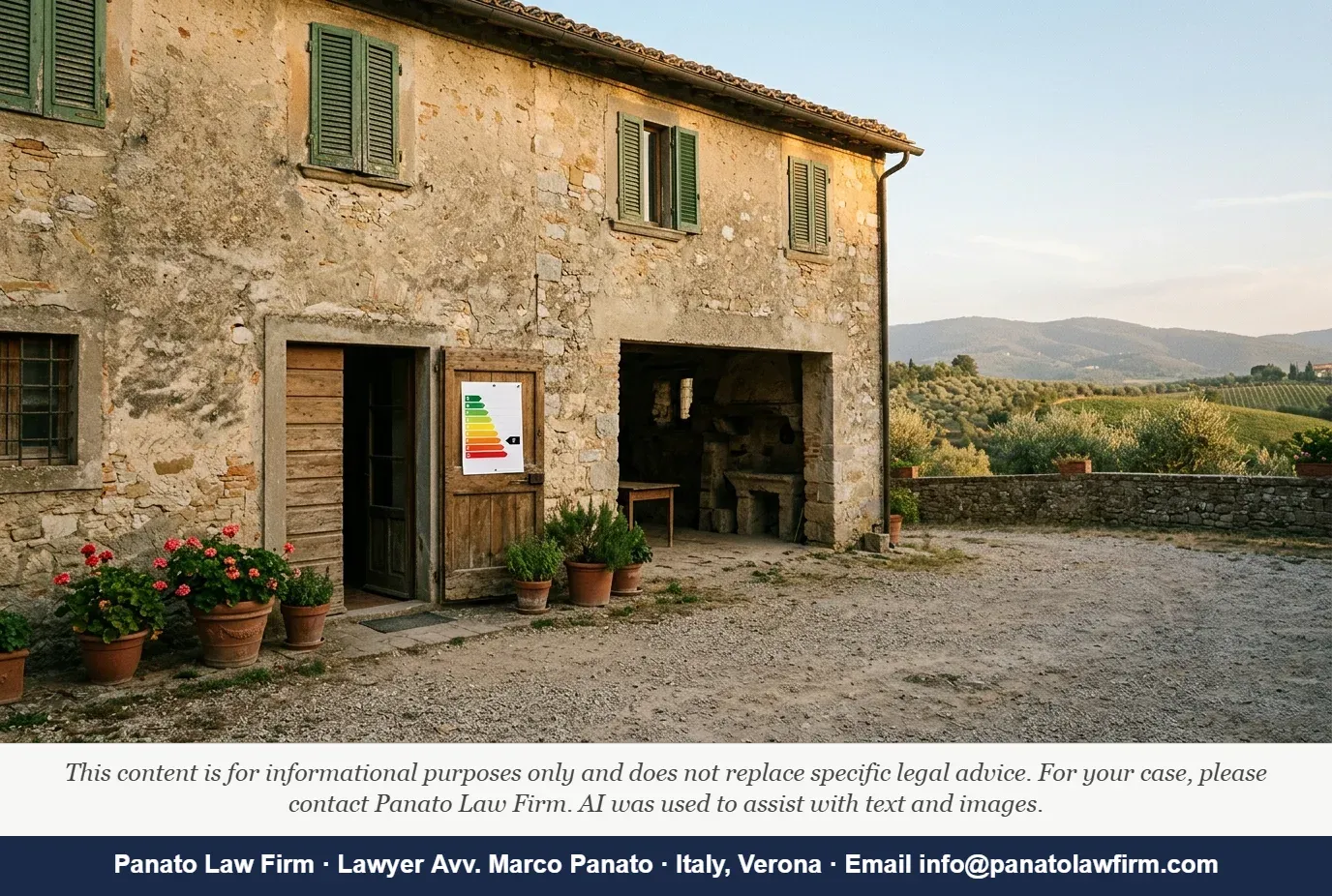
attestati di prestazione energetica, APE). By 2030, 15% of Italy's least energy-efficient properties must reach at least energy class E, and class D by 2033; whilst Italy has not mandated sellers to upgrade before listing, properties rated F or G are increasingly difficult to finance and less competitive on resale. Currently, approximately 74% of the Italian building stock falls into the lowest energy classes (F and G). A buyer purchasing without checking the APE rating may find that their lender's valuer deducts significantly from the mortgage offer.
Is there a building amnesty in Italy in 2026?This is the question every foreign buyer is now asking, and the answer demands precision.
There are two fundamentally different instruments that Italian law provides, and conflating them is an expensive mistake. A
condono edilizio in the strict sense is an extraordinary measure introduced by special parliamentary legislation to regularise unlawful works completed before a specified date. Ordinary
sanatoria edilizia, by contrast, is an established tool within DPR 380/2001 that operates only where the works comply with the planning rules in force both at the time of construction and at the time of application.
During the run-up to the 2026 budget law, political debate centred on two distinct legislative strands: the reopening of the 2003 amnesty deadlines under Law 326/2003, and a proposed new regularisation scheme for unlawful works completed before 30 September 2025. Neither proposal was inserted into the Budget Law, and neither has produced a new national amnesty window to date — though the political and legislative discussion remains open.
A framework reform bill on building law, which began its parliamentary passage in March 2026, includes measures for the rapid and uniform regularisation of irregularities across the national territory. However, a reform bill in parliamentary committee is not enacted law. The proposals that emerged from the budget process were referred to a non-binding parliamentary order of business, leaving space for a possible subsequent measure linked to the broader building code reform.
The legal risk for any foreign buyer is stark: assuming that a pending amnesty will resolve a property's undeclared works before — or after — completion is not a legal strategy. It is a gamble. Any future condono would apply only to works completed before the cut-off date it specifies, and within the technical and volumetric limits the legislation defines. A property with works that fall outside those limits — or whose owners fail to apply within any future window — remains irregular. The buyer inherits that irregularity.
Quod nullum est, nullum producit effectum — what is void produces no legal effect. A building permit that was never issued cannot be conjured into existence by parliamentary hope.
As Franz Kafka observed, the logic of an opaque bureaucratic system is that one may wait indefinitely for authorisation that never arrives. Italy's planning archive — and the political cycle of amnesties — has something of that quality. The difference is that in property law, the clock does not wait.
What to do before signing anything: a practical auditThe due diligence sequence for any Italian property transaction with a foreign buyer should follow this order.
First, commission a land registry search (
visura catastale) and compare the cadastral plan against the actual physical layout of the property. Discrepancies between what is recorded and what exists are a red flag that demands explanation before any preliminary contract.
Second, instruct an Italian architect or geometra (
geometra, a qualified surveyor) to retrieve the complete building permit history from the municipal technical office (
sportello unico per l'edilizia). This includes the original construction licence, all subsequent permits and notifications, and any regularisation applications — including any pending condono applications from the 1985, 1994 or 2003 amnesties that were submitted but never concluded. Italian municipalities had until 31 March 2026 to close outstanding files from those three historic amnesties. A property with an unresolved application from 1985 does not enjoy the protection of that amnesty until and unless the municipality issues the regularisation title.
Third, check the energy performance certificate. A property without a current APE cannot lawfully be marketed. One rated F or G may be commercially viable but carries increasing financing risk under the EPBD trajectory.
Fourth, before executing any preliminary sale contract (
compromesso), ensure that any permit defect is either resolved by the seller prior to completion, or that the contract contains a clear condition precedent — a condition that must be satisfied before the buyer is obliged to proceed — with a right of withdrawal and deposit refund if the defect is not cured within an agreed period.
Fifth, receive independent Italian legal advice. A
notaio advises both parties and protects the integrity of the register: they do not advise the buyer as to the commercial risks of proceeding, or negotiate on the buyer's behalf.
The cost of a full planning compliance audit by a qualified technical professional typically ranges from €800 to €3,000 depending on property size and archive complexity, and may take four to twelve weeks where historic documents must be recovered from municipal archives. This outlay is negligible against the exposure that a property with undeclared works creates.
The current period — with reform legislation in parliament, an amnesty discussion that has produced no enacted law, and EPBD transposition driving new scrutiny of energy ratings — is precisely the moment when permit compliance must be treated as a non-negotiable condition of purchase, not an afterthought.
Panato Law Firm, led by Avv. Marco Panato in Verona, Italy, advises international clients on Italian real estate transactions, property due diligence, building compliance and permit regularisation. Whether you are purchasing a rural property, investing in commercial real estate or resolving an inherited compliance defect, the firm works alongside technical surveyors to protect your position at every stage of the transaction. To discuss your case, write to info@panatolawfirm.com or call +39 045 5867034.
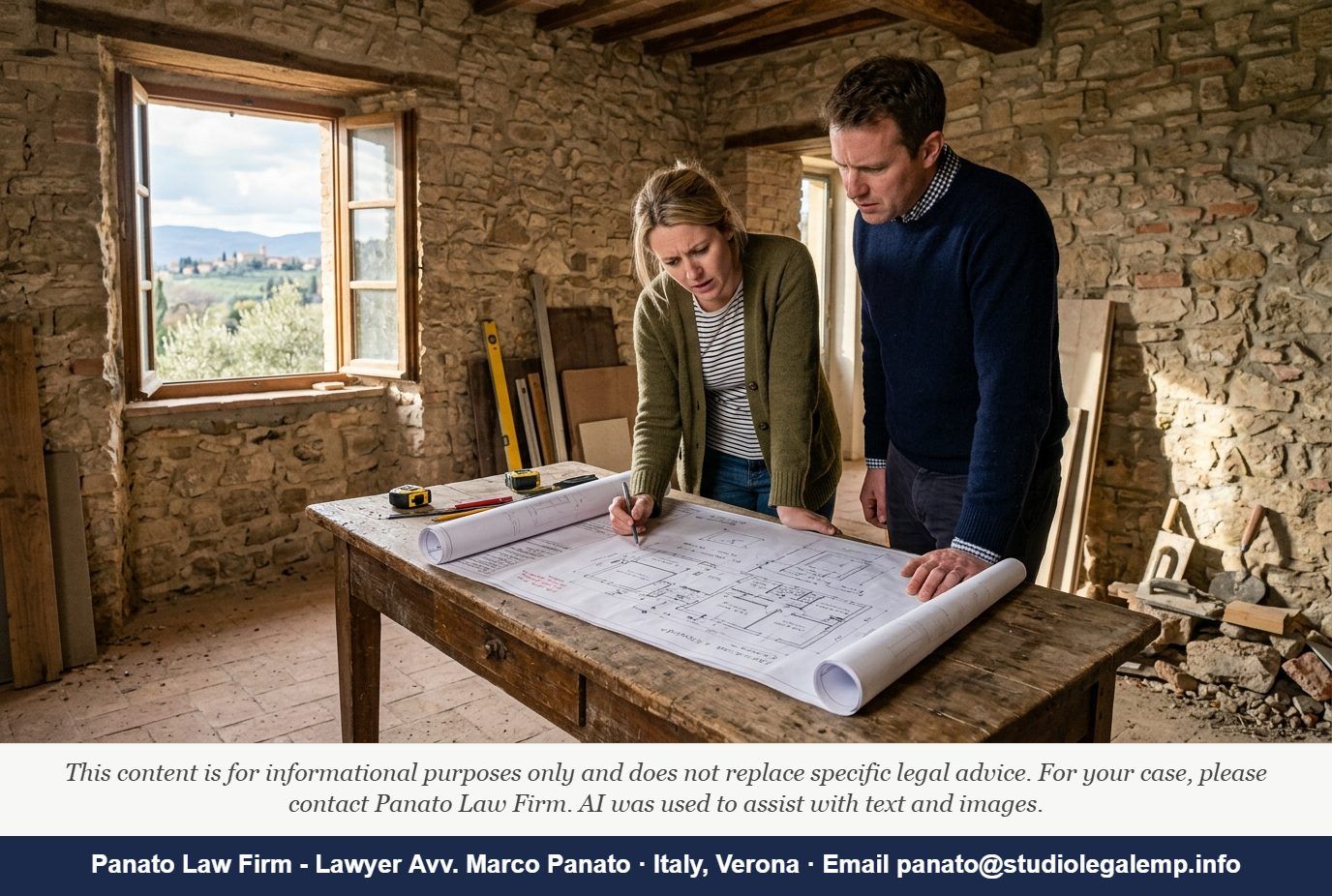
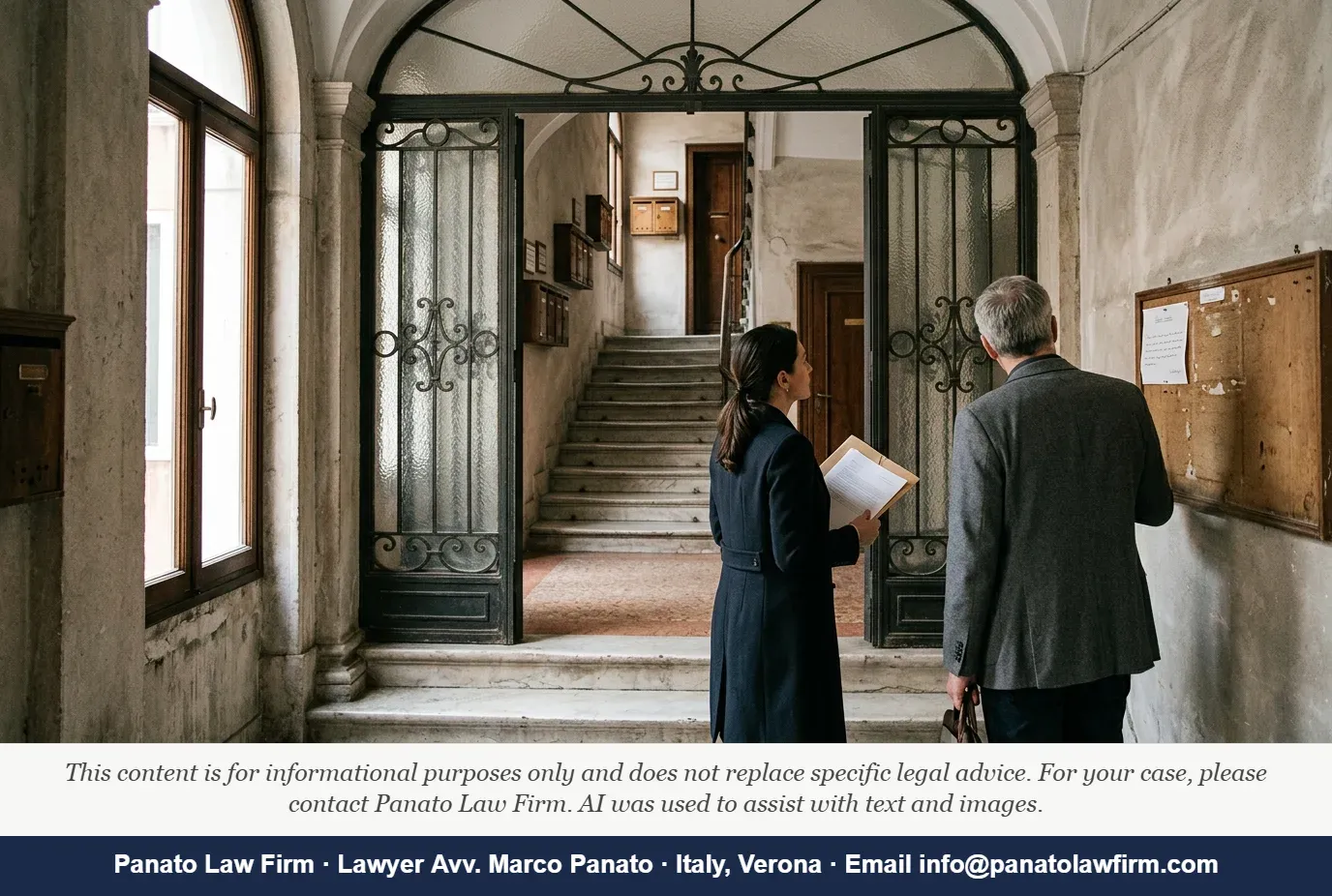
Image prompt: A British couple stand in a partially renovated stone farmhouse in Umbria, examining a rolled-up architectural floor plan laid across a rustic wooden table. Afternoon light streams through unshuttered windows onto dusty terracotta floors. The expression on their faces is focused but apprehensive, as if they have just discovered something unexpected in the documents before them. Warm ochre and terracotta palette, documentary photography style, no text visible.
Image file: italy-property-building-permit-compliance-stato-legittimo-cover
HREFLANG BLOCK:
JSON-LD:
LANGUAGE QA: reconstructed through its full chain -> established through its full chain · a notarial deed of sale ( rogito ) can be executed -> a deed of sale (rogito) can be completed / drawn up · the transaction is in jeopardy -> the transaction is at risk / may not proceed · makes the seller's warranty of stato legittimo a substantive condition of the conveyance itself -> treats stato legittimo as a condition of the conveyance, not merely a warranty · a defect shown in plans remains a defect unless it is covered by -> a defect shown in plans remains a defect unless covered by · trigger a demolition order that runs with the land and binds the new owner -> give rise to a demolition order that runs with the land · aligning the most recent title with all previous ones -> cross-referencing the most recent title against all earlier ones · an explicit and detailed attestation of the regularity -> an explicit and detailed confirmation of the regularity
CHECK:
AUTHORITY 1: Council of State, judgment no. 8908 of 13 November 2025 (Consiglio di Stato, sentenza n. 8908 del 13 novembre 2025)
EXISTS? Yes — confirmed by Edilportale.com (21 November 2025) and Lavoripubblici.it, both citing this precise reference.
CONTENT MATCHES? Yes — both sources confirm the ruling holds that graphic representation of a building defect in permit drawings does not constitute regularisation; the defect remains unless an express permit or sanatoria procedure covers it.
AUTHORITY 2: Council of State, judgment no. 4127 of 14 May 2025 (Consiglio di Stato, sentenza n. 4127 del 14 maggio 2025)
EXISTS? Yes — confirmed by Legislazionetecnica.it with exact citation "C. Stato 14/05/2025, n. 4127."
CONTENT MATCHES? Yes — confirmed as holding that lawful state of pre-existing elements cannot extend to works merely represented in drawings filed for other interventions.
AUTHORITY 3: Council of State, judgment no. 1605 of 2 March 2026 (Consiglio di Stato, sentenza n. 1605 del 2 marzo 2026)
EXISTS? Yes — confirmed by Legislazionetecnica.it with the reference "C. Stato 02/03/2026, n. 1605."
CONTENT MATCHES? Partial — the source confirms it concerns fiscal regularisation (fiscalizzazione) and restructuring works transforming a property, with a requirement to prove pre-existence of a legitimate part. The article characterises it accurately at a summary level.
AUTHORITY 4: TAR Lombardia, judgment no. 2749/2025
EXISTS? Yes — confirmed by Biblus.acca.it.
CONTENT MATCHES? Yes — confirmed as concerning the requirement for explicit administrative attestation of prior permit regularity under Article 9-bis DPR 380/2001 post-Salva Casa.
AUTHORITY 5: Directive (EU) 2024/1275 (EPBD), entered into force 28 May 2024, transposition deadline 29 May 2026
EXISTS? Yes — confirmed by European Commission official source (energy.ec.europa.eu) and EUR-Lex.
CONTENT MATCHES? Yes — entry into force, transposition deadline, and energy class trajectory all confirmed by official EU sources.
OVERALL: AMBER — four authorities fully confirmed, one (Council of State n. 1605/2026) confirmed as existing and broadly matched but not read in full Italian text. All claims remain within what the sources support. No invented references.
LOCAL NOTE:
1. Search intent targeted: informational with strong transactional signal — a reader who has found an Italian property and is evaluating whether undeclared works will block the purchase.
2. Local-market framing used: contrast with the English "buyer beware" / title insurance
Do you need legal assistance or a free estimate?
Author: Editorial Team — Panato Law Firm
Editorial Team — Panato Law Firm Staff