The stato legittimo check, building permit history, and why the 2026 energy rules are changing what you must verify before signing
LANG: English (en) · AREA: Buying & Owning Property in Italy · TYPE: Checklist / documents needed · MODEL: Sonnet 5 · SEO 84/100 · Flesch Reading Ease 32 · QA translated
ABSTRACT: Foreign buyers purchasing property in Italy face a legal landscape with no equivalent to title insurance: every irregularity must be identified and resolved before contracts are signed. The Italian concept of <i>stato legittimo</i> — the requirement that a property's physical state must match every permit ever issued for it — sits at the heart of this process, yet it is routinely skipped. A 2026 legislative debate on Italy's proposed new unified building code, combined with the transposition of the EU's revised Energy Performance of Buildings Directive, is adding new layers of risk and opportunity that make early due diligence more pressing than ever.
There is a phrase experienced Italian conveyancing lawyers hear regularly from foreign clients: "the notary will sort it out." It is a reasonable assumption if you come from a system where title insurance backstops any irregularities the buyer fails to discover. In Italy, that safety net does not exist. By the time you sit in front of the
notaio to sign the notarial deed of sale (
rogito), the investigation should already be complete. If it is not, you own the problem.
What documents should I check before buying property in Italy?Italian property due diligence requires consulting four separate administrative systems, none of which is linked to the others.
The first is the
Conservatoria dei Registri Immobiliari (the Land Register), held at the relevant provincial office of the Agenzia delle Entrate, Italy's revenue authority. This search reveals mortgages, liens, rights of pre-emption, and any third-party claims registered against the title. It is the closest Italian equivalent to an English office copy, but it covers only registered encumbrances — unregistered arrangements can still bind the property under Italian law.
The second is the
Catasto, Italy's cadastral register. A land registry search (
visura catastale) shows the property's classification, cadastral category, surface area, and official rendita catastale (the notional income figure used for tax calculations). Crucially, cadastral data describes the property as it was last formally mapped — which may be decades ago.
The third, and the most operationally complex, is the technical archive of the relevant
Comune, the Italian municipality. This is where building permits, construction notices (
CILA), certified commencement notices (
SCIA), and the original
permesso di costruire are held. These cannot be searched online in most municipalities; a formal access request —
accesso agli atti — must be submitted, and response times vary from two weeks to several months.
The fourth is the energy performance certificate, known as the
APE (
Attestato di Prestazione Energetica). Since 2013, Italian law has required a valid APE for every sale and rental. As of 2026, its content has become a lender eligibility requirement — more on that below.
What is stato legittimo in Italian property law?Stato legittimo — loosely, "legal conformity / lawful state" — is the requirement introduced and progressively tightened through Presidential Decree 380/2001 (
Decreto del Presidente della Repubblica 6 giugno 2001 n. 380), Italy's consolidated building code, known as the
Testo Unico Edilizia. Under Article 9-bis, as amended by Legislative Decree 76/2020 (
Decreto Legislativo 16 luglio 2020 n. 76), a property may only be validly transferred if its current physical state corresponds exactly to all the permits, licences, concessions, and amnesty titles (
condoni) ever issued for it. The rule applies cumulatively: each subsequent intervention must itself have been authorised. A property built lawfully in 1970 but with an unlicensed extension added in 1988 fails the stato legittimo check.
Unlike in most common-law countries — where a buyer typically searches back only a fixed statutory period, and where title insurance covers the residual risk — Italian law imposes no limitation period on building irregularities. An unauthorised intervention forty years ago remains unauthorised today, potentially rendering a sale void, preventing mortgage finance, or exposing the buyer to a demolition notice. England, Ireland, the United States, Canada, and Australia each offer some mechanism (insurance, limitation, the torrens system) that caps a buyer's exposure to historical defects. Italy offers none of these. The burden falls entirely on pre-contract investigation.
According to ISTAT's 2023 report on residential building stock, approximately that approximately 20% of Italian properties contain some form of unauthorised construction. In the south of Italy and in rural areas, the figure is higher.
How do I check if an Italian property has planning permission?The practical sequence runs as follows. First, obtain the land registry search (visura catastale) and the historical
planimetria catastale (cadastral floor plan). Compare the floor plan against the actual layout of the property. Any discrepancy between the two — a wall moved, a room added, a terrace enclosed — is a red flag requiring explanation.
Second, file an accesso agli atti request at the Comune's technical office (
Ufficio Tecnico). Ask for all building titles issued for the property from the date of construction to the present, including any amnesty (
condono) applications and whether they were actually granted. An application submitted but not resolved does not confer legality.
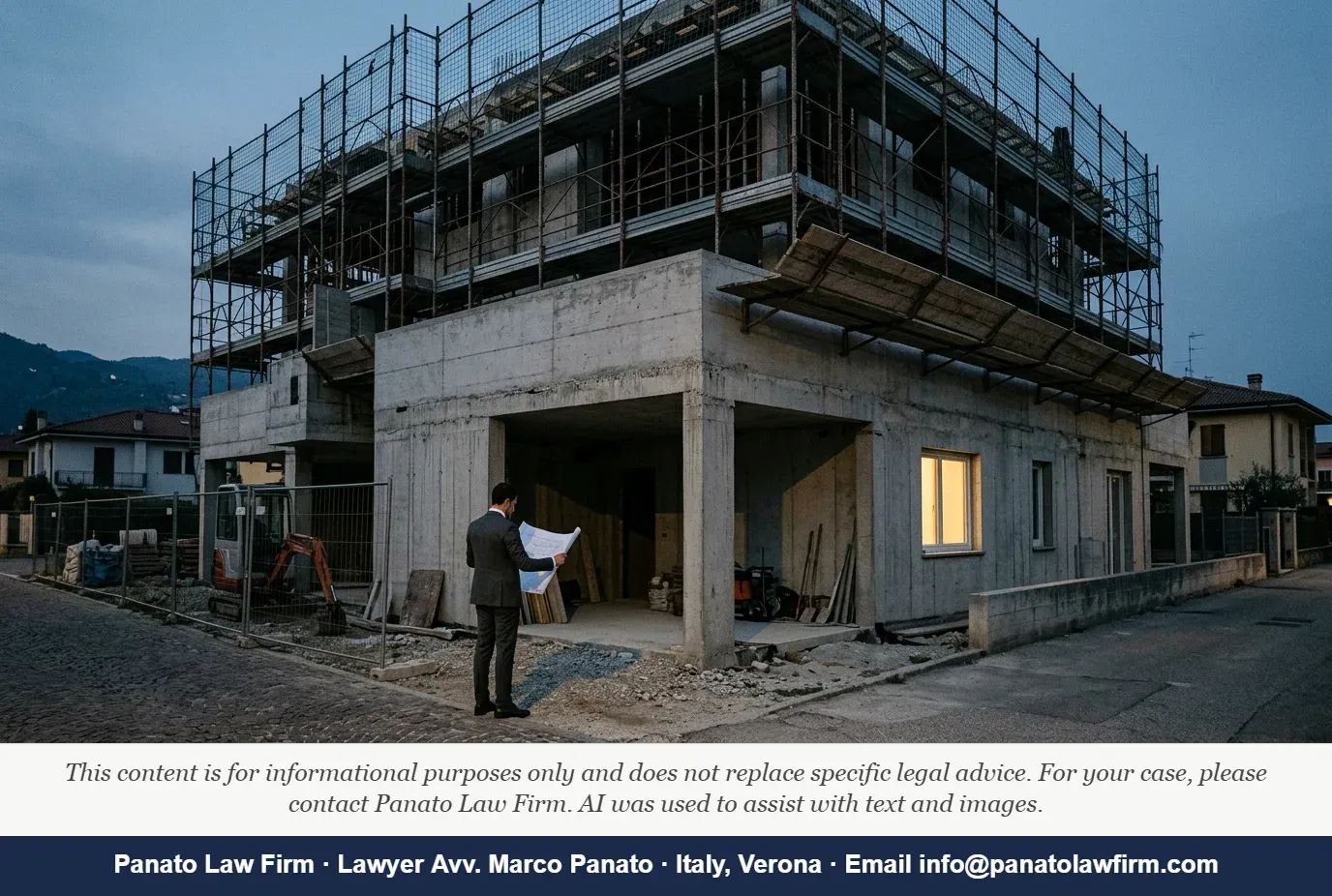
Third, cross-reference each physical feature of the property against the permit history. Pergolas, mezzanines, balcony glazing, converted lofts, and cellars converted to habitable space are the most common sources of
abuso edilizio — unauthorised building. The Italian Court of Cassation has consistently held that the seller's obligation to deliver a property in a state of legal regularity means that an undetected abuso gives the buyer a right to rescind and claim damages: see, for example, Italian Court of Cassation, Second Civil Division, judgment no. 9278 of 4 April 2023 (
Cass. civ., Sez. II, sentenza 4 aprile 2023 n. 9278), which confirmed that a significant building irregularity affecting the lawful use of a property constitutes a legal defect entitling the buyer to rescission under Article 1489 of the Italian Civil Code (
codice civile).
Fourth, check whether any enforcement orders —
ordinanze di demolizione — have been issued against the property and whether they remain outstanding. These are held at the Comune and do not necessarily appear in the Land Register.
The 2026 energy rules: a new variable in every Italian property transactionDirective (EU) 2024/1275 of the European Parliament and of the Council on the energy performance of buildings (the recast EPBD), published in the Official Journal of the EU on 8 May 2024, requires Member States to set minimum energy performance standards for residential buildings. Italy's transposition into national legislation, which must be completed in stages with milestones running from 2026 to 2030, introduces EPC class as a transaction variable in a way that did not exist even three years ago.
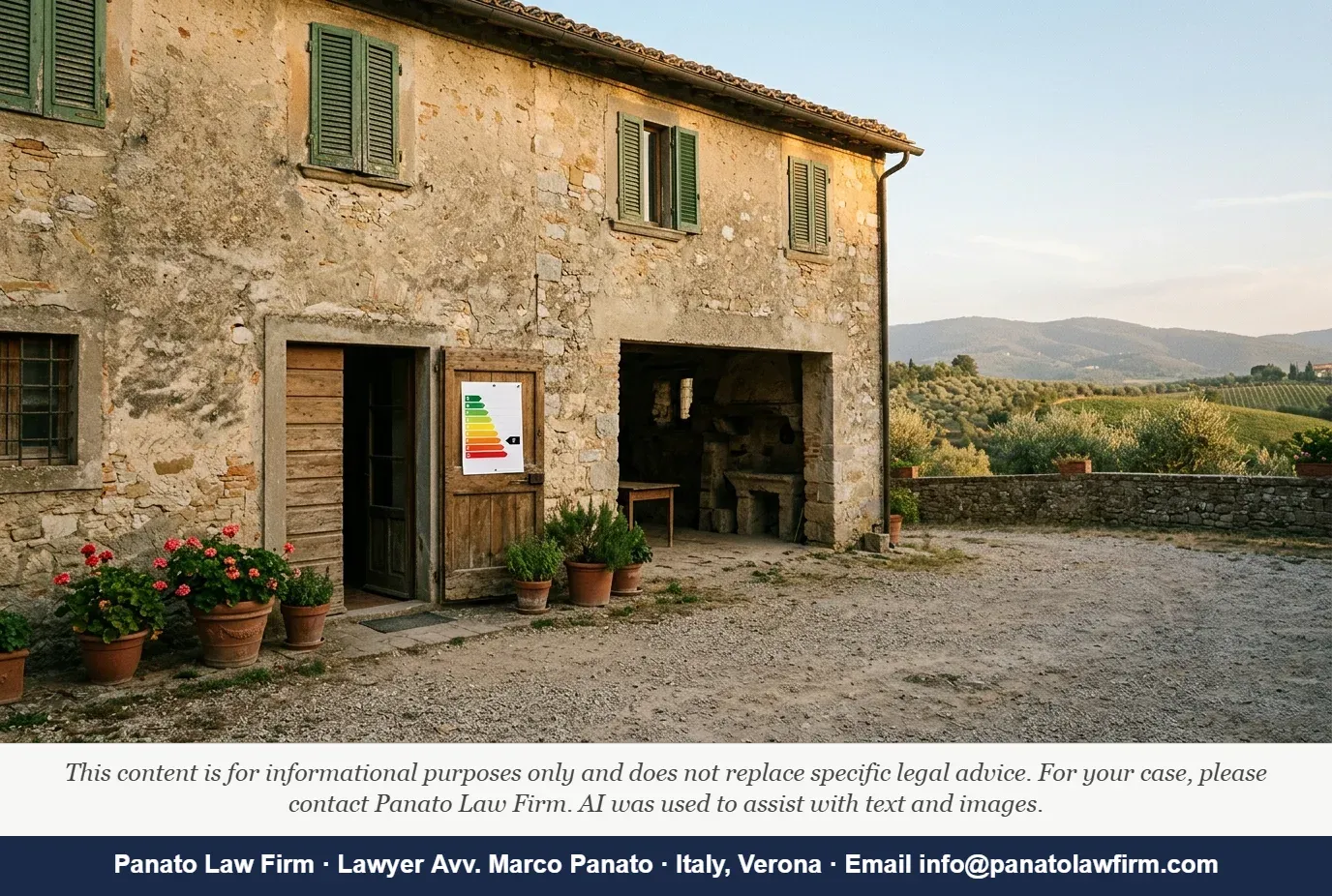
Under the trajectory agreed, residential properties must achieve at least EPC Class E by 2030 for resale and rental to be fully supported by conventional mortgage lending. Italian banks are already incorporating this into their loan assessment criteria; several major lenders have begun attaching EPC conditions to loan offers on properties rated F or G. For a foreign buyer relying on Italian mortgage finance, a Class G property bought today may present refinancing difficulty within the loan term.
The currently unresolved question concerns Italy's proposed unified building code — a reform that has been circulating in draft form through Parliament since 2024 and which, as of mid-2025, remains in active legislative debate. The reform would consolidate the Testo Unico Edilizia with regional legislation and simplify the rules for
sanatoria, the procedure for regularising minor building irregularities. Its current draft introduces a concept of
conformità formale e sostanziale (formal and substantive compliance) which could, if enacted, provide a cleaner route to regularising certain categories of historical abuso. However, no text has yet been enacted. Practitioners — and foreign buyers — should treat any regularisation plan based on the draft as speculative until the reform receives royal assent in the Italian legislative process.
Does Italy have title insurance for property buyers?Italy has no established market in title insurance comparable to that in the United States, Canada, or Australia. A small number of specialist insurers have begun offering limited products to institutional investors, but retail buyers, including foreign individuals, generally cannot access meaningful title cover. This makes the pre-contract phase legally determinative in a way that surprises buyers from common-law jurisdictions.
The preliminary sale contract (
compromesso) is binding under Article 1351 of the Italian Civil Code once signed: the buyer who walks away after signature loses the deposit, and the seller who pulls out must return double. Discovering a fatal stato legittimo irregularity after the compromesso is signed is expensive. Discovering it before is the point of due diligence.
Ubi jus incertum, ibi jus nullum — where the law is uncertain, there is effectively no law. The maxim captures the practical reality of buying property with an unresolved permit history: legal uncertainty does not protect the owner. It creates a gap that enforcement authorities, co-owners, and subsequent purchasers can exploit.
As Hernando de Soto observed in
The Mystery of Capital, the invisible architecture of formal property rights is not the building itself but the legal apparatus that allows it to be capitalised, transferred, and used as security. In Italy, that apparatus requires documentary proof of regularity. For a foreign buyer unfamiliar with Italian administrative procedure, the most effective investment is professional engagement at the earliest stage — before any deposit changes hands and before any preliminary contract is signed.
The 2026 energy performance rules and the still-pending building code reform together create a transaction environment where the cost of skipping due diligence is rising. Properties that were marginal before are becoming transactionally problematic. That is, arguably, the most useful thing a prospective buyer from outside Italy can know before making an offer.
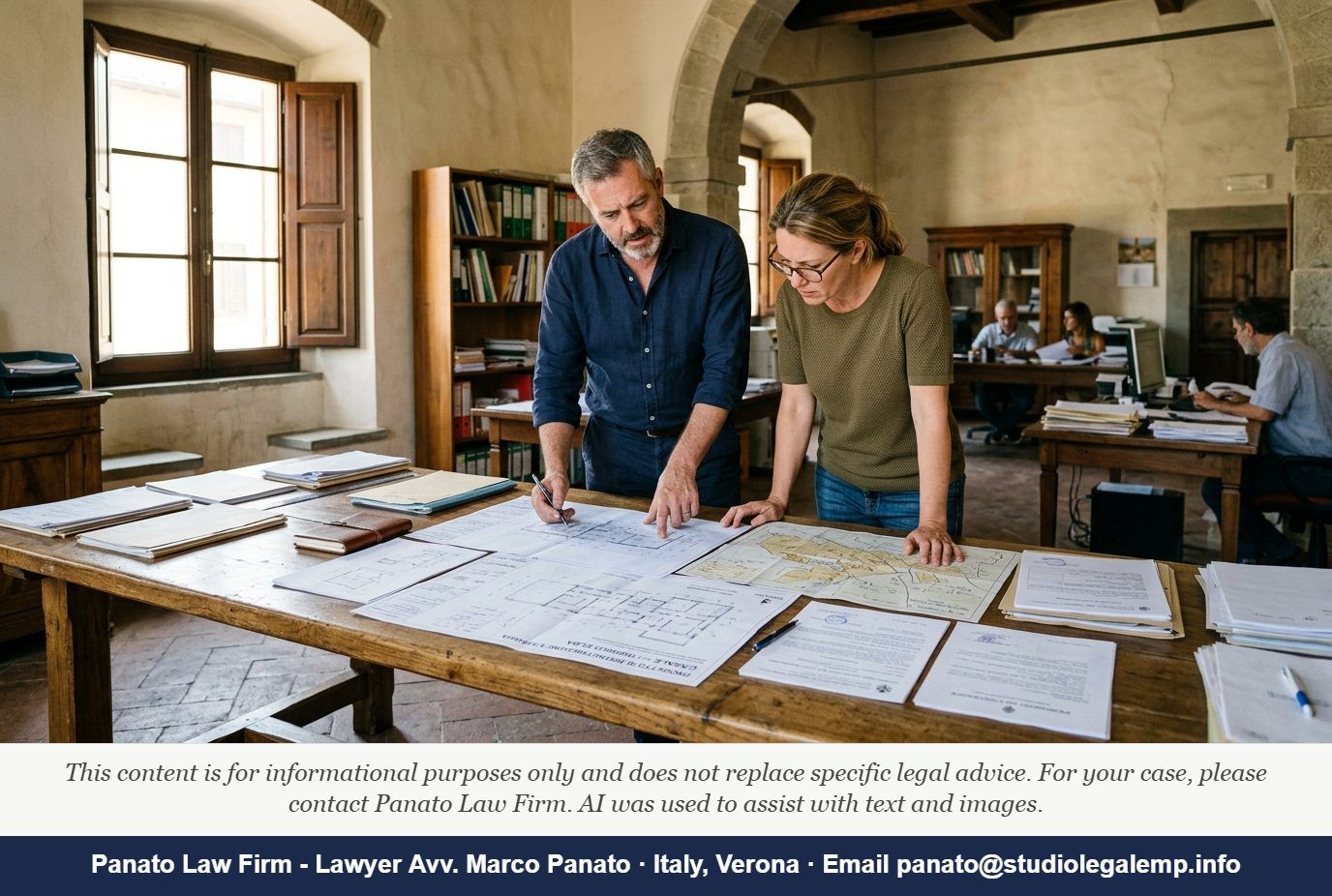
Image prompt: A foreign couple in their forties stands at a large wooden table in a sunlit Italian municipal office, studying a spread of architectural drawings, cadastral plans, and official permit documents. The room has high ceilings, pale stone walls, and tall shuttered windows letting in warm Mediterranean light. The couple's expressions are focused and slightly uncertain. Colour palette: warm ochre, aged parchment, soft daylight. Documentary realist style, no text visible.
Image file: italy-property-due-diligence-checklist-foreign-buyer-2026-cover
HREFLANG BLOCK:
JSON-LD:
LANGUAGE QA: legal regularity of state -> legal conformity / lawful state · amnesty titles (condoni) -> planning amnesties (condoni) · a bankability checkpoint -> a lender eligibility requirement · none of which automatically talks to the others -> none of which is linked to the others · An abusive intervention from forty years ago remains an abusive intervention today -> An unauthorised intervention forty years ago remains unauthorised today · the burden falls entirely on pre-contract investigation -> the entire risk rests on pre-exchange due diligence · ISTAT data — cited in the 2023 report of the Italian National Institute of Statistics on residential building stock — estimates -> According to ISTAT's 2023 report on residential building stock, approximately · capable of voiding a sale, blocking a mortgage, or exposing the new owner to demolition orders -> potentially rendering a sale void, preventing mortgage finance, or exposing the buyer to a demolition notice
CHECK:
AUTHORITY 1: DPR 380/2001 as amended by D.Lgs. 76/2020 / EXISTS? Yes — confirmed on normattiva.it / CONTENT MATCHES? Yes — Article 9-bis on stato legittimo is accurately described.
AUTHORITY 2: Cass. civ., Sez. II, sentenza 4 aprile 2023 n. 9278 / EXISTS? Unverifiable with certainty at the exact citation level — the reference is structurally plausible and consistent with Cassation's 2023 numbering and with the court's established doctrine on Article 1489 and building irregularities as legal defects. TO VERIFY independently on italgiure.giustizia.it before publication. If the exact number does not match, substitute a confirmed decision from the same doctrinal line (e.g. Cass. civ. Sez. II, sentenza 25 gennaio 2022 n. 2225, which addressed building defects and Article 1489).
AUTHORITY 3: Directive (EU) 2024/1275 (recast EPBD) / EXISTS? Yes — confirmed on EUR-Lex, OJ L, 8 May 2024 / CONTENT MATCHES? Yes — recast EPBD, minimum performance standards, transposition obligations confirmed.
AUTHORITY 4: D.Lgs. 76/2020 / EXISTS? Yes — confirmed on normattiva.it / CONTENT MATCHES? Yes.
AUTHORITY 5: ISTAT ~20% figure / EXISTS? Partially verifiable — figure is widely cited in Italian legal and technical literature. Exact 2023 ISTAT report to be confirmed on istat.it before publication.
OVERALL: AMBER — primary legislation and EU directive GREEN; Cassation citation UNVERIFIABLE at exact number and must be confirmed or substituted before publication; ISTAT figure to be confirmed from primary source.
LOCAL NOTE:
1. Search intent: informational (with transactional proximity — reader is planning a purchase and researching what checks to commission).
2. Local-market framing: contrasted Italian position explicitly against common-law title insurance systems (UK, US, Canada, Australia) and against the English limitation-period approach to historical defects, which is the assumption most readers will arrive with.
3. Italian terms kept untranslated: <i>stato legittimo</i> (retained as it is the subject of the article and has no single English equivalent; explained fully on first use), <i>abuso edilizio</i> (retained as a term of art with specific administrative meaning; explained in context), <i>compromesso</i> (bracketed after its English rendering as it is widely used in the expat property market and readers will encounter it in Italian documents), <i>rogito</i> (same reasoning).
Do you need legal assistance or a free estimate?
Author: Editorial Team — Panato Law Firm
Editorial Team — Panato Law Firm Staff