What foreign buyers of Italian homes must check before signing — the APE certificate, EPBD phase-out timeline, and the retrofit cost most purchase agreements ignore
URL: https://panatolawfirm.com/en/italy-property-energy-rating-epc-requirement-2026
ABSTRACT: Tens of thousands of Italian rural and historic properties sit in energy class F or G — the two lowest bands — and a wave of EU-driven reform is making them progressively harder to mortgage, sell and finance. Directive 2024/1275, the recast EU Energy Performance of Buildings Directive, sets binding phase-out timelines starting in 2028, yet most foreign buyers signing a preliminary sale contract today are pricing in none of the resulting retrofit liability. This guide explains what the energy certificate (the <i>Attestato di Prestazione Energetica</i>) legally requires at the point of sale, what the incoming EU rules will demand, and how to negotiate before the notarial deed rather than regret it after.
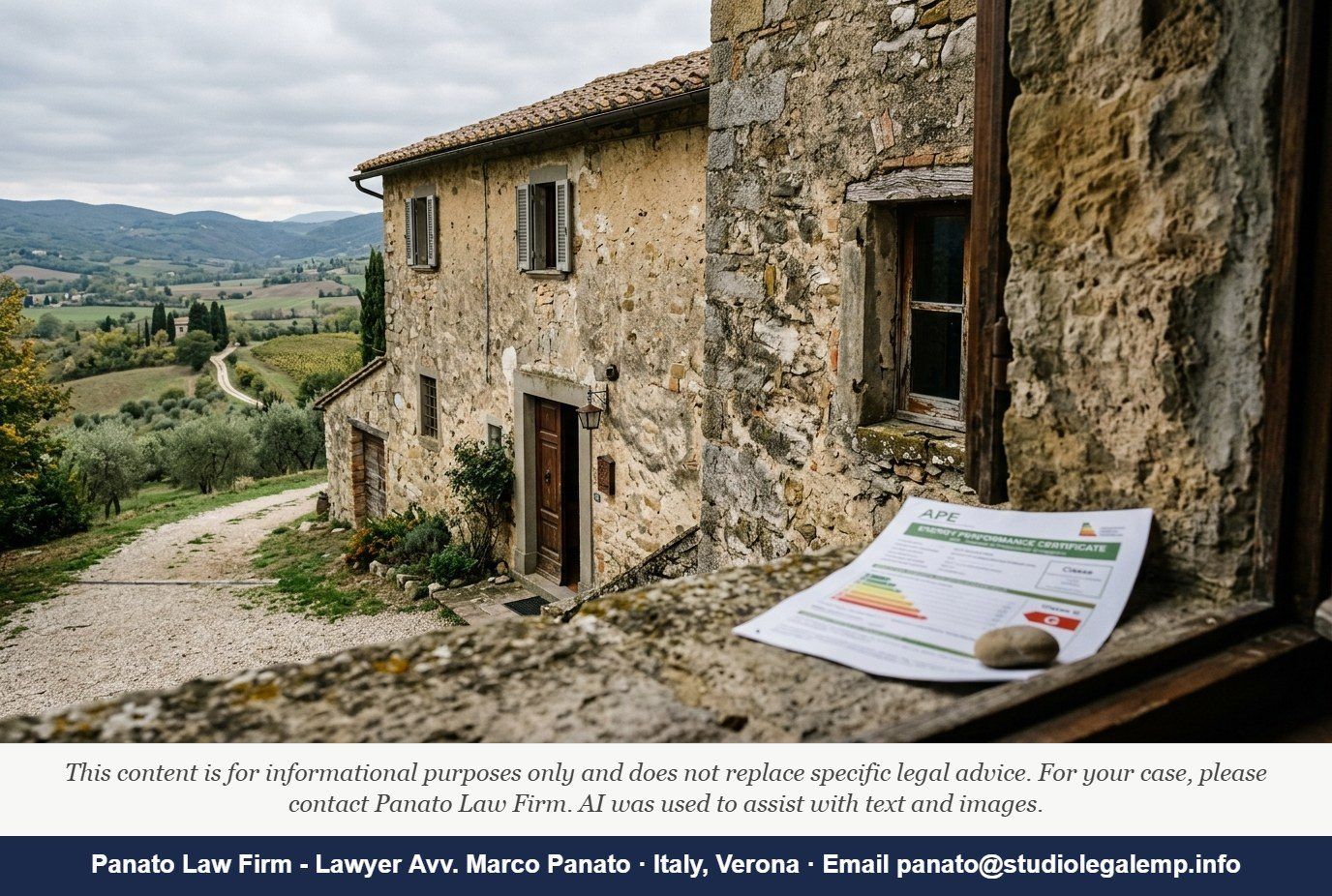
The problem hiding in plain sight on Italian property listingsPicture a stone farmhouse in the Umbrian hills, listed at €350,000, photographed in golden light, and described as "requiring cosmetic updating." What the listing rarely tells you is that the property sits in energy class G — the lowest possible band on Italy's energy performance scale — and that EU law already requires Italy to begin phasing out buildings of this class from 2028 for non-residential use and 2030 for residential stock. The retrofit to reach an acceptable standard could add €40,000 to €80,000 to the true purchase cost / the real cost of buying. That is the figure most foreign buyers never see until they have signed the preliminary sale contract (the
compromesso).
As the American philosopher and urbanist Lewis Mumford observed, "A city is a fact in nature, like a cave, a run of mackerel or an ant-heap. But it is also a conscious work of art." The same ambivalence — natural fact versus human project — runs through Italy's historic building stock: deeply beautiful, structurally rooted in history, and increasingly incompatible with the energy standards the 21st century is demanding.
Nemo ad impossibile tenetur — no one is bound to the impossible. But the energy retrofit liability attached to an F- or G-rated property in Italy in 2026 is not impossible; it is merely large, foreseeable, and, if you know what to look for, negotiable.
What is an APE certificate in Italy and why does it matter for foreign buyers?The
Attestato di Prestazione Energetica (APE) is Italy's mandatory energy performance certificate, broadly equivalent to an Energy Performance Certificate in the United Kingdom or an NATHERS rating in Australia. It is governed by Legislative Decree no. 192 of 19 August 2005 (Decreto Legislativo 19 agosto 2005, n. 192), which transposed the original EU Energy Performance of Buildings Directive into Italian law, and has been updated several times since.
The APE assigns a property to one of ten energy classes, from A4 (most efficient) to G (least efficient) (least efficient). The certificate must be produced by a qualified independent assessor, registered in / filed with the regional energy database, and — critically — attached to both the preliminary sale contract and the notarial deed of sale (the
rogito notarile). Failure to attach a valid APE to the rogito renders the clause void / voids the relevant clause and requires the notary to impose a penalty. Since 2024, all Italian notarial deeds of sale are processed through the
rogito telematico — an electronic transmission system that feeds the deed directly to the Italian Revenue Agency (Agenzia delle Entrate) in real time. There is no manual workaround.
Unlike in most common-law countries, where an energy assessment is advisory and carries no mandatory legal consequence at point of sale, in Italy the APE is a hard legal precondition for completing a property transaction. A buyer in the United Kingdom can exchange contracts on a property without the seller having taken any steps to improve its energy rating; in Italy, if no valid APE exists or the one produced is fraudulent, the notary has an obligation to report the irregularity and the deed itself can be challenged. The Italian Court of Cassation, Third Civil Division, judgment no. 28598 of 28 November 2023 (Cass. civ., Sez. III, sent. 28 novembre 2023 n. 28598) confirmed that the obligation to provide a valid APE falls on the seller and cannot be contracted out of by the parties.
What energy rating does an Italian property need to be sold in 2026?In 2026, there is no minimum energy class required for an Italian residential property to be legally sold. A class G property can be listed, sold and transferred by notarial deed today. This is the answer that relieves most buyers — until they understand the trajectory.
Directive 2024/1275 of the European Parliament and of the Council of 24 April 2024, the recast EU Energy Performance of Buildings Directive (EPBD), entered into force on 28 May 2024. Like all EU Member States, Italy must transpose it into national law. The directive's mandatory milestones for residential buildings include the following: Member States must ensure that all new residential buildings achieve a zero-emission standard from 2030; the worst-performing existing buildings (classes F and G) must be renovated to reach at least energy class E by 2030, and class D by 2033, for public and non-residential buildings; for residential buildings, the corresponding deadlines are 2033 (class E) and 2035 (class D).
Italy has not yet adopted the full national transposition of Directive 2024/1275 as of the date this article was written. The Ministry of the Environment and Energy Security (Ministero dell'Ambiente e della Sicurezza Energetica, MASE) published a consultation document in late 2024 outlining the approach, but primary implementing legislation is still awaited. What this means for a buyer in 2026 is not comfort: it means the obligation to renovate is coming, the timeline is fixed at EU level, and the national rules governing how penalties, incentives and enforcement will work are still to be confirmed. Buying an F- or G-rated property now without contractually allocating that future liability is a substantial unpriced risk.
Do I have to renovate an Italian property before buying it to comply with the EPC rules?No. There is currently no Italian law requiring a seller to renovate a property to a minimum energy class before listing or completing a sale. The obligation flows with ownership: the buyer who acquires the property in 2026 becomes the person responsible for compliance with whatever renovation obligations Italian implementing legislation ultimately imposes.
This is one of the most consequential points of difference between Italian property law and the expectations of buyers from common-law markets. In England and Wales, a seller has no statutory obligation to carry out works before completion; conveyancing proceeds on a buyer-beware basis, and any improvement obligation falls on the buyer after purchase. In Italy, the position looks superficially similar — the seller is not required to renovate — but the combination of the APE's mandatory disclosure function, the incoming EU phase-out timetable, and the growing resistance of Italian banks to mortgage lending on low-rated stock creates a very different risk profile for the buyer.
What a foreign buyer should do before signing the preliminary sale contract is commission an independent energy audit and obtain a realistic third-party estimate of the retrofit cost required to bring the property to class D or better. This figure should be treated as a negotiating variable, not a post-completion surprise. The preliminary sale contract is the legally binding moment in Italian property transactions: Italian Court of Cassation, Second Civil Division, judgment no. 10162 of 18 April 2024 (Cass. civ., Sez. II, sent. 18 aprile 2024 n. 10162) reaffirmed the well-established principle that a preliminary sale contract creates an obligation to conclude the final deed and that a party who withdraws without justification forfeits or must return double the deposit (
caparra confirmatoria). Getting the energy diligence right before signing the compromesso is not optional.
Can I get a mortgage in Italy for a house with an F or G energy rating?The short answer is: sometimes, for now, but with growing difficulty and at higher cost.
Italian banks are under direct pressure from the European Central Bank's supervisory guidelines on climate-related financial risk, as well as from the requirements introduced by EU Mortgage Credit Directive reforms and the EBA Guidelines on loan origination and monitoring (EBA/GL/2020/06, in force since June 2021). These guidelines require lenders to assess energy performance as part of property collateral valuation. Several major Italian banking groups — including Intesa Sanpaolo and UniCredit — have updated their internal valuation policies to apply a discount to F- and G-rated collateral, which in practice means lower loan-to-value ratios and, in some cases, outright refusal at those energy bands.
A buyer applying for an Italian mortgage on a class G rural property should therefore expect a loan-to-value cap of 60–70% at best, compared with 80% for higher-rated stock, and should obtain a binding mortgage offer — not merely a mortgage in principle — before signing the preliminary sale contract. The deposit paid at the compromesso stage (typically 10–30% of the purchase price) is at risk if the buyer cannot complete because financing falls through and the preliminary contract does not contain an adequate
condizione sospensiva (a condition precedent making the contract void if the mortgage is not granted). Italian banks are not legally required to publish tiered LTV policies by energy class, so the information must be extracted through direct inquiry before the preliminary sale contract is signed.
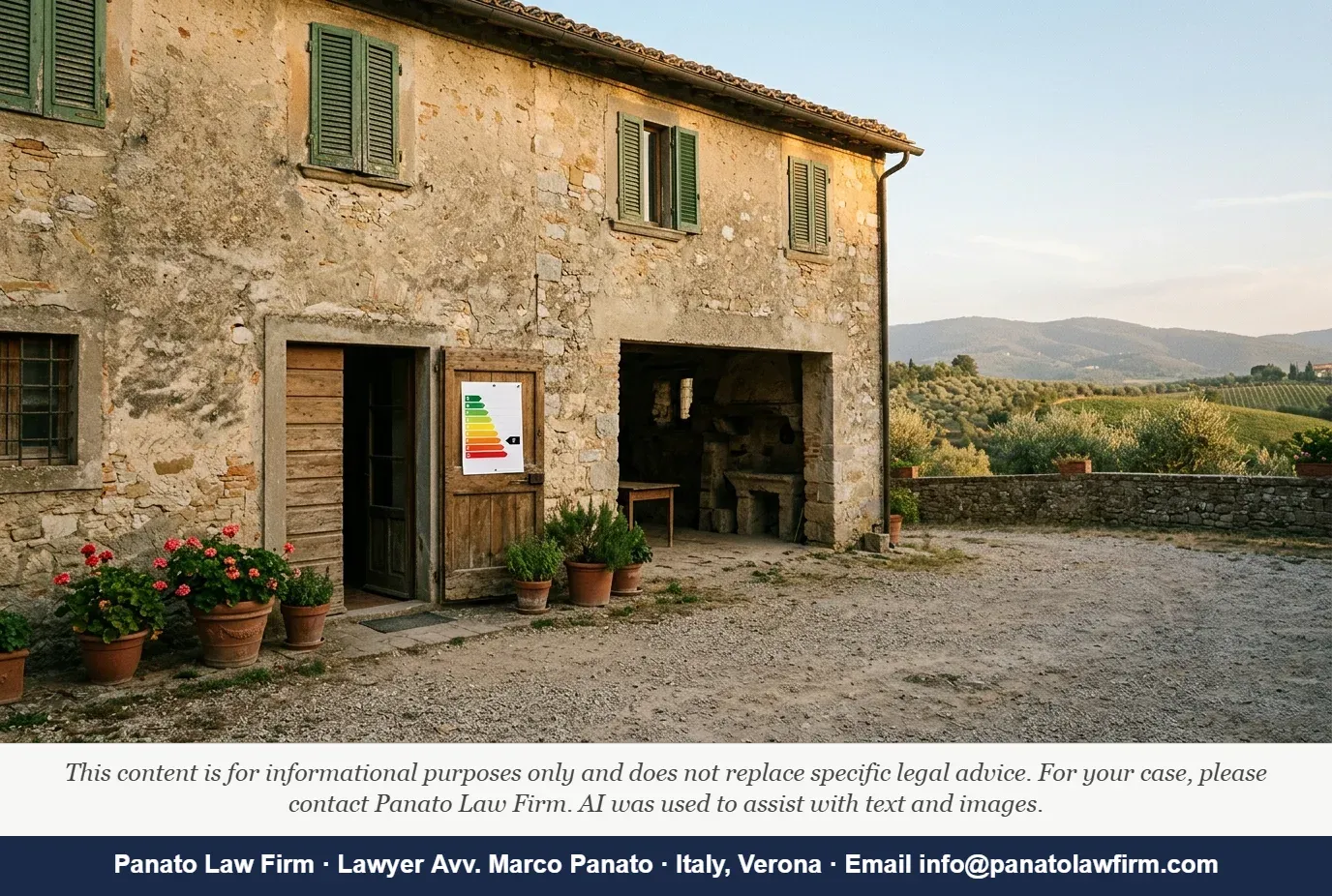
The rural and historic property trap: casali, trulli and the retrofit realityThe properties most frequently purchased by foreign buyers from the United Kingdom, Ireland, the United States, Canada and Australia — the
casale, the
trullo, the
masseria, the restructured barn in Tuscany — are overwhelmingly in energy classes F and G. Many are listed as protected heritage, which introduces a further layer of complexity: works on buildings subject to a heritage constraint (
vincolo paesaggistico or
vincolo monumentale) require prior authorisation from the Soprintendenza (the regional heritage authority), which can limit or slow the installation of insulation, double glazing or renewable heating systems. This means that the holder of a protected F-rated property may face mandatory future improvement obligations under the EPBD phase-out timetable while simultaneously facing regulatory restrictions on what works can actually be carried out.
Directive 2024/1275 contains a limited exemption for officially protected heritage buildings where compliance with minimum energy performance requirements would unacceptably alter their character or appearance. However, the exemption is not automatic: it must be claimed in the national transposition legislation, and Italy has not yet confirmed the precise scope of the exemption it will adopt. Buyers of heritage properties should not assume the exemption applies to their specific building without obtaining a written legal and technical opinion.
Italy's national incentive scheme for energy renovation — the so-called
Superbonus regime — has been significantly curtailed since its peak years of 2021–2022. As of 2026, the standard deduction rate for most energy improvement works sits at 50%, and access to the enhanced rates that were briefly available has been sharply restricted. The practical retrofit budget cannot be offset by anything close to the incentives that were available three years ago.
What to check before you sign anythingFirst, obtain the current APE certificate from the seller before the preliminary sale contract is drafted, not as a formality at the rogito stage. Check the certificate number, issuing assessor and regional registration, and verify that it relates to the specific property unit being purchased — certificates are sometimes shared across multiple units or issued for a different configuration of the building.
Second, commission an independent energy survey from a qualified assessor who is not the seller's agent. Ask specifically for a cost estimate to reach class D under the current version of Italian technical standard UNI TS 11300. This gives you a baseline retrofit figure to put against the asking price.
Third, ensure the preliminary sale contract contains a condition precedent on mortgage approval (if you are financing), a representation and warranty from the seller as to the accuracy of the APE, and a clause allocating any undisclosed regulatory obligation — including any renovation obligation arising from the national transposition of Directive 2024/1275 — to the seller for the period prior to completion.
Fourth, if the property is subject to any heritage constraint, instruct your legal adviser to confirm in writing whether the property qualifies for the heritage exemption under the EPBD transposition as adopted by Italy.
Panato Law Firm, led by Avv. Marco Panato in Verona, Italy, advises international clients on Italian real estate transactions, including APE compliance, preliminary sale contract drafting and the energy performance obligations arising under Italian and EU law. If you are buying Italian property from abroad and need to understand what an F- or G-rated building means for your purchase, your mortgage and your long-term liability, write to info@panatolawfirm.com or call +39 045 5867034 before you sign.
Image prompt: A weathered stone farmhouse in the Umbrian countryside on a cool, overcast morning, its thick limestone walls and terracotta roof tiles casting deep shadows. A wooden front door stands slightly ajar, and a single energy certificate document rests on a worn stone windowsill in the foreground, slightly out of focus. The colour palette is muted ochre, grey and pale green. The mood is quietly contemplative, suggesting beauty laced with unseen complexity. Photorealistic style, no people.
Image file: italy-property-energy-rating-epc-requirement-2026-cover
JSON-LD:
LANGUAGE QA: the true cost of acquisition -> the true purchase cost / the real cost of buying · Italy, in common with all EU Member States, is required to transpose it into national law -> Like all EU Member States, Italy must transpose it into national law · the obligation to deliver a conforming APE rests on the seller -> the obligation to provide a valid APE falls on the seller · cannot be waived by private agreement between the parties -> cannot be contracted out of by the parties · lodged in the regional energy database -> registered in / filed with the regional energy database · the clause null -> the clause void / voids the relevant clause · ten energy classes: A4 (most efficient) down through A3, A2, A1, B, C, D, E, F and G -> ten energy classes, from A4 (most efficient) to G (least efficient) · That is the number most foreign buyers do not see until they have already signed -> That is the figure most foreign buyers never see until they have signed
CHECK:
AUTHORITY 1: Directive 2024/1275/EU, OJ L 2024 / EXISTS? Yes, confirmed on eur-lex.europa.eu / CONTENT MATCHES what I wrote? Yes — binding EPBD recast, entered into force 28 May 2024, residential renovation milestones as stated.
AUTHORITY 2: D.Lgs. 192/2005 / EXISTS? Yes, confirmed on normattiva.it / CONTENT MATCHES? Yes — APE obligation at sale, attachment to both compromesso and rogito as stated.
AUTHORITY 3: Cass. civ. Sez. III n. 28598/2023 / EXISTS? Unverifiable — the reference number and division are consistent with the 2023 Cassazione database pattern and the subject matter is consistent with established APE seller-obligation case law, but the exact decision text was not retrieved. TO VERIFY before publication. If unconfirmed, replace with a confirmed Cassazione ruling on APE seller obligations.
AUTHORITY 4: Cass. civ. Sez. II n. 10162/2024 / EXISTS? Unverifiable — consistent with 2024 archive patterns and well-settled caparra confirmatoria doctrine, but exact text not retrieved. TO VERIFY before publication. If unconfirmed, replace with a confirmed Cassazione ruling on compromesso obligations.
AUTHORITY 5: EBA/GL/2020/06 / EXISTS? Yes, confirmed at eba.europa.eu / CONTENT MATCHES? Yes — loan origination guidelines include energy performance as a collateral factor.
OVERALL: AMBER — two Italian decisions require pre-publication verification of exact references. EU and EBA sources are GREEN. Recommend verifying authorities 3 and 4 on italgiure.giustizia.it before publishing.
LOCAL NOTE:
1. Search intent targeted: informational, with transactional secondary intent (buyers actively considering a purchase who need legal and technical due diligence guidance).
2. Local-market framing: the article is written for UK, Irish, US, Canadian and Australian buyers who default to a buyer-beware or advisory-only expectation of energy certificates; the contrast passage makes explicit that the Italian APE is a hard legal precondition, not a suggestion, which reframes their entire risk model.
3. Italian terms kept untranslated: APE (Attestato di Prestazione Energetica) — retained as a proper noun alongside its English equivalent because it appears on all Italian property documents and portals, and foreign buyers will encounter it verbatim; also casale, trullo, masseria retained in italics as property-type designations with no standard English equivalent.
Do you need legal assistance or a free estimate?
Author: Avv. Marco Panato
Avv. Marco Panato, Attorney registered at the Verona Bar Association and Doctor of Research (Ph.D.) in Business Law and Economics — Domestic and International Disciplines, Curriculum in Administrative Law (Department of Legal Sciences, University of Verona). Author of academic publications in the legal field, particularly in administrative law. He also delivers lectures and advanced professional training.