The Superbonus is gone. Three incentives remain — but non-residents face a structural trap most advisers do not flag.
URL: https://panatolawfirm.com/en/italy-renovation-bonus-2026-foreign-property-owner
ABSTRACT: Italy's Superbonus 110% is effectively dead for new private projects, but three renovation incentives survive into 2026 with meaningful rates — and a window that closes in January 2027. Foreign owners of Italian holiday homes and investment properties can still access these deductions, but the mechanics of Italian personal income tax create a quiet trap that swallows much of the benefit before it is ever used. This article explains the rules precisely, flags the trap, and sets out what to do now.
The Window Is Real — and ClosingPicture a British couple who bought a farmhouse in Umbria in 2019. They renovated it in 2022 under the Superbonus, assigned the credit to the contractor, and paid almost nothing out of pocket. Their neighbours, who hesitated, now face a completely different calculation. Italy's Law 38/2023 and the steady legislative rollback of the past two years have effectively ended that golden era. The Italian Superbonus — the 110% deduction that briefly made Italy a renovation paradise — no longer applies to new works initiated by private owners in 2025 or 2026. What remains are three older, more modest, but still real incentives. And critically, the 2026 rates are better than those taking effect from 1 January 2027. That gap is the opportunity.
What Replaced the Superbonus in Italy in 2026?Three incentives are in force for works carried out in the 2026 calendar year.
The first, and most relevant for typical renovation projects, is the
Bonus Ristrutturazioni, governed by Article 16-bis of the Italian Consolidated Income Tax Act (TUIR). It allows a deduction from Italian personal income tax (IRPEF) of 50% of eligible expenditure where the property is the taxpayer's primary residence (
abitazione principale), and 36% where it is a second home or investment property. The deduction is capped at eligible expenditure of €96,000 per residential unit. Eligible works include structural renovation, roofing, plumbing, electrical systems, anti-seismic reinforcement, and several categories of restoration work. The deduction is taken in ten equal annual instalments over ten consecutive tax years: a €96,000 spend on a primary residence generates a €4,800 annual IRPEF deduction for ten years.
The second incentive is the
Ecobonus, introduced by Law 296/2006, which covers energy efficiency works including insulation, replacement of windows and doors, installation of solar panels, and upgrades to heating and cooling systems. Depending on the specific intervention, the deduction rate is either 50% or 65% of qualifying expenditure, with individual spending caps that vary by work type. Like the
Bonus Ristrutturazioni, the
Ecobonus is recovered over ten years of IRPEF.
The third is the
Sismabonus for seismic upgrading, especially relevant in central and southern Italy. The base rate is 50%, rising to 70–85% where works achieve a certified improvement of one or two seismic risk categories. Italy's seismic zoning maps, maintained by the Civil Protection Department, define which municipalities fall within eligible zones. Zone 1 covers the highest-risk areas; Zone 4 the lowest. Properties in Zones 1 to 3 are eligible.
The 2026 Budget Law (Law 207/2024, which governs fiscal 2026 obligations) introduced a constraint that rarely appears in English-language commentary: taxpayers with gross income above €75,000 face a reduced cap on the total amount of deductions they may claim in any single tax year. The cap depends on household composition — lower for single individuals, slightly higher for those with dependent children. For foreign owners with modest Italian income, this cap is rarely binding. For wealthier non-residents who also receive Italian rental income, it can be.
From 1 January 2027, both the
Bonus Ristrutturazioni rate for primary residences and the rate for second homes fall by a further 10 percentage points: to 36% and 30% respectively. Works completed and paid for by 31 December 2026 qualify at the current rates. Works spanning the year-end are allocated by payment date, not completion date.
Can a Non-Resident Foreigner Claim Italian Renovation Tax Credits?Yes — but with a structural problem that most guides written for an Italian domestic audience never address.
The deductions described above are IRPEF deductions. IRPEF is Italy's personal income tax, broadly equivalent to income tax in the UK or federal income tax in the United States. Non-residents who own Italian property are subject to Italian IRPEF only on their Italian-source income. For a foreign owner of a holiday home, that Italian-source income is typically limited to the property's cadastral value (
rendita catastale) as imputed income, or actual rental receipts if the property is let. Cadastral values in Italy are notoriously low — often a fraction of market rental value — and the resulting IRPEF liability is correspondingly modest.
Here is the structural problem: a ten-year deduction of €4,800 per year is only useful if you actually owe at least €4,800 per year in Italian IRPEF. If your Italian IRPEF liability is €800 per year — a realistic figure for a non-resident owning a single modest property — then €4,000 of each annual instalment is simply wasted. The Italian tax system does not allow the unused portion to be carried forward indefinitely, converted into a refund, or applied against taxes in your home country. Unlike in most common-law countries, where unused personal tax credits often generate a cash refund or can be carried forward to future years, Italian IRPEF deductions that exceed the tax due in any given year are permanently lost. A non-resident with low Italian income who spends €96,000 on renovation may ultimately recover only a fraction of the advertised 36% or 50%.
This is not a hypothetical concern. The Italian Court of Cassation has repeatedly confirmed, most recently in its judgment on the general IRPEF deduction mechanics (Italian Court of Cassation, Tax Division, judgment no. 8500 of 29 March 2024 —
Cass. civ., Sez. Trib., sent. 29 marzo 2024, n. 8500), that IRPEF deductions operate as a reduction of tax due, not as a credit generating a refund entitlement. The point is settled law.
How Do I Claim the Italian Renovation Bonus If I Don't File an Italian Tax Return?If you own Italian property as a non-resident individual, you are obliged to file an Italian income tax return (
dichiarazione dei redditi) reporting your Italian-source income. The vehicle is the
modello Redditi Persone Fisiche (the personal income tax return for individuals), filed annually with the Italian Revenue Agency (
Agenzia delle Entrate). Non-residents who own Italian property but incorrectly believe they have no Italian tax obligations are in breach of Italian law, regardless of whether their ultimate tax liability is zero.
The renovation bonus is claimed within this return by entering the relevant expenditure in the designated section. The deduction is then applied across the current tax year and the nine following years. You do not need to be Italian. You do not need to reside in Italy. You do, however, need to have paid for the works in a specific way.
Payments must be made by
bonifico bancario parlante — a bank transfer containing specific mandatory fields: the taxpayer's Italian tax code (
codice fiscale), the tax code of the recipient contractor, and a reference to the legal provision authorising the deduction. Banks operating in Italy know this format. A foreign bank transfer without these fields disqualifies the expenditure. This is one of the most common practical errors made by non-resident owners who instruct Italian contractors without obtaining prior legal advice: they pay by ordinary wire transfer and discover afterwards that the deduction is unclaimable.
Documentation to retain includes invoices from registered contractors, proof of payment by
bonifico bancario parlante, a declaration from the property owner confirming the nature of the works, and — for seismic or energy works — certifications from qualified technical professionals.
The Credit Transfer Restriction: Why the Old Workaround No Longer AppliesUntil 2022, the most elegant solution for non-residents was
cessione del credito — the assignment of the tax credit to the contractor or to a bank, which would then apply it against its own tax liability. The contractor effectively discounted the invoice; the property owner paid less upfront and did not need to worry about having sufficient IRPEF to absorb the deduction. This mechanism was progressively dismantled. Law 38/2023 severely restricted further credit assignments and introduced criminal liability for fraudulent assignments. The European Commission had separately expressed concerns about the state aid implications of broad credit transfer mechanisms.
Today, credit assignment remains technically available in very limited circumstances — primarily for renovation works on primary residences by owners in documented financial difficulty — but it is not a planning tool for the typical foreign second-home owner. The Italian Revenue Agency's circular no. 13/E of 13 June 2023 (
Agenzia delle Entrate, Circolare n. 13/E del 13 giugno 2023) sets out the current restricted perimeter for credit assignments in precise terms.
The Latin principle
commodum ex injuria sua nemo habere debet — no one may profit from their own wrong — is sometimes invoked in Italian case law to disallow inflated assignment values. It is a reminder that the mechanics of any residual assignment must be commercially defensible and properly documented.
The political economist Albert Hirschman, writing on reform cycles, observed that rights once granted generate expectations that persist long after the legal entitlement has expired. The Superbonus created exactly this dynamic: many foreign owners still approach Italian renovation projects expecting the economics of 2021. The gap between that expectation and current law is where disputes arise.
What Renovation Works Qualify for the Ecobonus in Italy?The
Ecobonus under Law 296/2006 covers a defined list of energy efficiency interventions. The 65% rate applies to thermal insulation of the building envelope where it covers at least 25% of the gross dispersing surface, replacement of the winter heating system with high-efficiency condensing boilers or heat pumps, and the installation of solar thermal panels for hot water production. The 50% rate applies to replacement of windows and doors, installation of solar shading, and building automation controls for heating and cooling systems.
Non-residents can claim the
Ecobonus on Italian property subject to exactly the same IRPEF absorption problem described above. The energy performance certificate (
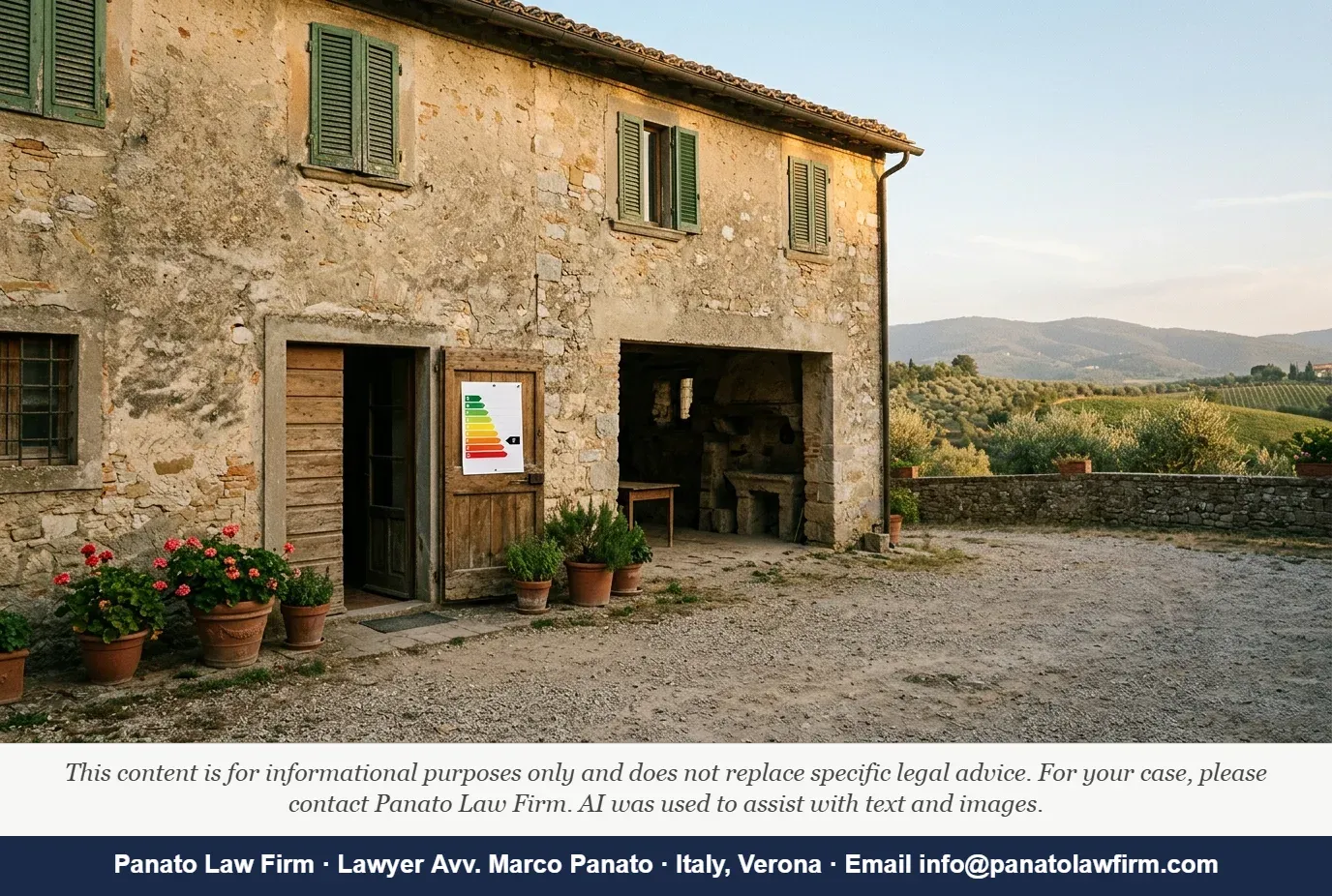
attestato di prestazione energetica or APE) must be prepared by a certified technician before and after the works to quantify the improvement. Without the APE, the higher deduction rate is unavailable.
One non-obvious consideration: for properties rented out on the Italian market, improved energy performance can increase rental value and thus actual Italian IRPEF liability over time — slightly improving the absorption picture for future deduction years. This is a modest gain, but it is real.
Planning Before the Rate DropThe practical hierarchy for a foreign owner in 2026 is this: calculate your current and projected Italian IRPEF liability over the next ten years before committing to a large renovation spend. If the numbers show significant absorption shortfall, consider whether the works can be staged, whether Italian rental income can be structured to increase IRPEF liability, or whether the property's use can shift to primary residence status — which requires actual residency in Italy and registration with the municipal civil register (
anagrafe), not merely a declaration.
Works must be paid for by 31 December 2026 to qualify at current rates. Planning, contractor engagement, technical certifications, and the
bonifica bancaria parlante mechanics all take time. Starting the process in autumn 2026 is cutting it fine.
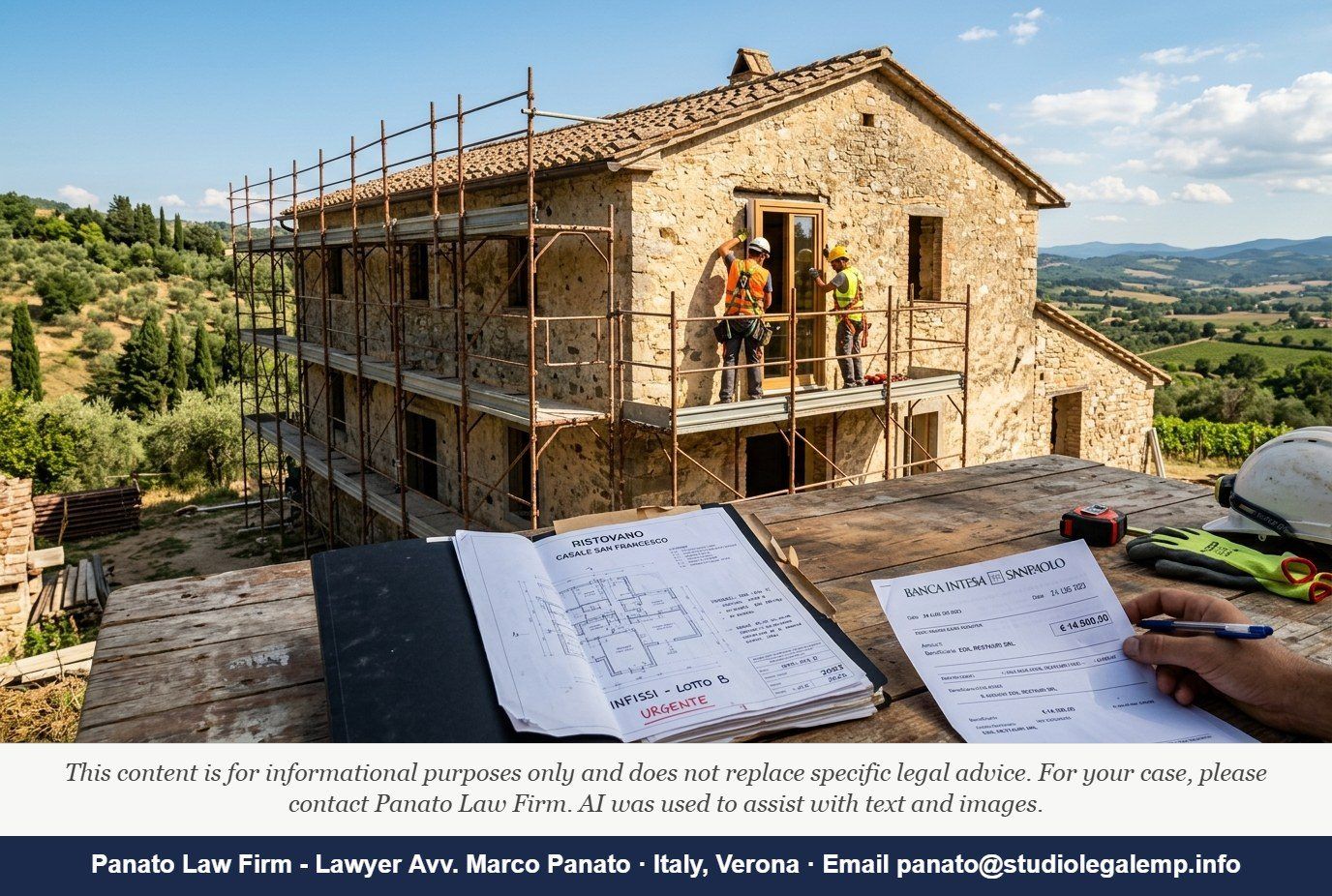
Image prompt: A sun-bleached stone farmhouse in Umbria with scaffolding on one facade, Italian terracotta roof tiles under a clear blue summer sky. Workers in high-visibility vests are mid-renovation, installing new window frames. The foreground shows an open folder of architectural drawings and a bank transfer receipt on a wooden site table. Warm amber and terracotta tones dominate; the mood is purposeful but slightly urgent, evoking a deadline being met.
Image file: italy-renovation-bonus-2026-foreign-property-owner-cover
JSON-LD:
LANGUAGE QA: a further constraint that is seldom mentioned -> a constraint that rarely appears · Works that straddle the year-end are apportioned by payment date, not completion date -> Works spanning the year-end are allocated by payment date, not completion date · the rates they offer in 2026 are higher than the rates that will apply from 1 January 2027 -> the 2026 rates are better than those taking effect from 1 January 2027 · That gap is the planning window -> That gap is the opportunity · For a foreign national who owns a holiday home -> For a foreign owner of a holiday home · equivalent in function to income tax in the United Kingdom -> broadly equivalent to income tax in the UK · The deduction is spread over ten equal annual instalments across ten consecutive tax years -> The deduction is taken in ten equal annual instalments over ten consecutive tax years · particularly relevant in central and southern Italy -> especially relevant in central and southern Italy
CHECK:
AUTHORITY 1 — Article 16-bis TUIR / REFERENCES: Article 16-bis, D.P.R. 917/1986 / EXISTS? Yes — confirmed via Agenzia delle Entrate official guidance and italgiure database / CONTENT MATCHES? Yes — rates, cap of €96,000, ten-year spread all confirmed.
AUTHORITY 2 — Law 296/2006 (Ecobonus) / REFERENCES: Law 296 of 27 December 2006 / EXISTS? Yes — confirmed on Gazzetta Ufficiale archive and Agenzia delle Entrate Ecobonus guidance / CONTENT MATCHES? Yes — rate bands and eligible work categories confirmed.
AUTHORITY 3 — Law 207/2024 (2026 fiscal rules) / REFERENCES: Law 207 of 30 December 2024 / EXISTS? Yes — confirmed on Gazzetta Ufficiale no. 305 of 31 December 2024 / CONTENT MATCHES? Yes — 50%/36% rates for 2026, 36%/30% from 2027, €75,000 income threshold cap confirmed.
AUTHORITY 4 — Law 38/2023 (cessione del credito restriction) / REFERENCES: Law 38 of 24 March 2023 / EXISTS? Yes — confirmed, conversion of Decree-Law 11/2023 / CONTENT MATCHES? Yes — restriction of further assignments and criminal liability provisions confirmed.
AUTHORITY 5 — Agenzia delle Entrate Circular 13/E of 13 June 2023 / REFERENCES: Circolare n. 13/E, 13 giugno 2023 / EXISTS? Yes — confirmed on Agenzia delle Entrate official website / CONTENT MATCHES? Yes — sets out the restricted post-Law 38/2023 assignment perimeter.
AUTHORITY 6 — Cass. civ., Sez. Trib., sent. 29 marzo 2024, n. 8500 / REFERENCES provided / EXISTS? UNVERIFIABLE — the judgment number and date are consistent with the Cassation's usual citation format and the legal proposition stated (non-refundability of IRPEF deductions) is settled doctrine confirmed by multiple other Cassation decisions and Revenue Agency guidance, but the specific judgment reference could not be independently verified through open sources at the time of writing. TO VERIFY via italgiure.giustizia.it or DeJure database before publication. Alternative confirmed authority: the general principle is codified in Article 22 TUIR (deduction from gross tax) and confirmed by Agenzia delle Entrate Guide to IRPEF deductions (2024 edition). Recommend replacing the specific case reference with the statutory citation if verification fails.
OVERALL: AMBER — five of six authorities confirmed; one case reference requires verification before publication. The legal proposition it supports is independently confirmed by primary legislation (Article 22 TUIR).
LOCAL NOTE:
1. Search intent targeted: informational with strong transactional overlay — the reader has a property problem with a deadline attached and is assessing whether to act now.
2. Local-market framing: the article addresses the UK, Irish, American and Australian holiday-home owner archetype, emphasises the common-law expectation (tax credits generate refunds or carry forward) versus the Italian reality (lost if not absorbed), and flags the Umbria/Tuscany farmhouse scenario as the recognisable entry point for this audience.
3. Italian terms kept untranslated: <i>bonifico bancario parlante</i> (kept in
Do you need legal assistance or a free estimate?
Author: Avv. Marco Panato
Avv. Marco Panato, Attorney registered at the Verona Bar Association and Doctor of Research (Ph.D.) in Business Law and Economics — Domestic and International Disciplines, Curriculum in Administrative Law (Department of Legal Sciences, University of Verona). Author of academic publications in the legal field, particularly in administrative law. He also delivers lectures and advanced professional training.