Why the police visit after your anagrafe application matters more than the paperwork — and what to do before you book that flight home
#182 · LANG: English (en) · AREA: Residency, Citizenship & Relocation · TYPE: Short practical tip · MODEL: Sonnet 5 · SEO 84/100 · Flesch Reading Ease 39 · fonte: 01_ENG_PT_batch_articles_16items_2026-08-14_h10-02_vulm.doc
URL: https://panatolawfirm.com/en/italy-residency-registration-foreign-nationals-45-day-trap
ABSTRACT: Submitting your residency application to an Italian municipal registry office is only the beginning. A mandatory police verification visit within the following 45 days can nullify the entire process if you are not physically present at the address you declared. This guide explains how the Italian civil-registration system works, what foreign nationals most commonly get wrong, and why the distinction between registry residency and tax residency can have costly consequences.
You filed the paperwork. You handed over the lease, the passport, the permit. The desk officer stamped your application and handed you a receipt. You assumed you were done.
You were not. You had, in fact, just started a 45-day window that could silently erase everything you thought you had achieved — and if you spent those weeks travelling, visiting family abroad, or staying in a hotel while your flat was being renovated, you may find your application cancelled without a single letter arriving in time to warn you.
This is the detail that almost nobody explains before you move to Italy, and it is the one that matters most.
What the anagrafe actually is — and why it is not optionalThe
Anagrafe della Popolazione Residente is the official civil registry of individuals who have established their residence within the jurisdiction of an Italian municipality (
comune). It records all residents, Italian citizens and foreign nationals alike, and it is the backbone of Italy's administrative system — used for everything from healthcare access to voting rights.
When a person lives in Italy, Italian law requires them to register with this registry. The rule applies to everyone, regardless of citizenship. EU citizens must register if they stay for more than 90 days. It is equally mandatory for non-EU citizens holding a residence permit valid for more than three months who are planning to live permanently in Italy.
The legal basis sits in Presidential Decree No. 223 of 30 May 1989 (
DPR 223/1989), which governs how local registrars collect, update and verify population data — including the verification procedures that catch so many foreign arrivals off guard.
Unlike in most common-law countries — where a change of address is self-declared to a tax authority, an electoral register, or a government portal and is taken at face value — Italy sends a state official to your front door. Physical presence is the proof. A form is not enough.
The 45-day police check: the step everyone glosses overShortly after you submit your residency application, the relevant office issues a formal receipt called a
comunicazione di avvio del procedimento anagrafico. This document does not confirm the conclusion of the process; it confirms only that verification has just started.
Within the following 45 days, local police verify that you actually reside at the declared address. If no objections are raised, the registration is confirmed under the principle of tacit consent. That principle derives from Article 20 of Law No. 241/1990, Italy's general administrative procedure statute: silence, once the window closes with no objection, equals approval.
The practical consequence is stark. Once you submit your application, there is a 45-day window in which the municipality may send clerks or municipal police (
polizia municipale) to verify that you and your family are physically living at the declared residence. Failure to be present when they visit may result in your registration being rejected, forcing you to restart the process.
You generally need to be home when the officers call. However, practice varies widely across the country, and some municipalities no longer make verification visits or do so on a random basis. That unpredictability is precisely the problem: you cannot know which approach your
comune takes until the officer does or does not appear at your door.
Being consistently absent from the address during the verification period is a red flag that can lead to denial. And denial means beginning again — new documents, new queue, new 45-day window.
The non-EU path: an extra layer of sequencingFor non-EU nationals, the process adds a constraint EU citizens are spared. Non-European citizens often ask whether residency registration and a residence permit are the same thing. The two procedures are separate. Obtaining the permit does not automatically include registering residence in Italy, and residency registration does not guarantee the residence permit.
Non-EU citizens generally have to wait for the residence permit to be issued before sending the anagrafe application. Attempting to register without it will typically result in the municipality declining the application. So the sequence matters: permit first, then residency — but the 45-day verification clock starts ticking the moment you file the registry application, not the moment you receive your permitt.
There is also a renewal obligation that catches long-term residents unawares. Each time non-EU citizens renew their residence permit, they must also attend the registry office to renew the declaration of habitual residence within 60 days of that renewal. Failure to do so results in deletion from the registry. If you fail to renew your declaration, six months after the expiry of your permit you will receive a 30-day notice to comply. If you do not comply within those 30 days, the registry cancels your registration entirely.
The tax-residency trap: when your anagrafe registration lies to the authoritiesHere is the non-obvious risk that most relocation guides omit entirely.
Registry residency and tax residency are not the same thing. When they do not neatly overlap, costly consequences follow — audits and unsubstantiated tax claims.
Under Article 2 of the
Testo Unico delle Imposte sui Redditi (TUIR), Italy's consolidated income tax code, an individual is considered an Italian tax resident if, for more than 182 days of the tax year, they meet at least one of three criteria: registration at the
Anagrafe della Popolazione Residente, habitual residence in Italy, or the location of their centre of vital interests (professional, economic, and personal ties) in Italy.
The critical word is "or". You can be unregistered at the anagrafe and still be treated as an Italian tax resident if your economic or personal centre of gravity remains in Italy. Conversely, you can remain registered — perhaps because you forgot to cancel your registration when you left Italy — and face a presumption of Italian tax residency for a year in which you genuinely lived abroad. The Italian Court of Cassation has consistently reinforced that substance prevails over form: the tax authorities must still demonstrate that the individual had either their habitual residence or their centre of interests in Italy, even in the absence of anagrafe registration.
This has a direct consequence for foreign nationals arriving in Italy. Your registration date at the anagrafe fixes the formal start of your Italian residency for tax purposes. After the municipality completes its checks and verifications, you will be deemed registered as resident from the date of application, or the following day. That date is fundamental for tax purposes — keep the municipality's correspondence confirming it.
What to do, in what order, and what to avoidThe practical checklist runs as follows. Before you apply, secure accommodation under a genuine lease or ownership title — a hotel address or a short-let holiday rental will not satisfy the habitual-residence requirement and will flag the verification visit as failed. Ensure your residence permit (for non-EU nationals) is in hand. Then submit your application to the
Ufficio Anagrafe of the municipality where you intend to live.
Applications can be made in person or via certified email (PEC), but you should always check the specific procedure of your local municipality for exact guidelines, as some have their own online forms.
During the 45-day window, remain physically at the declared address as much as possible. In some municipalities, officers will give you an appointment; in others they visit without prior notice. Make sure your name is on the door buzzer so the officer knows where to ring. If you must travel, inform the registry office in writing — it does not stop the clock, but it creates a paper trail of good faith.
Once registration is confirmed, you can obtain an official residence certificate (
certificato di residenza) from the municipality. This document may be required for a range of purposes: purchasing a car, opening a resident bank account, and qualifying for the primary-home tax reduction (
prima casa) on a property purchase.
Finally, if you later leave Italy, do not leave your anagrafe registration open. Cancel it formally. An inactive registration that sits on the Italian population registry may expose you to an Italian tax-residency presumption in years when you are living and working elsewhere.
Ubi ius, ibi remedium — where there is a right, there is a remedy. But in Italian administrative law, the remedy for a failed residency application is simply starting again, with all the downstream delays that implies. Getting the sequence right the first time is not bureaucratic caution; it is the difference between a clean Italian legal status and months of compounding uncertainty.
As Kafka observed in
The Trial, the most disorienting bureaucratic experience is not being told you have failed, but never being clearly told why the process stalled. Italy's tacit-consent mechanism is designed to protect the applicant — but only if you are present when the system looks for you.
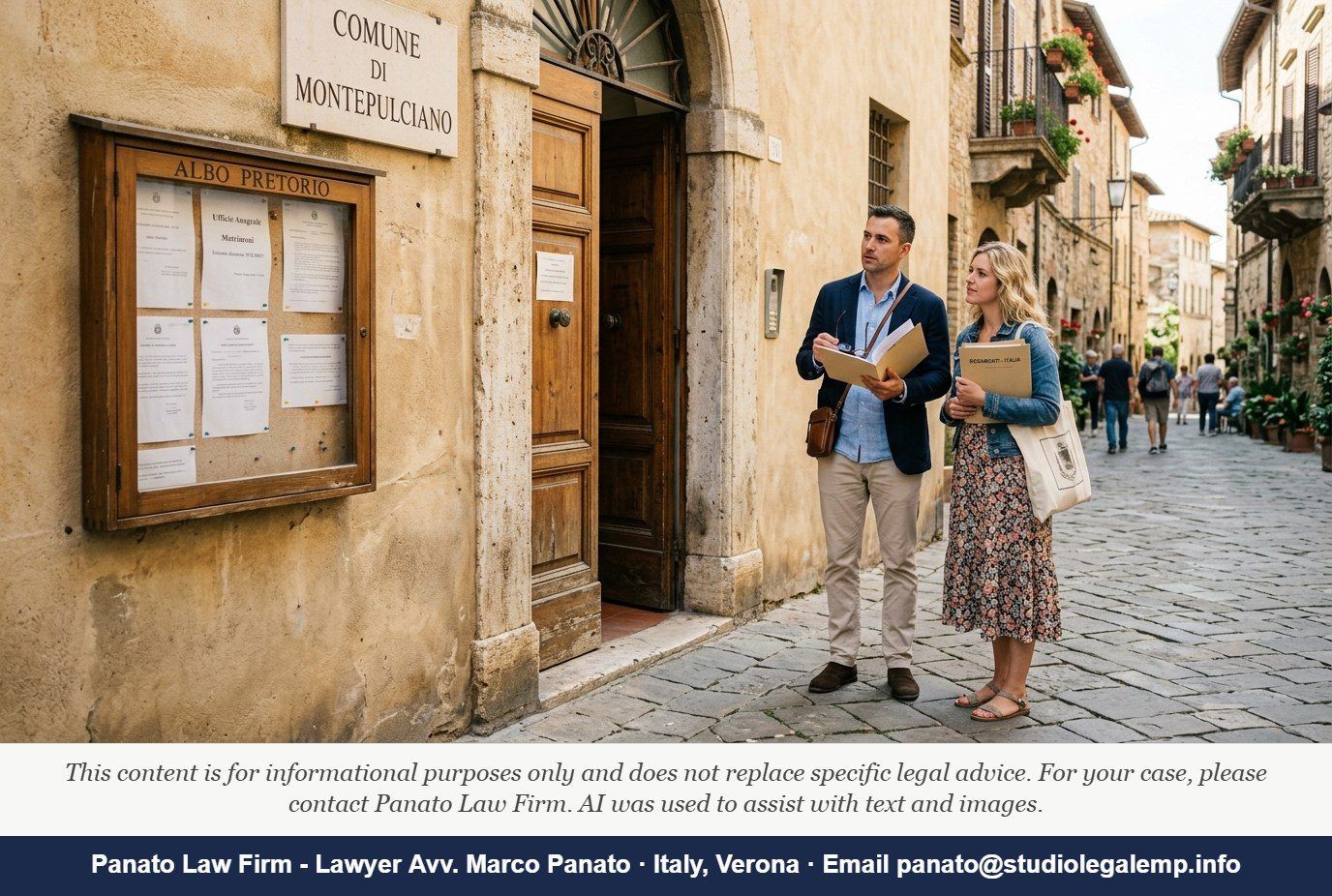
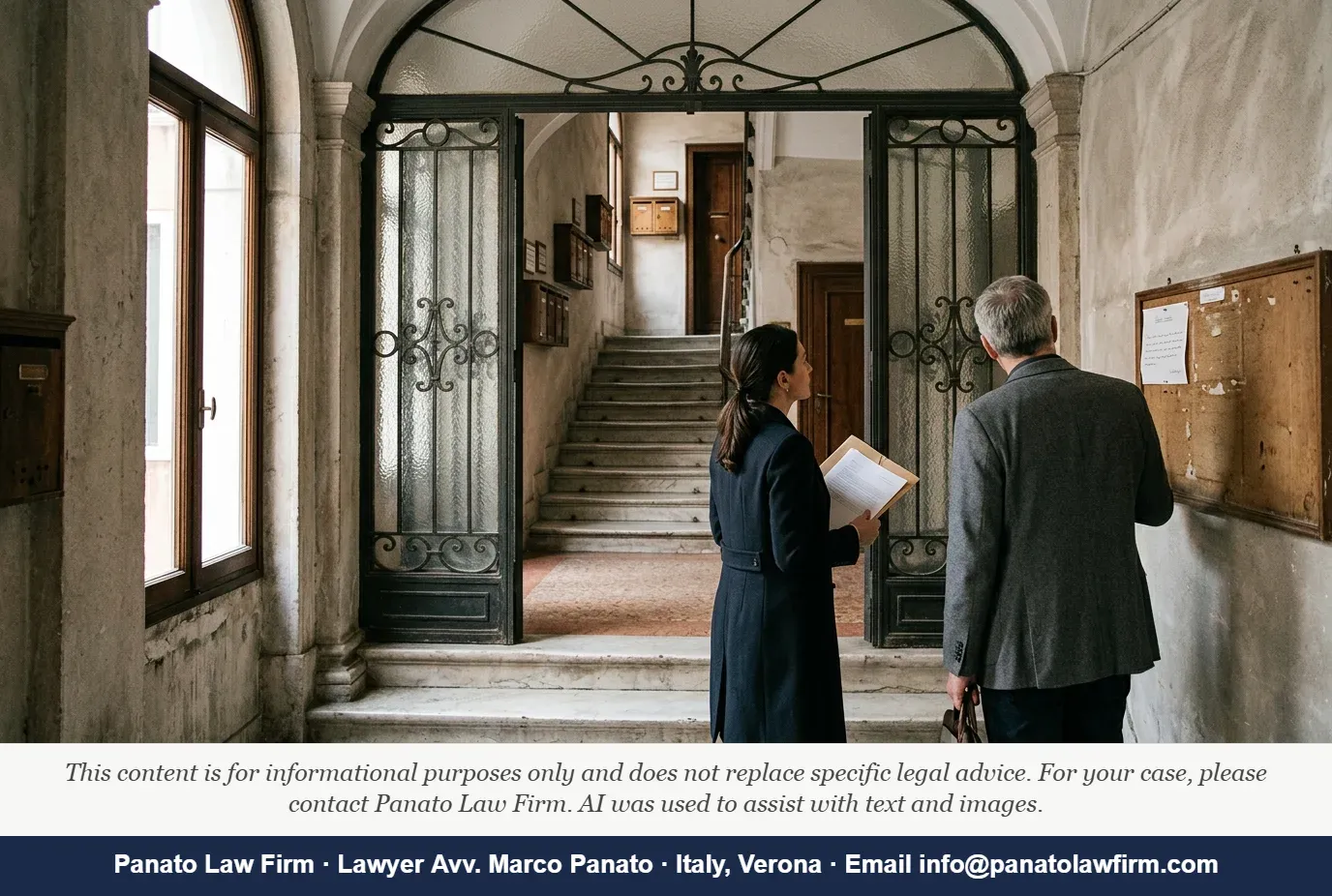
Image prompt: A sunlit Italian municipal hall entrance — warm ochre stone facade, wooden double doors ajar, a small notice board beside the entrance with official papers pinned to it. A well-dressed foreign couple stand just outside, holding a folder of documents, looking focused rather than anxious, with a narrow cobblestone street curving away behind them. Soft morning light, muted terracotta and cream tones, photorealistic style.
Image file: italy-residency-registration-foreign-nationals-45-day-trap-cover
JSON-LD:
LANGUAGE QA: the moment you received your permi -> the moment you receive your permit · residency registration coincides with obtaining a residence permit -> residency registration and a residence permit are the same thing · You generally need to be in attendance when the officers visit -> You generally need to be home when the officers call · the competent office issues a formal receipt -> the relevant office issues a formal receipt · carries an additional constraint that EU citizens do not face -> adds a constraint EU citizens are spared · A common question among non-European citizens is whether -> Non-European citizens often ask whether · silence, after the window closes without adverse communication, equals approval -> silence, once the window closes with no objection, equals approval · sets out how local registrars collect, update, and verify population data -> governs how local registrars collect, update and verify population data
CHECK:
AUTHORITY 1: DPR 223/1989 (Presidential Decree No. 223, 30 May 1989)
REFERENCES: DPR 223/1989
EXISTS? Yes — verifiable on normattiva.it; confirmed cited by multiple authoritative sources (legalclarity.org, yourwaytoitaly.it, refugee.info)
CONTENT MATCHES what I wrote? Yes — governs civil registry rules and verification procedure
STATUS: GREEN
AUTHORITY 2: Law No. 241/1990, Article 20 (tacit-consent principle)
REFERENCES: L. 241/1990, art. 20
EXISTS? Yes — normattiva.it; confirmed cited in legalclarity.org (index 19-1/19-6 with explicit normattiva footnote)
CONTENT MATCHES? Yes — tacit consent / silenzio assenso after 45-day window
STATUS: GREEN
AUTHORITY 3: Article 2, TUIR (DPR 917/1986) — three-pronged Italian tax residency test
REFERENCES: Art. 2 DPR 917/1986 (TUIR)
EXISTS? Yes — normattiva.it; confirmed described in taxing.it (Risposta no. 112, 17/04
Do you need legal assistance or a free estimate?
Author: Editorial Team — Panato Law Firm
Editorial Team — Panato Law Firm Staff