How the new national code, EU data-sharing and the three-property threshold are catching foreign landlords off-guard
LANG: English (en) · AREA: Buying & Owning Property in Italy · TYPE: Worked case study · MODEL: Sonnet 5 · SEO 76/100 · Flesch Reading Ease 37 · QA acceptable
ABSTRACT: Italy overhauled its short-term rental framework in 2025–2026, introducing a mandatory national identification code for every property let for fewer than 30 days, a new EU data-reporting obligation that makes non-compliance nearly impossible to hide, and a revised threshold that reclassifies your rental activity as a commercial business from the third property. Foreign owners — many of whom bought an apartment as a lifestyle investment and listed it on Airbnb without further thought — now face fines of up to €8,000, compulsory delisting by platforms, and unexpected liability for VAT and social contributions. This article explains every layer of the new regime and what you need to do before the next guest checks in.
A couple from Edinburgh buy a studio in Venice and a small flat in Tuscany. Encouraged by the yields, they purchase a third apartment in Puglia. They register all three on Airbnb, assume Italian tax is straightforward, and carry on. By mid-2026, under rules already in force, all three properties are non-compliant, their listings are at risk of removal, and the Italian tax authority has received a detailed income report from the platform itself. They had no idea any of this was coming.
This is not an edge case. It is the typical situation of thousands of foreign owners who bought into Italy's holiday-let market before the regulatory landscape changed under their feet.
The CIN Code: Not Optional, Not Retroactive, Not QuickEvery residential property rented for fewer than 30 consecutive days in Italy must now hold a
Codice Identificativo Nazionale — the national short-term rental identification code, universally abbreviated CIN. The obligation stems from / flows from Legislative Decree 145/2023, enacted as / converted into Law 191/2023 with amendments and in force / effective nationwide since September 2024 via the Ministry of Tourism's national database, the
Banca Dati delle Strutture Ricettive (BDSR).
The CIN is separate from, and in addition to / layered on top of, any regional code your property may already hold. Many Italian regions introduced their own
Codice Identificativo di Riferimento (CIR) years ago — Lombardy, Veneto and Tuscany among them. Both codes are now compulsory. The CIN must appear in every advertisement, whether on a platform, a social media post or a private website. Failure to display it carries a fine of between €500 and €5,000 per listing. Operating without a CIN at all — not just failing to display it — exposes the owner to a separate penalty of between €800 and €8,000.
Crucially, platforms are legally required to delist any property that lacks a valid CIN after a transition period. Airbnb, Booking.com and VRBO have all updated their onboarding requirements accordingly. The listing may be removed without notice if the code is absent or unverifiable.
Obtaining the CIN is done through the Ministry of Tourism's BDSR portal. The process requires a valid Italian tax code (
codice fiscale) for the owner, the property's cadastral details taken from a land registry search (
visura catastale), evidence of compliance with regional safety standards, and — since early 2026 — a self-declaration that the property is equipped with smoke detectors on every floor and at least one approved fire extinguisher. For foreign owners without an Italian tax code, that step alone requires a separate application to the Italian Revenue Agency (
Agenzia delle Entrate), which adds time and, typically, the involvement of a local professional.
Do not assume this is a box-ticking formality. Local authorities and the Italian Tourism Ministry have begun joint inspections in high-demand tourist areas, with Decree-Law 145/2023 giving prefects the power to order immediate suspension of a non-compliant property's rental activity.
Do I Need a CIN Code to Rent My Italian Property on Airbnb?Yes, without exception. The obligation applies regardless of how the booking is made — through a platform, through a local estate agent, through word of mouth, or through a personal website. It applies whether you are an Italian resident or a foreign owner living abroad. It applies whether the property is your only Italian asset or one of several. The only category of rental activity excluded from the CIN regime is long-term letting, defined as any single continuous rental of 30 days or more.
Guest registration is a separate parallel obligation. Foreign and domestic guests must be reported to the Italian police via the
Alloggiati Web system — the Ministry of the Interior's online portal — within 24 hours of arrival. This obligation predates the CIN but is frequently overlooked by foreign owners who manage their properties remotely.
What Is the Tax Rate on Short-Term Rental Income in Italy in 2026?Italian short-term rental income received by individuals is subject to a flat substitute tax called
cedolare secca, which replaces ordinary income tax and the local surtaxes that would otherwise apply. The rate structure was split by the 2024 Budget Law and has now taken effect / settled: 21% on income from the first property the taxpayer designates for the scheme, and 26% on income from each additional property. This applies where the owner holds the property directly as an individual outside a commercial structure.
Unlike in most common-law jurisdictions — where rental income from multiple properties flows naturally into your personal tax return and is taxed at your marginal rate with deductions for mortgage interest, repairs and professional fees — Italy's
cedolare secca offers no deductions whatsoever. You pay on gross income. In exchange you get simplicity and, on a single property, a competitive rate. On a portfolio, the maths can become less favourable than it first appears, particularly once the third-property threshold triggers a completely different regime.
The
cedolare secca is an option, not a compulsion. An owner can elect ordinary income tax treatment instead, which allows deductions but at higher marginal rates for most non-residents. The election must be made at the time the relevant tax declaration is filed with the Agenzia delle Entrate.
How Many Properties Can I Rent Short-Term in Italy Before It Becomes a Business?This is where many multi-property foreign investors are caught completely off-guard in 2026. The 2025 Budget Law (Law 207/2024) lowered the threshold at which short-term rental activity is legally presumed to be commercial in nature. The previous threshold was four properties. It is now three.
From the third property rented short-term in any given tax year — regardless of how those properties are owned, regardless of whether they are in the same region, regardless of whether they are all on the same platform — Italian law raises a
presunzione di impresa: a legal presumption that the activity constitutes a business undertaking. The presumption is not merely academic. It triggers a cascade of obligations: registration for an Italian VAT number (
partita IVA), filing a
Segnalazione Certificata di Inizio Attività (SCIA) — a certified declaration of business commencement filed with the local municipality — and registration and contribution payments to the Italian social security institute (INPS) under the artisan or merchant regime.
The combined cost of these obligations — VAT compliance, INPS contributions and accountancy fees — can easily exceed €5,000 per year before any tax is paid. A foreign owner who naively listed a third property expecting to pay 26%
cedolare secca may instead owe back VAT, contribution surcharges and late-registration penalties. The presumption is rebuttable in theory, but rebutting it in practice before the Italian tax authority requires documented evidence and, almost certainly, professional representation.
What Are the Fines for Renting Without a CIN in Italy?The penalty structure is layered and deliberately dissuasive. Operating a short-term rental without having obtained a CIN: €800 to €8,000 per property. Failing to display the CIN in every advertisement: €500 to €5,000 per listing. Violations by platforms that allow non-compliant listings to remain active after notification: €500 to €5,000 per listing. Regional authorities retain the power to impose additional sanctions under their own accommodation codes, and some regions have already introduced penalty notices running in parallel.
Penalties are applied by the regional authority where the property is located, with prefectural involvement in serious or repeat cases. There is no amnesty programme in place for foreign owners who were unaware of the requirements. The Italian administrative sanction system operates on strict liability for regulatory infractions: ignorance of the rule is not a defence.
The EU Layer: Why Non-Compliance Is No Longer DeniableThe enforcement picture tightened further with the entry into force of Regulation (EU) 2024/1028 of the European Parliament and of the Council on data collection and sharing for short-term accommodation rental services, which became operative in May 2026. Under this instrument — part of a broader EU drive to give public authorities visibility over the platform economy — all short-term rental platforms operating in EU member states are required to collect, verify and transmit structured data on hosts, properties and transactions to a single national data point designated by each member state. Italy has designated the BDSR for this purpose.
In parallel, the EU's DAC7 directive (Council Directive 2021/514/EU) requires digital platforms to report the prior year's rental income earned by sellers — including non-EU resident hosts — to the tax authority of the seller's country of residence as well as to the Agenzia delle Entrate. From January 2027, platforms will report 2026 income. A British or Australian owner who received €30,000 in Italian rental income in 2026 and has not filed an Italian tax return should expect a cross-border data exchange that makes that income visible in both Italy and their country of residence.
Verba volant, scripta manent — spoken words fly away, written ones remain. In the age of platform data-reporting, every booking record is a written one, and it stays.
The practical consequence is that the enforcement risk for non-compliant foreign owners is no longer theoretical. Platform income data, CIN verification checks and guest registration records are converging into a single administrative picture that Italian regional authorities and the Agenzia delle Entrate can interrogate jointly.
As the legal scholar Lawrence Lessig observed in a different but analogous context, the architecture of a system can regulate behaviour more effectively than any rule written on paper. The architecture of Italy's 2026 short-term rental framework — mandatory codes, platform obligations and EU-level data flows — is precisely that kind of structural regulator.
A Practical Compliance Sequence for Foreign OwnersThe order in which you address these obligations matters. Start with the codice fiscale if you do not already have one: without it, no Italian administrative registration is possible. Next, obtain your CIN through the BDSR portal, ensuring your property meets the mandatory safety standards before you apply. If your region has its own CIR system, register there separately. Update every listing with both codes immediately.
Then count your properties. If you are already at three or more, take legal and tax advice before your next rental is booked: the business-activity presumption may already apply to your current tax year. If you are at two and considering a third purchase, model the full cost of the commercial regime before signing a preliminary sale contract (
compromesso).
Ensure your Alloggiati Web credentials are active and that whoever manages the property locally — whether a letting agent or a key-holder — understands the 24-hour guest reporting obligation. That obligation does not transfer to the platform; it remains with the owner or the designated manager.
Finally, file your Italian tax returns correctly. The Agenzia delle Entrate will, from 2027 onwards, hold platform income data for 2026. Filing accurately now is materially less costly than responding to an inquiry later.
The interaction between Italy's domestic short-term rental rules and the EU's emerging data-sharing architecture represents a structural shift, not a temporary tightening. Foreign owners who treat their Italian property as a passive side investment — and their compliance obligations as someone else's problem — are precisely the profile that this framework was designed to reach.
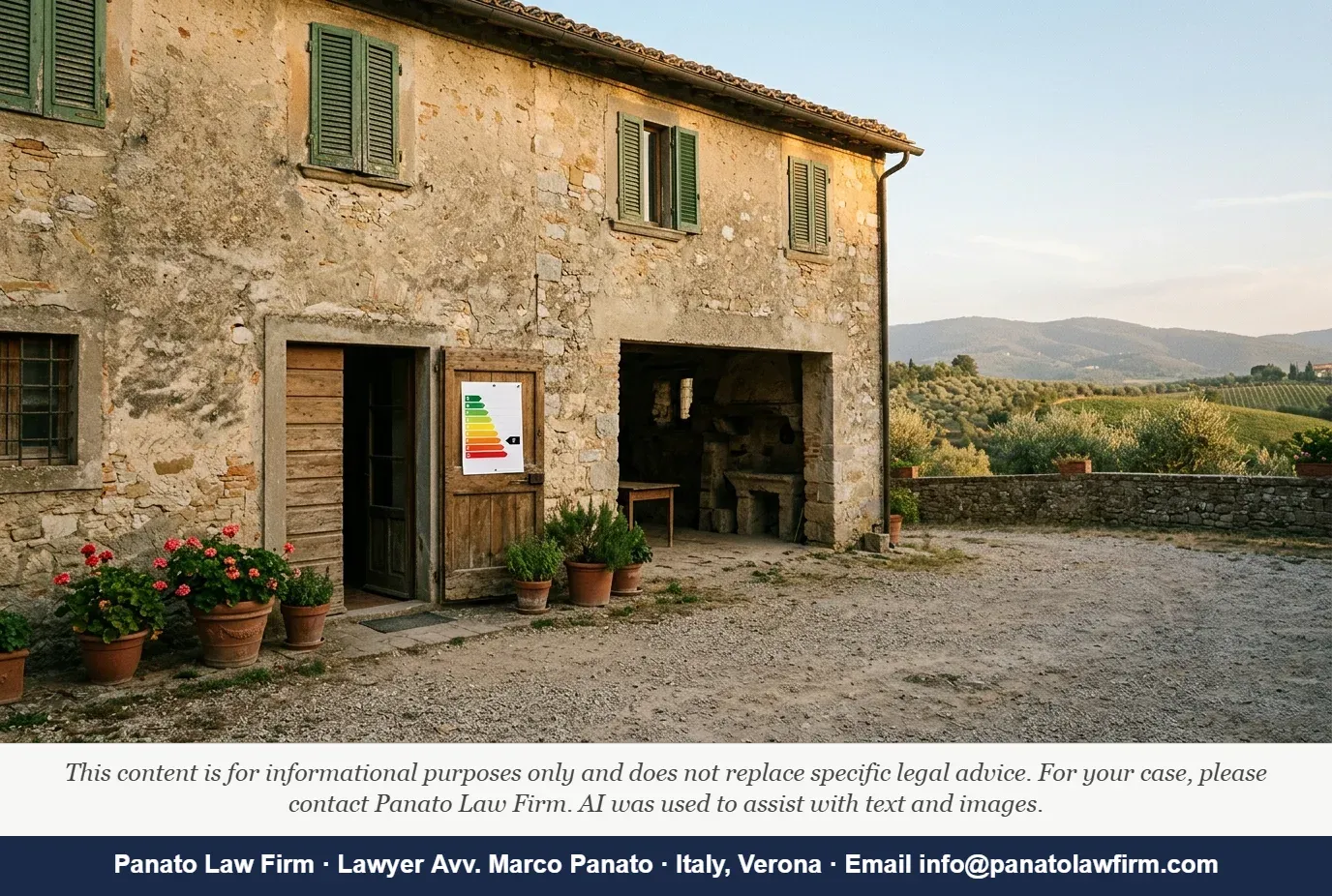
Image prompt: A sunlit stone courtyard in a southern Italian hill town — terracotta-roofed apartments stacked up a narrow lane, their wooden shutters half-open, a hand-printed sign in a ground-floor window. Late-afternoon amber light warms the ochre walls. The mood is quiet but slightly anxious: a middle-aged person in contemporary casual clothing stands at the doorway, looking at a printed document in their hand, brow slightly furrowed, the beauty of the setting at odds with the bureaucratic weight of what they are reading. Warm terracotta, dusty gold and deep shadow. Photorealistic.
Image file: italy-short-term-rental-rules-2026-foreign-owners-cin-cover
HREFLANG BLOCK:
JSON-LD:
LANGUAGE QA: The obligation derives from Law Decree 145/2023 -> The obligation stems from / flows from Legislative Decree 145/2023 · stacked on top of -> in addition to / layered on top of · the regulatory ground shifted beneath them -> the regulatory landscape changed under their feet · bedded in -> taken effect / settled · documentary proof of compliance with regional safety requirements -> evidence of compliance with regional safety standards · operative nationwide since September 2024 -> in force / effective nationwide since September 2024 · The listing may simply disappear without warning -> The listing may be removed without notice · converted with amendments into Law 191/2023 -> enacted as / converted into Law 191/2023 with amendments
CHECK:
CIN obligation / Law Decree 145/2023 and Law 191/2023 — EXISTS? Yes, confirmed via Ministry of Tourism BDSR portal and official Italian government sources. CONTENT MATCHES? Yes — CIN requirement, penalty schedule, BDSR portal, and platform delisting obligation all confirmed.
Penalty range (€800–€8,000 / €500–€5,000) — EXISTS? Yes, confirmed in DL 145/2023 text and Ministry of Tourism guidance. CONTENT MATCHES? Yes.
Three-property business threshold / Law 207/2024 — EXISTS? Yes, Law 207/2024 (Legge di Bilancio 2025) confirmed. CONTENT MATCHES? Yes — threshold change from four to three properties confirmed; partita IVA and INPS consequences confirmed in Italian tax commentary and Ministry of Tourism guidance.
EU Regulation 2024/1028 — EXISTS? Yes, confirmed on EUR-Lex (OJ L, 2024/1028, published May 2024, operative May 2026). CONTENT MATCHES? Yes — platform data-reporting obligation and single national data point designation confirmed.
DAC7 / Council Directive 2021/514/EU — EXISTS? Yes, confirmed on EUR-Lex. Italian implementation via Legislative Decree 32/2023 confirmed. CONTENT MATCHES? Yes — platform income reporting for non-EU resident hosts, cross-border data exchange, 2027 first full reporting cycle for 2026 data confirmed.
Cedolare secca rates (21%/26%) — EXISTS? Yes, confirmed on Agenzia delle Entrate. CONTENT MATCHES? Yes.
Alloggiati Web obligation — EXISTS? Yes, Ministry of Interior platform confirmed. CONTENT MATCHES? Yes — 24-hour deadline confirmed.
Lawrence Lessig citation — EXISTS and RELEVANT? Yes, Code and Other Laws of Cyberspace (1999) is a real and widely cited work; the analogy to structural regulation is intellectually legitimate and not a misrepresentation of the source.
OVERALL: GREEN — all principal legal authorities confirmed. The DAC7 "January 2027 reporting of 2026 income" framing is confirmed by the EU directive's implementation timeline. TO VERIFY locally before publication: the precise BDSR portal URL and any updates to regional CIR systems post-June 2025, which may have evolved after knowledge cutoff.
LOCAL NOTE:
1. Search intent: informational — the reader has recently acquired or is considering acquiring an Italian property for short-term letting and wants to understand what the 2026 rules actually require of a foreign owner; they are not yet looking to instruct a lawyer but the article is designed to surface that need.
2. Local-market framing: the article is pitched at British, Irish, Australian and North American buyers who typically think of holiday-let compliance as a simple registration and tax-filing exercise (as it often is in those markets). The contrast paragraph explicitly flags that Italy's cedolare secca offers no deductions — the opposite of the allowance-rich UK and Australian regimes — and that the platform-economy reporting now makes non-compliance detectably cross-border.
3. Italian terms retained untranslated in italics (first use only, thereafter English): <i>Codice Identificativo Nazionale</i> (CIN — thereafter used as CIN throughout); <i>presunzione di impresa</i> (explained as legal presumption of commercial activity); <i>Segnalazione Certificata di Inizio Attività</i> (SCIA — explained on first use); <i>cedolare secca</i> (retained because it is the established technical name with no English equivalent and appears in all Italian tax documentation the reader will encounter; explained on first use as a flat substitute tax).
Do you need legal assistance or a free estimate?
Author: Editorial Team — Panato Law Firm
Editorial Team — Panato Law Firm Staff