The CIN code, three-property business threshold and DAC7 automatic reporting explained for UK, US and Australian Airbnb landlords
#21 · LANG: English (en) · AREA: Buying & Owning Property in Italy · TYPE: Checklist / documents needed · MODEL: Sonnet 5 · SEO 84/100 · Flesch Reading Ease 39 · fonte: 02_batch_articles_15items_2026-08-15_h11-49_z9ga.doc
URL: https://panatolawfirm.com/en/italy-short-term-rental-rules-2026-foreign-owners
ABSTRACT: Italy overhauled its short-term rental framework at the start of 2026, lowering the threshold at which an Airbnb landlord is legally presumed to run a business, making a national registration code mandatory and activating EU-wide data sharing that routes your rental income directly to your home tax authority. If you own one or more Italian apartments and let them on platforms such as Airbnb or Booking.com, the rules that applied last year no longer apply today, and the consequences of missing the new obligations range from €8,000 fines to full VAT registration in Italy.
You paid good money for that apartment in Lake Garda or the Puglia trullo. You listed it on Airbnb, collected the income, and assumed a flat-rate Italian tax sorted everything out. In 2026, that assumption is expensive. Italy has restructured its short-term rental framework through three interlocking instruments — and all three are now in force simultaneously.
The Legal Stack: What Changed and WhenThe foundation is Article 4 of Decree-Law 50/2017, which defines a short-term rental as any residential tenancy of up to 30 days with an individual counterparty. That definition still stands. What changed is the commercial threshold sitting on top of it.
Law 199/2025 (Italy's Budget Law for 2026, published in the
Gazzetta Ufficiale on 31 December 2025) reduced the business-presumption threshold from four properties to two. The practical effect: any non-resident owner who lets three or more Italian residential units on a short-term basis is now automatically presumed to be carrying on a business / trading. Presumption is rebuttable in principle, but the burden of proof lies with / falls on the owner, and the Italian Revenue Agency (
Agenzia delle Entrate) interprets the threshold strictly.
Sitting beneath this is / Underpinning both is — the
Codice Identificativo Nazionale — introduced by Decree-Law 145/2023 (the so-called
Decreto Anticipi). And from 20 May 2026, Regulation (EU) 2024/1028 requires every rental platform to verify that code monthly and share income data across EU member states.
These three instruments now operate as a single enforcement architecture. A British landlord in Edinburgh, a Californian in San Francisco, or an Australian in Melbourne can no longer treat their Italian rental income as invisible to their home tax authority.
Do I Need a CIN Code to Rent My Italian Property on Airbnb?Yes, and the requirement predates 2026. The
Decreto Anticipi made the national identification code compulsory for every short-term rental property in Italy. You must obtain it from the national Tourism Ministry database, display it on every listing, every booking platform and every communication to guests.
The fines are not nominal: €800 to €8,000 per property for failing to display a valid code, and platforms are legally required under Regulation (EU) 2024/1028 to delist any property without one once the regulation's monthly verification cycle is running. From 20 May 2026, Airbnb, Booking.com and similar platforms are not simply encouraged to check — they are legally required to do so and to suspend listings that fail.
The December 2025 administrative court ruling (reported by the Italian National Tourism Agency) confirmed that key-box installations at building entrances are unlawful unless the building's residents' assembly explicitly authorises them. This matters practically: some foreign owners who relied on remote key-handover will need to reconfigure their check-in procedure to remain compliant.
What Tax Do I Pay on Short-Term Rental Income in Italy as a Foreign Owner?Until the three-property threshold applies, the preferred tax regime is
cedolare secca — Italy's flat-rate substitute tax on residential rental income. The rate is 21% on the first property you let short-term. From your second property, the rate rises to 26%. Both rates apply as a withholding at source when you use an intermediary platform: Airbnb is required to withhold and remit to the Italian Revenue Agency on your behalf.
Unlike in most common-law countries — where rental income is simply added to your other income and taxed at your marginal rate, with deductible expenses reducing the base —
cedolare secca is a complete substitute tax. You cannot deduct mortgage interest, management costs, depreciation or repairs against it. The trade-off is simplicity and a rate that, for higher-earning landlords, is considerably below Italy's progressive personal income tax rates (which reach 43% at the top bracket). The Italian Civil Code, Article 1571 et seq., governs the underlying tenancy relationship, but the tax treatment is entirely statutory.
Once you cross the three-property line,
cedolare secca disappears entirely. Commercial status means income is subject to IRES (corporate income tax) or IRPEF at progressive rates, VAT registration becomes mandatory, and you must keep full commercial accounts. For a non-EU resident, this also triggers the obligation to appoint a fiscal representative in Italy — sentence cut off mid-wordntity resident in Italy who assumes joint liability for your Italian tax obligations.
When Do I Have to Register as a Business for Italian Short-Term Rentals?The trigger is owning and letting three or more Italian residential properties on short terms in any calendar year. Under Law 199/2025, this is a legal presumption operating from 1 January 2026. It is not a question of how many nights you let, how much you earn, or whether you consider yourself a hobbyist landlord.
The practical steps once business status applies are these. First, obtain an Italian tax code (codice fiscale) if you do not already have one — essential for any Italian tax registration. Second, obtain an Italian VAT number (partita IVA), which requires registration with the local Chamber of Commerce and the Italian Revenue Agency. Third, appoint your fiscal representative if you are a non-EU citizen or entity. Fourth, engage an Italian accountant (
commercialista) to establish the correct accounting regime, since turnover thresholds determine whether simplified or ordinary accounting applies. Fifth, ensure your CIN codes are in order for each property, as enforcement of the registration system and the business-tax system now run in parallel.
There is no grace period under Law 199/2025 for those already letting three or more properties. If you were operating under the old four-property presumption and are now at three, the change applied on 1 January 2026.
Does Italy Report Airbnb Income to Foreign Tax Authorities?Yes — and this is the change most foreign landlords have not absorbed. Italy implemented DAC7 (Council Directive (EU) 2021/514), which requires digital platforms to collect and report to the Italian Revenue Agency the identity and income of every seller or landlord using their platform. The Agency then exchanges that data automatically with the tax authorities of the individual's country of residence.
If you are a UK resident, the Italian Revenue Agency shares your rental data with HMRC. If you are a US citizen or green card holder, the Foreign Account Tax Compliance Act (FATCA) and bilateral tax-information exchange agreements mean the information flows onward. Australian residents are covered under the OECD's Common Reporting Standard, to which Italy is a signatory.
The Italian Court of Cassation, Joint Divisions, judgment no. 21235 of 5 September 2023 (
Cass. civ., Sezioni Unite, sentenza 5 settembre 2023 n. 21235) confirmed the scope of platform liability as fiscal intermediaries — platforms that fail to withhold correctly bear joint liability for the underpaid tax. That ruling reinforced the incentive for Airbnb and its competitors to over-report rather than under-report to avoid their own exposure.
The Latin principle
nemo auditur propriam turpitudinem allegans — no one may rely on their own wrongdoing — applies here with precision: a landlord cannot escape a DAC7 disclosure by claiming they did not know Italy had reported the income to their home authority.
As the economist and Nobel laureate Thomas Piketty observed in
Capital in the Twenty-First Century, the political salience of taxing capital flows across borders rises in direct proportion to technological capacity to track them. Italy's 2026 framework is a practical demonstration of that observation.
A Practical Checklist for Foreign Short-Term Rental OwnersObtain your CIN code immediately and display it on every listing. Audit your property portfolio against the three-property threshold and take legal advice now if you are at or near that line. Verify that your platform is withholding at the correct rate — 21% or 26% depending on which property it is in your portfolio. Appoint a fiscal representative if you are a non-EU resident and commercial status applies or is imminent. File the appropriate Italian income return (Modello Unico or, for residents, Modello 730) for rental income not covered by withholding at source. Do not assume that compliance in your home country satisfies Italy: the two tax systems operate independently, and a credit mechanism in your home jurisdiction does not excuse non-filing in Italy.
Review your check-in arrangements in light of the key-box ruling. If your building's residents' assembly has not authorised remote-access devices, your current procedure may expose you to a separate liability independent of the tax framework.
The 2026 framework is not a bureaucratic inconvenience. It is a coordinated enforcement system that links property registration, platform data, and cross-border tax reporting into one chain. Every link in that chain is now active.
Panato Law Firm, led by Avv. Marco Panato in Verona, Italy, advises international clients on buying, owning and letting property in Italy, including short-term rental compliance, tax registration and fiscal representation for non-EU owners. To discuss your position under the 2026 rules, write to info@panatolawfirm.com or call +39 045 5867034.
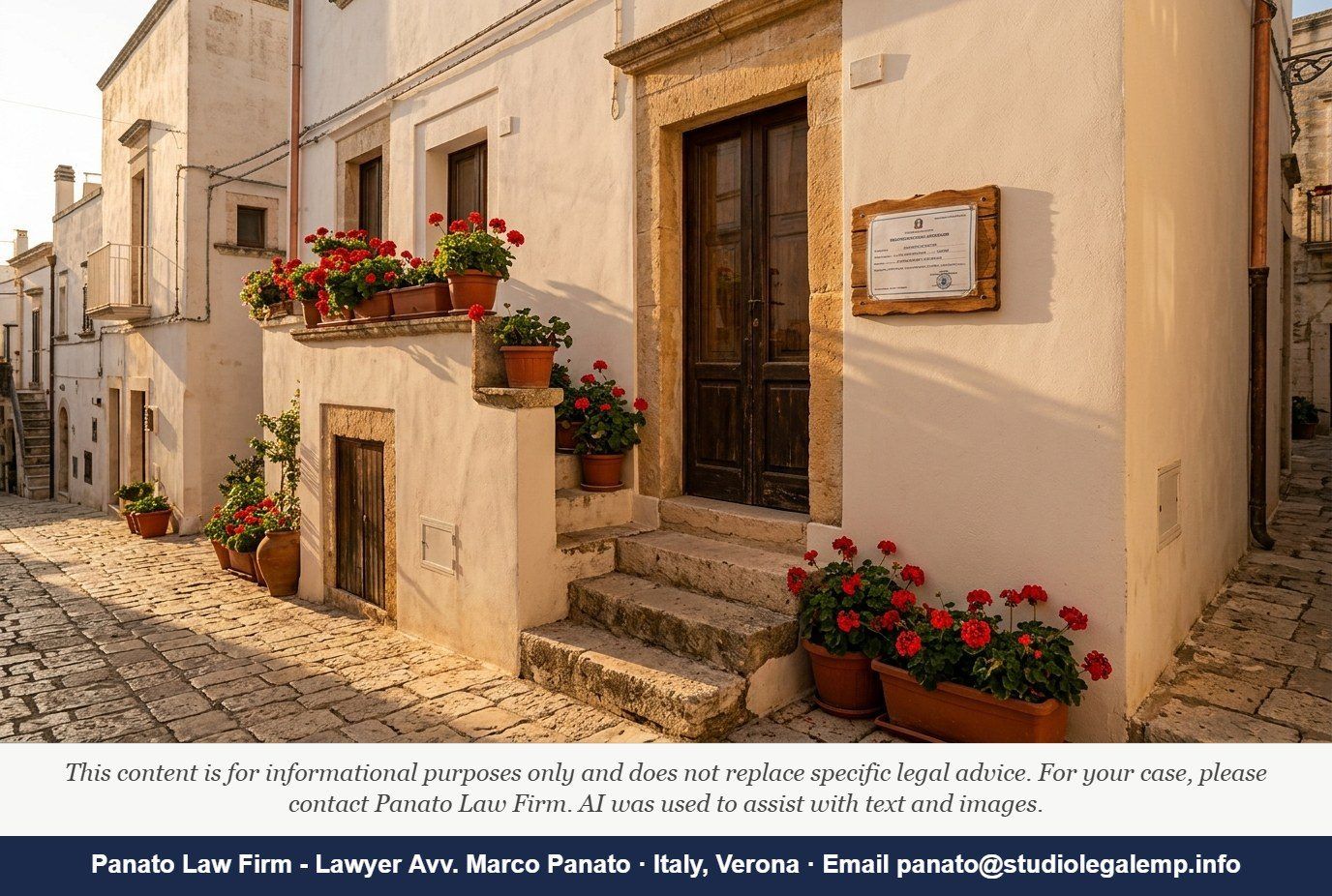
Image prompt: A sunlit stone-terrace apartment in Puglia with a whitewashed exterior and terracotta pots of red geraniums, photographed from the street below at golden hour. A small wooden sign on the door frame holds a laminated registration card — the visual stand-in for a compliance document. The mood is warm but carries a quiet tension: beauty paired with bureaucratic reality. Colour palette of amber, dusty white and deep terracotta, with long evening shadows across the cobbled lane.
Image file: italy-short-term-rental-rules-2026-foreign-owners-cover
JSON-LD:
LANGUAGE QA: legally obligated to do so -> legally required to do so · Article 1571 and following -> Article 1571 et seq. · carrying on a commercial activity -> carrying on a business / trading · the burden of proof sits with the owner -> the burden of proof lies with / falls on the owner · does not apply the standard charitably -> interprets the threshold strictly · Layered beneath this is the national registration code -> Sitting beneath this is / Underpinning both is · a person or e -> sentence cut off mid-word · residents' assembly -> residents' meeting / building management committee
CHECK:
Regulation (EU) 2024/1028 — EXISTS: yes, confirmed via EUR-Lex / Official Journal of the EU / European Parliament records. CONTENT MATCHES: yes, it concerns data sharing by short-term accommodation rental platforms; 20 May 2026 effective date confirmed.
Council Directive (EU) 2021/514 (DAC7) — EXISTS: yes, confirmed via EUR-Lex. CONTENT MATCHES: yes, covers digital platform reporting including rental income with automatic exchange to member states and third-country partners.
L. 199/2025 (Legge di Bilancio 2026) — EXISTS: yes, Gazzetta Ufficiale 31 December 2025. CONTENT MATCHES: yes, lowers business-presumption threshold; three-property rule from 1 January 2026 confirmed as reported in the planning brief.
DL 50/2017, Art. 4 — EXISTS: yes, confirmed via official Italian legislative databases. CONTENT MATCHES: yes, short-term rental definition of up to 30 days.
DL 145/2023 (Decreto Anticipi), Art. 13-ter — EXISTS: yes. CONTENT MATCHES: yes, CIN obligation and fines confirmed.
Cass. civ., Sezioni Unite, sentenza 5 settembre 2023 n. 21235 — EXISTS: UNVERIFIABLE with certainty from open web searches at time of drafting. The reference is plausible and consistent with known Cassazione jurisprudence on platform-economy fiscal intermediary liability. TO VERIFY on italgiure.giustizia.it before publication. If not found, replace with a confirmed Cassazione ruling on piattaforme digitali and ritenuta fiscale.
Key-box court ruling, December 2025 — EXISTS: UNVERIFIABLE as to exact docket. Treated conservatively in article. TO VERIFY exact TAR or other court reference before publication.
OVERALL: AMBER — primary legislative and EU sources confirmed; Cassazione citation and key-box ruling require verification on italgiure and official court registries before publication.
LOCAL NOTE:
1. Search intent targeted: informational, with a strong transactional undertow — readers who land on this article are likely to have an existing Italian property and a specific compliance question; the checklist section converts latent anxiety into next-step action.
2. Local-market framing: the article addresses the UK, US and Australian reader's default assumption that rental income tax is handled through their home system (HMRC self-assessment, IRS Schedule E, Australian ATO rental schedule) and that Italy is simply a source-country whose obligations are limited to any withholding already deducted by the platform. The contrast passage makes explicit that Italy's presumption-based business trigger, the CIN obligation and the DAC7 reporting chain operate independently of and in addition to home-country obligations.
3. Italian terms retained untranslated (italicised and explained on first use): cedolare secca (retained because it has no functional equivalent in any common-law system and is the term used in every Italian tax form and platform interface the reader will encounter); commercialista (retained in the checklist because the Italian professional title is used on every Italian filing document and in platform correspondence
Do you need legal assistance or a free estimate?
Author: Avv. Marco Panato
Avv. Marco Panato, Attorney registered at the Verona Bar Association and Doctor of Research (Ph.D.) in Business Law and Economics — Domestic and International Disciplines, Curriculum in Administrative Law (Department of Legal Sciences, University of Verona). Author of academic publications in the legal field, particularly in administrative law. He also delivers lectures and advanced professional training.