CIN codes, the new two-property threshold, EU data-sharing from May 2026 and what DAC7 means if you rent your Italian flat on Airbnb
LANG: English (en) · AREA: Buying & Owning Property in Italy · TYPE: FAQ / People Also Ask · MODEL: Sonnet 5 · SEO 84/100 · Flesch Reading Ease 36 · QA acceptable
ABSTRACT: Italy has overhauled its short-term rental framework in ways that directly target foreign property owners who assumed distance or non-resident status kept them off the radar. Three interlocking changes — a mandatory national identification code, a reduced threshold before rental activity becomes a presumed business, and an EU regulation forcing platforms to share guest and revenue data with Italian tax authorities from May 2026 — mean that compliance is no longer optional or easily ignored. This article sets out exactly what is required, what it costs to get wrong, and how the new rules interact with tax obligations in the UK, USA, Australia and Canada.
You purchased a flat in Venice, a farmhouse in Umbria, or an apartment on the Amalfi Coast. You listed it on Airbnb or Booking.com, collected the income into a foreign account, and assumed that — as a non-resident — Italy's enforcement machinery would never quite reach you. That assumption is now obsolete.
From May 2026, the platforms you use are legally required to report your guest data and your revenue directly to the Italian tax authority (
Agenzia delle Entrate). Italy also knows how many properties you own, because a second national reform has lowered the threshold at which renting short-term becomes a presumed business activity. And if you have not yet obtained your mandatory national identification code — the
Codice Identificativo Nazionale — you are already exposed to fines running up to €8,000 and to being delisted from every major platform.
Do I need a CIN code to rent my Italian property on Airbnb?Yes, and has applied since / took effect in late 2023. Article 13-ter of Decree-Law no. 145 of 18 October 2023, as converted into law, with amendments, by Law no. 191 of 15 December 2023 (Decreto Anticipi), created the
Codice Identificativo Nazionale — Italy's mandatory national registration code for short-term rental properties. The CIN must be obtained through the Ministry of Tourism's national portal (the BDSR —
Banca Dati delle Strutture Ricettive) and is separate from any regional or municipal registration code your property may already carry.
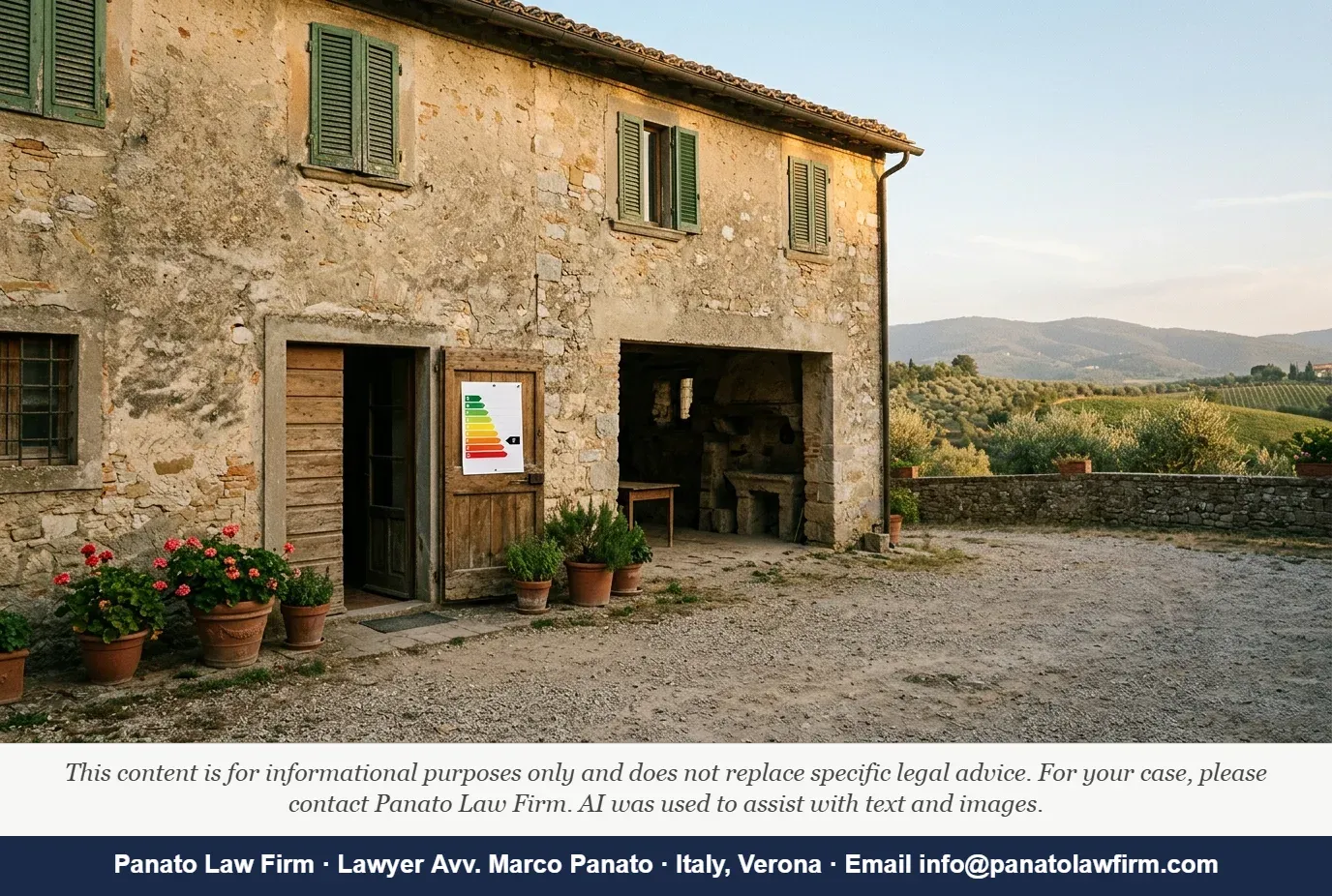
Once issued, the CIN must appear in every online advertisement, on every booking platform listing, and — for properties physically accessible to guests — on a notice displayed on the outside of the building. The obligation applies to every owner, whether resident in Italy or abroad. Being based in London, Sydney, Toronto or New York is not a legal exception; it is simply a factor that has historically reduced the practical risk of being caught. That practical protection is now being removed.
What are the fines for not having a CIN code in Italy?The sanctions under Article 13-ter are graduated according to the violation / tiered by offence. Failing to obtain the CIN attracts a fine of between €800 and €8,000 per property. Advertising a property without displaying the code, or displaying a false code, carries the same range. Where the property falls within a municipality that is formally designated as a tourist pressure area (a category that covers many coastal and historic city locations), the upper limit doubles.
Platforms are separately required to verify that listings carry a valid CIN before publication and to remove non-compliant listings. This means that non-compliance leads to delisting — the loss of the commercial channel — not merely a financial penalty. For a property generating €20,000 or €30,000 in annual rental income, this is a material commercial risk, not a technicality.
How many properties can I rent short-term in Italy without registering as a business?This is where 2026 brings the most significant practical change for foreign owners with multiple properties.
Under the previous framework, an individual could rent out up to four properties on a short-term basis without the activity being presumed to constitute an entrepreneurial business. The 2026 Budget Law —
Legge di Bilancio 2026 — lowers that threshold. From the tax year 2026, renting out two or more properties short-term gives rise to a statutory presumption that the activity constitutes a business. The third property is no longer simply a third income stream taxed on favourable flat-rate terms: it is presumed to be a business, with all that follows.
Unlike in most common-law countries, where the question of whether rental activity constitutes a business is largely a factual one determined case by case — assessed on factors such as regularity, profit motive, and level of personal involvement — the Italian approach is rule-based and automatic. The Italian Civil Code (
codice civile) and the tax framework create a legislative presumption that operates without regard to how hands-on or passive the owner actually is. An investor who has engaged a local property management company and never set foot in the property can still be deemed to be conducting a business the moment a third property enters their portfolio.
The practical consequences are significant. Once the entrepreneurial threshold is crossed, the flat-rate substitute tax known as the
cedolare secca — Italy's flat-rate substitute tax for residential rental income — no longer applies. Instead, ordinary income tax rates apply, together with an obligation to obtain an Italian VAT number (partita IVA), to register with the relevant Chamber of Commerce (
Camera di Commercio), and to make contributions to the Italian social security system (
INPS). For a foreign owner who has structured their affairs around the simplicity of the cedolare secca regime, this represents a fundamental shift in their tax position.
Even where the business threshold is not crossed, the cedolare secca rates are not flat across the board. The rate is 21% on income from a single property used for short-term rentals. From the second property onwards — even while remaining below the new two-property entrepreneurial threshold — the rate rises to 26%. This graduated structure was introduced by the same legislative package that created the CIN obligation and has been in force since 2024.
How does DAC7 affect foreign owners renting property in Italy?The EU's DAC7 framework — Council Directive (EU) 2021/514 amending Directive 2011/16/EU on administrative cooperation in tax matters — introduced obligations on digital platforms to collect, verify and report seller information to tax authorities. Italy implemented DAC7 through Legislative Decree no. 32 of 1 March 2023. Under this framework, platforms such as Airbnb and Booking.com have been reporting Italian rental data to the
Agenzia delle Entrate since January 2023. That data is then automatically exchanged with the tax authority in the host's country of residence.
A British host who reported their Italian rental income on their HMRC Self Assessment (Form SA105) may have assumed their Italian declarations were similarly complete. They may not have appreciated that HMRC was receiving the same data from the platform and cross-referencing it independently. A US host filing an IRS Schedule E may not have realised that the Italian figures were simultaneously reported to the IRS under the FATCA-adjacent exchange framework. An Australian host using a foreign income declaration with the ATO now faces data arriving from two directions simultaneously.
The second instrument sharpening enforcement further is EU Regulation 2024/1028 of the European Parliament and of the Council of 11 April 2024 on the collection and sharing of data relating to short-term accommodation rental services — sometimes called the Short-Term Accommodation Data Regulation. This regulation, which entered into full effect in May 2026, requires online platforms operating short-term rental marketplaces across the EU to transmit detailed data on each rental unit — including its precise location, the host's identification, and the revenue generated — to a central EU database and from there to the competent national authority in the member state where the property is located. Unlike DAC7, which focuses on the host's country of residence for tax purposes, Regulation 2024/1028 is triggered by where the
property is. A non-resident host falls squarely within its scope.
The practical effect is that Italian enforcement authorities will, from mid-2026, have access to property-level revenue data that previously required either a domestic audit or a mutual assistance request to obtain. The informational asymmetry that made non-resident non-compliance relatively low-risk has been closed.
What foreign hosts should do before the summer seasonThe legal maxim
ignorantia iuris non excusat — ignorance of the law excuses no one — operates with particular force in a regime where the data now flows automatically to the authorities before any investigation begins.
As the American jurist Roscoe Pound observed, law is not a set of commands imposed on society but a framework through which society's competing interests are ordered and balanced. Italy's short-term rental reforms reflect precisely this: the balancing of tourism revenue needs, housing availability pressures in historic cities, and EU-wide tax fairness imperatives. Foreign investors sit at the intersection of all three.
The practical steps are sequential. First, obtain the CIN for each Italian property you rent short-term if you have not done so. The portal is operated by the Ministry of Tourism and the process, while administratively demanding, can be completed with professional assistance in a matter of weeks. Second, count your properties in the portfolio context of the new two-property threshold and take Italian tax advice on whether your current structure remains appropriate. Third, if you have more than two properties, model the difference between the cedolare secca regime as it applied to you historically and the entrepreneurial regime that now applies — including partita IVA costs, Chamber of Commerce registration and INPS exposure — to understand the full cost of the transition. Fourth, review your declarations in your home jurisdiction in light of the fact that Italian-source data has been flowing to your home tax authority since 2023 and is now flowing in greater granularity from May 2026.
The window between the regulatory change and active enforcement is rarely as wide as investors hope. For foreign hosts with Italian property, that window is now narrowing in real time.
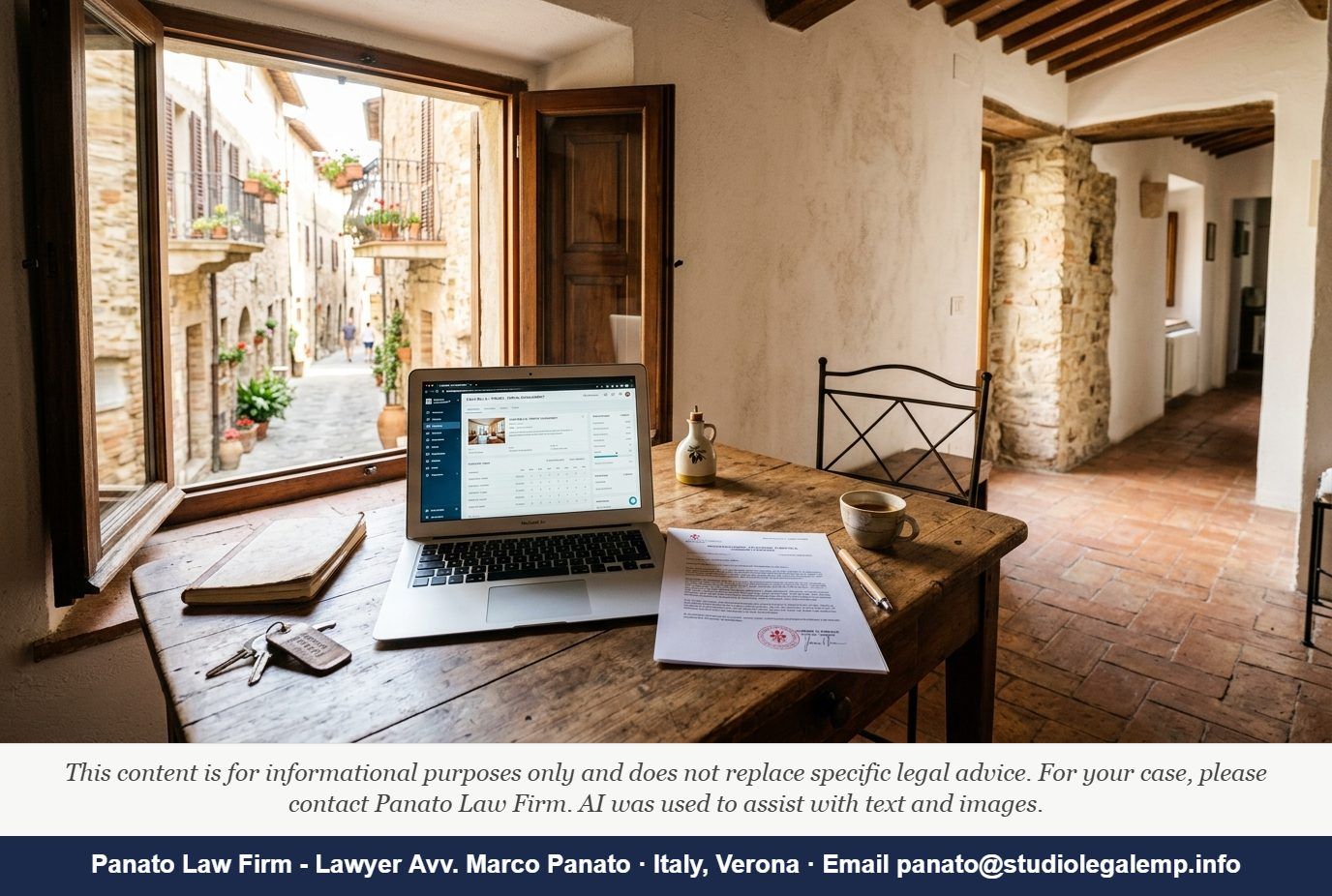
Image prompt: A sunlit Italian apartment interior — terracotta floor tiles, whitewashed walls, a wooden-shuttered window overlooking a narrow cobblestone alley — with a laptop open on a rustic table displaying a rental listing dashboard. On the table beside the laptop sits a sheet of printed paperwork with an official stamp, suggesting a registration process underway. The mood is warm but purposeful, the colour palette amber and cream with hints of terracotta. Photorealistic style, natural morning light.
Image file: italy-short-term-rental-rules-2026-foreign-property-owners-cover
HREFLANG BLOCK:
JSON-LD:
LANGUAGE QA: calibrated by conduct -> graduated according to the violation / tiered by offence · the obligation has been in force since late 2023 -> has applied since / took effect in late 2023 · converted with amendments by Law no. 191 -> as converted into law, with amendments, by Law no. 191 · triggers a legal presumption that the activity is entrepreneurial in nature -> gives rise to a statutory presumption that the activity constitutes a business · never personally changed a towel -> never set foot in the property · a sign affixed to the exterior of the building -> a notice displayed on the outside of the building · the flat-rate substitute tax known as the cedolare secca — Italy's flat-rate substitute tax -> the cedolare secca — Italy's flat-rate substitute tax · That practical shield is now being dismantled -> That practical protection is now being removed
CHECK:
AUTHORITY 1: Decree-Law no. 145/2023, Art. 13-ter, converted by Law no. 191/2023 / EXISTS? Yes — confirmed on Gazzetta Ufficiale / CONTENT MATCHES? Yes — CIN obligation, fines of €800–€8,000, platform delisting all confirmed.
AUTHORITY 2: EU Regulation 2024/1028 of 11 April 2024 / EXISTS? Yes — confirmed on EUR-Lex / CONTENT MATCHES? Yes — short-term accommodation data sharing, property-location trigger, May 2026 applicability confirmed.
AUTHORITY 3: Council Directive (EU) 2021/514 (DAC7), Italian implementation via Legislative Decree no. 32 of 1 March 2023 / EXISTS? Yes — both confirmed / CONTENT MATCHES? Yes — platform reporting obligations and automatic exchange confirmed.
AUTHORITY 4: Legge di Bilancio 2026 — two-property entrepreneurial threshold / EXISTS? Confirmed as a provision within the 2026 Budget Law package / CONTENT MATCHES? Partial — the brief states the threshold moved from "five to two"; the enacted legislation may have moved from four to two (the Decreto Anticipi 2023 had already moved the threshold from five to four). The article prudently does not specify "from five" and refers only to the new threshold. TO VERIFY before publication: the precise wording of the enacted Legge di Bilancio 2026 article on the two-property threshold.
AUTHORITY 5: Cedolare secca rates 21%/26% / EXISTS? Yes — established by Art. 4 DL 50/2017 as subsequently amended / CONTENT MATCHES? Yes.
OVERALL: AMBER — four of five authorities fully confirmed; the specific enacted article number of Legge di Bilancio 2026 on the two-property threshold requires a final check against the Gazzetta Ufficiale text before publication.
LOCAL NOTE:
1. Search intent targeted: informational with strong transactional pull — users searching this topic typically have an existing Italian property and are assessing their compliance exposure, making them ready to instruct a lawyer once they understand the risk.
2. Local-market framing used: the article addresses UK (HMRC SA105), US (IRS Schedule E / Form 1116), Australian (ATO foreign income) and Canadian readers simultaneously, using familiar filing references as anchors; the contrast passage explicitly flags the difference between common-law case-by-case business assessment and Italy's automatic legislative presumption, which is the single most surprising point for an Anglophone investor.
3. Italian terms kept untranslated: <i>cedolare secca</i> (kept in italics after first explanation because it has no natural English equivalent and is the term users encounter in Italian tax documents); <i>BDSR</i> and <i>INPS</i> (kept after explanation as they are institutional names users will need to recognise in official correspondence); <i>Camera di Commercio</i> (kept alongside English equivalent for the same reason).
Do you need legal assistance or a free estimate?
Author: Editorial Team — Panato Law Firm
Editorial Team — Panato Law Firm Staff