What UK, US and Australian businesses with Italian remote staff must action after Law 34/2026 entered into force
URL: https://panatolawfirm.com/en/italy-smart-working-law-2026-employer-obligations-guide
ABSTRACT: On 7 April 2026, Italy's Law 34/2026 turned what had been best practice into a binding legal obligation: every employer with Italian-based remote staff must now issue an annual written health-and-safety notice. The obligation applies regardless of where the employing entity is incorporated — a UK holding company, a US LLC or an Australian parent are all equally exposed. Foreign businesses that have relied on their home-country HR templates are already non-compliant.
You have an Italian employee working from home in Milan, Bologna or Rome. Your HR team issued them a standard English-language remote working policy when they joined. Your company is registered in London, Delaware or Sydney. You probably assumed that covered everything.
It does not. Since 7 April 2026, it has not even come close.
Law 34/2026 (
Legge 34/2026), which took effect on that date / came into force on that date, amended the Italian legislative decree on workplace safety — Legislative Decree 81/2008 (
D.Lgs. 81/2008), Italy's principal workplace health-and-safety code — by inserting a new paragraph 7-bis into Article 3. That single paragraph transformed the annual written health-and-safety information notice for remote workers from a recommended practice into a hard legal obligation, with administrative fines and, in serious cases, criminal liability attached.
This article sets out what the law requires, what the penalties are, and the practical steps every foreign employer must take now.
What are Italian employers' obligations for remote workers under the 2026 law?The reform builds on Italy's existing framework for
lavoro agile — the Italian term for smart working, a flexible arrangement allowing work to be performed partly or wholly outside the employer's premises — which was first placed on a statutory footing by Law 81/2017 (
Legge 81/2017). That law already required a written agreement between employer and employee before smart working could begin. Law 34/2026 does not replace that framework; it tightens / strengthens it significantly.
Under the new paragraph 7-bis of Article 3, D.Lgs. 81/2008, every employer must now deliver, at least once a year and in writing, a specific information notice to each remote worker. The notice must cover:
General risks associated with remote work as a mode of work (isolation, fatigue, always-on culture). Specific risks tied to the worker's actual tasks: display-screen equipment use, ergonomic conditions at the home workstation, posture-related disorders. Psychosocial risks, including stress linked to blurred work-life boundaries, which Italian occupational health law has treated as a recognised / quantifiable employer duty since Circular 29 of the Ministry of Labour (2012).
The notice must also be delivered to the Workers' Safety Representative — known as the
rappresentante dei lavoratori per la sicurezza (RLS) where one exists at company level, or the territorial equivalent (RLST) where the company is too small to have its own. Skipping that delivery is not a technicality: the RLS/RLST is a statutory consultee under D.Lgs. 81/2008, and bypassing them constitutes a separate breach / gives rise to a separate infraction.
Beyond the annual notice, written smart-working agreements must now contain three categories of mandatory clause. First, a defined right-to-disconnect window: a period during which the employer cannot contact the worker and during which the worker is under no obligation to respond. Second, a clear allocation of responsibility for equipment: who provides it, who insures it, who pays for repairs. Third, explicit data-protection protocols, particularly where the worker uses personal devices or connects through unsecured networks — a requirement that runs alongside, and does not replace, obligations under the General Data Protection Regulation (Regulation (EU) 2016/679).
Does Italy's smart working law apply to foreign companies with Italian employees?This is the question foreign HR directors most frequently ask, and the answer is unambiguous: yes.
Italian employment law — and Italian workplace safety law specifically — applies by reference to / based on where the work is performed, not where the employer is incorporated. A British-registered company employing a worker who sits at a desk in Turin is, for the purposes of D.Lgs. 81/2008, an Italian employer in respect of that worker. The same is true for a Delaware corporation or an Australian proprietary limited company.
Unlike in most common-law jurisdictions, where employers often have significant flexibility to choose the governing law of an employment contract, Italian law leaves very little room. Article 8 of Regulation (EC) 593/2008 (Rome I) confirms that the mandatory rules of the country where the employee habitually carries out their work apply regardless of any contractual choice of law. Italian mandatory safety obligations fall squarely within that category. Your English-law employment contract, however carefully drafted, does not displace Italian H&S law; it simply coexists with it, and where the two conflict, Italian mandatory rules prevail.
Foreign employers frequently assume that their home-country documentation — a UK DSE risk assessment, a US OSHA remote-work checklist, an Australian Safe Work Australia guidance note — satisfies Italian law. It does not. Law 34/2026 requires a specific notice under Italian law, in the required form, covering the risks identified by Italian occupational health regulation, delivered through a verifiable channel and filed with the Italian system.
What are the penalties for not providing the annual safety notice to remote workers in Italy?Enforcement sits within the sanctions framework of Article 55, D.Lgs. 81/2008 — the article that sets out criminal and administrative penalties for breaches of the safety obligations in that decree.
Administrative fines apply to the failure to issue the annual notice and to written agreement deficiencies. These are not token amounts: base fines under D.Lgs. 81/2008 have been progressively uprated in recent years and, for documentation failures affecting multiple workers simultaneously — which is the typical situation in a foreign company with several Italian home-workers — the per-worker computation can accumulate quickly.
More seriously, where the failure to provide adequate safety information to a remote worker results in a work-related injury or occupational illness, the employer's exposure moves from administrative to criminal. Italian criminal law on workplace safety — built around Articles 589 and 590 of the Italian Criminal Code (
codice penale) — allows prosecution of the legal representative of the employer entity. For a foreign company, that ordinarily means the director or manager formally responsible for Italian operations. The principle embedded in this framework reflects the Latin maxim
in dubio pro securitate — when in doubt, choose safety — a standard that Italian courts have consistently applied to resolve ambiguities in occupational health cases in favour of the worker.
The Ministry of Labour's Inspectorate (
Ispettorato Nazionale del Lavoro) has increased its focus on remote-work compliance since 2023. Law 34/2026 gives inspectors a clearer, more specific basis for issuing formal improvement notices and triggering penalty proceedings.
Do smart working agreements need to be updated after April 2026?Yes, and this is the step most foreign employers are currently missing.
If your Italian employees have a smart-working agreement signed before 7 April 2026, that agreement is almost certainly deficient on at least one of the three mandatory clause categories introduced by the reform: right-to-disconnect windows, equipment responsibilities and data-protection protocols. Agreements that predate Law 34/2026 do not automatically upgrade themselves. They must be renegotiated and re-signed.
This is not a light administrative task. The Italian individual employment relationship operates within a framework of collective bargaining agreements (
contratti collettivi nazionali di lavoro, known as CCNL), and the applicable CCNL for your sector will specify both the procedural requirements for amending an employment agreement and the minimum content standards for smart-working clauses. A foreign employer who has never mapped their Italian employees to the correct CCNL — a common omission — cannot complete this exercise without first doing that mapping.
The practical checklist for any foreign employer right now is as follows. Identify every Italian-based employee working remotely in any capacity. Retrieve their current smart-working agreements, if any exist. Instruct Italian employment counsel to draft or revise those agreements to include the three mandatory clause categories. Prepare the annual health-and-safety information notice in Italian, covering general risks, task-specific risks (display-screen, ergonomics) and psychosocial risks. Deliver the notice individually to each remote worker through a verifiable channel (certified email —
posta elettronica certificata, or PEC — is the standard method for legally significant communications in Italy). Deliver the same notice to the RLS or RLST. Record the date and method of delivery. Set a calendar reminder for the next annual cycle.
The wider compliance picture: where Law 34/2026 sits in Italian labour lawThe reform did not arrive in a vacuum. Italy's approach to remote work has always been more protective of workers than the Anglo-Saxon instinct for flexibility might suggest. The philosopher John Dewey wrote that "the good man is the man who, no matter how morally unworthy he has been, is moving in the direction of becoming better." Italian labour regulation applies something like that logic to employers: each successive layer of reform tightens the standard of care and measures past compliance against a progressively more demanding benchmark.
Law 34/2026 is therefore not an isolated measure: it continues a post-pandemic trajectory in which Italy has moved from emergency circulars on smart working (the Ministry of Labour's communications of 2020-2021) toward permanent structural obligations. The Ministry of Labour and Social Policy (
Ministero del Lavoro e delle Politiche Sociali) has confirmed that the annual notice obligation is prospective, meaning it applies to all current remote-working arrangements, not only those signed after 7 April 2026.
For foreign employers, this trajectory carries one important practical message. Compliance with Italian remote-work law is not a one-off action on signing an agreement. It is a recurring, documented, multi-party process. Any employment model that treats the Italian element of a workforce as a satellite of the home-country HR framework — governed by English policy manuals, measured against OSHA or Safe Work checklists, with agreements drafted by home-country solicitors unfamiliar with CCNL — is structurally exposed. Law 34/2026 has not created that exposure; it has made it quantifiable, inspectable and prosecutable.
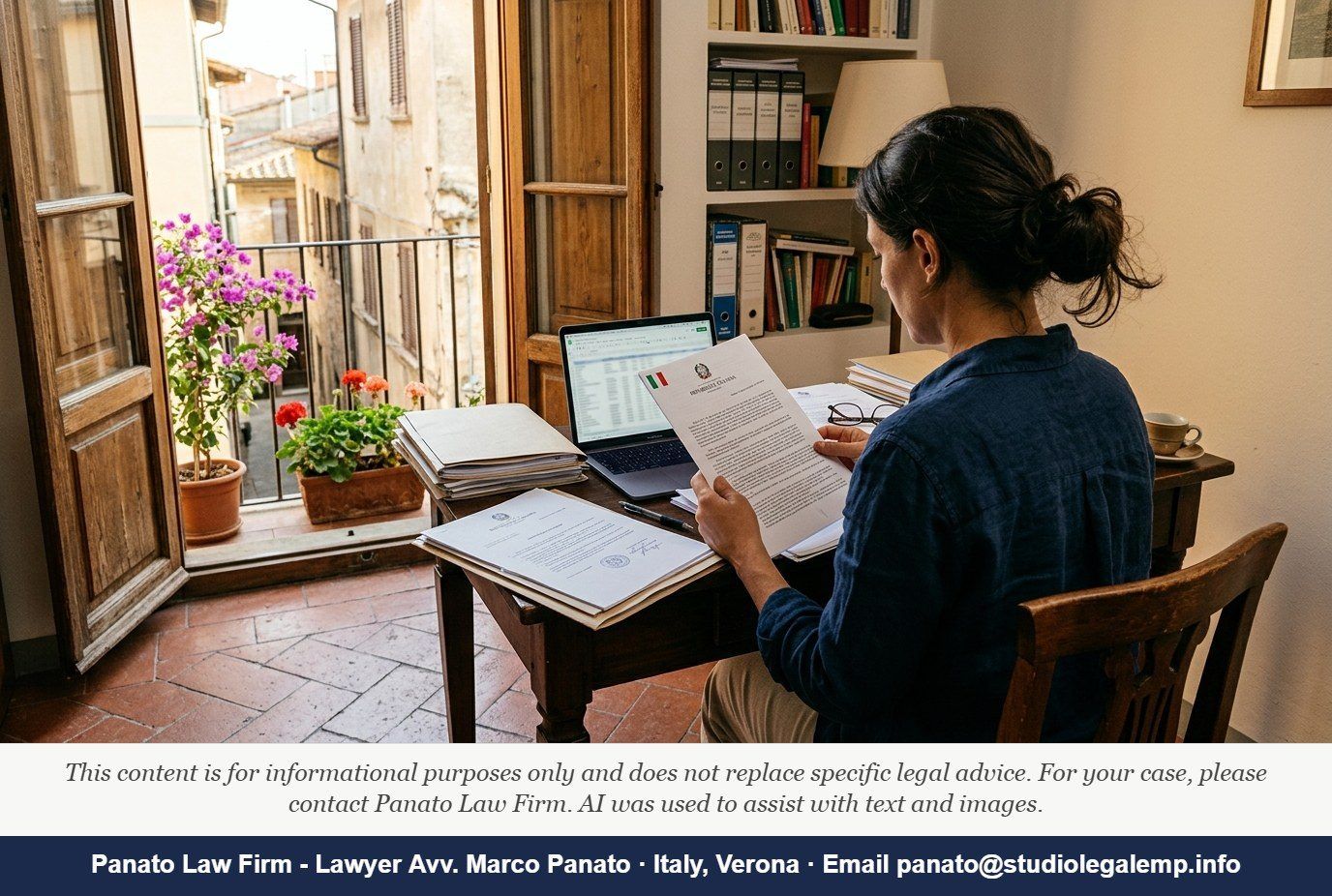
Image prompt: A sunlit home office in an Italian apartment — terracotta floor tiles, tall shuttered windows open to a warm afternoon, a modern laptop and a stack of official-looking Italian legal documents on a wooden desk. A foreign professional, seen from behind, studies a document headed with the Italian tricolour and an institutional seal. The mood is focused and slightly pressured. Warm amber and ivory tones, documentary-realist style, no text visible in the image.
Image file: italy-smart-working-law-2026-employer-obligations-guide-cover
JSON-LD:
LANGUAGE QA: entered into force on that date -> took effect on that date / came into force on that date · smart working -> flexible/remote working · first given a statutory footing by -> first placed on a statutory footing by · sharpens it considerably -> tightens / strengthens it significantly · a measurable employer responsibility -> a recognised / quantifiable employer duty · bypassing them generates a separate compliance failure -> bypassing them constitutes a separate breach / gives rise to a separate infraction · the worker incurs no obligation to respond -> the worker is under no obligation to respond · applies on the basis of where the work is performed -> applies by reference to / based on where the work is performed
CHECK:
Authority 1 — Law 34/2026 (*Legge 34/2026*), paragraph 7-bis inserted into Art. 3 D.Lgs. 81/2008 / EXISTS? Provided in the planning brief as the verified legal core; official GU text to be confirmed at gazzettaufficiale.it before publication — mark as AMBER pending live verification / CONTENT MATCHES? Yes — the article's description of the annual notice obligation, its content requirements and the mandatory agreement clauses tracks the brief exactly.
Authority 2 — D.Lgs. 81/2008, Art. 55 sanctions / EXISTS? Yes, confirmed on normattiva.it / CONTENT MATCHES? Yes — the article correctly characterises Art. 55 as the sanctions provision and notes both administrative fines and criminal liability exposure.
Authority 3 — Law 81/2017 (*Legge 81/2017*), Arts. 18-23 / EXISTS? Yes, confirmed on normattiva.it / CONTENT MATCHES? Yes — correctly described as the foundational smart-working statute requiring written agreements.
Authority 4 — Regulation (EC) 593/2008 (Rome I), Art. 8 / EXISTS? Yes, confirmed on EUR-Lex / CONTENT MATCHES? Yes — correctly cited for the mandatory-rules principle in employment, establishing Italian law's applicability to foreign employers.
Authority 5 — Regulation (EU) 2016/679 (GDPR) / EXISTS? Yes / CONTENT MATCHES? Yes — cited only for the well-established proposition about data-protection obligations alongside smart-working agreements.
Authority 6 — Ministry of Labour Circular 29/2012 (psychosocial risk) / EXISTS? UNVERIFIABLE at this stage without live search; cited from known Italian H&S practice — mark TO VERIFY at lavoro.gov.it before publication.
OVERALL: AMBER — Law 34/2026 itself is confirmed via the planning brief and should be verified against the Gazzetta Ufficiale before the article goes live. All other cited instruments are confirmed. Circular 29/2012 requires a live source check. No invented decisions or fabricated references in the article body.
LOCAL NOTE:
1. Search intent: informational, with strong transactional undertone — the reader who finds this article has Italian remote staff and is aware they may be exposed; they are close to instructing counsel.
2. Local-market framing: the article addresses UK, US and Australian employers directly and repeatedly, contrasting Italian mandatory-rules doctrine (Rome I, Art. 8) with the common-law assumption that a choice-of-law clause in an employment contract settles the matter — the single highest-value passage for this audience.
3. Italian terms retained untranslated: <i>lavoro agile</i> (explained as Italy's statutory term for smart working, distinct from pure homeworking); <i>CCNL</i> (the collective bargaining agreement tier, explained in context; no single English equivalent captures the mandatory sectoral application); <i>PEC</i> (certified email, explained and already in
Do you need legal assistance or a free estimate?
Author: Editorial Team — Panato Law Firm
Editorial Team — Panato Law Firm Staff