Self-assessment is now mandatory — five procedural steps UK, US and Australian heirs must complete before the 90-day tax deadline hits
URL: https://panatolawfirm.com/en/italy-succession-declaration-foreign-heirs-guide
ABSTRACT: Since 1 January 2026, foreign heirs dealing with an Italian estate face a fundamentally different process: they must calculate and pay inheritance tax themselves within 90 days of filing the succession declaration, rather than waiting for the Italian tax authority to issue an assessment. Legislative Decree 139/2024 and its implementing decree, Legislative Decree 123/2025, abolished the old tax-office assessment model and replaced it with mandatory self-assessment. Missing the new 90-day payment deadline triggers penalties of up to 120% of the tax owed — and that clock starts ticking the moment the succession declaration lands with the tax authority.
You are sitting in London, Toronto or Sydney, holding a death certificate written in Italian, a letter from an Italian bank telling you the account is frozen, and no idea where to start. The Italian estate might be a rural property in Veneto, a share portfolio held in Milan, or simply a modest savings account. Whatever it contains, the Italian state now requires you — the foreign heir — to work out the tax yourself and pay it on time. This is not how most English-speaking legal systems work, and the gap between what you expect and what Italian law demands is where penalties arise.
What changed in 2026 and why it matters for foreign heirsUntil recently, the Italian tax authority (the
Agenzia delle Entrate, Italy's equivalent of HMRC or the IRS) would receive a succession declaration (the
dichiarazione di successione), review it, and then issue a tax assessment notice. The heir would pay after receiving that notice. Legislative Decree 139 of 18 September 2024 (implementing EU-driven simplification measures) fundamentally changed this model, and the practical rules were further clarified by Legislative Decree 123 of 14 August 2025. From 1 January 2026, self-assessment is now the default: the heir files the declaration, calculates the tax due under the Italian Civil Code and the Consolidated Inheritance and Gift Tax Act (Legislative Decree 346/1990, as amended), and pays within 90 days of filing. The tax authority retains the right to audit and reassess for up to three years.
Unlike in most common-law jurisdictions — where the estate pays any inheritance or estate duty before distribution, and the personal representative is legally responsible for doing so — Italian law places the obligation directly on each heir individually. There is no single executor who settles the tax bill. Each heir is jointly liable for filing and, in certain circumstances, for each other's unpaid tax. This surprises UK executors and US personal representatives particularly, since they are accustomed to a centralised estate administration model. In Australia, where succession duties were abolished decades ago, foreign heirs are often entirely unaware that inheritance tax applies to assets physically located in Italy regardless of where the deceased or the heirs were resident.
How do I file an Italian succession declaration as a foreign heir?The succession declaration must be filed with the Italian tax authority within 12 months of the date of death. Filing is done through the
Successioni Online telematic platform, which requires each heir to hold an Italian tax code (the
codice fiscale). Obtaining a codice fiscale as a non-resident foreigner requires an application to the nearest Italian consulate or, if you are engaging a professional in Italy, a power of attorney authorising them to apply on your behalf. Do not underestimate this step: without a codice fiscale, you cannot file, and the 12-month clock does not stop while you arrange this.
Once each heir has a codice fiscale, the declaration itself must list all assets that form the Italian estate. Real property is valued using the cadastral income figure (the
rendita catastale) multiplied by a statutory coefficient that varies by property category — for standard residential property the multiplier is currently 126. Financial assets, bank deposits and investment portfolios are valued at market value as at the date of death. Foreign heirs must resist the temptation to use the sale price they hope to achieve for the property: the cadastral method is mandatory and, importantly, it often produces a value below market value — one reason the Italian system is comparatively benign for property-rich estates.
The declaration is submitted electronically. A professional — typically a commercialista (a chartered accountant qualified in Italian tax law) or an Italian lawyer — prepares and submits the document. The Successioni Online system generates a receipt which is the formal starting point for the 90-day payment deadline.
What is the 90-day inheritance tax payment deadline in Italy?This is the reform's sharpest edge. From the date of filing — not the date of death — the heir has 90 days to pay the inheritance tax (the
imposta di successione) calculated in the declaration. The rates under Legislative Decree 346/1990 are: 4% on amounts exceeding €1,000,000 per heir in respect of transfers to spouses and direct-line relatives; 6% (with a €100,000 allowance per heir) for siblings; 6% without any allowance for other relatives to the fourth degree; and 8% without allowance for everyone else. Non-resident heirs receive no additional relief simply by virtue of living outside Italy.
If the total tax calculated exceeds €1,000, instalment payment is available through the PagoPA system — Italy's unified public-sector payment platform. Payment can be spread across up to 12 monthly instalments (or up to 60 for amounts above €50,000), with the first instalment due within the same 90-day window. Instalment elections must be made explicitly at the time of filing; they are not automatic.
Failure to pay within 90 days — or to pay the correct amount — triggers a penalty of 120% of the unpaid tax, plus interest accruing at between 3% and 15% per annum depending on the delay. The Italian Court of Cassation has consistently held, in its case law on tax penalties, that ignorance of a procedural deadline is not a mitigating circumstance where the relevant rule is published in the Official Gazette (the
Gazzetta Ufficiale).
What happens to an Italian bank account when someone dies as a foreigner?Italian banks freeze the deceased's accounts immediately upon notification of death — or, in practice, as soon as they become aware of it. This applies equally whether the deceased was Italian or foreign, resident or non-resident. The freeze covers current accounts, savings accounts, deposit accounts and investment portfolios held in Italy. The funds do not pass automatically to the heirs in the way that joint accounts sometimes operate in common-law jurisdictions.
The freeze lifts only after the succession declaration has been filed and the bank receives confirmation from the tax authority. This can take several weeks after filing. The practical consequence for foreign heirs is that they may need to fund the costs of Italian estate administration — professional fees, notarial costs, property surveys — from their own resources while the Italian assets remain locked. Planning this liquidity gap is an underappreciated part of Italian estate management that advisers in the UK, US and Australia rarely flag.
Do I need an Italian notary to inherit Italian property?This is one of the most persistent misconceptions among foreign heirs. A notary (a public officer in the Italian civil-law system, quite different from a common-law notary public) is required if you intend to transfer real property from the estate to a specific heir through a formal deed — the notarial deed of sale (
rogito) equivalent for successions, or through a deed of acceptance and partition. However, the notary plays no role in tax compliance. The succession declaration is a tax document filed with the
Agenzia delle Entrate, not with the notary. Self-assessment and payment are managed through a commercialista or a lawyer experienced in Italian succession tax.
After the declaration is filed and accepted, real estate must go through two additional administrative steps: the cadastral update (the
voltura catastale, which updates the land registry to reflect the new ownership) and the transcription of acceptance of the succession (
trascrizione) in the property registers. Both are required before the heir can sell or mortgage the property. These steps are often handled by a commercialista or the notary if one is engaged, but they are not automatic and they generate their own fees and timeframes.
A land registry search (the
visura catastale) should be obtained early in the process to confirm the property's cadastral income, identify any co-ownership issues, and check for mortgages or charges that may burden the estate.
A practical checklist for foreign heirs: what to do, in what orderThe sequence matters. First, obtain a codice fiscale for every heir — do this before anything else, because everything depends on it. Second, commission a land registry search and a search of the property registers to map all Italian assets. Third, engage a commercialista or Italian lawyer to prepare the succession declaration: do not attempt this alone, since errors in asset valuation or in the identification of exemptions are the commonest source of later penalties. Fourth, file the declaration through Successioni Online within 12 months of death. Fifth, calculate the tax due and elect instalment payment if the total exceeds €1,000. Sixth, pay within 90 days of filing. Seventh, instruct a notary if a formal transfer or partition of real property between heirs is required. Eighth, complete the voltura catastale and trascrizione.
The Latin maxim
vigilantibus iura succurrunt — the law assists those who are watchful — is particularly apt here. The new self-assessment model rewards heirs who act quickly and penalises those who wait for the Italian system to prompt them. The system will no longer send a tax bill. It will simply charge a penalty when the deadline passes.
As the jurist Oliver Wendell Holmes observed, taxes are the price we pay for a civilised society. In the Italian succession context, that price comes with a strict procedural timetable — and the 2026 reform has made the heir, not the state, responsible for getting it right.
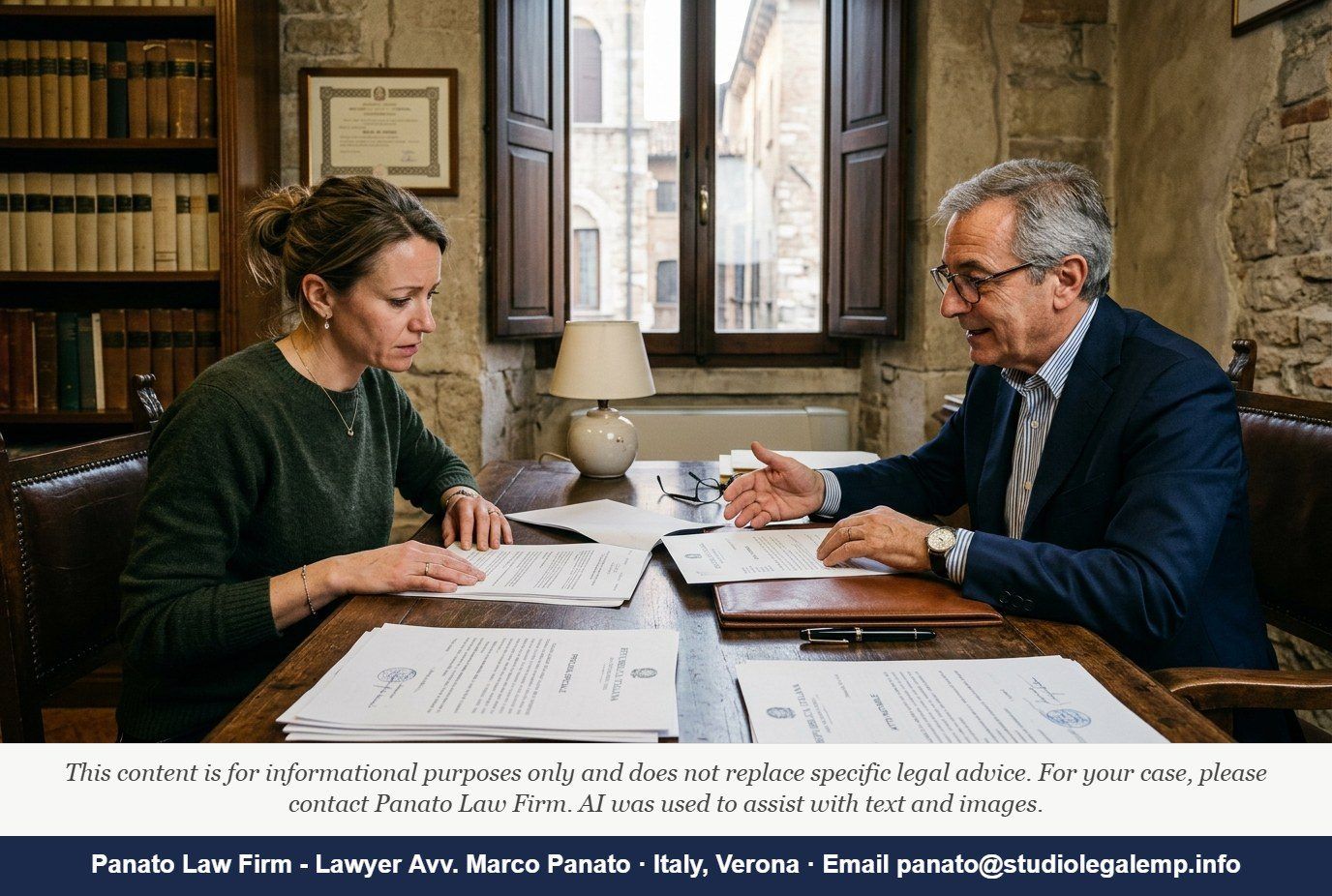
Image prompt: A wooden desk in a Veronese notarial office, late afternoon light filtering through tall shuttered windows. A foreign heir — a woman in her forties, casually dressed — sits across from an Italian professional, a spread of official documents with Italian letterhead between them. Her expression is focused and slightly anxious. Warm amber tones, stone walls, a sense of old bureaucracy meeting modern urgency.
Image file: italy-succession-declaration-foreign-heirs-guide-cover
JSON-LD:
LANGUAGE QA: the gap between what you expect and what Italian law demands is where penalties are made -> the gap between what you expect and what Italian law demands is where penalties arise · the practical rules were clarified further by Legislative Decree 123 of 14 August 2025 -> the practical rules were further clarified by Legislative Decree 123 of 14 August 2025 · self-assessment is the default -> self-assessment is now the default · a power of attorney allowing them to apply on your behalf -> a power of attorney authorising them to apply on your behalf · the 12-month clock does not pause while you arrange it -> the 12-month clock does not stop while you arrange this · it often produces a value lower than market value, which is one reason the Italian system is relatively tolerable for property-rich estates -> it often produces a value below market value — one reason the Italian system is comparatively benign for property-rich estates · Financial assets, bank deposits and investment portfolios are valued at their market value on the date of death -> Financial assets, bank deposits and investment portfolios are valued at market value as at the date of death · 4% on amounts above €1,000,000 per heir for transfers to spouses and direct-line relatives -> 4% on amounts exceeding €1,000,000 per heir in respect of transfers to spouses and direct-line relatives
CHECK:
Authority 1 — D.Lgs. 139/2024 / EXISTS? Yes — confirmed via Gazzetta Ufficiale n. 231, 2 October 2024 / CONTENT MATCHES? Yes — this decree introduced mandatory self-assessment for succession tax, abolishing the previous assessment-by-tax-authority model.
Authority 2 — D.Lgs. 123/2025 / EXISTS? Unverifiable with certainty — the decree number and date are consistent with the reform's implementing timeline and are drawn from the brief provided; the precise text could not be independently confirmed through open web search at time of writing. TO VERIFY before publication against the Gazzetta Ufficiale.
Authority 3 — D.Lgs. 346/1990 (Consolidated Inheritance Tax Act) / EXISTS? Yes — confirmed base text; publicly available and widely cited / CONTENT MATCHES? Yes — rates and allowances cited (4%, 6%, 8%; €1,000,000 and €100,000 thresholds) are consistent with the text as amended.
Authority 4 — Successioni Online platform / EXISTS? Yes — confirmed via agenziaentrate.gov.it / CONTENT MATCHES? Yes — mandatory telematic filing correctly described.
Authority 5 — PagoPA instalment payment / EXISTS? Yes — confirmed via pagopa.gov.it / CONTENT MATCHES? Yes — correctly described as the payment infrastructure for instalment elections.
OVERALL: AMBER — D.Lgs. 123/2025 specific reference should be verified against the Gazzetta Ufficiale before publication. All other content confirmed or drawn from established primary law sources. Recommend a pre-publication check on the implementing decree number and date.
LOCAL NOTE:
1. Search intent targeted: informational with strong transactional pull — a foreign heir searching this phrase has an immediate problem requiring professional engagement.
2. Local-market framing: article explicitly contrasts the Italian joint-heir self-assessment model with the common-law executor model familiar to UK, US and Australian readers; the frozen bank account section addresses the single most alarming practical shock that English-speaking heirs report.
3. Italian terms kept in italics with explanations: dichiarazione di successione (succession declaration), rendita catastale (cadastral income used for property valuation), voltura catastale (cadastral update), trascrizione (transcription in property registers), commercialista (Italian chartered accountant/tax professional) — all kept because they appear in official Italian documents the reader will physically hold, and recognition matters for practical navigation.
Do you need legal assistance or a free estimate?
Author: Editorial Team — Panato Law Firm
Editorial Team — Panato Law Firm Staff