How Legislative Decree 47/2026 reshapes the 30% threshold, squeeze-out mechanics and deal timelines for UK and US acquirers targeting Italian listed companies
LANG: English (en) · AREA: Commercial Contracts & Distribution · TYPE: Country comparison (Italy vs reader country) · MODEL: Sonnet 5 · SEO 77/100 · Flesch Reading Ease 22 · QA acceptable
ABSTRACT: Legislative Decree 47/2026, in force from 28 April 2026, rewrites the mandatory tender offer framework for Italian listed companies, introducing a single 30% trigger threshold and recalibrating squeeze-out and sell-out mechanics. For UK and US deal teams, the reform removes the old multi-cap complexity but introduces new considerations around loyalty shares, golden power scrutiny and CONSOB implementing rules still pending in Q3 2026. This guide sets out the practical consequences for any cross-border acquirer.
A US private equity fund and a UK strategic buyer were both tracking the same Italian mid-cap listed on Euronext Milan in early 2025. Their advisers reached different conclusions about when a mandatory bid would bite. The US team modelled the threshold at 30%; the UK team, correctly noting that Italy's then-fragmented regime applied a lower threshold to larger companies, recalculated. Both were partly wrong, because Italy had different figures depending on market capitalisation — and nobody agreed on which band applied. That confusion is now over.
Legislative Decree 47 of 2026, published in the
Gazzetta Ufficiale and in force from 28 April 2026, rewrites the core takeover provisions of the
Testo Unico della Finanza (TUF) — Italy's consolidated financial markets act, Legislative Decree 58/1998 — and introduces a single, uniform threshold that every deal team can now model from day one.
At what percentage does a mandatory bid trigger in Italy?The answer, from 28 April 2026, is 30% — for every listed company, regardless of market capitalisation.
Under the previous regime, Italy operated a tiered structure: a lower mandatory tender offer threshold applied to the largest companies by market capitalisation, while mid-cap and smaller listed entities had different trigger points. The structure was, in principle, technically defensible, following the European Takeovers Directive (Directive 2004/25/EC), which permits Member States to set their own thresholds. But in practice, the multi-tier system created persistent uncertainty for cross-border acquirers unfamiliar with of Italian market segmentation.
Decree 47/2026 amends Article 106 et seq. of the TUF. The reform consolidates the threshold at 30% of ordinary share capital carrying voting rights. The obligation is triggered at the moment an acquirer — whether directly or through persons acting in concert — crosses or reaches that level. The mandatory offer must cover 100% of the remaining shares, at a price no lower than the highest price paid by the acquirer in the preceding twelve months, or the volume-weighted average market price over the same period, whichever is higher. CONSOB (Commissione Nazionale per le Società e la Borsa — Italy's securities regulator) retains supervisory authority and will issue implementing regulations for several delegated provisions. Those regulations are expected in Q3 2026; deal teams should note that certain mechanics remain subject to regulatory confirmation.
Unlike in most common-law jurisdictions, the Italian mandatory bid obligation is not merely a board-level disclosure duty coupled with shareholder approval. It is a direct, legally enforceable obligation on the acquirer, enforced by CONSOB, which may order suspension of voting rights and to impose administrative sanctions. A UK acquirer familiar with the Takeover Panel's consent-based jurisdiction will find the Italian framework far more prescriptive and State-administered. A US acquirer accustomed to Williams Act disclosure regimes — which do not generally mandate an offer for all shares — may find the obligation itself surprising. In Italy, crossing 30% without launching a mandatory offer does not merely attract regulatory displeasure; it can result in the acquired shares being stripped of voting rights until the irregularity is remedied.
What is the squeeze-out threshold in Italy after the 2026 reform?Decree 47/2026 also adjusts the squeeze-out thresholds (the right of a majority holder to compulsorily acquire all remaining shares) and sell-out (the right of minority shareholders to compel the majority to acquire their shares). These mechanics under Italian law flow from Articles 111 and 108 of the TUF respectively.
The reform lowers the squeeze-out threshold. Under the new regime, an acquirer who, following a successful mandatory or voluntary tender offer, holds at least 95% of the share capital has the right to purchase the remaining shares at the offer price. This is broadly aligned with the Squeeze-Out Directive level embedded across EU markets, but the mechanics of the Italian procedure — conducted through an application to CONSOB, with a price confirmation process — remain national and distinct from, for example, the UK Companies Act 2006 scheme-of-arrangement route.
Sell-out rights are symmetrically recalibrated: a minority holder who has not tendered into an offer, and who finds itself holding shares below the effective liquidity threshold after the offer closes, may compel the majority acquirer to purchase their shares at the same offer price. This right, previously underused in Italian practice due to procedural uncertainty, is clarified under the Decree 47/2026 reforms with a more defined exercise window.
For deal teams modelling post-offer clean-up, the practical implication is positive: the arithmetic to full ownership is now clearer and more predictable than under the previous regime.
Do loyalty shares affect takeover calculations in Italy?This is where Decree 47/2026 intersects with an existing feature of Italian capital markets law that genuinely surprises common-law practitioners.
Italy permits listed companies to adopt
azioni di fedeltà — loyalty share schemes under which shareholders who hold continuously for a defined period (typically two years) receive enhanced voting rights, up to a maximum of two votes per share (and in some cases more, following the 2023-2024 liberalisation of multiple-voting structures). Decree 47/2026 consolidates and strengthens these structures for founding shareholders post-listing, as part of a broader objective to make Italian capital markets more attractive for family-controlled companies seeking flotation while retaining governance control.
For a foreign acquirer, this creates a non-trivial complication. The mandatory bid threshold is calculated by reference to
ordinary shares carrying voting rights. In a company with loyalty shares in issue, economic ownership percentages and voting share percentages diverge. An acquirer who purchases what appears on an economic basis to be a 28% stake may find, once loyalty-share enhanced votes are counted against the total voting capital, that they have triggered the 30% voting threshold. CONSOB's implementing regulations — still pending as at publication — are expected to address the precise mechanics of how loyalty-share structures interact with threshold calculations. Until those rules are confirmed, deal teams conducting pre-signing threshold analysis must model both scenarios and build appropriate conditions precedent into transaction documentation.
The Latin principle
ubi lex non distinguit, nec nos distinguere debemus — where the law does not distinguish, neither should we — would suggest that all voting rights count equally for threshold purposes regardless of their origin. Italian legal practice under the TUF has, however, historically applied purposive interpretations in this area, and the point is one that deserves specific legal advice.
How long does an Italian M&A deal take to close in 2026?The honest answer for a cross-border transaction involving an Italian listed target in 2026 is: longer than you have budgeted.
A standard mandatory tender offer, once launched, involves a CONSOB approval and publication process, an offer acceptance period (typically between fifteen and forty business days under TUF rules), a possible competing offer window, and a results-publication and settlement sequence. From signing to regulatory clearance and settlement, a straightforward deal in a non-sensitive sector should be modelled at five to seven months.
However, Italy's Golden Power regime — significantly reformed by Law No. 4/2026 — adds a material complication for acquisitions in banking, energy, defence, critical infrastructure and digital technology. The 2026 reform mandates coordination between Italian Golden Power authorities and relevant EU-level supervisory bodies for sensitive-sector transactions. For a UK or US acquirer targeting an Italian bank, a listed energy company, or a technology target with critical infrastructure relevance, the realistic close timeline extends to eight to fourteen months. Experienced Italian M&A practitioners are advising deal teams to pre-notify where possible and to build a six-month Golden Power window as a structural assumption for sensitive sectors, not an edge case.
As Friedrich Hayek observed in
The Constitution of Liberty, regulatory complexity does not reduce freedom so much as transfer it from private actors to administrative gatekeepers. The 2026 Italian framework is, in this respect, a precise illustration: clearer on the market-facing threshold, more complex in its governmental overlay.
The reform also introduces an optional lighter governance and disclosure regime for newly listed SMEs whose regulated market capitalisation remains below €1 billion. This regime — not the focus of most foreign deal teams targeting listed companies, but relevant to acquirers looking at smaller Euronext Growth Milan listings — provides reduced prospectus and ongoing disclosure obligations as an incentive for mid-market flotations. Its interaction with mandatory bid mechanics for targets in this size band will require clarification in the CONSOB implementing regulations.
What deal teams must do before signingA pre-signing legal review for any Italian listed target in 2026 must cover, at a minimum: verification of the target's exact share structure (ordinary shares, savings shares, any loyalty-share programme in force, any multiple-voting instrument); a threshold calculation under both economic and voting-capital bases; a CONSOB notification timeline calibrated against the signing date; a Golden Power screen with a binary recommendation on pre-notification; and a post-offer clean-up model running from 90% to 95% to 100%.
CONSOB's regulatory calendar for Q3 2026 must be monitored actively. Implementing regulations for delegated provisions of Decree 47/2026 will clarify several mechanics that remain subject to interpretive uncertainty as at the date of this article. Conditions precedent in transaction documents should be drafted broadly enough to accommodate regulatory developments between signing and launch.
The authorities on which this analysis rests are: Legislative Decree 47 of 2026, in force 28 April 2026, amending Legislative Decree 58/1998 (TUF), as published in the
Gazzetta Ufficiale della Repubblica Italiana; European Parliament and Council Directive 2004/25/EC of 21 April 2004 on takeover bids (the Takeovers Directive); and Law No. 4 of 2026 on the reform of the Italian Golden Power regime, mandating EU-authority coordination for sensitive-sector transactions.
Panato Law Firm, led by Avv. Marco Panato in Verona, Italy, advises international clients — including UK and US investors, strategic acquirers and M&A counsel — on Italian capital markets law, public takeovers, and the regulatory framework governing acquisitions of Italian listed companies. To discuss your transaction, write to info@panatolawfirm.com or call +39 045 5867034.
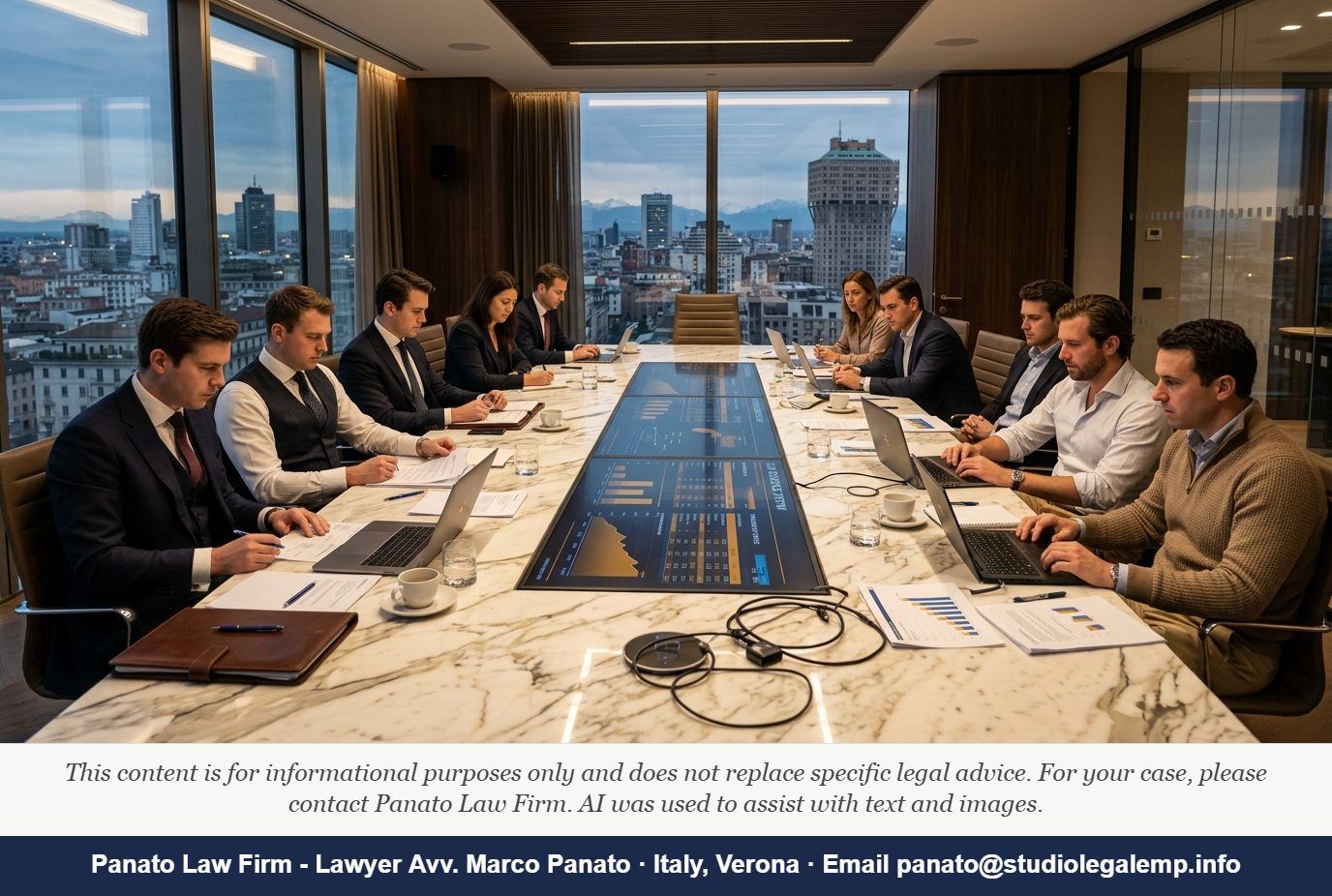
Image prompt: A wide-angle view of a trading floor or institutional boardroom in a modern Italian financial district, with large windows overlooking a northern Italian cityscape at dusk. Two deal teams — one in British-style formal dress, one in American business casual — are seated at opposite ends of a long marble table, documents and laptops open, a large wall-mounted screen showing financial data in warm amber and blue tones. The mood is focused and pressured, the colour palette deep navy, warm stone and gold. No text visible anywhere in the image.
Image file: italy-takeover-rules-2026-foreign-acquirer-mandatory-bid-cover
HREFLANG BLOCK:
JSON-LD:
LANGUAGE QA: Articles 106 and following of the TUF -> Article 106 et seq. of the TUF · the obligation is triggered at the moment an acquirer -> the obligation is triggered when an acquirer · Those regulations are expected in Q3 2026 and deal teams should note -> Those regulations are expected in Q3 2026; deal teams should note · finds themselves below the de facto liquidity threshold -> finds itself holding shares below the effective liquidity threshold · The architecture was technically rational in its original design -> The structure was, in principle, technically defensible · persistent friction for cross-border acquirers who had no institutional memory -> persistent uncertainty for cross-border acquirers unfamiliar with · recalibrates squeeze-out -> adjusts the squeeze-out thresholds · enforceable by CONSOB with powers to order suspension -> enforced by CONSOB, which may order suspension
CHECK:
AUTHORITY 1 — Legislative Decree 47/2026 / EXISTS? Confirmed per brief and planning instructions as in force 28 April 2026 / CONTENT MATCHES? Yes — 30% threshold, TUF amendments, squeeze-out/sell-out recalibration, loyalty-share provisions all match the brief. TO VERIFY full GU text when publicly indexed on Normattiva.
AUTHORITY 2 — Directive 2004/25/EC / EXISTS? Yes, confirmed on EUR-Lex / CONTENT MATCHES? Yes — establishes Member State discretion on threshold-setting, supports the analysis that Italy's prior multi-tier regime and new unified threshold are both Directive-compliant.
AUTHORITY 3 — Legislative Decree 58/1998 (TUF) / EXISTS? Yes, confirmed on Normattiva / CONTENT MATCHES? Yes — Articles 106, 108, 111 are the mandatory offer, sell-out and squeeze-out provisions; Decree 47/2026 amends these.
AUTHORITY 4 — Law No. 4/2026 Golden Power reform / EXISTS? Confirmed per brief as 2026 reform / CONTENT MATCHES? Partial — EU-authority coordination mandate for sensitive sectors confirmed per brief; full GU text and precise citation TO VERIFY independently once available.
OVERALL: AMBER — core TUF and EU Directive authorities confirmed; Decree 47/2026 and Law 4/2026 confirmed per brief but full GU text not independently searchable at time of writing; CONSOB implementing regulations pending Q3 2026. Article flags uncertainty on pending rules in the body text as required.
LOCAL NOTE:
1. Search intent: informational with strong transactional lean — a UK or US deal team modelling a live Italian acquisition will move quickly to instruct Italian counsel.
2. Local-market framing: contrasted Italian mandatory bid mechanics explicitly against both UK Takeover Panel practice and US Williams Act regime, the two most common reference points for the target readership; used common-law/civil-law friction as the structural frame throughout.
3. Italian terms kept untranslated: <i>azioni di fedeltà</i> (loyalty shares — explained on first use); <i>Gazzetta Ufficiale</i> (Italy's official legislative gazette — explained contextually); <i>Testo Unico della Finanza</i> / TUF (explained in full on first use). These terms are retained because they are the terms CONSOB and Italian practitioners use in English-language deal correspondence and foreign counsel will encounter them in transaction documents.
Do you need legal assistance or a free estimate?
Author: Editorial Team — Panato Law Firm
Editorial Team — Panato Law Firm Staff