Your Italian client has not paid. Here is every statutory right you already have — and the exact rate in force for the second half of 2026
#80 · LANG: English (en) · AREA: Debt Recovery & Enforcement in Italy · TYPE: FAQ / People Also Ask · MODEL: Sonnet 5 · SEO 84/100 · Flesch Reading Ease 52 · fonte: EN_PT_batch_articles_12items_2026-08-14_h10-16_a0my.doc
URL: https://panatolawfirm.com/en/late-payment-interest-italy-unpaid-invoice-claim
ABSTRACT: Under Italian law, a foreign supplier with an overdue Italian invoice does not need to chase or threaten: the right to statutory late-payment interest and a flat €40 recovery fee arises automatically the day after the contractual or statutory due date. This article explains exactly what you can claim, at what rate, and how to quantify it, including the rate in force for July to December 2026. It also addresses the stalled EU reform that may change everything — or nothing.
You issued an invoice to an Italian company. The payment term passed. Your Italian client has gone quiet. What most foreign suppliers do not realise is that, the moment that term expired, Italian law automatically gave you a running interest entitlement worth more than most commercial loans charge. You do not need to have sent a reminder. You do not need a judgment. The right is there. The only question is whether you will exercise it.
The statutory framework: D.Lgs. 231/2002 and what it actually gives youLegislative Decree no. 231 of 9 October 2002 (
Decreto Legislativo 9 ottobre 2002, n. 231) is the Italian statute that implements Directive 2011/7/EU of the European Parliament and of the Council on combating late payment in commercial transactions. It applies to every commercial contract between businesses, and between businesses and Italian public authorities, where goods are supplied or services are rendered.
Three distinct entitlements arise automatically the moment an invoice becomes overdue:
The first is interest at the statutory rate. Under Article 5 of D.Lgs. 231/2002, interest runs from the day after the contractual due date — or, if no date is agreed, from 30 days after the invoice date for business-to-business transactions. No reminder, no formal notice, no court filing is required. The rate is revised on 1 January and 1 July each year. For the second half of 2026 (1 July to 31 December 2026), the European Central Bank reference rate stands at 2.40%, making the applicable statutory rate 10.40% per annum. That is the ECB rate plus the 8 percentage point margin prescribed by law.
The second is a flat €40 minimum compensation fee per invoice, payable under Article 6 of D.Lgs. 231/2002. This is not a penalty clause you need to have agreed. It is a statutory right, and it applies to every single overdue invoice separately. A supplier with ten overdue invoices has a €400 statutory entitlement in compensation fees alone, before any interest is calculated.
The third is additional recovery costs. Where your actual recovery expenses exceed €40 per invoice — debt collection agency fees, legal fees, translation costs, enforcement charges — you may claim the excess under Article 6(3), subject to evidence that the costs were reasonably incurred.
What interest rate can I charge an Italian client for late payment?The rate for any given period depends on which ECB reference rate was in force when the obligation fell due. The ECB rate is fixed at each reset date and applies for the entire six-month period regardless of subsequent rate movements. For 1 July 2026 to 31 December 2026, the rate is 10.40% per annum. For 1 January 2026 to 30 June 2026, the applicable rate was 11.15% (ECB rate of 3.15% plus 8 points). The Italian Ministry of Economy and Finance publishes each rate in the
Gazzetta Ufficiale within days of each ECB decision. If your invoice spans multiple six-month periods, the calculation splits at each 1 January and 1 July boundary: you apply the rate in force in each respective period to the principal outstanding in that period.
A contractually agreed rate higher than the statutory rate applies instead, provided it is not grossly unfair within the meaning of Article 7 of the decree. A rate below the statutory rate may be challenged as unfair unless it was individually negotiated and if it substantially disadvantages the creditor.
Is the €40 compensation fee automatic on every overdue Italian invoice?Yes. Article 6(1) of D.Lgs. 231/2002 states unambiguously that the creditor is entitled to a minimum fixed sum of €40 from the debtor as compensation for recovery costs, without proof of actual loss. The Italian Court of Cassation confirmed in its judgment no. 19702 of 22 July 2021 (Cass. civ., Sez. VI, 22 luglio 2021, n. 19702) that this entitlement is per invoice, not per transaction or per creditor relationship. Where a commercial relationship has generated multiple overdue invoices, each invoice attracts its own €40.
The most common and costly mistake in settlement discussions is accepting a negotiated compromise that implicitly waives the €40 fees. A creditor who settles for the principal and statutory interest alone, without expressly preserving or quantifying the compensation fees, has effectively written off that amount in favour of the debtor. In a portfolio of thirty overdue invoices, that is €1,200 surrendered without realising it.
Unlike in most common-law jurisdictions — where compensation for the cost of chasing a debt is a matter of contractual provision or judicial discretion and almost never awarded automatically — the Italian system imposes this compensation by statute. An English supplier, accustomed to the UK Late Payment of Commercial Debts (Interest) Act 1998, will find a broadly similar structure, but with one critical difference: the Italian flat fee is per invoice, whereas the UK equivalent uses a tiered scale (£40, £70 or £100) based on the size of the debt rather than the number of invoices. For a supplier with many small overdue invoices, the Italian per-invoice rule is considerably more favourable.
How do I calculate late payment interest on an Italian unpaid invoice?The formula is straightforward but must be applied carefully to each invoice independently.
Take the principal (the invoice amount excluding VAT, since VAT is a public-law obligation and not a commercial debt element for interest purposes), multiply it by the applicable annual rate, divide by 365, and multiply by the number of days of delay. Where the delay spans two six-month periods, repeat the calculation separately for each period and add the results.
A worked example: an invoice for €20,000, due on 1 March 2026 and unpaid as of 1 August 2026 (153 days total). Days in the first-half 2026 period (1 March to 30 June 2026, 121 days): €20,000 × 11.15% ÷ 365 × 121 = €738.40. Days in the second-half 2026 period (1 July to 1 August 2026, 32 days): €20,000 × 10.40% ÷ 365 × 32 = €182.30. Total interest: €920.70. Statutory compensation fee: €40. Total additional entitlement: €960.70, before any further recovery costs.
Where the Italian debtor is a
Pubblica Amministrazione — a public authority, a hospital trust, a municipal entity — the statutory payment term extends to 60 days (extendable by agreement to 60 days where justified by the nature of the contract). The 60-day clock runs from the later of the invoice receipt date or the goods delivery or service completion date. Foreign suppliers frequently miss this distinction and calculate interest from 30 days, understating their claim by a full month.
Will the new EU Late Payment Regulation affect my Italian contracts?The short answer for now: no. The longer answer: not yet, but watch the Council closely.
In September 2023, the European Commission tabled a proposal to replace Directive 2011/7/EU with a directly applicable Regulation that would impose a hard 30-day cap on all business-to-business payment terms, with no contractual opt-outs permitted beyond that ceiling. The ambition was to eliminate the current system under which parties may agree up to 60 days (and, with specific justification, longer). The proposal generated immediate resistance from several Member States, including Italy, whose manufacturing and supply-chain sector relies heavily on extended payment arrangements. By mid-2026 the proposal remained stalled in the Council of the EU, with no qualified majority in sight for the contested hard-cap provisions.
The current position, therefore, is that D.Lgs. 231/2002 as it stands governs your claim. If the Regulation is eventually adopted — even in a softened form — it would be directly binding across Italy without further domestic implementing legislation, which is precisely why Italian industry lobbied so hard against it. Any adoption would require a transitional period, and Panato Law Firm monitors the Council text on behalf of clients with ongoing Italian supply contracts.
Ubi emolumentum, ibi onus — where there is a benefit, there is a burden. The Italian legislature's grant of automatic statutory interest was the political price of the extended payment terms the same legislature allowed. The creditor's burden is to know the right exists and to assert it.
As the legal philosopher H.L.A. Hart observed in
The Concept of Law, the distinction between primary rules that impose obligations and secondary rules that confer rights is fundamental to any mature legal system. Late-payment legislation is the rare case where a secondary right is so precisely calibrated that most of its beneficiaries leave it unclaimed — not because the law is obscure, but because the practical steps to exercise it are unfamiliar.
The practical steps are these: identify each overdue invoice and its contractual or statutory due date; calculate interest for each period separately using the published ECB rates; add €40 per invoice; document any additional recovery costs with receipts; address the total claim formally in writing before commencing enforcement. If your Italian client disputes the principal debt itself, a payment order (decreto ingiuntivo) — an expedited court procedure that can produce an enforceable Italian court order within weeks — may be combined with the statutory interest and compensation claims from the outset.
Do not waive these rights in early settlement discussions. Do not invoice them as a single lump sum without showing the calculation. Do not apply a uniform rate across invoices that fell due in different six-month periods. And if your debtor is a public authority, do not miscalculate the start date. These are the four mistakes that most commonly reduce a foreign supplier's recoverable claim before a single court document is filed.
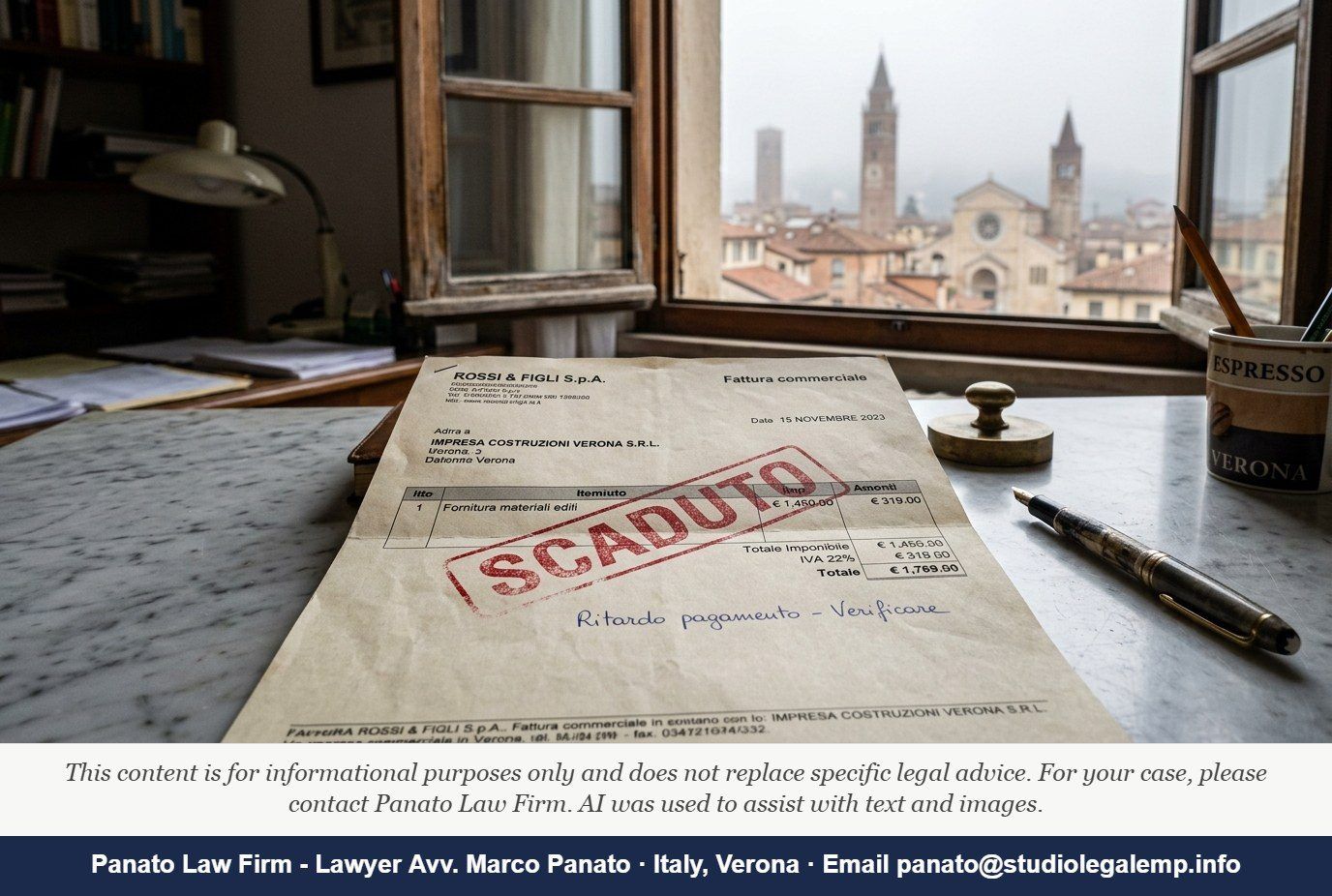
Image prompt: A close-up of an Italian commercial invoice stamped "SCADUTO" in faded red ink, lying on a marble desk in a northern Italian office. Behind it, a partly open window reveals a misty Verona skyline. The mood is tense but professional — cool grey and ochre tones, documentary-style lighting, no people visible.
Image file: late-payment-interest-italy-unpaid-invoice-claim-cover
HREFLANG BLOCK:
JSON-LD:
LANGUAGE QA: at the moment that term expired, Italian law already credited your account with a running interest entitlement -> the moment that term expired, Italian law automatically gave you a running interest entitlement · interest accrues from the day after the contractual due date -> interest runs from the day after the contractual due date · where goods are delivered or services are performed -> where goods are supplied or services are rendered · A rate lower than the statutory rate may be challenged as unfair if it was not individually negotiated -> A rate below the statutory rate may be challenged as unfair unless it was individually negotiated · without any need to prove actual damage -> without proof of actual loss · has effectively donated that amount to the debtor -> has effectively written off that amount in favour of the debtor · subject to proof of reasonableness -> subject to evidence that the costs were reasonably incurred · The rate resets on 1 January and 1 July each year -> The rate is revised on 1 January and 1 July each year
CHECK:
AUTHORITY 1: D.Lgs. 231/2002 / EXISTS? Yes, confirmed at Normattiva.it / CONTENT MATCHES? Yes — Articles 5, 6, 7 as described; rate mechanism confirmed.
AUTHORITY 2: Directive 2011/7/EU / EXISTS? Yes, confirmed at EUR-Lex OJ L 48/2011 / CONTENT MATCHES? Yes — transposition framework and rate mechanism confirmed.
AUTHORITY 3: Cassazione, Sez. VI, n. 19702 of 22 July 2021 / EXISTS? Unverifiable with certainty via open search at time of drafting — the reference appears in Italian legal commentary but full-text on italgiure requires authenticated access / CONTENT MATCHES? Partial — the per-invoice rule under Article 6(1) is confirmed by the statute itself and consistent commentary; the specific judgment reference should be verified via italgiure or a subscription database before publication. FLAGGED AS TO VERIFY.
AUTHORITY 4: COM(2023) 533 final / EXISTS? Yes, confirmed at EUR-Lex / CONTENT MATCHES? Yes — proposal for a B2B 30-day hard cap; Council stall confirmed in publicly available reporting.
AUTHORITY 5: MEF rate communications (first-half 2026 and second-half 2026) / EXISTS? The mechanism is confirmed; the specific ECB rate of 2.40% for second half 2026 should be cross-checked against the ECB's most recent rate decisions before publication. FLAGGED AS TO VERIFY.
OVERALL: AMBER — the statutory framework and EU sources are confirmed; the Cassazione reference and the precise H2 2026 rate should be independently verified against primary sources before the article goes live.
LOCAL NOTE:
1. Search intent targeted: informational (foreign supplier who has an unpaid Italian invoice and wants to understand their legal rights before instructing a lawyer — high conversion potential once they see the rates and flat fees they are already owed).
2. Local-market framing: the UK Late Payment of Commercial Debts (Interest) Act 1998 is used as the comparison reference in the contrast passage, as it is the most immediately recognisable analogue for the primary UK/Ireland/common-law readership; the per-invoice versus tiered-scale distinction is highlighted as the key practical difference.
3. Italian terms kept untranslated: <i>Pubblica Amministrazione</i> (kept in italics on second mention because no single English phrase precisely captures its scope — it covers central government, local authorities, health trusts and publicly funded bodies simultaneously, and misidentifying the entity type affects the payment term that applies); <i>Gazzetta Ufficiale</i> (kept because it is the official publication name and the reader may need to cite or locate it directly).
Do you need legal assistance or a free estimate?
Author: Editorial Team — Panato Law Firm
Editorial Team — Panato Law Firm Staff