What non-resident businesses get wrong — and why it blocks deals, property closings, and Italian contracts before they begin
#2 · LANG: English (en) · AREA: Banking, Guarantees & Financial Disputes · TYPE: Mistakes to avoid · MODEL: Sonnet 5 · SEO 76/100 · Flesch Reading Ease 28 · fonte: 01_ENG_PT_batch_articles_16items_2026-08-14_h10-02_vulm.doc
URL: https://panatolawfirm.com/en/opening-italian-bank-account-non-resident-company
ABSTRACT: A non-resident company that needs to operate in Italy — buy property, collect from Italian clients, pay suppliers, or hold a local contract — will almost certainly need an Italian bank account. The process looks straightforward on paper. In practice, most foreign companies underestimate the compliance burden, misread Italian anti-money-laundering rules, and arrive at the counter with documents that Italian banks cannot accept. This article sets out the seven mistakes that cause the most rejections, delays, and frozen applications — with the legal background and the practical fix for each.
Why Italian banks say no — and why it keeps happeningA foreign director walks into a branch of a major Italian bank with a clean set of company documents. Three weeks later, the application is still suspended. No explanation arrives in writing. A follow-up call reaches someone who does not speak English. The deal the account was meant to support is now at risk.
This scenario is not unusual. For non-residents, foreign nationals, and overseas companies, the Italian banking process can appear complex due to strict KYC, AML compliance, documentation requirements, language barriers, and bank-specific internal policies. That complexity is real — but it is also navigable, provided you understand exactly where things go wrong.
The legal framework is not designed to exclude foreign companies. What it does demand is rigorous proof of identity, ownership, and purpose. The mistakes below are the ones that trigger refusals in practice.
Mistake 1: Treating all Italian banks as interchangeableThis is the first and most expensive assumption. Account-opening requirements, terms and conditions vary from bank to bank, and sometimes even between branches of the same bank. To avoid delays, contact the local branch before you visit to make sure the local representatives are familiar with non-resident accounts and to check requirements and specific policies in advance. A branch in Milan's financial district may process a non-resident corporate account routinely. The same bank's branch in a provincial town may never have handled one.
The fix is to research which institutions have a dedicated non-resident or international corporate desk before booking flights. Some banks regularly operate with foreign clients and may even offer dedicated packages for non-residents. Ask this question directly before you make any appointment.
Mistake 2: Underestimating the UBO disclosure obligation — the biggest compliance trapThis is the mistake that most surprises foreign companies, particularly those from common-law jurisdictions accustomed to lighter disclosure regimes.
Unlike in most common-law countries, where beneficial ownership disclosure to a bank is often a relatively informal self-certification, Italy operates a mandatory statutory framework for identifying the
titolare effettivo (ultimate beneficial owner, or UBO). Article 20 of Legislative Decree 231/2007 — Italy's principal anti-money laundering statute — states that "the beneficial owner of entities other than natural persons is the natural person or persons who ultimately own or control the entity." The UBO is therefore the natural person who owns or controls a legal entity or is the beneficiary according to the criteria identified in the law.
split into two sentences or use a short list. Indirect chains of ownership are followed all the way up: if Person X owns 30% of Company B, which owns 40% of Company C, Person X is still identified as Company C's UBO because their total control chain exceeds the 25% threshold.
The bank cannot simply take your word for this. Businesses must comply with Italian Know Your Business requirements by identifying and confirming legal entities involved in financial or business relationships, and identifying individuals who own or control 25% or more of the entity. Complex holding structures — nominee shareholders, discretionary trusts, layered BVI or Cayman vehicles — are precisely the structures that Italian compliance teams flag for enhanced scrutiny. Arrive without a clear, documented answer to who ultimately controls the company and the application will stall indefinitely.
A further and very recent development compounds this point. On 9 January 2026, Legislative Decree No. 210 of 31 December 2025 entered into force, amending Legislative Decree No. 231/2007, Italy's cornerstone anti-money-laundering and counter-terrorist-financing framework. It implements Article 74 of Directive (EU) 2024/1640 and tightens rules governing access to the register of beneficial owners. Banks are now operating within a significantly tightened regulatory environment. Do not assume the rules you read about two years ago still apply in full.
Mistake 3: Sending documents that Italy cannot legally acceptItalian banks cannot simply accept whatever your home jurisdiction produces. Financial institutions must collect and verify certified business registry extracts dated within the last three months alongside identity documents. A Companies House printout from the UK, an SEC filing from the United States, or a commercial register extract from a German Handelsregister are not automatically treated as equivalent. They may need to be apostilled, notarially certified, and accompanied by a sworn Italian translation.
The key entities to disclose and certify are: the legal entity itself (articles of association, certificate of incorporation or equivalent, current registered address), the authorised representative who will manage the account, and every UBO identified under the cascade above. If any of these documents are missing, out of date, or presented in a form the bank's compliance team cannot process, the application freezes.
Mistake 4: Confusing the Italian tax code for a company with the one for its directorEvery entity — and every individual signatory — needs a separate Italian tax code (codice fiscale). Many foreign directors assume that obtaining their own personal codice fiscale is sufficient. It is not. The company itself also requires a codice fiscale, which for a non-resident entity is issued by the Italian tax authority (Agenzia delle Entrate) upon application with a certified set of corporate documents.
Similarly, if your company will be conducting business in Italy subject to Italian VAT, it will need an Italian VAT number (partita IVA). These are distinct instruments, and the bank will ask for the correct one for the correct entity. Presenting the director's personal tax code in place of the company's codice fiscale is a routine error that causes avoidable delays.
Mistake 5: Assuming the account-opening process can be completed remotelyDespite digitalisation, most Italian banks still require a personal presence. Where full remote onboarding is offered, it is typically limited and comes with conditions. If the account holder cannot be physically present during the signing of the contract for opening a current account, it becomes necessary to have the presence of a public official with legal power — a notary public — to authenticate the signature of the applicant.
This means that a foreign company whose authorised representative cannot travel to Italy must either arrange for a notarially authenticated power of attorney — executed abroad and apostilled — or engage Italian counsel who can accompany and assist the signatory. Sending scanned documents by email and hoping the bank processes them at a distance almost never works for a corporate, non-resident account.
Mistake 6: Failing to explain the business purpose convincinglyItalian banks are required to apply a risk-based approach to customer due diligence under Legislative Decree 231/2007, supervised and regulated by the Bank of Italy (
Banca d'Italia). Italy's anti-money-laundering rules are contained in Legislative Decree 231/2007, which tasks Banca d'Italia with the regulation and supervision of intermediaries for anti-money-laundering purposes and to combat the financing of terrorism.
What this means in practice is that a non-resident company must give the bank a coherent, documented explanation of why it needs an Italian account and what transactions will flow through it. A company buying real estate in Verona has a different risk profile from one receiving payments from multiple Italian counterparties for services provided entirely outside Italy. The bank is not asking out of curiosity: it is fulfilling a statutory obligation. Vague answers — "we do business in Italy" — trigger enhanced due diligence and delays. A well-drafted business summary, with supporting contracts or letters of intent, is a document worth preparing before you approach any bank.
Mistake 7: Overlooking the account's operating limitationsEven once opened, a non-resident corporate account may have significant restrictions that the foreign client did not anticipate. The only type of Italian bank account a non-resident can open is a
conto corrente non residente, which usually has more restrictive conditions and may not offer the full range of services available for residents. Non-resident bank accounts usually allow the holder to perform only basic operations such as salary credit, making payments, and arranging withdrawals.
The cost required to open an account without residency is higher than that reserved for Italian residents. This is because the fees are higher and one must account for currency exchange if resident outside the eurozone. The increased cost is also influenced by the anti-money-laundering rules applied by the financial institution. Understanding these limitations before you commit to a particular bank — and verifying whether the account type actually supports the transactions your Italian operations require — prevents a second round of frustration after opening.
The coming EU framework: why urgency matters nowThe regulatory environment will tighten further. The EU AML legislative package must be transposed into national law by July 2026, while the new European Anti-Money Laundering Authority (AMLA) is preparing to assume direct supervision over a selected number of entities starting in 2027. Italy, with a former head of AML at Banca d'Italia appointed as AMLA's first Chair, is likely to be at the front of implementation. The EU AML Regulation, Regulation (EU) 2024/1624, is scheduled to apply from 10 July 2027 to most obliged entities.
The practical consequence for foreign companies is straightforward: documentation standards that seem demanding today will become the minimum baseline. A company that builds compliant, transparent ownership structures and clean corporate documentation now will be far better placed to open and maintain Italian accounts under the incoming regime.
As the Roman jurists put it:
vigilantibus non dormientibus iura subveniunt — the law assists those who are vigilant, not those who sleep on their rights. In Italian banking compliance, that maxim is not merely elegant. It is operationally correct.
Franz Kafka once observed that the logic of bureaucratic obstruction is not random: it is a system that rewards those who know the rules it never writes down. Italian bank account compliance for foreign companies is precisely such a system. The rules are written — in Legislative Decree 231/2007, in Regulation (EU) 2024/1624, in Banca d'Italia's supervisory provisions — but assembling them into a coherent application strategy requires knowing where to look and how to sequence the steps. A foreign company that approaches the process with that knowledge will not guarantee approval, but it will eliminate the seven avoidable reasons for refusal that account for most of the rejections that reach Italian legal counsel.
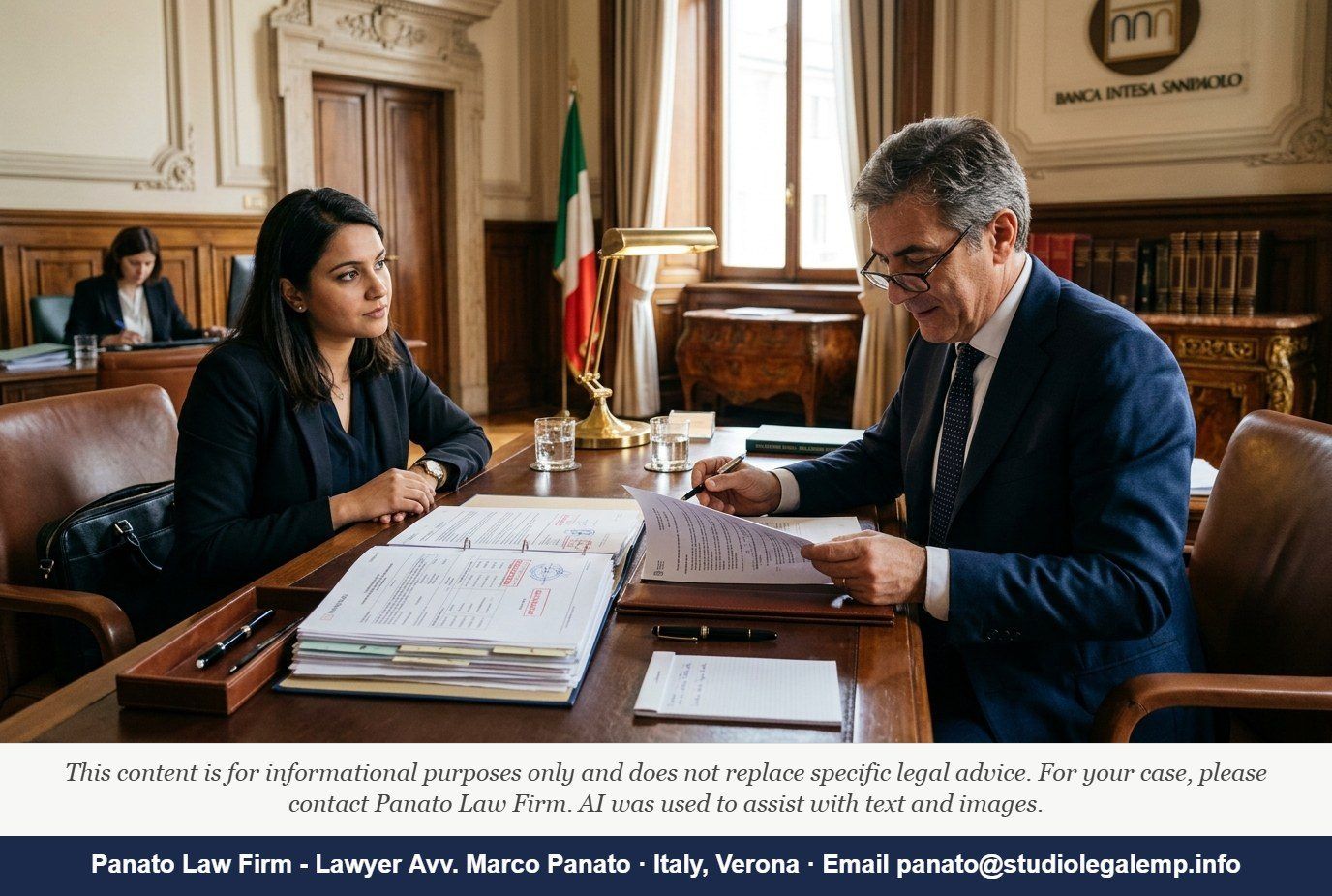
Image prompt: A foreign business professional sits across a polished wooden desk from an Italian bank officer in a formal Milanese branch interior. On the desk lies a thick folder of international corporate documents — some with red stamps, some in foreign alphabets. The professional looks focused but cautious; the bank officer studies a document closely. Warm amber light, muted institutional palette of navy, cream, and brass. Photorealistic, cinematic depth of field, no text visible.
Image file: opening-italian-bank-account-non-resident-company-cover
JSON-LD:
LANGUAGE QA: it is advisable to contact the local branch prior to your visit -> contact the local branch before you visit · In order to avoid delays -> To avoid delays · Non-resident bank account opening formalities, terms and conditions, and policies vary from bank to bank -> Account-opening requirements, terms and conditions vary from bank to bank · A person qualifies as a UBO if they own more than 25% of company shares, control majority voting rights, exercise dominant influence through binding agreements, or hold legal representation or management authority -> split into two sentences or use a short list · This measure implements Article 74 of Directive (EU) 2024/1640, part of the EU's AML package, and introduces more stringent rules -> It implements Article 74 of Directive (EU) 2024/1640 and tightens rules · the people who own or control 25% or more of the entity -> individuals who own or control 25% or more of the entity · and is the beneficiary according to the criteria identified in the law -> or is a beneficiary under the criteria set out in the legislation · might even have specific packages designed for non-residents -> may even offer dedicated packages for non-residents
CHECK:
AUTHORITY 1: Legislative Decree 231/2007 (Italy's AML Decree, as amended)
REFERENCES: Legislative Decree 231/2007, as cited by Banca d'Italia (official site), A&O Shearman, Osborne Clarke, Commenda, and multiple other sources.
EXISTS? YES — confirmed by Banca d'Italia official website (bancaditalia.it) and multiple authoritative legal sources.
CONTENT MATCHES? YES — used for UBO definition (Art. 20), KYC/AML obligations on banks, and bank supervisory framework. All confirmed.
AUTHORITY 2: Legislative Decree No. 210 of 31 December 2025 (entered into force 9 January 2026), amending Legislative Decree 231/2007, implementing Directive (EU) 2024/1640
REFERENCES: A&O Shearman article (aoshearman.com, June 2026); zavia.ai (April 2026); both confirm the decree number, date, and substance (tightened UBO register access rules).
EXISTS? YES — confirmed by two independent sources including A&O Shearman, a major international law firm.
CONTENT MATCHES? YES — used to flag tightened AML environment for non-resident companies. Confirmed.
AUTHORITY 3: Regulation (EU) 2024/1624 (EU AML Regulation, applying from 10 July 2027)
REFERENCES: voveid.com (July 2026); Chambers Banking Regulation 2025 Italy (practiceguides.chambers.com) confirms the EU AML legislative package and AMLA timeline.
EXISTS? YES — confirmed as the EU AML Regulation by two sources; the application date of 10 July 2027 confirmed by voveid.com.
CONTENT MATCHES? YES — used for forward-looking compliance warning. Confirmed.
OVERALL: GREEN — all three authorities confirmed as existing and content-matched to the article's use of them.
LOCAL NOTE:
1. Search intent targeted: transactional/informational hybrid — user
Do you need legal assistance or a free estimate?
Author: Avv. Marco Panato
Avv. Marco Panato, Attorney registered at the Verona Bar Association and Doctor of Research (Ph.D.) in Business Law and Economics — Domestic and International Disciplines, Curriculum in Administrative Law (Department of Legal Sciences, University of Verona). Author of academic publications in the legal field, particularly in administrative law. He also delivers lectures and advanced professional training.