The notification, wage parity and social security obligations that catch UK, US and international companies by surprise — and the new 2025 wage reform that raised the compliance bar further
#116 · LANG: English (en) · AREA: Employment Law for Foreign Employers & Workers · TYPE: FAQ / People Also Ask · MODEL: Sonnet 5 · SEO 69/100 · Flesch Reading Ease 32 · fonte: 01_ENG_PT_batch_articles_16items_2026-08-14_h10-02_vulm.doc
URL: https://panatolawfirm.com/en/posting-workers-to-italy
ABSTRACT: Sending employees to work in Italy, even temporarily, triggers a precise set of legal obligations under Italian and EU law that most foreign employers do not anticipate. The rules cover advance notification, sector-specific minimum wages, social security certificates, a resident liaison person, and a document archive that must survive in Italian translation for two years after the posting ends. A new wage reform published in Italy's Official Gazette in October 2025 has tightened the standards further. This guide answers the real questions international companies ask before — and sometimes after — their first Italian inspection.
Why "temporary" does not mean "unregulated" in ItalyYour project engineer arrives in Milan on a Monday. She is there for six weeks, still employed by your UK or US entity, still paid from your payroll. You have not hired anyone in Italy. Surely Italian employment law barely applies?
That instinct is wrong, and it is the most common and costly misunderstanding foreign employers bring to Italy. The moment your employee begins working on Italian soil under a service arrangement, she is a
lavoratrice distaccata — a posted worker — and your company is subject to a body of rules that can generate fines measured not in hundreds but in hundreds of thousands of euros.
The governing framework in Italy has three layers. Companies from EU member states posting employees to Italy must comply with various legal requirements and provisions. The EU Directives 96/71/EC, 2014/67/EU and 2018/957/EU set out the guidelines in this regard. Italy transposed the latest of those directives into domestic law through Legislative Decree No. 122 of 15 September 2020, which amended the earlier Legislative Decree 136/2016 of 17 July 2016. The posting of employees from an EU country to Italy must comply with Legislative Decree 136/2016, which transposes into national law EU Directive 2014/67/EU on the posting of employees in the context of providing services. Legislative Decree 136/2016 applies to companies established in EU member states which, in the context of the provision of services, post to Italy one or more employees for another company, including those belonging to the same group, another production unit or another recipient, on condition that during the posting, an employment relationship continues to exist with the posted employee.
For companies outside the EU the framework is different but not necessarily lighter, and the rules on wages and working conditions apply regardless of where the sending company is incorporated.
What must a foreign employer do before the first day of work?If posting workers from the UK to Italy, the foreign employer must file an electronic notification (form UNI_Distacco_UE) with the Italian Ministry of Labour by midnight the day before posting begins. Failure to notify incurs a fine of €250–€1,500 per worker. That deadline is stricter than many employers expect: there is no grace period, and the obligation applies even for a posting of a single day.
Beyond the pre-arrival notification, two further steps are required. The authorities require foreign companies to appoint a contact person in Italy responsible for receiving official communications and liaising with authorities during inspections. This person must be physically reachable in Italian territory — a registered agent or a local lawyer will fulfil the role. If the person is absent, enforcement notices are served at the worksite, with a fine of €2,000–€6,000.
Does the posted worker's salary have to match Italian rates?This is the question most foreign employers underestimate, and it has become considerably more significant since October 2025. The posted worker is entitled to the same minimum wage and working conditions provided by Italian law and by the national collective agreement (CCNL —
contratto collettivo nazionale di lavoro) applicable to the destination sector for the relevant qualification. Determining the right minimum requires identifying the correct CCNL and a detailed comparison of actual pay against the applicable CCNL rates. The fine for non-compliance is €25–€50 per worker per day, up to €150,000 in total.
Unlike in most common-law countries — where a statutory national minimum wage sets a single floor below which no employer may go — Italy has no single statutory minimum wage figure. Instead, minimum pay is determined by sector-specific collective agreements negotiated between trade unions and employer associations. There are hundreds of active CCNLs: the engineering CCNL, the tertiary sector CCNL, the construction CCNL, the commercial logistics CCNL, and so on. Each job category typically has its own CCNL: engineering roles fall under the Engineering CCNL, administrative staff under the Administrative/Tertiary Sector CCNL, manufacturing workers under the Industrial Manufacturing CCNL, and healthcare workers under the Healthcare CCNL. The applicable CCNL is determined by the
destination sector — where the worker is posted — not the sector in which the sending company operates at home.
In October 2025 the Italian legislature went further. On 3 October 2025, Italy published Law No. 144/2025 in the Official Gazette, granting the government authority to reform remuneration and collective bargaining procedures. The law reinforces the constitutional right to fair and proportionate pay under Article 36 and mandates the adoption of legislative decrees within six months. Key objectives include ensuring equitable pay, combating underpayment especially in vulnerable work models and categories, encouraging timely renewal of CCNLs, and curbing unfair competition through cost-cutting contractual practices. The practical consequence for posted workers is that the implementing decrees, expected by April 2026, will tighten the wage-parity standard already embedded in Legislative Decree 136/2016 and make CCNL compliance the explicit benchmark against which labour inspectors will measure every posting.
What documents must be held in Italy — and for how long?Throughout the posting and for two years thereafter, the foreign employer must keep available — translated into Italian — the employment contract, payslips, working-time records, proof of payment of wages, and the A1 certificate. A frequently underestimated aspect concerns language: the documentation must be accessible in Italian so that it can be easily reviewed by the inspection bodies. The fine for failing to maintain this archive is €1,000–€12,000 per worker concerned.
Under Article 12 of Legislative Decree 136/2016, a failure to send the preliminary declaration of posting is punishable by a fine from €180 to €600 per posted worker. In the event of failure with the obligation to store any posting-related documentation, the posting company is punishable by an administrative fine from €600 to €3,600 per posted worker.
One further risk that almost no published guide flags: if posted workers are employed through a subcontractor or agency, the main contractor may be held jointly liable for wages, insurance, and contributions. Italian case law applies strict standards in this regard. A UK or US company that engages an Italian intermediary to supply posted labour does not thereby escape the obligations of the sending entity.
How does social security work during the posting?Under EU Regulation (EC) 883/2004, a worker posted from an EU/EEA member state continues paying social security in their home country for up to 24 months, confirmed by an A1 certificate obtained before the posting begins. Failure to produce a valid A1 can result in Italian authorities demanding back payment of INPS contributions plus penalties. INPS is the Italian National Social Security Institute (
Istituto Nazionale della Previdenza Sociale), the body that collects and administers social contributions in Italy.
An A1 certificate is confirmation that a worker is subject to the legislation of their own country and is thus not required to pay social security contributions in the destination country. Without it, or once the 24-month ceiling is reached, Italian contributions become due from the first day.
Italy maintains bilateral social security agreements with over 40 countries — including the US, UK, Canada, Australia, Japan, Brazil, and India — that prevent double contributions through totalisation, detachment, and export of benefits. For US-based companies, the US–Italy Totalisation Agreement extends the posting period to up to five years. For companies outside the EU with no bilateral agreement, work performed in Italy generally triggers Italian INPS obligations from the first day.
Who is exempt from the notification rules?Not every cross-border assignment to Italy is a "posting" in the legislative sense. A significant number of posted workers are exempted from the new requirements, which include providing notice of the posting and retaining certain documents. Among those still covered by the rules are service workers posted to Italy (1) under a service agreement between an Italian company and a non-EU company, (2) via the "Van der Elst" route for non-EU workers employed by an EU company, or (3) within the provisions of the services framework of the EU Enforcement Directive on Posted Workers (2014/67/EU). The exemptions for intra-corporate transferees (as defined in the EU Intra-Corporate Transfer Directive, 2014/66/EU) save some employers administrative steps previously required under Italy's posted worker rules, including providing notification to the Labour Inspectorate before posted workers begin work in Italy and retaining contracts, payslips and timesheets.
Whether a given assignment falls inside or outside the exemption is a matter of Italian and EU law that requires careful analysis of the contractual arrangements, the nature of the service, and the worker's immigration status before the assignment begins.
The Latin maxim
lex loci laboris — the law of the place of work governs — expresses the principle at the heart of all these obligations. It is the foundation on which EU posted worker law rests, and it explains why a worker's physical presence on Italian soil, however brief, activates Italian rules.
As the legal philosopher Ronald Dworkin noted in
Law's Empire, the interpretation of rules depends not only on their text but on the institutional purpose behind them. The purpose here is explicit and threefold: protect workers from social dumping, preserve competitive fairness among Italian and foreign employers, and fund the Italian social security system. Italian labour inspectors enforce these rules with that purpose consciously in mind. A foreign employer that treats the Italian posting regime as a technicality will find that inspectors do not.
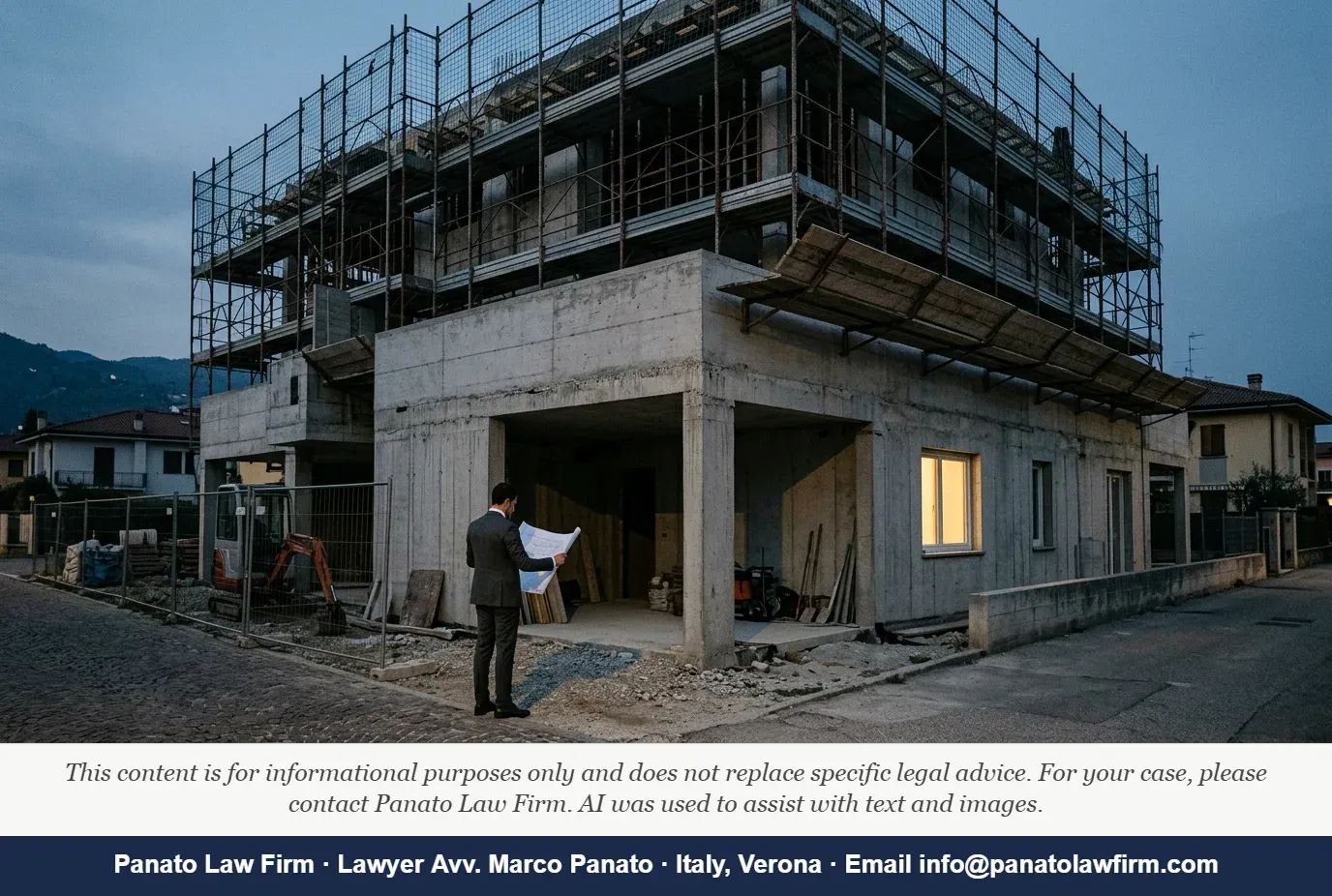
Image prompt: A foreign business professional in a hard hat reviews a printed compliance dossier at a construction site on the outskirts of Verona, with pale stone buildings and a row of cypress trees visible in the warm late-afternoon light behind her. Her expression is focused and slightly anxious. The colour palette is dusty terracotta, warm gold and slate grey. Documentary-realist style, no text in the image.
Image file: posting-workers-to-italy-cover
JSON-LD:
LANGUAGE QA: two further appointments must be made -> two further steps are required · in the framework of the provision of services -> in the context of providing services · in favour of another company -> for another company · The posting of employees from an EU country to Italy must comply with Legislative Decree 136/2016, which transposes into national law EU Directive 2014/67/EU on the posting of employees in the framework of the provision of services. -> Remove or condense; the same point was just made in the preceding sentence · inspection acts are served at the place of work itself -> enforcement notices are served at the worksite · cooperating in the event of inspections -> liaising with authorities during inspections · a technical assessment of the wage actually paid -> a detailed comparison of actual pay against the applicable CCNL rates · built on the earlier Legislative Decree No. 136 of 17 July 2016 (Legislative Decree 136/2016) -> amended the earlier Legislative Decree 136/2016 of 17 July 2016
CHECK:
AUTHORITY 1: Legislative Decree No. 136 of 17 July 2016 (D.Lgs. 17 luglio 2016, n. 136)
EXISTS? Yes — confirmed via Lexology (citing D.Lgs. 136/2016 directly), arlettipartners.com and postingtoitaly.com, yourwaytoitaly.it, and italianbusinesslawyers.com, all of which cite the specific Article 12 penalty provisions.
CONTENT MATCHES what I wrote? Yes — notification obligation, document retention, penalty ranges all confirmed.
AUTHORITY 2: EU Directive 2018/957/EU (amending Directive 96/71/EC on posting of workers) / Legislative Decree No. 122 of 15 September 2020 transposing it
EXISTS? Yes — confirmed via arlettipartners.com (citing D.Lgs. 122/2020 and Directive 2018/957/EU explicitly) and mobilexpense.com.
CONTENT MATCHES? Yes — equal-pay/equal-conditions requirement and wage parity obligation confirmed.
AUTHORITY 3: EU Regulation (EC) 883/2004 (social security coordination)
EXISTS? Yes — confirmed via arlettipartners.com, italianbusinesslawyers.com (citing Reg. CE 883/2004 and 987/2009), yourbusinessinitaly.com, mobilexpense.com, and the INPS official portal.
CONTENT MATCHES? Yes — 24-month A1 posting ceiling and home-country social security continuity confirmed.
AUTHORITY 4: Law No. 144 of 3 October 2025 (Legge 3 ottobre 2025, n. 144) — wage and bargaining reform
EXISTS? Yes — confirmed via DLA Piper GENIE knowledge base citing publication in the Official Gazette on 3 October 2025.
CONTENT MATCHES? Yes — Article 36 constitutional basis, CCNL reform mandate, six-month decree timeline confirmed.
OVERALL: GREEN — all four authorities confirmed as existing and substantively matching the claims made in the article.
LOCAL NOTE:
1. Search intent targeted: transactional (foreign company about to post workers or already under inspection, ready to instruct Italian employment counsel).
2. Local-market framing used: contrasted Italy's CCNL-based sectoral minimum wage system explicitly against the single statutory national minimum wage familiar to UK, US and Australian readers — the sharpest practical difference and the one most likely to generate fee-earning queries.
3. Italian terms kept untran
Do you need legal assistance or a free estimate?
Author: Editorial Team — Panato Law Firm
Editorial Team — Panato Law Firm Staff