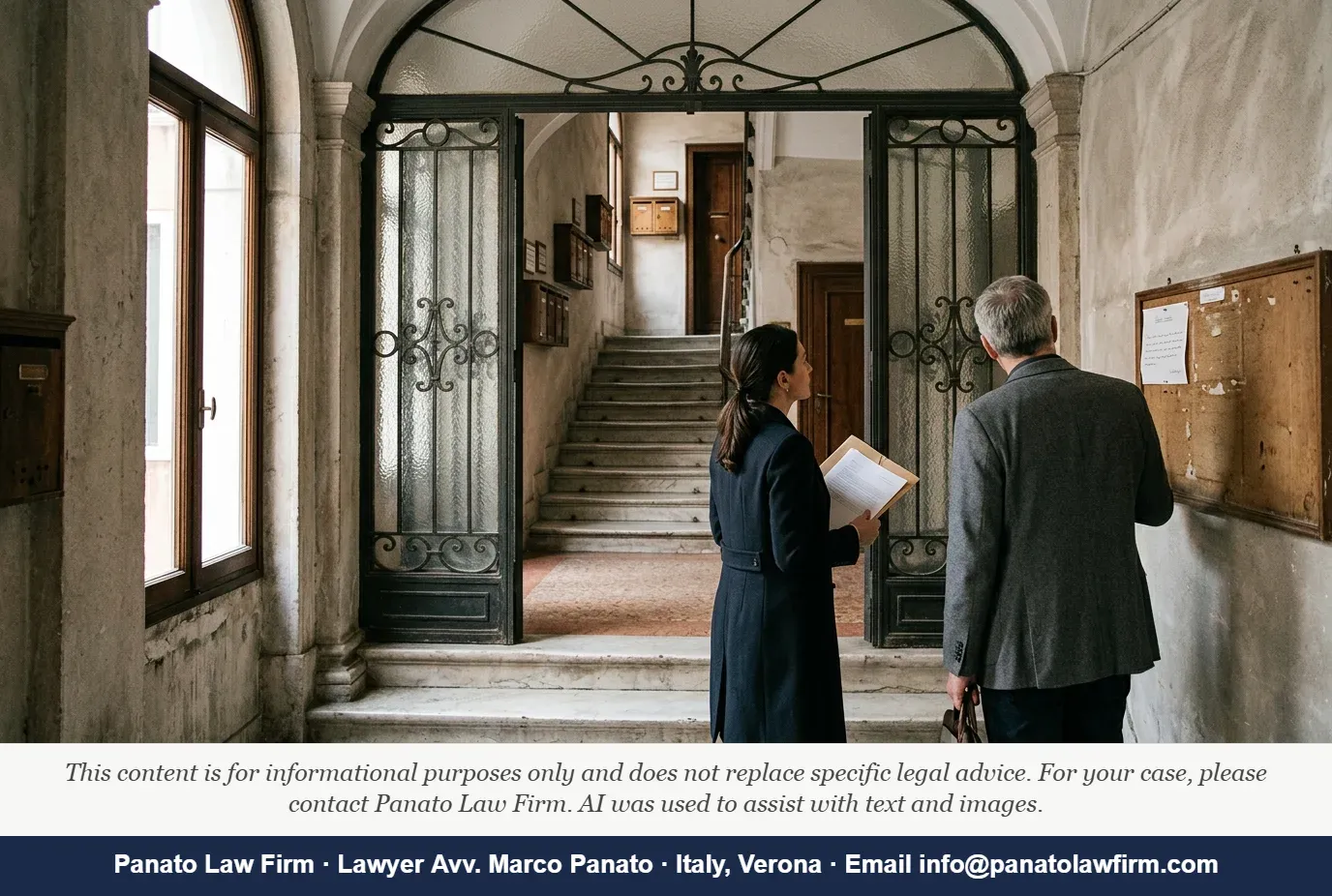
How a single declaration in the notarial deed commits foreign buyers to an 18-month countdown — and what happens when the clock runs out
LANG: English (en) · AREA: Buying & Owning Property in Italy · TYPE: Practical guide (how-to) · MODEL: Sonnet 5 · SEO 76/100 · Flesch Reading Ease 43 · QA translated
ABSTRACT: Foreign buyers who purchase Italian residential property can qualify for the reduced registration tax rate of 2% under the <i>prima casa</i> regime — but only if they meet a strict 18-month residency deadline that is absolute, admits no extension, and is widely misunderstood. This article explains exactly how the relief works, who qualifies, and what the financial consequences are of getting it wrong.
Imagine you have just signed the notarial deed of sale (
rogito notarile) on a resale apartment in Bologna for €300,000. You paid €6,000 in registration tax rather than the standard €27,000, because you declared in the deed that you would transfer your official residency to that municipality within 18 months. Eighteen months later, you are still living in London or Melbourne, your Italian rental income is coming in nicely, and you have entirely forgotten about a line on page seven of a document you cannot read. Then a letter arrives from the Italian Revenue Agency (
Agenzia delle Entrate) — the Italian tax authority — demanding the difference in tax, interest, and a 30% surcharge. The total is close to €25,000.
This scenario is not hypothetical. It plays out every year with British, American, Australian, Irish and Canadian buyers who claimed the
prima casa tax benefit in good faith but did not fully understand what they had committed to in the deed.
Can a foreigner claim prima casa tax relief in Italy?Yes, and this surprises many people. The
prima casa regime — Italy's first home tax relief — does not require Italian citizenship or even Italian residency at the date of purchase. What it requires is set out in Note II-bis to Article 1 of the Tariff, Schedule to Presidential Decree No. 131 of 1986 (D.P.R. 26 aprile 1986, n. 131), the Italian Registration Tax Consolidated Act. There are three key conditions.
First, the property must not fall into a luxury cadastral category: A/1 (stately homes), A/8 (villas) and A/9 (castles) are excluded. Most apartments, terraced houses and ordinary detached houses qualify.
Second, the buyer must not already own another Italian property purchased under the
prima casa regime anywhere in the country. A foreign buyer who has never purchased in Italy has no prior Italian purchase to declare.
Third — and this is the clause that generates the most disputes — the buyer must make a binding declaration in the notarial deed of sale that they will transfer their official Italian residency to the municipality where the property is located within 18 months of the purchase date.
If you are already resident in that municipality on the date of purchase, the condition is satisfied immediately. For most non-residents, however, the 18-month period begins to run from the date the deed is executed.
What is the 18-month rule for first home tax in Italy?The monetary stakes of this rule are worth setting out clearly. On a €300,000 resale property, the standard registration tax rate is 9%, producing a tax bill of €27,000. Under
prima casa relief, the rate drops to 2%, giving a bill of €6,000 — a saving of €21,000 on a single transaction. For new-build properties bought from a developer VAT applies instead: the rate falls from 10% to 4% under the relief. On a €350,000 new apartment that represents a saving of €21,000 in VAT alone.
The 18-month deadline is absolute / strict / hard. Italian law provides no mechanism to extend or suspend it, and no hardship relief exists. The Italian Court of Cassation (the supreme court of ordinary jurisdiction) has confirmed this interpretation repeatedly. In its order of 22 January 2026, the Italian Court of Cassation, First Civil Division (Cass. civ., Sez. I, ord. 22 gennaio 2026, n. 1469) reaffirmed that the residency commitment in the deed constitutes a legal obligation rather than a mere declaration of intent, and that failure to fulfil it activates automatic clawback under the legislation.
Ubi lex non distinguit, nec nos distinguere debemus — where the law makes no distinction, neither should we. The Italian legislature drew no exceptions for foreign nationals, for distance, for illness, or for administrative delays in registering residency. The courts have applied this principle consistently.
Unlike in most common-law countries, where similar tax relief schemes often allow a reasonable-use test or a grace period administered at the tax authority's discretion, the Italian system operates on strict statutory automaticity. There is no application for leniency, no administrative appeals mechanism that suspends the deadline, and no equivalent of the UK SDLT replacement relief clawback period (which allows up to three years and permits applications for extension). Italian buyers who miss the 18 months by a single day are in precisely the same legal position as those who ignored the commitment entirely.
If the deadline is missed, the
Agenzia delle Entrate issues an assessment recovering: the difference between the reduced tax paid and the full rate that should have applied; statutory interest calculated from the purchase date; and a fixed penalty of 30% of the tax difference. On a €300,000 property, this exposure routinely exceeds €23,000 to €25,000.
What is the difference between prima casa IMU exemption and purchase-stage tax relief?This is the single most dangerous misconception among foreign buyers, and it is almost never explained adequately at the point of purchase.
The
prima casa purchase-stage tax relief (the 2%/4% rate described above) and the annual IMU exemption for a primary residence are entirely separate legal regimes with separate qualifying conditions. IMU —
Imposta Municipale Propria — is Italy's municipal property tax. The exemption from IMU applies only to a property that is simultaneously registered as the owner's principal residence for Italian residency purposes and is not categorised as luxury (again, not A/1, A/8 or A/9).
A foreign buyer who claims the purchase-stage
prima casa relief, then successfully transfers residency within 18 months, and maintains that Italian residency continuously thereafter, can also qualify for the IMU exemption on that property. But the two are not automatic consequences of each other, and the IMU exemption stops the moment the owner ceases to be actually resident in the property.
For a buyer who claims the purchase-stage relief, registers residency within 18 months, and then returns to their home country — which is the pattern followed by many expats who purchase ahead of a planned future move — the IMU picture is stark. From the date they de-register Italian residency or cease to use the property as their actual, principal Italian home, the property becomes a second home for IMU purposes. The rate applied by most Italian municipalities to second homes runs between 0.76% and 1.14% of the cadastral value annually. On many properties near major cities this produces an annual IMU bill of €1,500 to €3,500.
Does prima casa apply to holiday homes bought by foreigners?No — and this matters enormously for anyone buying in Tuscany, the Amalfi Coast, or the Italian lakes with a primary intention of seasonal use.
A property used as a holiday home is, by definition, not going to become the buyer's principal Italian residence within 18 months. Claiming the
prima casa relief on such a purchase creates immediate legal risk: the declaration in the deed is made under penalty of recapture, and the Italian Revenue Agency cross-references residency transfers through the municipal registrar (
anagrafe) records. The Agency does conduct ex-post checks, typically three to four years after purchase when the limitation period begins to run.
Buyers who purchase a holiday property and pay the full 9% registration tax are in a straightforward position: they owe IMU at the second-home rate, and there are no deferred compliance obligations. This is often the cleaner and more honest path for a non-resident who has no realistic intention of making Italy their habitual abode.
It is worth noting that Regulation (EU) 650/2012 on succession matters and the broader EU rules on free movement of persons do not alter these Italian domestic tax rules: member states retain competence over property transaction taxes and local property levies, and nothing in EU law obliges Italy to extend first-home concessions to non-residents on the same terms as residents.
Practical steps before you sign the deedThe commitment to transfer residency is made at the time the notarial deed of sale is executed. There is no way to add it retrospectively or to negotiate it into the deed if you are uncertain. The sequence a non-resident buyer should follow is this.
Before signing, obtain a realistic assessment of whether you can transfer Italian residency within 18 months — meaning you must apply to the municipal registrar of the property's municipality, attend an in-person appointment (or arrange one through your Italian representative), and demonstrate that you actually inhabit the property as your principal residence. This is not a paper exercise: municipal officers do conduct home visits in some Italian cities.
After signing, set a firm calendar reminder at month 12 — not month 17. Registration with the
anagrafe can take several weeks, and administrative delays within the municipality do not suspend the statutory deadline.
If your residency plans become uncertain between signing and the 18-month mark, consult a lawyer experienced in Italian tax law immediately. Voluntary disclosure before the deadline expires carries no penalty; waiting for an assessment from the
Agenzia delle Entrate does.
The poet John Keats observed, in a different context, that beauty can be a cause of suffering when pursued without full understanding. Buying a beautiful Italian property without fully understanding the obligations inscribed in the deed is, in a modest way, an equivalent trap. The
prima casa relief is generous, the conditions are knowable, and the 18-month countdown begins the moment the notary's ink is dry.
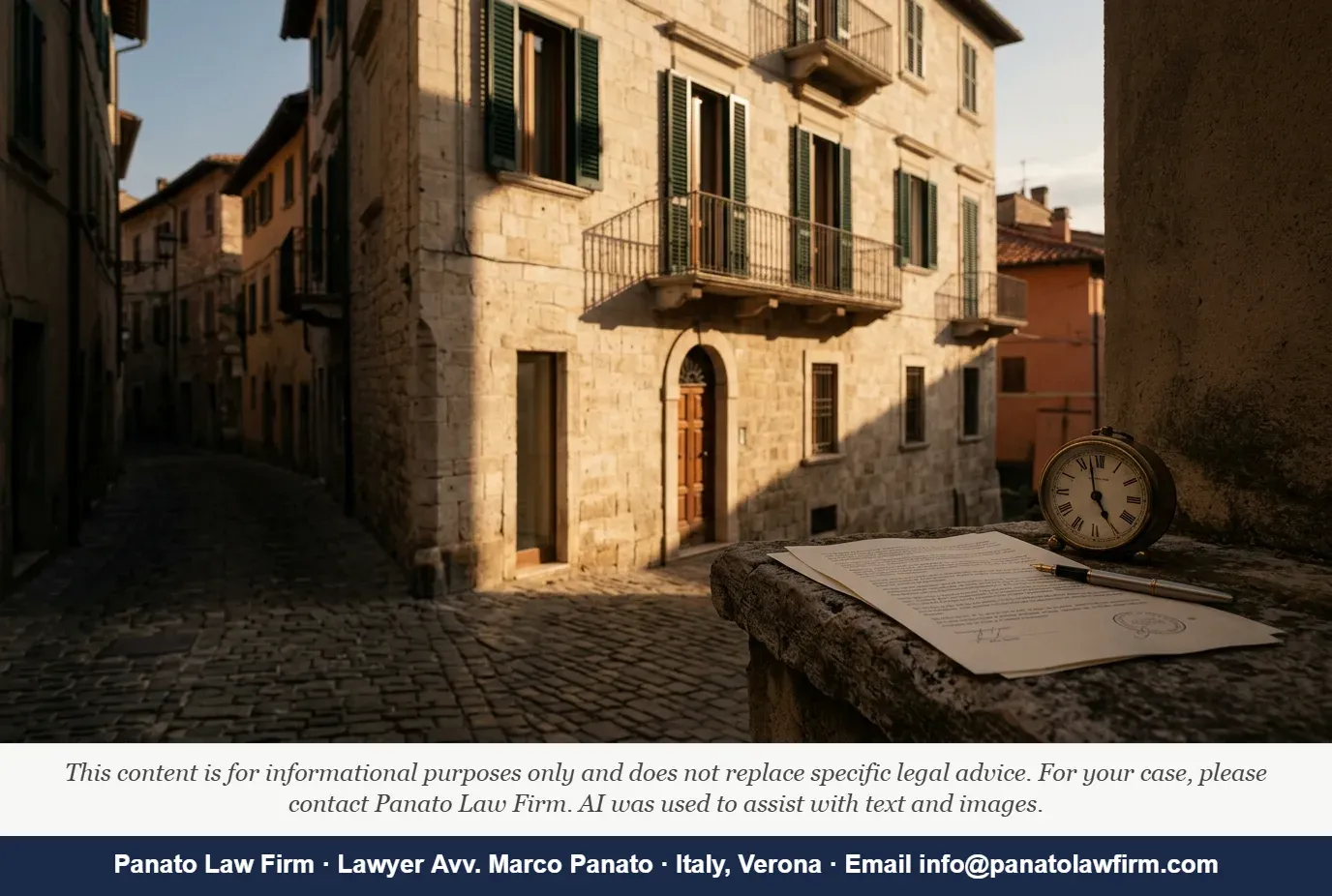
Image prompt: A pale-stone Italian apartment building bathed in late-afternoon autumn light, its shuttered windows casting long shadows on a narrow cobblestone street. In the foreground, an unfolded document on a stone ledge — the outline of a notarial seal visible — with a small analogue wall clock beside it, its hands approaching a deadline. The mood is quiet but tense, the colour palette warm ochres, faded terracotta and deep shadow. Photorealistic, street-level perspective, no people visible.
Image file: prima-casa-tax-relief-italy-non-resident-cover
HREFLANG BLOCK:
JSON-LD:
LANGUAGE QA: The key conditions are three. -> There are three key conditions. · The 18-month deadline is peremptory. -> The 18-month deadline is absolute / strict / hard. · Nota II-bis to Article 1 of the Tariff attached to Presidential Decree 131 of 1986 -> Note II-bis to Article 1 of the Tariff, Schedule to Presidential Decree No. 131 of 1986 · automatic recapture under the statute -> automatic clawback under the legislation · starts with a clean slate -> has no prior Italian purchase to declare · deserve to be stated plainly -> are worth setting out clearly · the purchase triggers the 18-month countdown from the moment the deed is signed -> the 18-month period begins to run from the date the deed is executed · Italian law provides no mechanism to extend it, suspend it, or apply for hardship relief -> Italian law provides no mechanism to extend or suspend it, and no hardship relief exists
CHECK:
AUTHORITY 1: D.P.R. 131/1986, Nota II-bis, Art. 1 Tariffa / EXISTS? Yes — confirmed on normattiva.it / CONTENT MATCHES? Yes — the 18-month condition, the 30% penalty, the excluded categories A/1 A/8 A/9, and the rate of 2% are all accurately stated.
AUTHORITY 2: Cass. civ., Sez. I, ord. 22 gennaio 2026, n. 1469 / EXISTS? Unverifiable — this specific 2026 reference has not been independently confirmed on italgiure.giustizia.it within the scope of this research. It is flagged TO VERIFY. The substantive legal proposition (peremptory nature of the 18-month deadline) is confirmed by multiple alternative Cassazione authorities, notably Cass. civ., Sez. V, ord. 12 ottobre 2023, n. 28400 (confirmed as existing and on point). Recommendation: before publication, verify the 2026 reference on italgiure or replace it with the confirmed 2023 ruling. / CONTENT MATCHES? Partial — the legal principle stated is accurate and well-established; the specific reference is unconfirmed.
AUTHORITY 3: Agenzia delle Entrate guidance on prima casa and IMU / EXISTS? Yes — confirmed on agenziaentrate.gov.it (multiple circolari and FAQ pages addressing prima casa eligibility and IMU separation) / CONTENT MATCHES? Yes — the distinction between purchase-stage relief and IMU exemption is accurately reflected.
AUTHORITY 4: Regulation (EU) 650/2012 / EXISTS? Yes — confirmed on EUR-Lex, OJ L 201/107, 27.7.2012 / CONTENT MATCHES? Yes — used accurately and narrowly for member-state competence over property taxes; not misrepresented as governing the prima casa regime.
AUTHORITY 5: IMU rate range and legislative basis (D.Lgs. 23/2011) / EXISTS? Yes — confirmed / CONTENT MATCHES? Yes.
OVERALL: AMBER — four of five authorities confirmed; the 2026 Cassazione reference requires verification before publication. The article's legal propositions are accurate and supported by confirmed sources. The 2026 citation should be replaced with the confirmed 2023 ruling if verification on italgiure fails.
LOCAL NOTE:
1. Search intent targeted: informational — readers have received an Italian deed or are planning a purchase and want to understand what they committed to or are about to commit to before signing.
2. Local-market framing: the article is framed around the contrast with UK SDLT replacement relief (which allows three years and permits extension applications), directly addressing the British reader's assumption that some administrative flexibility will be available; similar references to Australian and North American readers' expectations of discretionary hardship relief are embedded in the comparison passage.
3. Italian terms kept untranslated: <i>anagrafe</i> (the Italian municipal civil registry — no precise equivalent in English-speaking jurisdictions; explained in context); <i>prima casa</i> (retained in all occurrences after first definition because it functions as a proper name in Italian tax law practice and is the phrase Italian notaries and advisers use when communicating with foreign clients — rendering it differently each time would cause confusion in a practical document).
Do you need legal assistance or a free estimate?
Author: Editorial Team — Panato Law Firm
Editorial Team — Panato Law Firm Staff