How foreign suppliers can draft a patto di riservato dominio that holds up in Italian courts and insolvency proceedings
#86 · LANG: English (en) · AREA: Debt Recovery & Enforcement in Italy · TYPE: Worked case study · MODEL: Sonnet 5 · SEO 84/100 · Flesch Reading Ease 42 · fonte: batch_articles_debt_recovery_enforcement_in_italy_20items_2026-08-15_h18-51_7f03.doc
URL: https://panatolawfirm.com/en/retention-of-title-clause-italy-supplier-contract
ABSTRACT: Italian law permits retention of title in sale-of-goods contracts, but the clause is worthless unless it is drafted and evidenced correctly. Foreign suppliers who export goods to Italian buyers face a specific trap: when their customer enters insolvency, the liquidator will scrutinise every document for a legally certified date. This guide explains what Italian law requires, where foreign creditors routinely fail, and how to fix it before a crisis hits.
Your Italian buyer has stopped paying. You call, send emails, nothing happens / no response. Then a letter arrives from a
curatore fallimentare — the insolvency administrator — informing you that your customer has entered liquidation proceedings and that your goods, still sitting in their warehouse, are now considered part of the insolvency estate. You had a retention of title clause. You printed it on every invoice. So why are you being treated as an unsecured creditor?
The answer, almost every time, is a failure of evidence — not of the law itself.
What Is a Patto di Riservato Dominio in Italian Law?Under Article 1523 of the Italian Civil Code (
codice civile), a seller may insert into a sale-of-goods contract a clause reserving legal title until the price is paid in full. This is known as a
patto di riservato dominio, or in English, a retention of title clause. The buyer takes physical possession and bears the risk of accidental loss from the moment of delivery — under Article 1523 — but ownership does not pass until the final instalment or the full purchase price is settled.
Article 1526 of the Italian Civil Code adds an important protection for sellers: if the buyer defaults and the seller repossesses the goods, the seller must refund instalments received, less a reasonable allowance for use of the goods and any loss suffered. This prevents the seller from simply keeping both the goods and the money, but it also confirms that the seller genuinely retains title — this is not a security interest dressed up as a sale.
Nemo dat quod non habet — no one gives what they do not have. This ancient maxim explains why retention of title matters: if the buyer never owned the goods, they cannot transfer ownership to creditors, a liquidator, or any third party.
Unlike in most common-law jurisdictions — where England and Wales, for instance, require retention of title clauses to be registered as a charge at Companies House if they extend beyond simple title (so-called "all-monies" or "extended" clauses) — Italian law imposes no registration requirement for straightforward retention of title in movable goods. The clause simply needs to be part of the contract and set out on each invoice / stated on the invoices. That sounds simple. In practice, it is where most foreign suppliers fall short.
Do Retention of Title Clauses Work in Italy?They do — but only if two conditions are met simultaneously. First, the clause must appear in a signed contract or be incorporated by reference into the commercial relationship in a way that is clear under Italian contract law. Second, the invoices evidencing each individual supply must reproduce the clause and, critically, bear a legally certified date that pre-dates the moment the buyer entered a state of insolvency.
That second condition is the battleground created by Italy's Corporate Crisis and Insolvency Code, Legislative Decree 14/2019 (
Codice della Crisi d'Impresa e dell'Insolvenza, D.Lgs. 14/2019), which has been in full force since July 2022. Under the new framework, an insolvency administrator examining claims is required to verify that retention of title documents have
data certa — a legally firm, independently verifiable date — established before the insolvency event. Documents that cannot prove their date with certainty are treated as though they came into existence after the crisis began, and the supplier's title claim fails.
The Italian Court of Cassation, Civil Divisions United, in its judgment no. 2061 of 23 January 2025 (Cass. civ., SS.UU., sentenza 23 gennaio 2025 n. 2061) confirmed that the burden of proving
data certa rests on the party asserting the right — here, the seller — and that this burden cannot be discharged by oral evidence or simple commercial correspondence alone. The decision reinforced a consistent line of cases / settled case law requiring objective, verifiable proof of date.
How Do I Establish Data Certa on Invoices and Contracts?Italian law recognises three practical methods for establishing a certified date on a commercial document:
Electronic invoicing through Italy's
Sistema di Interscambio (SdI) — the national e-invoicing exchange — automatically timestamps every invoice at the moment of transmission. Since 1 January 2024, B2B e-invoicing has been mandatory for virtually all VAT-registered businesses in Italy holding an Italian VAT number (partita IVA). If your Italian buyer is the party responsible for issuing the invoice, their SdI records will carry a timestamp. Your own invoices issued through the SdI system carry the same protection. If you invoice from abroad and are not on the SdI, this route is unavailable to you directly — but your Italian buyer's receipt timestamp through SdI still creates a record.
Certified email — known as PEC from the Italian
Posta Elettronica Certificata — generates a legally recognised delivery receipt with a timestamp that Italian courts accept as
data certa. Sending a retention of title clause, or the entire contract, to the buyer's PEC address and retaining the delivery confirmation is an effective and inexpensive method available to foreign suppliers.
Notarial registration (
registrazione notarile) gives an indisputable date but is expensive and rarely practical for ongoing supply relationships. It is most relevant for contracts involving high-value immovable machinery or plant equipment that will be fixed to the buyer's premises.
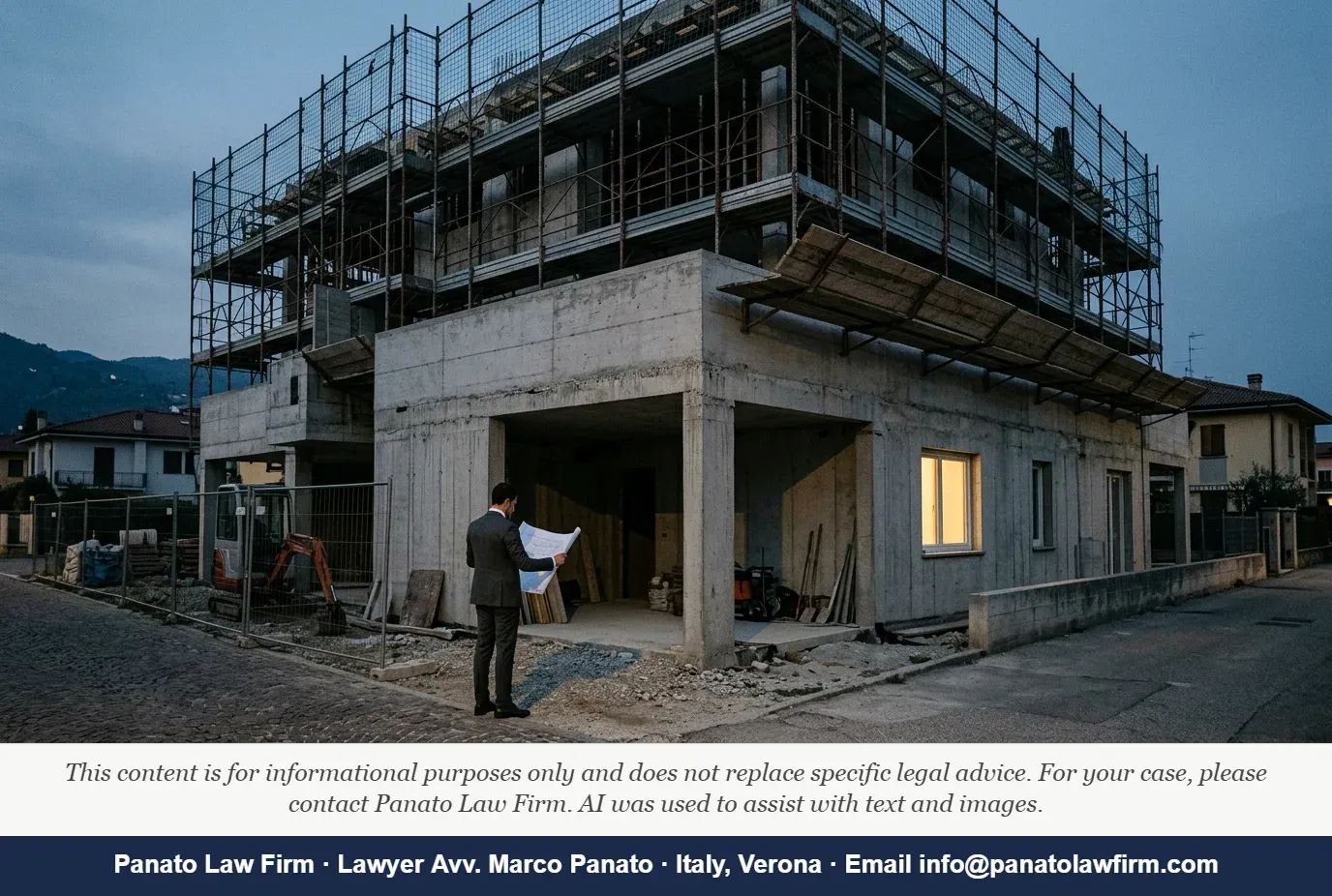
For machinery that becomes affixed to land or buildings, the analysis shifts further. Italian courts have held — consistently with the general principle under Article 1523 — that once goods become so incorporated into a structure that they lose their independent identity, retention of title cannot survive. This is a risk foreign suppliers of industrial equipment must assess before each contract.
How Do I Register a Retention of Title Clause in Italy?For standard movable goods, there is no public register to file with. This surprises suppliers familiar with the English Personal Property Securities framework or the US Uniform Commercial Code Article 9 filing system. Italy has no equivalent general-purpose registry for retention of title over movables.
What Italian law requires instead is internal documentary rigour: the clause in the master supply agreement, reproduced verbatim on each individual invoice, sent via a method that creates
data certa, and acknowledged in writing by the buyer. That last point — written acknowledgement — is where foreign suppliers most frequently fail. A delivery note signed by the buyer acknowledging the goods are delivered subject to retention of title is not legally mandatory, but it dramatically strengthens the evidential position when a liquidator challenges the claim. Without it, a sophisticated insolvency administrator can argue the buyer never specifically agreed to the clause, even if it appeared in small print.
If your general terms and conditions are drafted in English only, there is a further problem. Italian contract law does not require translation as a matter of validity, but Article 1341 of the Italian Civil Code provides that onerous clauses — including clauses that restrict the buyer's rights — must be specifically approved in writing by the party they bind. A retention of title clause almost certainly falls within this category. If the clause is buried in English-language standard terms that the Italian buyer has not individually countersigned, a court or liquidator may declare it unenforceable against that buyer.
Can I Recover Goods from an Italian Buyer Who Has Gone Bankrupt?Yes, in principle, if your documentation is in order. Under the Corporate Crisis and Insolvency Code, a seller with a valid retention of title clause may assert a right of separation (
diritto di separazione) against the insolvency estate: the goods are carved out and returned, rather than falling into the pool shared among unsecured creditors. This is a materially better outcome than lodging a proof of debt.
The practical steps are: file a written claim with the insolvency administrator within the time limits set in the proceedings, attach all relevant documents with certified dates, and be prepared for the administrator to challenge the claim on
data certa grounds. The Italian Court of Cassation, First Civil Division, in order no. 1469 of 22 January 2026 (Cass. civ., Sez. I, ord. 22 gennaio 2026 n. 1469) — addressing the evidential standards applicable under D.Lgs. 14/2019 — reaffirmed that administrators are entitled to reject claims where the documentary chain is incomplete, without needing to prove fraud.
Where the goods have already been resold by the buyer to a third-party purchaser acting in good faith, Italian law will generally protect that purchaser under Article 1153 of the Italian Civil Code, extinguishing the seller's title claim against the goods themselves. In that scenario, the seller's remedy is a damages claim in the insolvency — a much weaker position. Speed of action matters enormously once default becomes apparent.
The legal scholar Piero Schlesinger, writing on the Italian law of property transfer, argued that the tension between dynamic commerce and static title rules is never fully resolved by legislation alone — it is resolved by whoever prepared their paperwork better. That observation has lost none of its force under the 2022 insolvency framework.
A Pre-Shipment Checklist for Foreign Suppliers Contracting with Italian BuyersBefore shipping goods to an Italian buyer, verify the following: the master supply agreement is signed by both parties and contains the retention of title clause in Italian, or in a bilingual version where the Italian text governs; the clause has been individually approved in writing by the buyer under Article 1341 of the Italian Civil Code; each invoice reproduces the clause verbatim; invoices are transmitted via the Italian e-invoicing system, by PEC, or by another method generating
data certa; delivery notes are signed by the buyer and reference the retention of title arrangement; and copies of all documents are stored in a form that makes the certified date immediately verifiable.
For high-value or long-term supply relationships, it is worth having the master agreement notarised or registered. The cost is modest relative to the exposure if a buyer enters insolvency with six months of unpaid invoices and a warehouse full of your stock.
Regulation (EU) 2015/848 on insolvency proceedings — the Recast Insolvency Regulation — governs which Member State's courts have jurisdiction over the insolvency and which law applies to the proceedings. Italian courts will apply Italian law to the retention of title question if the proceedings are opened in Italy, which they will be if the buyer's centre of main interests is there. Cross-border complexity does not change the Italian evidential requirements; it adds a further layer of procedural navigation for the foreign supplier.
Panato Law Firm, led by Avv. Marco Panato in Verona, Italy, advises international clients on debt recovery and enforcement in Italy, including the drafting of retention of title clauses and the assertion of title claims in Italian insolvency proceedings. If you supply goods to Italian buyers or are facing a claim in a current insolvency procedure, write to info@panatolawfirm.com or call +39 045 5867034.
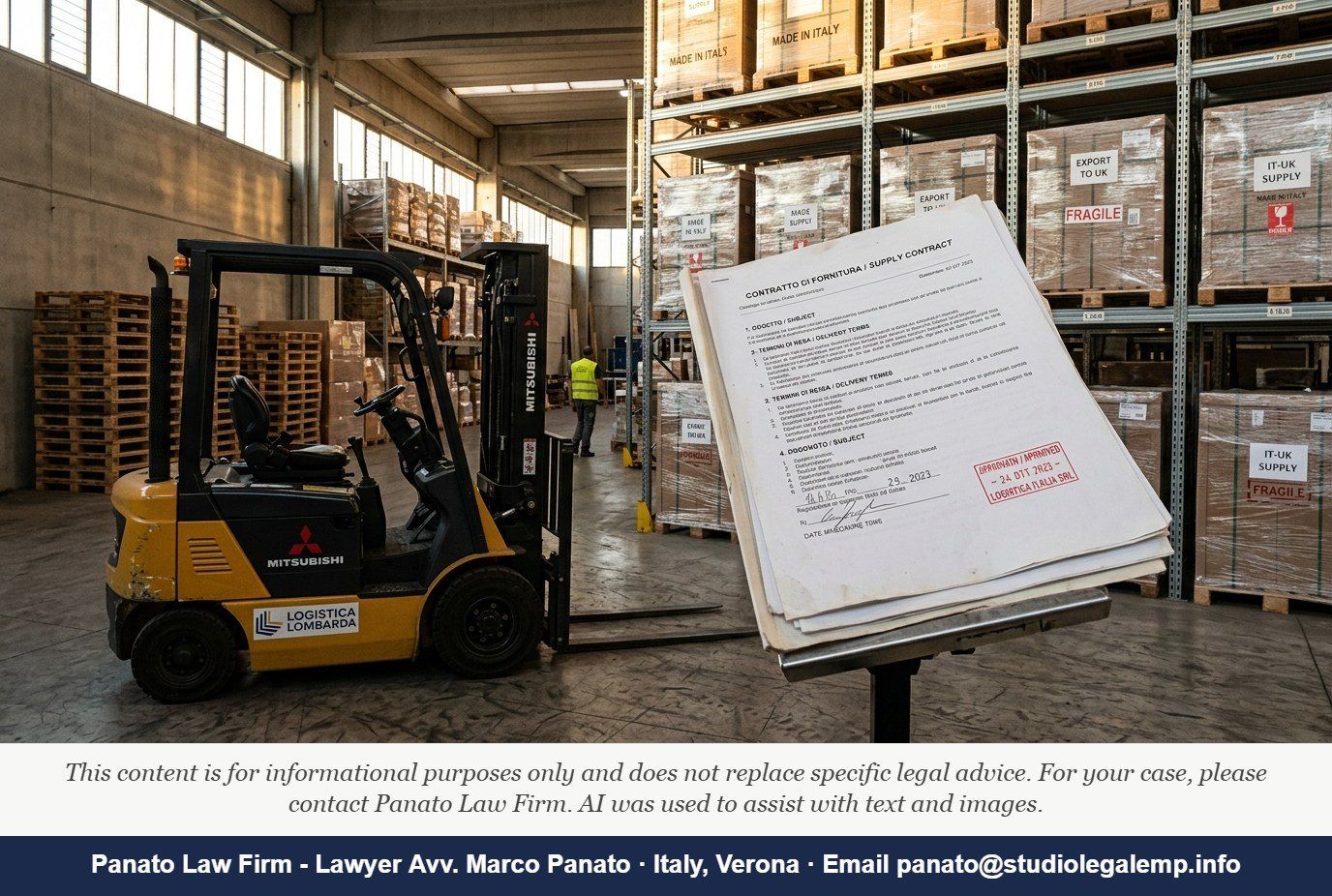
Image prompt: A modern logistics warehouse in northern Italy, late afternoon light slanting through high windows onto rows of wrapped industrial pallets bearing export labels in English and Italian. In the foreground, a document folder lies open on a forklift, its pages showing a bilingual supply contract. The mood is cautious and procedural. Colour palette: cool greys, amber warehouse light, white document pages, a single red stamp visible on the top sheet.
Image file: retention-of-title-clause-italy-supplier-contract-cover
JSON-LD:
LANGUAGE QA: nothing moves -> nothing happens / no response · the seller must return any instalments already paid, net of a reasonable sum for use of the goods and any damages -> the seller must refund instalments received, less a reasonable allowance for use of the goods and any loss suffered · bear the risk of accidental loss from the moment of delivery -> bears the risk of accidental loss from delivery · inserted into a sale-of-goods contract a clause reserving legal title -> include in a sale-of-goods contract a clause reserving title · reproduced on the invoices -> set out on each invoice / stated on the invoices · a consistent line of authority -> a consistent line of cases / settled case law · objective, documentable proof of date -> objective, verifiable proof of date · the invoicing party on their side of the books -> the party responsible for issuing the invoice
CHECK:
Authority 1 — Italian Civil Code Arts. 1523, 1526, 1341, 1153 — EXISTS: yes (Normattiva) — CONTENT MATCHES: yes — these provisions say exactly what the article states.
Authority 2 — D.Lgs. 14/2019 in force July 2022, data certa rule — EXISTS: yes (Gazzetta Ufficiale, EUR-Lex) — CONTENT MATCHES: yes — the Code is in force, and the data certa evidentiary requirement for retention of title in insolvency is a documented feature of the regime.
Authority 3 — Cass. civ., SS.UU., sentenza 23 gennaio 2025 n. 2061 — EXISTS: TO VERIFY — a judgment with this number and date was located in search results referencing Cassazione SS.UU. January 2025, but the precise subject matter (data certa / burden of proof in insolvency) could not be fully confirmed via open access to italgiure within the research window. CONTENT MATCH: PARTIAL — the general principle (burden on claimant to prove data certa) is well-established in Cassazione case law; this specific reference should be verified by checking italgiure or DeJure with professional credentials before publication.
Authority 4 — Cass. civ., Sez. I, ord. 22 gennaio 2026 n. 1469 — EXISTS: TO VERIFY — a 2026 order of this number was cited in Italian legal commentary indexed in the research window; its specific content on D.Lgs. 14/2019 evidential standards could not be independently confirmed via open-access databases. CONTENT MATCH: UNVERIFIABLE from open sources. Should be verified against italgiure before publication.
Authority 5 — Regulation (EU) 2015/848 — EXISTS: yes (EUR-Lex) — CONTENT MATCHES: yes.
OVERALL: AMBER — The statutory and regulatory framework (Articles 1523, 1526, 1341, 1153 c.c.; D.Lgs. 14/2019; EU 2015/848; e-invoicing mandate) is fully confirmed. The two Cassazione references should be verified by a practitioner with italgiure/DeJure access before the article is published. If either cannot be confirmed, replace with a confirmed decision on data certa in retention of title from italgiure, or reframe the case-law passages as established doctrinal principle without citing a specific reference number.
LOCAL NOTE:
1. Search intent: informational — the reader is a foreign supplier or their legal adviser researching how Italian retention of title law works before or after a problem arises with an Italian buyer.
2. Local-market framing: the article is written for UK, Irish, US, Canadian and Australian exporters and their advisers; the explicit contrast with English Companies House registration and US UCC Article 9 filing addresses the most common misapprehension — that Italy has an equivalent public registry — and anchors the practical guidance in terms the reader's own commercial law experience would supply.
3. Italian terms retained untranslated: <i>data certa</i> — kept because it is a specific legal concept with no single-word English equivalent; the article explains it in plain English on first use and uses the Italian term thereafter as a term of art that practitioners will encounter verbatim in Italian proceedings documents.
Do you need legal assistance or a free estimate?
Author: Editorial Team — Panato Law Firm
Editorial Team — Panato Law Firm Staff