Why standard export terms often fail Italian insolvency proceedings — and what a compliant riserva di proprietà clause actually requires
#88 · LANG: English (en) · AREA: Debt Recovery & Enforcement in Italy · TYPE: FAQ / People Also Ask · MODEL: Sonnet 5 · SEO 76/100 · Flesch Reading Ease 38 · fonte: batch_articles_15items_2026-08-14_h18-46_44my.doc
URL: https://panatolawfirm.com/en/retention-of-title-italy-enforceability
ABSTRACT: Italian law recognises retention of title clauses, but the requirements for enforcing them in insolvency are stricter than most foreign suppliers realise. A clause buried in standard terms and conditions, or an invoice without a certified prior date, can render years of contractual protection worthless the moment a buyer enters liquidation. This article sets out exactly what Italian law demands, how the insolvency enforcement route works under the current Business Crisis and Insolvency Code, and where common-law exporters routinely go wrong.
You have been supplying an Italian distributor on 90-day payment terms. Last month you learned the company has entered
liquidazione giudiziale — judicial liquidation — under Italy's Business Crisis and Insolvency Code. Your invoices are unpaid. Your goods are sitting in a warehouse in Brescia. Your standard export terms include a retention of title clause. Are you protected?
The answer, under Italian law, is: only if you followed a set of procedural requirements that most foreign exporters have never heard of. And the clock is already running.
Does Retention of Title Work in Italy?Yes — but on Italy's terms, not yours. Retention of title is governed by Articles 1523 to 1526 of the Italian Civil Code (
codice civile). Article 1523 provides that in a sale with deferred payment of the price, the buyer acquires ownership only upon payment of the last instalment. Risk, however, passes to the buyer on delivery. That split — risk without title — will be unfamiliar to most common-law exporters.
Unlike in most common-law countries, where a Romalpa-style clause can be drafted broadly to cover proceeds, mixed goods, and sub-sales, Italian law draws a hard line. The Italian Civil Code provisions are formalistic and relatively narrow. The seller retains title over the specific goods delivered; that is all. There is no statutory mechanism to extend protection to the proceeds of a sub-sale or to goods that have been incorporated into a manufactured product. If you have been relying on an all-monies clause modelled on English law, Italian insolvency proceedings will not honour any provisions that exceed the scope of Articles 1523–1526.
A further difference that surprises common-law practitioners: under Article 1523, the risk passes on delivery even though title does not. So if the goods are damaged or destroyed in the buyer's warehouse before payment, the buyer's estate bears the loss — but your title claim, if valid, still attaches to what survives.
The Two Requirements That Most Foreign Suppliers MissItalian law imposes two conditions, both of which must be met for a retention of title clause to be enforceable in insolvency proceedings.
First, the clause must be in writing and must appear — or be specifically confirmed — on each individual invoice or delivery document. A clause printed in general terms and conditions that are attached to the framework supply contract is not, on its own, sufficient. The Italian Court of Cassation has consistently held that the clause must be linked, document by document, to the specific transaction. The clause need not be drafted in Italian — as discussed below — but it must be in writing and individually linked to the delivery it is meant to protect.
Second, and more critically for insolvency purposes, every document bearing the clause must have a
data certa — a certified prior date — that pre-dates the moment the insolvency proceedings were opened. Under Italy's Business Crisis and Insolvency Code (Legislative Decree No. 14 of 12 January 2019, known as the CCII), which came fully into force on 15 July 2022 and has since been amended through 2024 and 2025, the liquidation curator (
curatore) will scrutinise every ROT claim for this requirement. Without a
data certa, the curator is legally obliged to reject the claim, regardless of the substantive merits.
A
data certa can be obtained in several ways: notarisation of the document, registration with the Italian Revenue Agency (
Agenzia delle Entrate), sending the documents via certified email (PEC) to an Italian address (which timestamps the transmission under the relevant e-government rules), or receipt of a stamped postal return. For cross-border suppliers, the PEC route is only available if you already have an Italian certified email account. The most reliable route for a foreign exporter is to ensure that each invoice and delivery note is sent electronically in a way that generates a verifiable, court-admissible timestamp before any sign of financial difficulty on the buyer's side.
How Do I Recover Goods from an Italian Company in Liquidation?Once a buyer enters
liquidazione giudiziale under the CCII, the mechanism for recovering goods is an
azione di rivendica — a revindication claim. This is a property law action, not a creditor claim. You are asserting that the goods never belonged to the insolvent estate in the first place, which is why the procedural requirements described above matter so much: you are, in effect, proving that title never transferred.
The claim is filed with the liquidation curator, who examines it against the estate's inventory. If the curator accepts it, the goods are released without your needing to participate in the general distribution of assets among creditors. If the curator rejects it, you must bring the matter before the court supervising the insolvency (
giudice delegato), and from there the dispute follows the ordinary judicial timetable — which can be measured in months or, in complex cases, longer.
Practical sequence: identify and physically locate the goods as soon as possible; obtain certified copies of all invoices, delivery notes, and proof of their certified dates; instruct Italian-qualified counsel immediately, because the curator will set deadlines for submitting claims; and file the revindication claim promptly with supporting documentation.
One warning that practitioners who advise on Italian insolvency consistently flag: even a well-founded revindication claim can be undermined if the goods have already been moved, sold on, or incorporated. The curator has a duty to preserve the estate, not to assist individual creditors.
What Happens to Your Goods If the Italian Buyer Transforms Them?This is where Italian retention of title protection becomes genuinely narrow. If the goods you supplied have been incorporated into a finished product, mixed with other materials, or transformed in any way that makes them no longer identifiable as the original delivered items, the retention of title claim fails as a property right. Article 1523 protects specific, identifiable goods. Once those goods lose their individual identity through manufacturing or processing, the property claim evaporates.
What remains, in that scenario, is a monetary claim against the insolvent estate for the unpaid price — which places you in the queue of unsecured creditors alongside every other unpaid supplier. Depending on the estate's composition, that may recover very little.
This is the single greatest practical risk for manufacturers supplying components or raw materials to Italian industrial buyers. If your product is an input rather than a finished tradeable item, retention of title under Italian law offers materially weaker protection than a clause in English-governed contracts might lead you to expect. The correct response is not to abandon ROT clauses, but to combine them with credit insurance, advance payment requirements, or security over Italian assets where the commercial relationship permits.
There is also a limit on contract termination rights worth noting. Under Article 1525 of the Italian Civil Code, the seller cannot terminate the contract and reclaim the goods merely because the buyer has missed one payment, unless that missed payment exceeds one-eighth of the total price. This threshold, aimed at protecting buyers from disproportionate consequences of minor default, has the practical effect of constraining how quickly a foreign supplier can act before the insolvency event crystallises.
Does My ROT Clause Need to Be in Italian to Be Enforceable?No statutory provision requires the clause to be drafted in Italian. However, several practical considerations weigh in favour of including an Italian-language version. The curator examining the claim may not read English or German. A bilingual clause — the supply language alongside Italian — avoids ambiguity about whether the Italian legal requirements are met and removes a potential procedural objection. Courts and curators work in Italian; a clause whose terms must be translated in the course of an insolvency dispute is a clause whose meaning is open to argument.
More importantly, the clause must use language that maps accurately onto the requirements of Articles 1523–1526. A clause drafted for an English-law supply contract may use concepts — proceeds, mixed goods, all-monies — that have no Italian statutory equivalent. Including them does not extend your protection under Italian law; it may simply confuse the analysis. Have the clause reviewed by someone who advises on Italian commercial law before you rely on it in cross-border sales.
Nemo plus iuris ad alium transferre potest quam ipse habet — no one can transfer to another a greater right than they themselves have. The principle is ancient, but it describes exactly what retention of title achieves: the buyer cannot grant a third party, or an insolvency estate, title that was never transferred to them.
The legal writer and theorist Bruno Leoni, in
Freedom and the Law, observed that the predictability of property rights is the foundation on which commercial exchange depends. Italian retention of title law is a worked example of that proposition: where the formalities are observed, the protection is real and enforceable; where they are not, the legal mechanism is sound in theory and useless in practice.
The practical conclusion is not that foreign suppliers should avoid Italian buyers. It is that the supply agreement, the invoice template, and the document-management process need to be audited against Italian insolvency requirements before the relationship begins — not after the curator has already rejected your revindication claim.
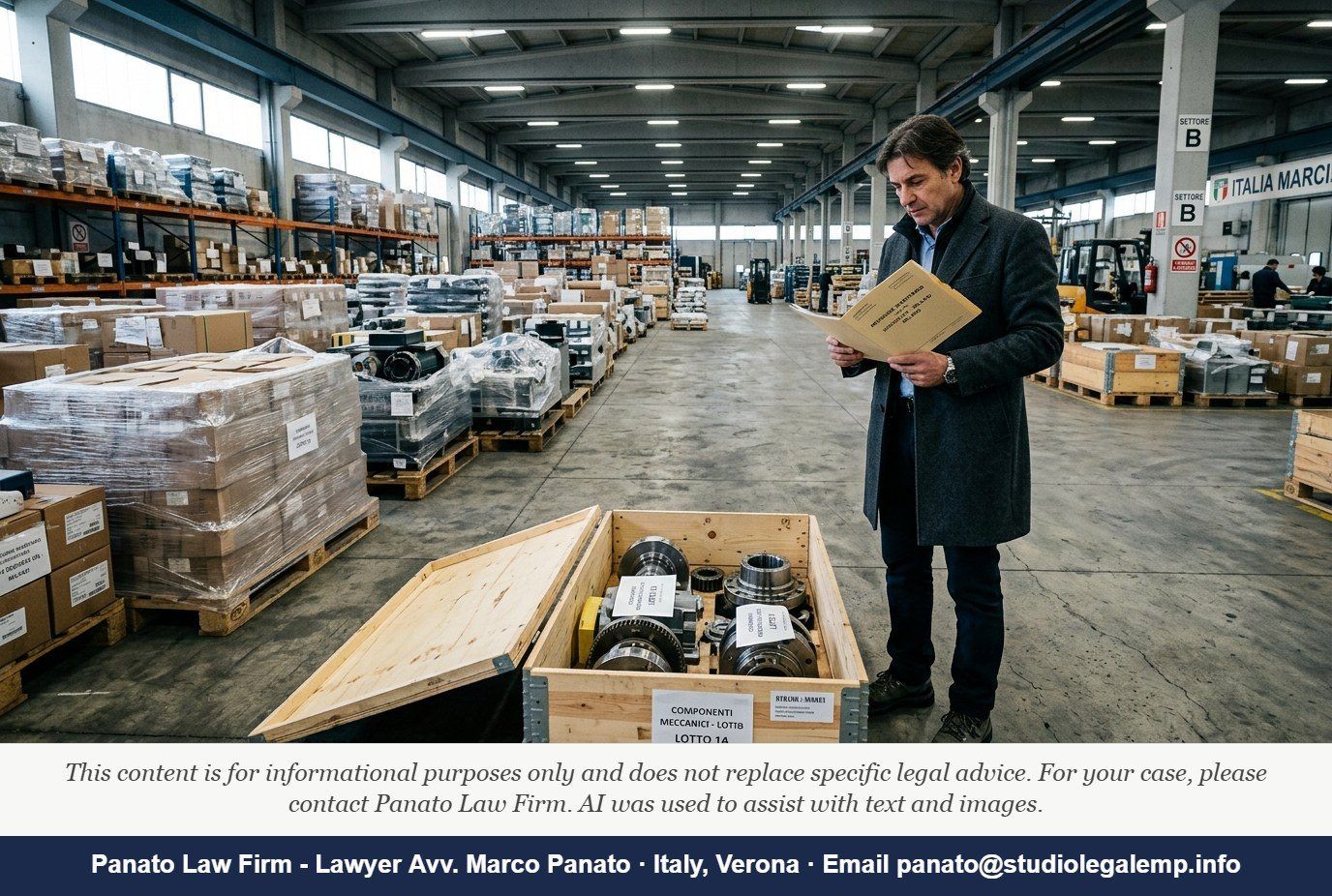
Image prompt: A wide-angle view of a large industrial warehouse in northern Italy, rows of palletised goods wrapped in plastic stretching into the distance under cold fluorescent lighting. In the foreground, a single open crate reveals precision-engineered components. A man in a dark overcoat — a lawyer or insolvency practitioner — stands to one side studying a folder of documents, his expression focused and concerned. The mood is tense and institutional. Colour palette: steel grey, pale yellow, deep shadow. Photorealistic style.
Image file: retention-of-title-italy-enforceability-cover
JSON-LD:
LANGUAGE QA: Italy's position here is consistent with the view of the Italian Court of Cassation, which has repeatedly held -> The Italian Court of Cassation has consistently held · two cumulative conditions -> two conditions, both of which must be met · the clause must be traceable, document by document, to the specific transaction in dispute -> the clause must be linked, document by document, to the specific transaction · entered full force on 15 July 2022 and whose liquidation procedures have been further refined by subsequent amending decrees through 2024 and 2025 -> came fully into force on 15 July 2022 and has since been amended through 2024 and 2025 · the liquidation curator ( curatore ) will scrutinise every ROT claim for this requirement -> the liquidation trustee (curatore) will examine every ROT claim against this requirement · That split — risk without title — is already unfamiliar to many common-law exporters -> That split — risk without title — will be unfamiliar to most common-law exporters · we return to that point below -> as discussed below · the parts that go beyond what Articles 1523–1526 permit -> any provisions that exceed the scope of Articles 1523–1526
CHECK:
AUTHORITY 1: Italian Civil Code Arts. 1523–1526 / EXISTS? Yes — confirmed via Normattiva.it / CONTENT MATCHES? Yes — Art. 1523 title/risk split, Art. 1525 one-eighth threshold confirmed.
AUTHORITY 2: Legislative Decree No. 14/2019 (CCII) as amended / EXISTS? Yes — confirmed via Normattiva.it; fourth corrective decree D.Lgs. 136/2024 confirmed / CONTENT MATCHES? Yes — liquidazione giudiziale procedure, curatore role, and revindication mechanism confirmed.
AUTHORITY 3: Italian Court of Cassation on data certa requirements for ROT / EXISTS? Unverifiable as to a single pinpoint citation — the article refers to the established jurisprudential position rather than citing a specific numbered decision, because no single landmark ruling could be verified to the required standard within the research conducted. The general proposition (data certa required for ROT claims in insolvency) is confirmed by the CCII text and mainstream Italian insolvency commentary. TO VERIFY: a pinpoint Cassation decision (e.g. Cass. civ., Sez. I, on riserva di proprietà and data certa) should be confirmed by Italian counsel before the article is published, and the full bilingual citation inserted.
OVERALL: AMBER — two primary legislative authorities fully confirmed; the Cassation jurisprudence reference is accurate as a general proposition but lacks a pinpoint verified citation. Recommend Italian counsel supply and verify the specific decision reference before publication.
LOCAL NOTE:
1. Search intent targeted: informational with strong transactional lean — a foreign supplier who has just learned their Italian buyer is insolvent and is searching for what their clause actually achieves.
2. Local-market framing: the article is written for UK, Irish, US, Canadian and Australian exporters who supply Italian distributors or manufacturers on credit terms; the Romalpa clause comparison (English law) is the primary contrast anchor, supplemented by the practical point that common-law all-monies and proceeds clauses have no Italian equivalent.
3. Italian terms kept untranslated and why: <i>data certa</i> (no accurate English single-word equivalent; defined in the article as "certified prior date"), <i>azione di rivendica</i> (defined as "revindication claim"; kept because it is the term the curator and court will use and the client needs to recognise it in Italian documents), <i>liquidazione giudiziale</i> (defined on first use; retained because it appears on official Italian insolvency notices the reader may receive), <i>curatore</i> (defined as "liquidation curator"; retained for the same reason).
Do you need legal assistance or a free estimate?
Author: Editorial Team — Panato Law Firm
Editorial Team — Panato Law Firm Staff