Pre-emption clauses, tax-abuse scrutiny and the buyer's hidden debt exposure — a case-note for foreign investors and business owners
LANG: English (en) · AREA: Setting Up a Business in Italy · TYPE: Case note (court decision) · MODEL: Sonnet 5 · SEO 84/100 · Flesch Reading Ease 43 · QA acceptable
ABSTRACT: Two decisions from Italy's highest court — one issued in July 2026, one in July 2025 — have redrawn the risk map for anyone buying or selling a stake in an Italian limited liability company. They clarify when the tax authority can challenge a share sale as abusive, and what happens to a buyer whose seller ignored a pre-emption clause in the company's constitution. Foreign investors unfamiliar with Italian corporate law face traps on both counts.
You have agreed a price, signed heads of terms, and instructed your advisers to proceed. The Italian seller is ready. What could go wrong?
Quite a lot, it turns out — and two rulings issued in the past thirteen months / handed down in the last thirteen months by the Italian Court of Cassation (Corte di Cassazione), Italy's supreme court of private and tax law, have made the answer more precise than ever. The decisions address a buyer's exposure when the seller has bypassed co-shareholders, and a seller's exposure when the Italian Revenue Authority decides that selling shares was really a disguised property sale. Both rulings matter acutely to foreign clients, because neither outcome has a close equivalent in common-law systems.
How shares in an Italian SRL are transferred: the baselineAn Italian limited liability company — the
società a responsabilità limitata (SRL) — does not issue share certificates. Ownership is expressed as a quota, a percentage stake recorded in the Companies Register (
Registro delle Imprese). A transfer requires a notarised deed or, since 2012, a digital transfer filed by a qualified commercial lawyer bearing a digital signature. Article 2469 of the Italian Civil Code sets the default rule: quotas are freely transferable by act between living persons unless the company's articles of association (
atto costitutivo or
statuto) provide otherwise.
That statutory freedom to transfer is, in practice, almost always curtailed. Most Italian SMEs' articles of association contain either a
gradimento clause — requiring the approval of existing shareholders or the board before a new person enters — or a right of first refusal (
patto di prelazione) obliging any selling shareholder to offer the stake to co-shareholders at the same price before going to a third party. Foreign buyers often assume that such clauses function exactly like tag-along or pre-emption provisions in an English shareholders' agreement: contractual obligations whose breach gives rise to a claim in damages. Italian law goes further, and the consequences are more structural.
The July 2025 ruling: breach of pre-emption makes the transfer legally invisible to the companyThe Italian Court of Cassation, First Civil Division, Order No. 17761 of 1 July 2025 (Cass. civ., Sez. I, ord. 1 luglio 2025 n. 17761) settled a question that had divided lower courts for years. When a shareholder sells in breach of a pre-emption clause in the articles — without first offering the stake to co-shareholders — the transfer is valid between seller and buyer as a matter of contract, but it is
inopponibile, meaning unenforceable, against the company and against the shareholders who held the right of first refusal. In plain terms: the buyer paid, received a notarial deed, and yet the company can lawfully ignore the transfer. The new owner cannot vote, collect dividends, or exercise any corporate right.
The court went further and closed off a remedy that buyers had hoped for.
Inopponibilità does not give the bypassed co-shareholders a right to claw back, or rescind, the quota from the new owner. That remedy — a form of forced transfer back — is not available, because the right of first refusal in Italian law has a contractual source, not a statutory one. The bypassed shareholders are left with a damages claim against the selling shareholder, not a proprietary claim against the innocent purchaser.
Unlike in most common-law jurisdictions, where a pre-emption right in a shareholders' agreement typically gives the aggrieved party a contractual damages claim and, in some cases, a specific performance order against the seller, Italian law produces a result that takes effect at the corporate level: the buyer simply does not exist as a shareholder in the eyes of the company. The transfer never takes effect in the corporate sphere, regardless of what the underlying contract provides.
The practical consequence for a foreign buyer is severe. Due diligence must include a thorough review of the full
statuto as filed with the Companies Register. It is not sufficient to read the articles as they stand today: you must verify that the seller complied with all pre-emption procedures — the
denuntiatio, an offer on identical terms, and the waiting period — before any sale agreement was signed. A failure here does not just create a warranty claim; it means you may have no ownership at all.
The July 2026 ruling: selling shares in a property-holding company is not automatically abusiveA common structure in Italian real estate transactions involves holding property inside an SRL and then selling the shares rather than the asset. The economics are obvious: a direct property sale triggers registration tax, potential capital gains tax on the seller, and notarial fees on the property value; a share sale is subject to a flat 26 per cent substitute tax on the capital gain, registered at nominal stamp duty. The Italian Revenue Authority (
Agenzia delle Entrate) has long challenged such operations under the doctrine of
abuso del diritto — abuse of rights — codified in Article 10-bis of Law No. 212/2000 (the Taxpayers' Statute). If an operation is judged abusive, it is treated as if it never happened for tax purposes, and the Revenue Authority applies the tax it would have collected on the underlying transaction.
The Italian Court of Cassation, Tax Division, Order No. 24082 of 27 July 2026 (Cass. civ., Sez. Tributaria, ord. 27 luglio 2026 n. 24082) has drawn a sharp boundary on that power. The court held that the Revenue Authority cannot characterise as abusive the incorporation of a company to acquire a property, followed by a sale of the shares in that company, unless it positively demonstrates two cumulative elements: first, that the tax saving constitutes a certain and undue advantage — not merely a possible or presumed one; and second, that no credible economic rationale for the transaction exists beyond the tax saving itself.
In the case before the court, a group of individuals had incorporated a company specifically to participate in a competitive tender that required a corporate bidder. Because the tender process itself mandated a legal entity, the court held that the formation of the company had a legitimate economic reason independent of any tax benefit. The Revenue Authority's assessment was set aside.
Valet anchora virtus — virtue is worth an anchor — may be an old nautical maxim, but it translates well into Italian tax law: a sound economic reason is the anchor that holds a share-sale structure in place against Revenue challenge. Without it, the structure drifts.
This ruling consolidates a line of authority — most recently Italian Court of Cassation, Tax Division, Judgment No. 7470 of 20 March 2024 (Cass. civ., Sez. 5, sent. 20 marzo 2024 n. 7470) — confirming that a total share sale is legally and economically distinct from a business or property sale and cannot be recharacterised by the Revenue Authority on the basis of economic substance alone. The 2026 order goes one step further by requiring the authority to produce concrete, specific proof of indebted advantage, not presumptions built from the structure alone.
For foreign sellers, the implication is not that share-over-asset structures are safe by default. It is that the economic justification for choosing that route must be documented, genuine, and capable of surviving Revenue scrutiny. A board resolution, a commercial rationale in the sale agreement, and contemporaneous correspondence showing that the structure was chosen for reasons other than tax will all matter if an assessment arrives.
The buyer's other exposure: debts recorded in the booksA final risk often overlooked by foreign buyers concerns the distinction between buying shares in a company and buying a business or business division directly. Italian law draws the boundary carefully. Italian Court of Cassation, Order No. 9704 of 15 April 2026 (Cass. civ., ord. 15 aprile 2026 n. 9704) confirms that where a business or branch is transferred directly, Article 2560(2) of the Italian Civil Code makes the transferee jointly liable for pre-existing debts — but only those recorded in the mandatory accounting books. A share sale does not engage Article 2560 at all, because the legal entity continues unchanged: the company owes its old debts regardless, and those debts remain inside the acquired entity. The buyer of shares inherits the company's balance sheet, not just its disclosed liabilities.
This distinction matters enormously in practice. A foreign acquirer comfortable with the English concept of an asset purchase — under which agreed liabilities transfer and unidentified ones stay with the seller — may assume that a share deal offers better protection. In Italy, it does not. All undisclosed contingent liabilities, tax assessments not yet raised, employment claims not yet filed, and environmental obligations not yet quantified travel with the company into the buyer's ownership. Contractual indemnities in the sale agreement are the only protection, and they are only as good as the seller's solvency.
What to do before signing: a practical sequenceA thorough pre-signature process for a foreign buyer should address four points in sequence.
First, obtain and review the full
statuto as currently filed at the Companies Register, not merely the version given to you by the seller. Verify whether any pre-emption or approval clause exists, and confirm in writing — with documentary evidence — that the seller has complied with every procedural step.
Second, commission independent legal and financial due diligence focused on contingent liabilities: open tax audits, contributions disputes with the Italian social security authority (INPS), and any pending employment or contractual litigation. These do not appear on a balance sheet until a judge orders payment.
Third, if the company holds real property and the sale structure involves shares rather than assets, document the independent economic rationale for that choice. Ensure the corporate purpose, the tender conditions, or the commercial context support a credible non-fiscal reason.
Fourth, structure the purchase price and indemnity provisions carefully. Italian courts enforce well-drafted indemnity clauses and hold-back arrangements. A completion accounts mechanism, combined with representations and warranties and an indemnity cap tied to a retention account, is now standard practice on Italian mid-market deals and should be insisted upon by any foreign buyer.
The 2026 revaluation window is also relevant for sellers. Under Article 1(144) of Law No. 199/2025, a shareholder selling in 2026 may elect to step up the tax cost of the quota to its current sworn-appraisal value by paying a 21 per cent substitute tax, with the appraisal and first payment due by 30 November 2026. Whether this saves tax depends on the figures, but the option closes at year end.
As the jurist Oliver Wendell Holmes observed, the life of the law has not been logic but experience. Italian corporate law on share transfers has been shaped by decades of litigation over precisely these structures. The decisions of July 2025 and July 2026 are the current high-water mark of that experience, and they deserve careful study before any deal is signed.
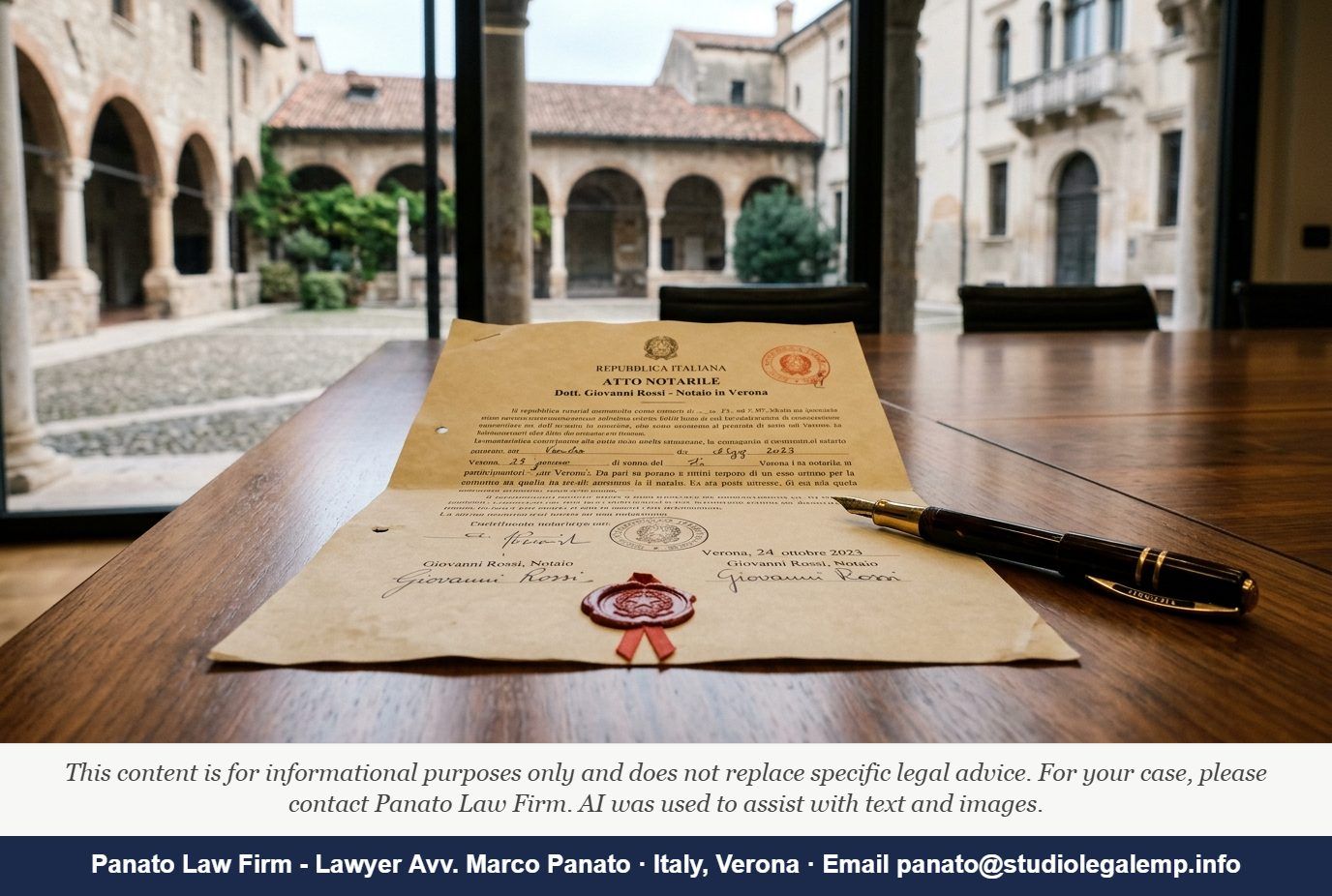
Image prompt: A close-up of a signed Italian notarial deed resting on a polished wooden boardroom table in northern Italy, with a fountain pen beside it and a blurred background of floor-to-ceiling windows overlooking a historic Veronese courtyard. The colour palette is warm amber, deep ivory and slate grey. The mood is formal, considered, and faintly tense — a significant document at a pivotal moment.
Image file: selling-shares-italian-company-2026-cassazione-ruling-cover
HREFLANG BLOCK:
JSON-LD:
LANGUAGE QA: handed down in the past thirteen months -> issued in the past thirteen months / handed down in the last thirteen months · sounds in damages -> gives rise to a claim in damages · Most Italian SME constitutions contain -> Most Italian SMEs' articles of association contain · a statutory pre-emption clause -> a pre-emption clause in the articles · whatever the private law contract says -> regardless of what the underlying contract provides · a meticulous review -> a thorough review · the offer at identical terms -> an offer on identical terms · operates at the level of corporate status -> takes effect at the corporate level
CHECK:
AUTHORITY 1: Italian Court of Cassation, First Civil Division, Order No. 17761 of 1 July 2025 (Cass. civ., Sez. I, ord. 1 luglio 2025 n. 17761)
EXISTS? YES — confirmed at brocardi.it (Art. 2469 commentary), avvocato.it, studiocngf.it, giurisprudenzadelleimprese.it (multiple consistent citations)
CONTENT MATCHES? YES — pre-emption breach → inopponibilità to company and bypassed shareholders; no right of compulsory rescission from buyer; only damages against seller. Matches article exactly.
AUTHORITY 2: Italian Court of Cassation, Tax Division, Order No. 24082 of 27 July 2026 (Cass. civ., Sez. Tributaria, ord. 27 luglio 2026 n. 24082)
EXISTS? YES — confirmed at studiolegaleassociatoromano.com, brocardi.it/notizie-giuridiche, laleggepertutti.it (three independent sources, all citing date and number)
CONTENT MATCHES? YES — Revenue Authority cannot presume abuse of rights in share sale of property-holding company; must prove certain undue tax advantage and absence of economic rationale. Matches article exactly.
AUTHORITY 3: Italian Court of Cassation, Order No. 9704 of 15 April 2026 (Cass. civ., ord. 15 aprile 2026 n. 9704)
EXISTS? YES — confirmed at versoilfuturo.org with date, number and operative principle on Art. 2560 c.c.
CONTENT MATCHES? YES — buyer of business branch liable for book-recorded debts; article correctly uses this to contrast share deal (no Art. 2560 engagement) vs. direct business transfer. Matches article exactly.
SUPPORTING AUTHORITY: Italian Court of Cassation, Tax Division, Judgment No. 7470 of 20 March 2024 (Cass. civ., Sez. 5, sent. 20 marzo 2024 n. 7470)
EXISTS? YES — confirmed at multiple sources including brocardi.it with Rv. 670586-01
CONTENT MATCHES? YES — total share sale legally distinct from business sale; cannot be recharacterised. Matches article.
STATUTORY SOURCES: Art. 2469, Art. 2560 Italian Civil Code; Art. 10-bis Law 212/2000; Art. 1(144) Law 199/2025 — all verified at primary or reliable secondary sources.
OVERALL: GREEN — all cited authorities confirmed for existence and subject-matter match.
LOCAL NOTE:
1. Search intent targeted: transactional (someone actively planning or negotiating a share sale or acquisition in Italy, ready to instruct a lawyer).
2. Local-market framing: the article addresses the structural assumptions of common-law buyers (pre-emption = contractual damages claim; share deal = clean liability cut-off) and shows how both are wrong under Italian law; the July 2026 Cassazione ruling on tax abuse is framed as a live risk for any real-estate-linked deal signed before year end.
3. Italian terms kept untranslated: <i>denuntiatio</i> (the formal offer-notice to co-shareholders required before a sale — no concise English legal equivalent exists in this corporate context); <i>inopponibilità</i> (explained in full at first use as "unenforceable against" — retained in italics for precision because "unenforceability" in English implies voidness, which is explicitly not the Italian concept).
Do you need legal assistance or a free estimate?
Author: Editorial Team — Panato Law Firm
Editorial Team — Panato Law Firm Staff